-
-
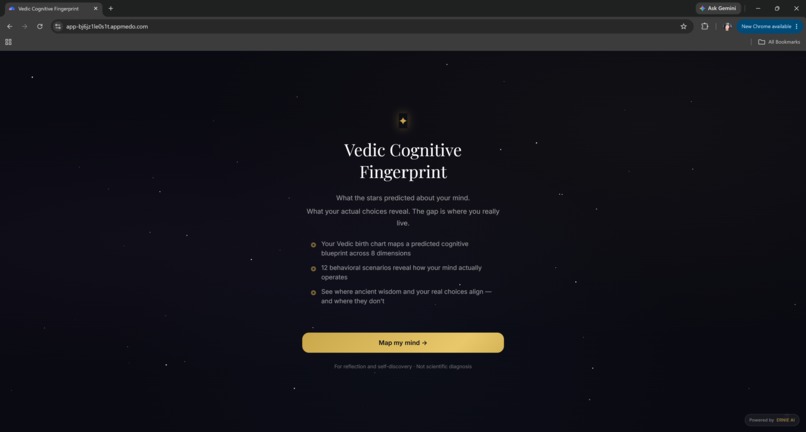
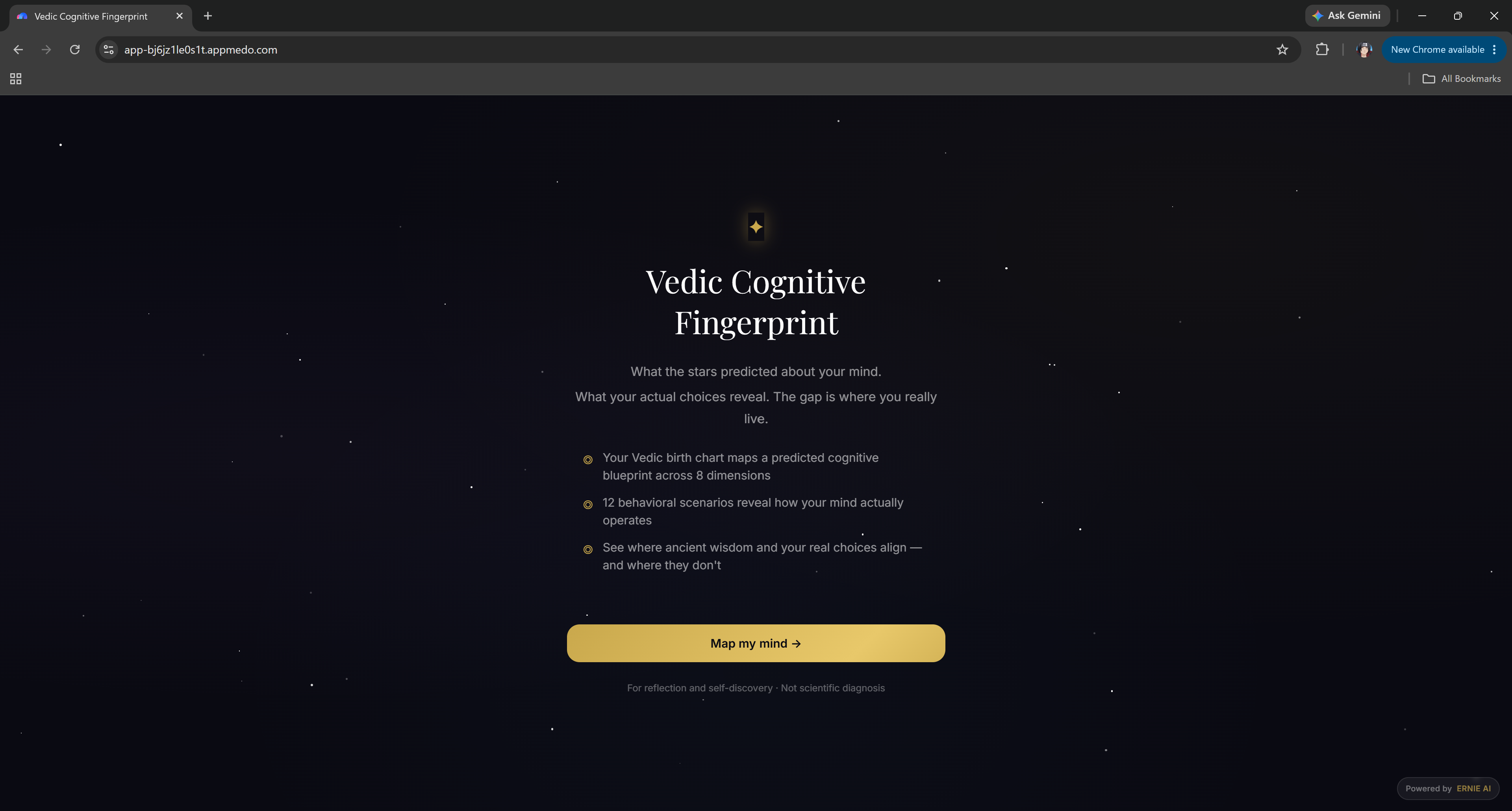
Landing page
-
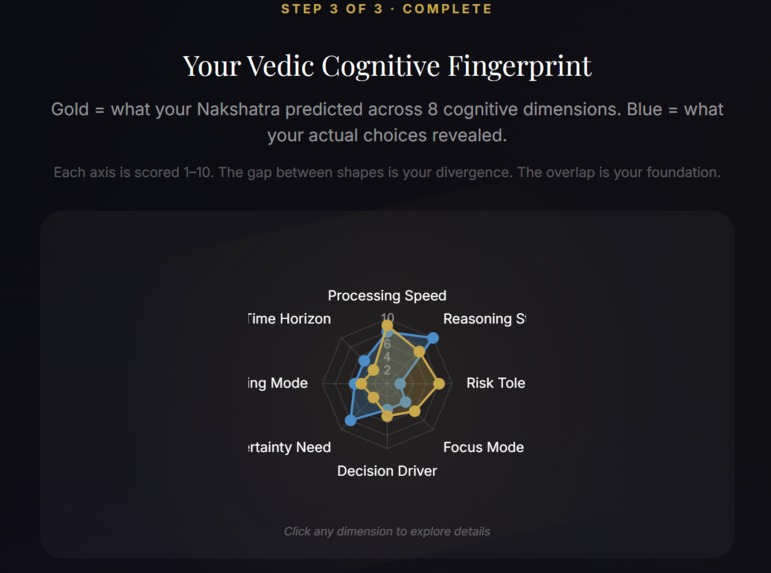
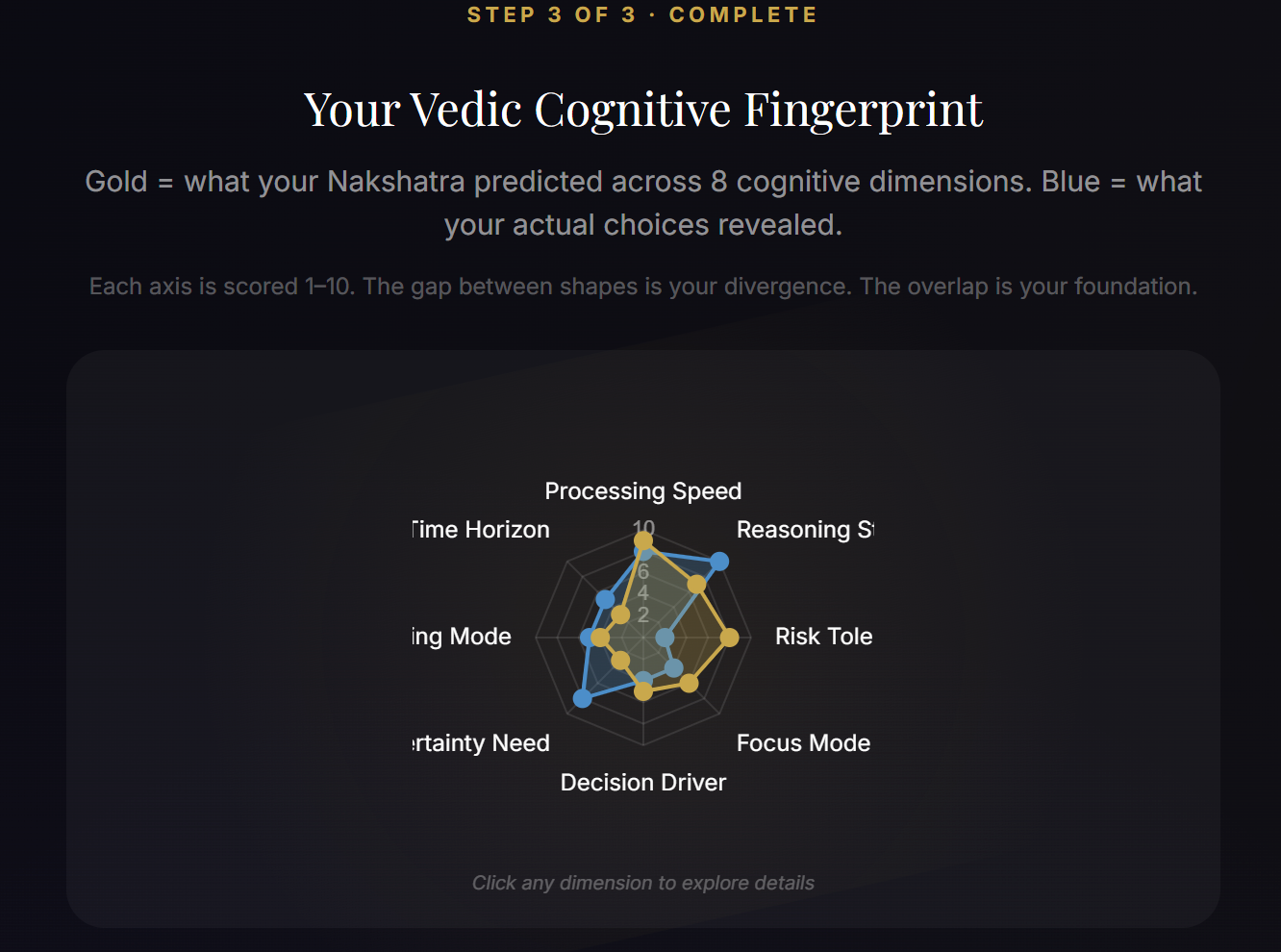
The alignment
-
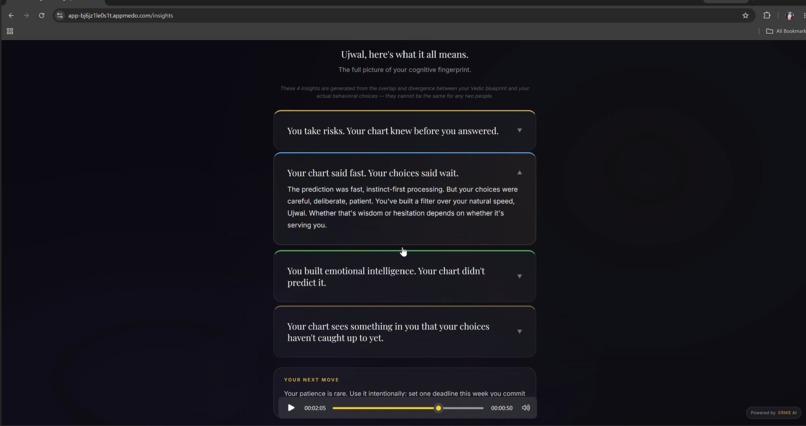
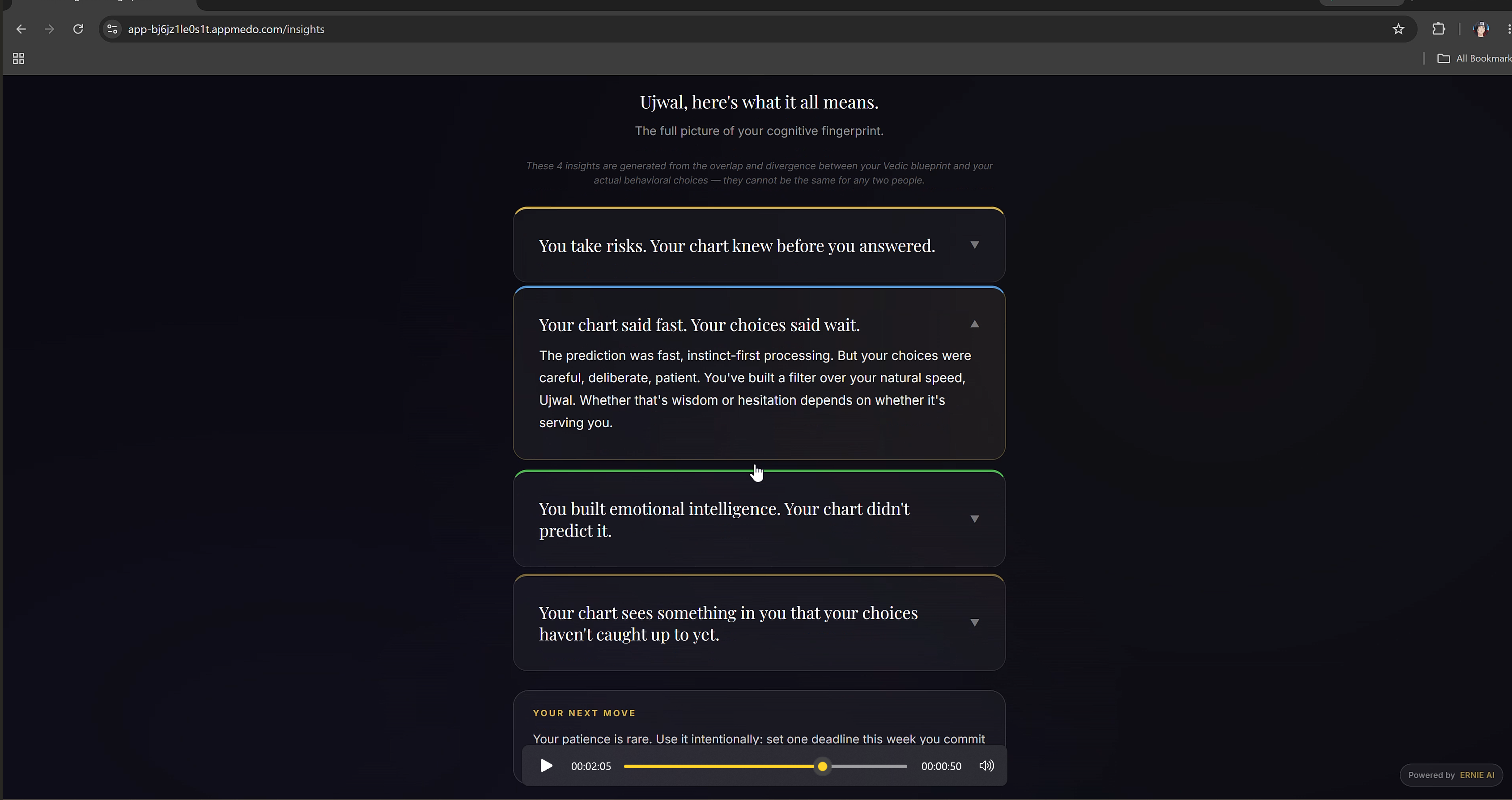
What the result mean
-
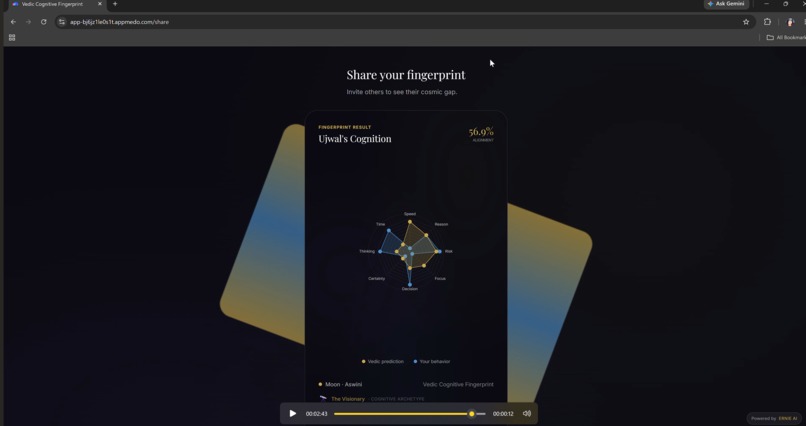
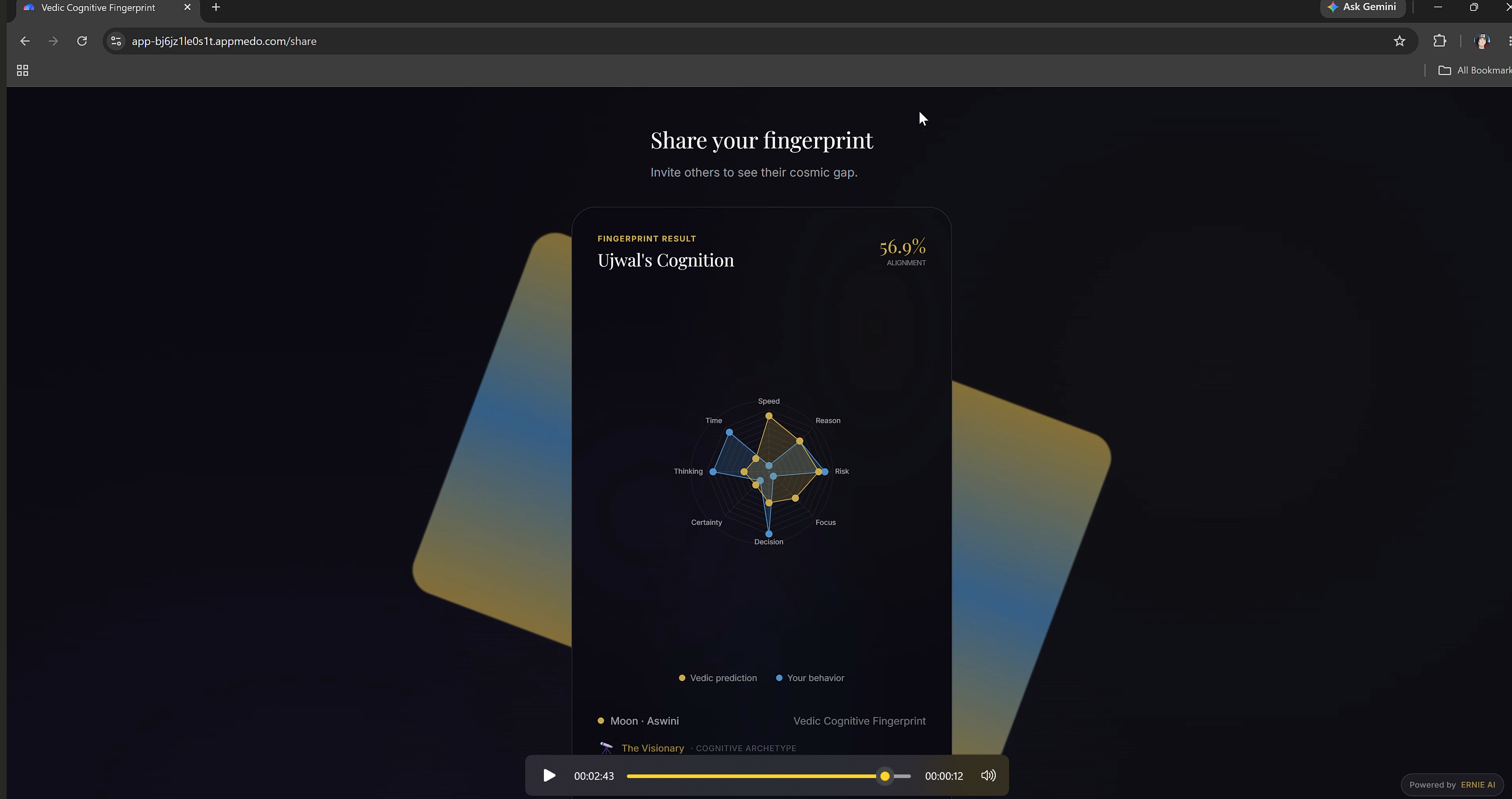
End results and share
Inspiration
Most personality tools ask you to describe yourself, and then reflect your own words back at you dressed up as insight. We wanted something that could actually surprise you.
The idea came from a simple question: ancient Vedic Jyotish has been mapping the architecture of the human mind through 27 Nakshatras for thousands of years. Modern behavioral science can measure how people actually decide under pressure, in real situations, when something is at stake. What happens when you run both on the same person, and compare the results?
Nobody had crossed the two. The gap between ancient prediction and lived reality felt like the most interesting question we'd ever seen in a personality tool. So we built the instrument to measure it.
What it does
You enter your birth details. The system calculates your Moon Nakshatra and generates a predicted cognitive profile across 8 dimensions, processing speed, risk tolerance, reasoning style, decision driver, certainty need, focus mode, thinking mode, and time horizon.
Then you take a 12-scenario behavioral assessment. Not HR-style questions about your "ideal work environment." Atmospheric, specific situations designed to reveal how your mind actually operates when something real is on the line, not how you'd like to think it does.
The two profiles get cross-referenced. You get:
- An alignment score, what percentage of your chart's predictions your real choices confirmed
- A cognitive archetype, one of 9 types drawn from your behavioral pattern (The Visionary, The Architect, The Catalyst, and six others)
- A cosmic paradox, one sentence naming your biggest contradiction between prediction and reality
- 4 personalized insights from the gap data, aligned traits, hidden strengths, divergences, growth edges
- A decision oracle that analyzes any real decision through three lenses: what your chart predicts, what your behavioral pattern says, and what the gap reveals
- An AI chat that holds your complete fingerprint in context and answers accordingly
How we built it
The core of the app is a custom Vedic-to-cognitive mapping, 27 Nakshatras encoded across 8 cognitive dimensions, sourced from primary Jyotish literature. That mapping is what generates the prediction. The behavioral assessment then scores your actual choices using a delta-accumulation model across 12 scenarios. Alignment is computed as the inverse of total divergence across all 8 dimensions.
Every AI response carries the user's full fingerprint as context, their Nakshatra, alignment score, all 16 cognitive scores, divergence points, and aligned traits. The AI doesn't just know your question. It knows your mind.
Challenges
The Nakshatra-to-cognitive mapping was the hardest part. There's no existing dataset, we encoded 27 × 8 = 216 values from primary Jyotish texts by hand. The challenge wasn't just accuracy but meaningful differentiation. If every Nakshatra scores similarly on a dimension, the predictions are useless. Getting genuine spread, so that a fast-processing Nakshatra and a slow-processing one feel meaningfully different in the real output, required going deep into the source texts and debating every number.
Session handling was the other challenge. If the server restarts mid-session, the user loses everything. The fix: every request re-sends the full state, and every endpoint accepts either a live session or raw state data, whichever is available. The server never needs to remember what the client already knows.
What we learned
The gap between prediction and reality is more interesting than either one alone. A user who scores 45% alignment isn't broken, they're the most interesting profile in the room. Life has shaped them beyond their original wiring, in specific directions, for specific reasons. That reframe changed how we wrote every piece of copy in the app: the gap isn't a flaw, it's the finding.
The other thing: ancient systems and modern behavioral science are more compatible than they look. Vedic Jyotish was always trying to map the mind. We just gave it a way to be verified.
Built With
- 3.3
- ai
- ernie
- fastapi
- groq
- jyotish
- llama
- medo
- python
- railway
- react
- supabase
- typescript
- vedic

Log in or sign up for Devpost to join the conversation.