Inspiration
Building web applications from scratch often bogs developers down with boilerplate setup, dependency management, and endless debugging cycles before seeing real progress. We wanted to eliminate the friction between having an idea and having working, interactive software. Our goal was to create an autonomous coding partner that doesn’t just output disconnected code snippets, but actively reasons through an implementation, executes it inside a secure containerized environment, reviews its own output, and serves an immediate live preview.
What It Does
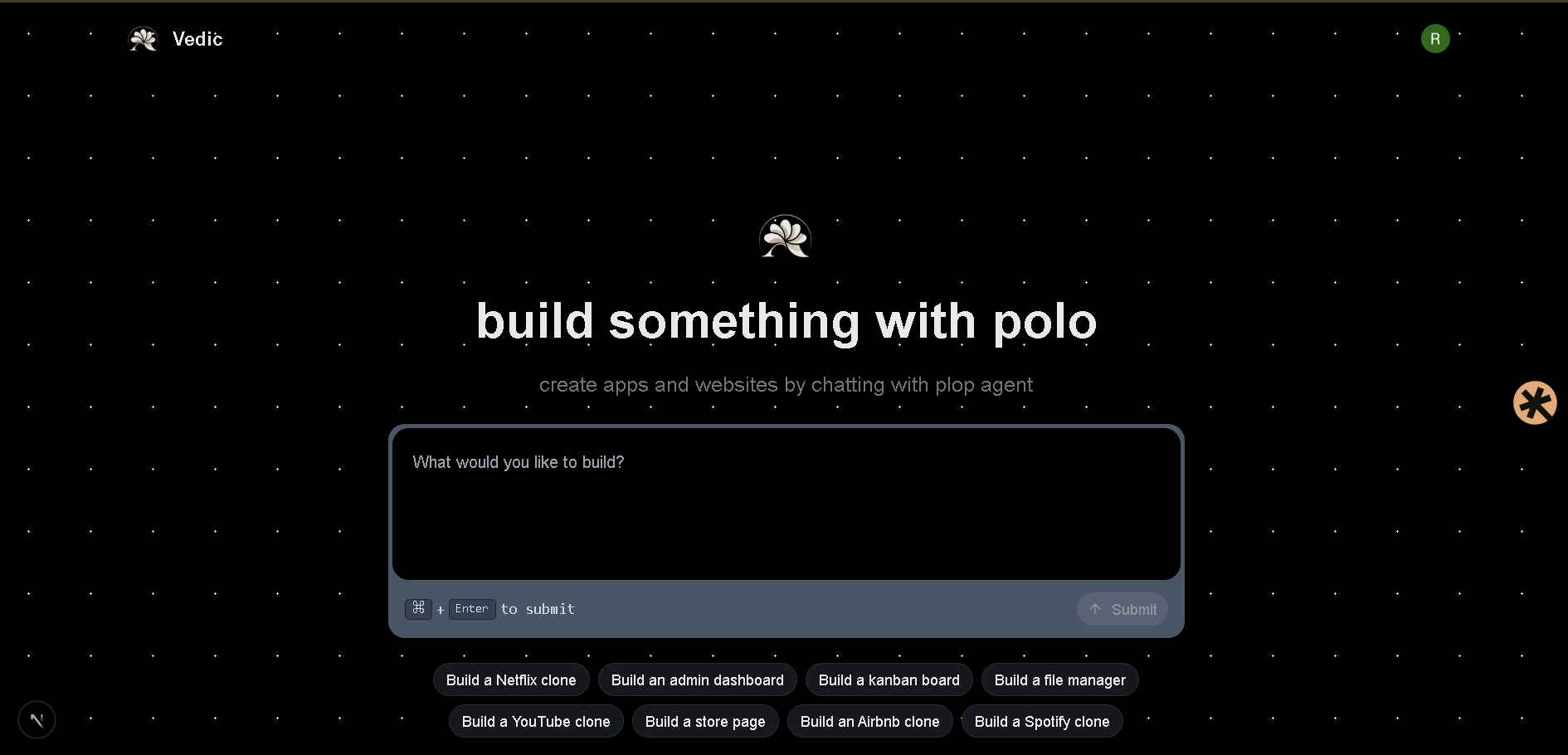
Vedic is an autonomous full-stack AI development workspace where users specify an application or feature through natural language and watch it come to life in real time:
- Natural Language Interaction: Users prompt the system with requirements, features, or iterative adjustments via a clean chat interface.
- Multi-Agent Orchestration: Incoming requests trigger a specialized agent workflow powered by Inngest and
@inngest/agent-kit. - Self-Correcting Refinement Loop: A dedicated planning agent lays out an execution roadmap, a coding agent executes file operations and shell commands, and an automated review agent enforces code quality—looping through fixes until the build criteria are satisfied.
- Isolated Sandboxing: Code is written, configured, and run securely inside dedicated E2B Code Interpreter micro-virtual environments.
- Real-Time Live Previews: The frontend continuously tracks agent progress, file changes, and immediately surfaces a live, interactive web preview URL once the build succeeds.
How We Built It
- Frontend & Full-Stack Core: Next.js 15 (App Router), TypeScript, and Tailwind CSS styled with shadcn/ui components for a fast, responsive chat workspace.
- APIs & State: tRPC handles end-to-end type-safe API communication between client mutations and backend procedures.
- Workflow & Agentic Pipelines: Inngest dev servers orchestrate background tasks using
@inngest/agent-kitto coordinate autonomous agents (planning-agent,code-agent,review-agent,fragment-title-generator, andresponse-generator). - Execution Runtime: E2B Code Interpreter provides isolated micro-VM sandboxes where the coding agent executes terminal commands, installs packages, and writes project files.
- Data Persistence: PostgreSQL managed through Prisma ORM to track chat history, user messages, agent fragments, generated file trees, and rate usage.
- Authentication: Clerk manages seamless user authentication and session management.
Challenges We Faced
- Agent Loop Drift & Hallucinations: Large language models can easily wander into over-complicated code changes or infinite fix loops. We resolved this by defining a strict routing state machine (
Plan -> Build -> Review), enforcing review iteration limits (MAX_REVIEW_LOOPS), and setting multi-file output thresholds for complex prompts. - Synchronizing Ephemeral Sandboxes: Maintaining state across disconnected agent runs required robust sandbox management. We designed a fallback system in E2B that restores prior file mappings and in-memory caches whenever a container session reconnects.
- Real-Time Feedback Latency: Managing long-running asynchronous agent processes without degrading the user experience required tight integration between tRPC mutations, Inngest event queues, and polling updates for immediate status indicators.
Accomplishments That We're Proud Of
- Designing a true self-correcting multi-agent loop where code is not accepted until an automated reviewer passes the generated implementation.
- Delivering a seamless end-to-end flow from single-prompt submission to a working, browser-accessible live sandbox URL in under a few minutes.
- Maintaining clean, type-safe architecture across the entire stack using Next.js 15, TypeScript, tRPC, and Prisma.
What We Learned
- Orchestrating multiple purpose-built agents with explicit boundaries (planner vs. builder vs. reviewer) yields far higher quality and fewer hallucinations than relying on a single mega-prompt.
- Sandboxed runtime environments like E2B paired with robust background event queues (Inngest) are critical components for production-grade agentic development environments.
What's Next for Vedic
- Multi-Model Support: Introducing flexible model selection, benchmarking speed and reasoning across different open-source and proprietary coding models.
- Direct Git/GitHub Integration: Enabling users to export generated fragments directly into personal GitHub repositories or create pull requests.
- Collaborative Workspaces: Supporting multi-user real-time pairing sessions where teams can prompt, debug, and inspect generated sandboxes together.
Built With
- clerk
- e2b
- inngest
- next.js
- openai
- postgresql
- prisma
- shadcn-ui
- tailwind-css
- trpc
- typescript

Log in or sign up for Devpost to join the conversation.