Inspiration
Cybersecurity today is like guarding a castle with invisible walls—attackers slip through, alerts pile up, and defenders drown in noise. We wanted to reimagine this battlefield. What if a Security Operations Center wasn’t just reactive, but predictive? What if AI and Zero-Trust didn’t just coexist but danced together seamlessly? That spark became VectorVault.
What it does
VectorVault is the nerve center of cybersecurity operations. It:
- Predicts failures and threats before they strike using LLM-powered analysis.
- Slashes investigation times with an AI engine that explains, recommends, and remembers.
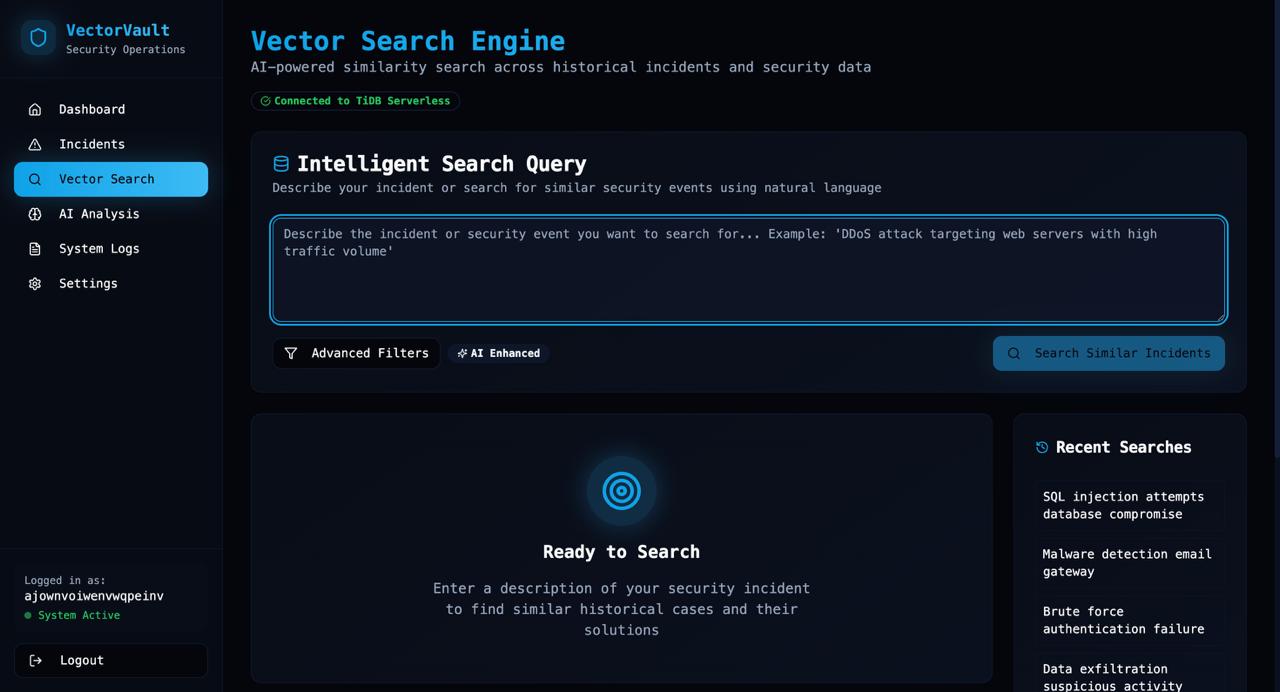
- Turns old incident logs into actionable playbooks through intelligent vector search.
- Hardens itself with A.S.T.R.A., an authentication framework where every credential is ephemeral, every session is verified, and every role is cryptographically bound. In short: it’s a SOC that thinks, learns, and never sleeps.
How we built it
We designed VectorVault like a living organism:
- Presentation Layer: A sleek, responsive dashboard for SOC analysts, built to turn chaos into clarity.
- Application & Logic Layer: Micro-services orchestrating incidents, roles, and workflows.
- AI Core: A fine-tuned LLM powering root-cause analysis, predictions, and semantic vector search.
- Persistence Layer: Polyglot databases (SQL for structure, vector DB for embeddings, time-series for logs).
- A.S.T.R.A.: The cryptographic backbone—daily rotating hashes, MFA-baked credentials, and zero-trust policies.
- Integration Layer: Bridges to SIEMs, ticketing tools, and SOAR platforms, making VectorVault the hub of the ecosystem.
Challenges we ran into
- Noise vs. Signal: Teaching the AI to cut through terabytes of logs without drowning analysts in false positives.
- Ephemeral Credentials: Designing "new day, new hash" without locking out legitimate users took creative cryptographic engineering.
- Trusting AI Wisely: Building a system where AI amplifies human judgment rather than replacing it.
- Scalability: Ensuring the platform could ingest massive data streams without lag while running compute-hungry KDFs in real-time.
Accomplishments that we're proud of
- Creating an SOC platform where analysts feel empowered, not exhausted.
- Embedding Zero-Trust at the cryptographic level—roles are literally baked into the hash.
- Seeing the AI identify and explain a complex DDoS pattern in seconds—a task that usually eats hours.
- Designing a platform resilient enough that even if one service is breached, no single point of failure exists.
What we learned
- Security is not just defense—it can be predictive, even artistic, when powered by AI.
- Cryptography is less about math on paper and more about designing trust.
- SOC teams don’t just need tools; they need clarity, speed, and the confidence to outpace adversaries.
- The future of authentication is ephemeral, contextual, and role-bound—not static passwords.
What's next for VectorVault
- SOAR on Steroids: Deepening automation so incidents can trigger intelligent, multi-step responses without human bottlenecks.
- Federated Learning: Sharing anonymized threat patterns across organizations while preserving privacy.
- Explainable AI: Making the AI not just smart, but transparent—so analysts know why it suggests what it does.
- Industry Adoption of A.S.T.R.A.: Publishing it as a standard so the world moves toward a safer, zero-trust-first authentication model. VectorVault isn’t just a tool—it’s a vision of security that predicts, explains, and protects by design.
Built With
- cors
- esbuild
- eslint
- express.js
- fetch
- hooks
- lucide
- mysql2
- node.js
- npm
- package.json
- postcss
- radix
- react
- restful
- router
- shadcn/ui
- tailwind
- tidb
- typescript
- vite

Log in or sign up for Devpost to join the conversation.