-
-

core_game_loop_logic
-
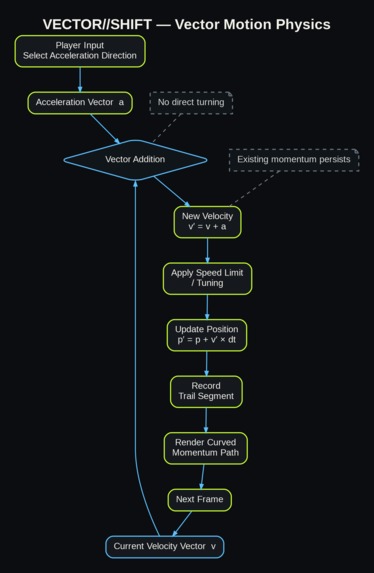
motion_physics_logic
-
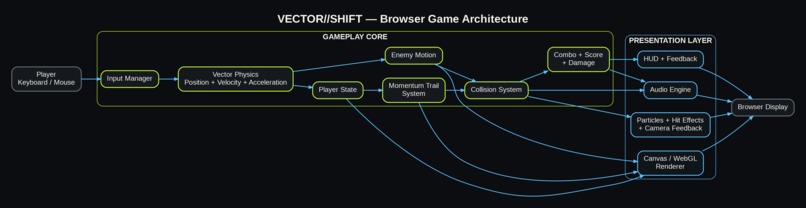
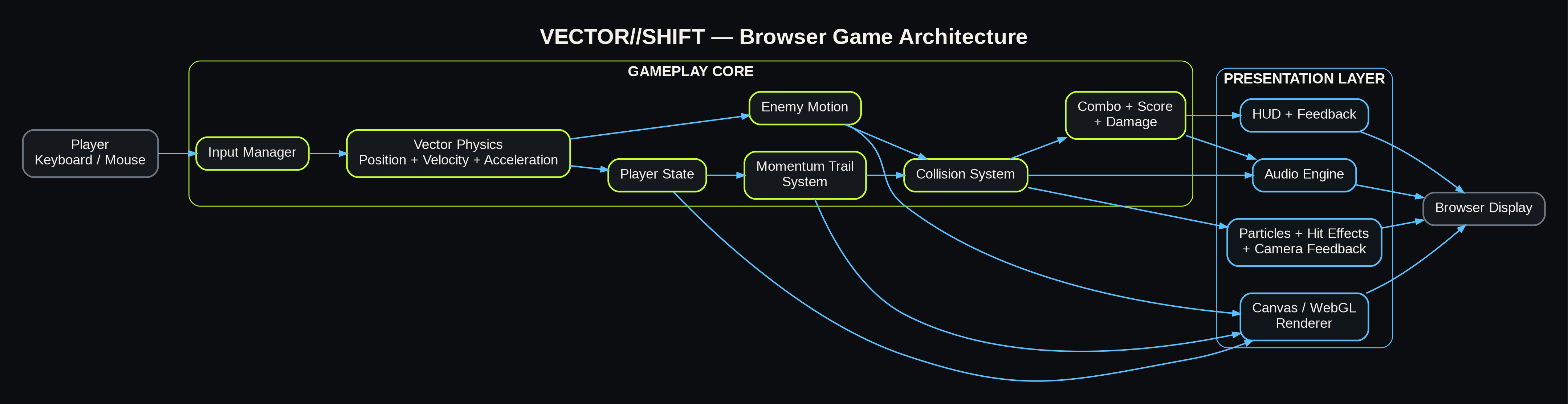
browser_architecture
-
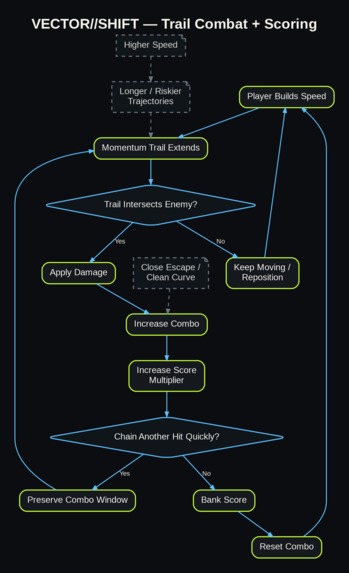
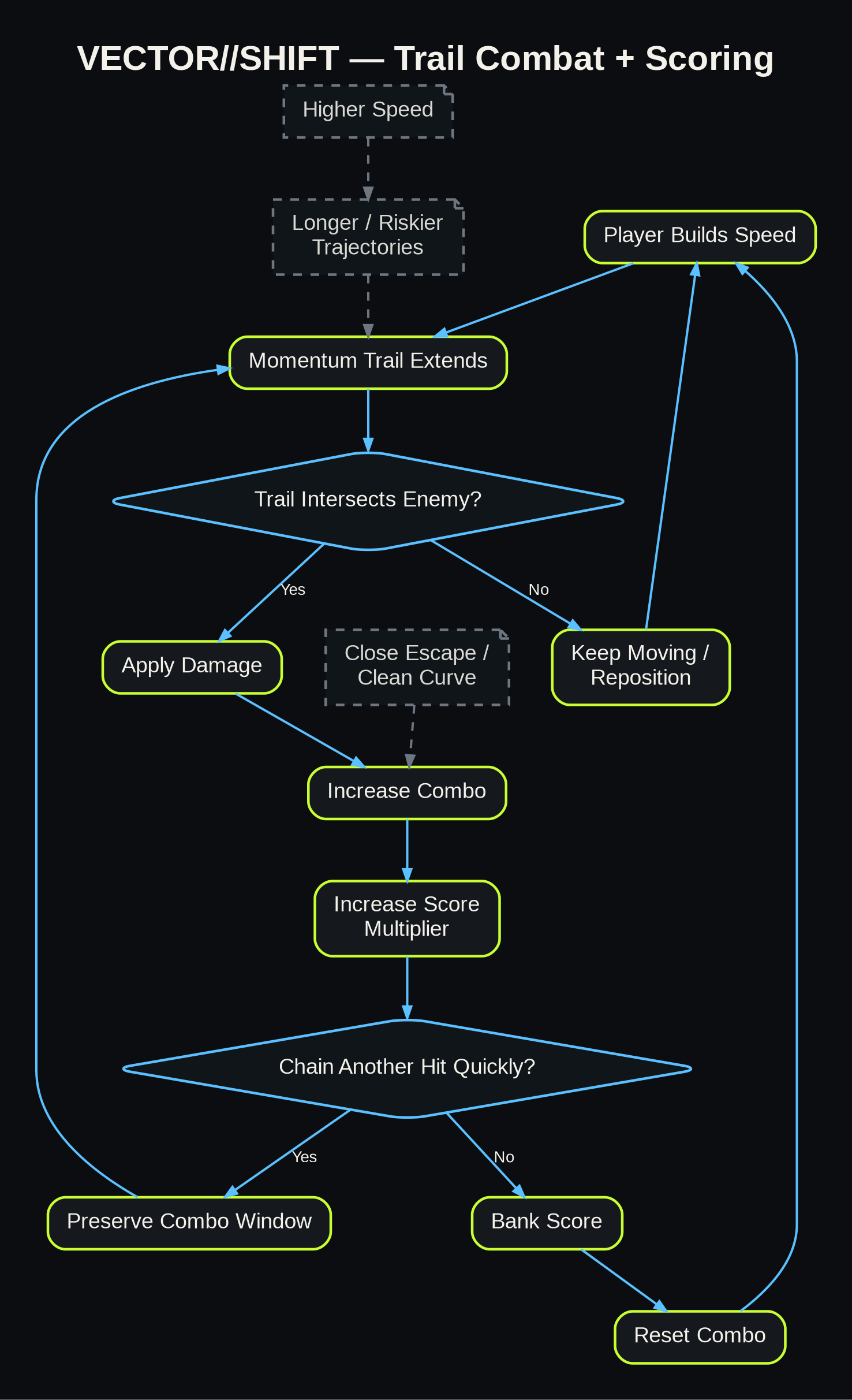
trail_combat_scoring

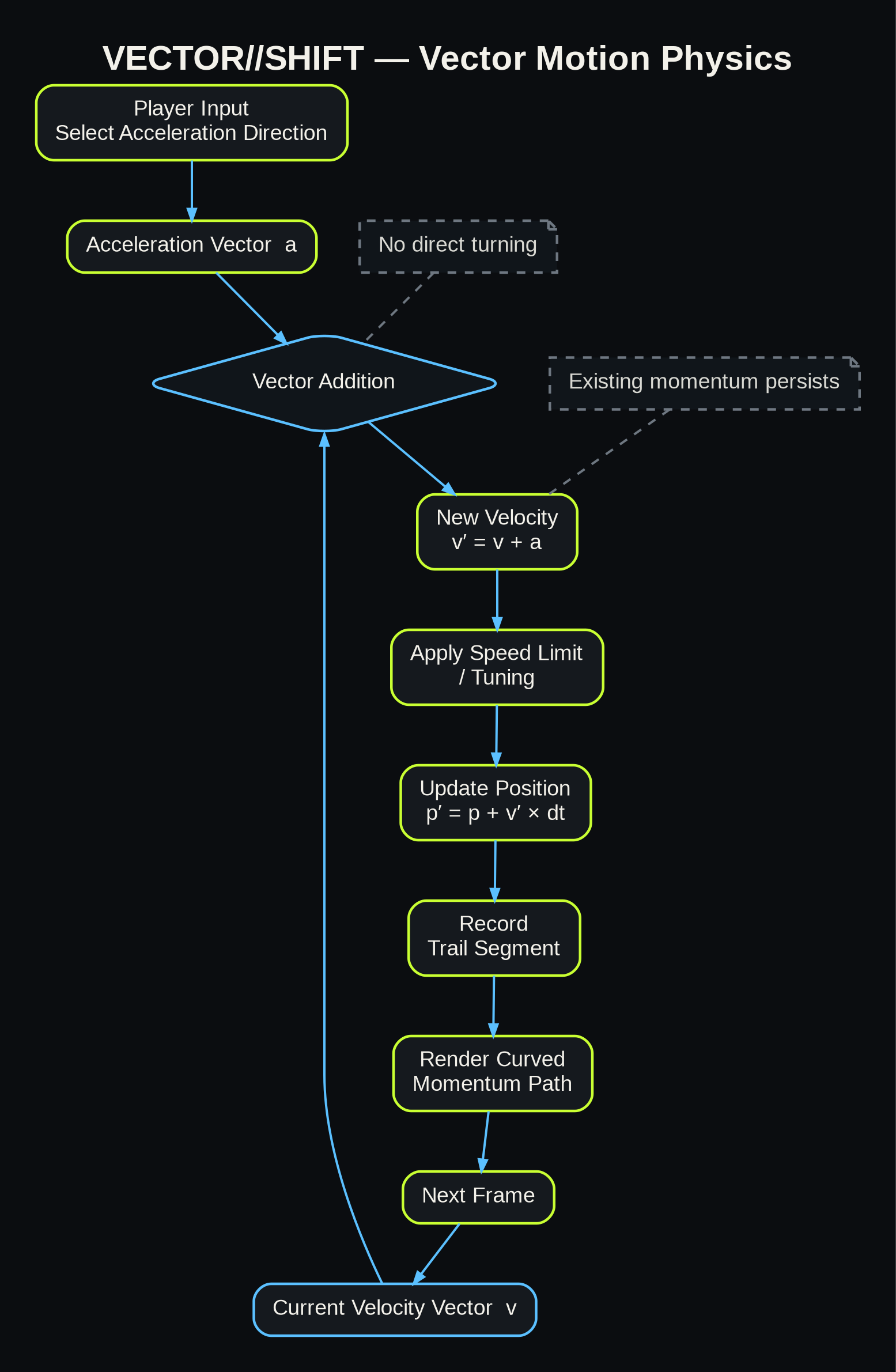
Inspiration
VECTOR//SHIFT was inspired by vector racing games and by a simple question: what if a game let you control acceleration instead of directly controlling direction? We liked the idea because it uses real vector maths, but it still has the potential to feel fast, physical, and easy to understand once you see it in motion. Our goal was to turn a small mathematical rule into an arcade game with strong movement, satisfying risk, and a visual identity built around momentum.
What it does
VECTOR//SHIFT is a browser arcade game where you never directly turn your character. Every input adds an acceleration vector to your current velocity, so your path bends naturally based on the momentum you already have. Moving faster gives you more power, but it also makes every decision more dangerous because you cannot instantly stop or change direction.
Your movement also leaves behind glowing momentum trails that can damage enemies. This means the same system controls both movement and combat. Players can curve around enemies, build long attack paths, escape at the last moment, and use their own trajectory as a weapon. The result is a game about planning motion, reacting quickly, and learning how to use momentum instead of fighting against it.
How we built it
We built the core game around simple vector maths for position, velocity, and acceleration. Every movement decision changes the velocity vector, and the next position is calculated from that updated motion. This keeps the rules small while allowing a wide range of movement patterns to emerge naturally.
The game runs directly in the browser and focuses heavily on game feel. We use glowing trails, particles, screen feedback, responsive controls, clean UI, and sound to make every acceleration change feel clear and satisfying. Instead of adding many complicated systems, we spent more effort making the main mechanic readable, responsive, and visually polished.
Challenges we ran into
The biggest challenge was making physics-based movement feel fun instead of frustrating. Real momentum can easily make a game feel difficult to control, so we had to carefully tune acceleration strength, speed limits, enemy behaviour, and how quickly players can understand their current direction.
Another challenge was visual clarity. Because the player is constantly moving and leaving trails behind, the screen can become busy very quickly. We had to make sure the player, enemies, vectors, trails, and danger areas remain easy to read even when the action becomes intense.
Accomplishments that we're proud of
We are proud that VECTOR//SHIFT gets a lot of gameplay from a very small set of rules. The same vector system can create smooth curves, sharp corrections, long drifts, close escapes, chain attacks, and unexpected paths without needing a large number of separate abilities.
We are also proud that the visual design supports the mechanic instead of only decorating it. Trails show where momentum has taken you, vector indicators help explain the next movement change, and effects make successful turns and attacks feel rewarding. The game stays focused on one central idea instead of becoming overloaded with features.
What we learned
We learned that maths and physics can create fun gameplay without making the game feel like an educational tool. A simple equation becomes much more interesting when the player can immediately see and feel its result.
We also learned how important feedback is in a movement-based game. Small details such as trail behaviour, particles, sound, timing, and visual direction indicators can completely change whether a mechanic feels confusing or satisfying.
What's next for VECTOR//SHIFT
Next, we want to deepen the game without losing its simplicity. That includes more enemy movement patterns, stronger combo and scoring systems, new arena interactions, better audio feedback, and a polished boss encounter that tests how well the player has learned to control momentum.
The goal is to keep every future feature connected to the same core idea: you do not turn, you bend momentum.
Built With
- 2d
- api
- canvas
- css3
- html5
- javascript
- mathematics
- physics
- vector
- vite
- web


Log in or sign up for Devpost to join the conversation.