
Inspiration
As a huge EDG fan and someone who loves playing VALORANT, I’ve spent countless hours watching matches and analyzing gameplay. I followed the entire 2024 Champions Tour, studying every team composition, every strategy, and every incredible clutch moment. My passion for the game and a desire to improve my understanding of team dynamics motivated me to create a digital assistant that could think like a professional coach and help others experience the thrill of strategizing like a pro.
What It Does
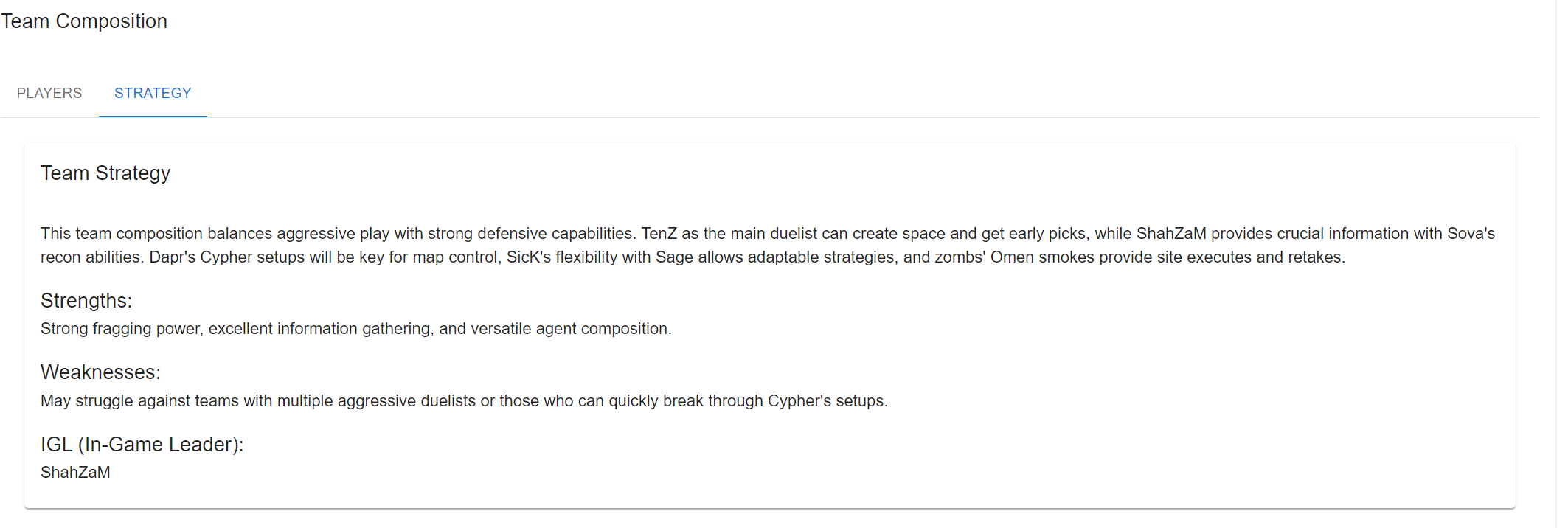
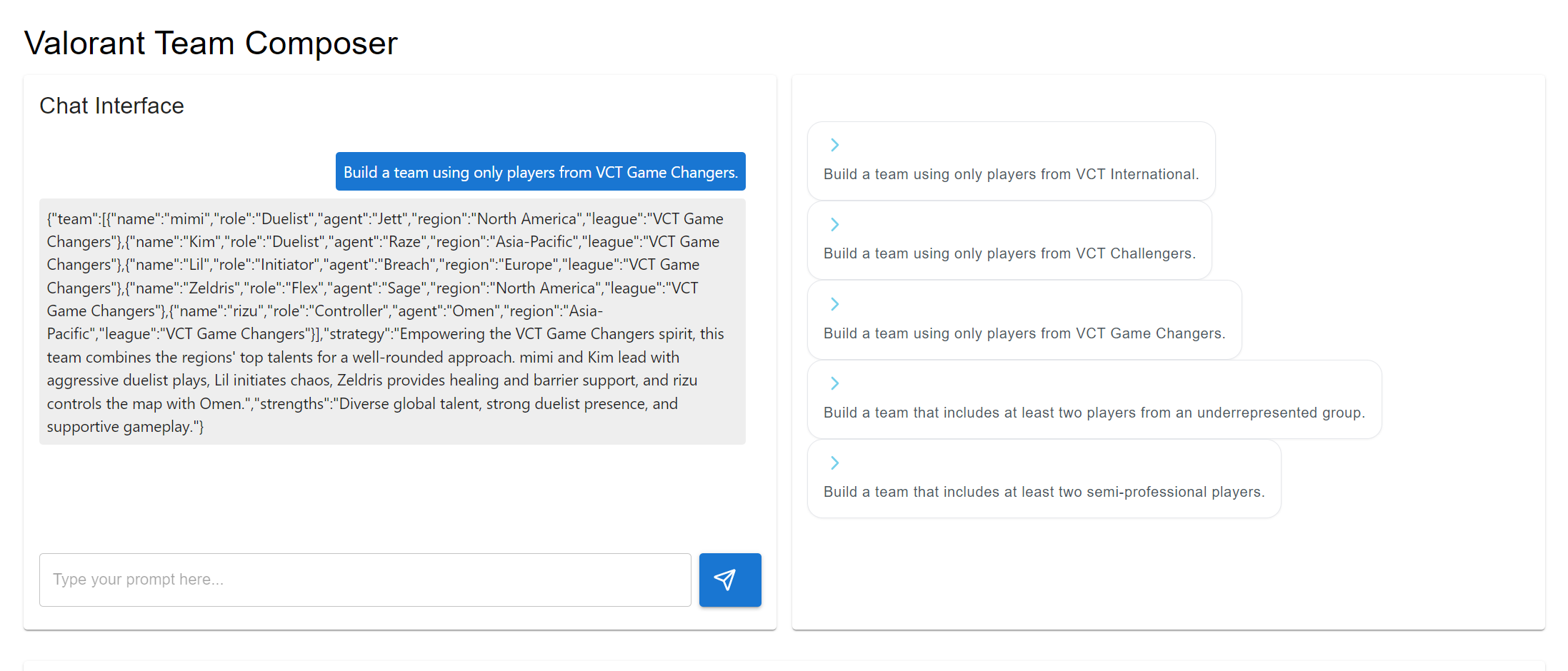
The VCT-AI-Manager is a digital assistant powered by an LLM that builds VALORANT teams based on user-defined prompts. Whether it’s creating a team from VCT International, focusing on semi-professional players from VCT Challengers, or promoting inclusivity with mixed-gender teams, the assistant can select players, assign roles, and explain the strategic effectiveness behind every choice.
The assistant not only builds teams but also answers detailed questions about:
- Player roles (Duelists, Sentinels, Controllers, Initiators)
- Offensive vs. defensive strategies
- IGL assignment (team leader and shotcaller)
- Team strengths and weaknesses
How We Built It
The project combines Python for the backend, TypeScript and TailwindCSS for the frontend, and Amazon Bedrock’s LLM capabilities to power the AI’s reasoning. Here’s the breakdown of the workflow:
- Data Preparation: I collected player data with details like roles, agent preferences, regions, and league tiers. This dataset served as the foundation for the model to interpret and answer the team-building prompts.
- LLM Training: I utilized Amazon Bedrock to fine-tune the LLM for interpreting prompts and selecting the most suitable players. I prioritized key factors like league importance (Champions, Masters, Challengers), role distribution, and IGL assignment.
- Backend Development: Built in Python, the backend reads player data and interfaces with the LLM to answer prompts. It uses a REST API to relay data between the backend and frontend, ensuring efficient communication and seamless integration.
- Frontend Integration: The frontend displays the assistant’s responses in an intuitive and engaging way, using interactive cards to show each player’s role, region, and agent. I integrated the backend API to handle prompt submissions and dynamically render team compositions.
Challenges We Ran Into
One of the biggest challenges was figuring out how to fine-tune the model with Amazon Bedrock to accurately capture the nuances of team-building decisions. VALORANT is a game that relies on a delicate balance of roles and strategies, so tuning the model required substantial experimentation and prompt engineering.
Another challenge was ensuring the backend and frontend integration. I needed the backend to process complex queries while the frontend rendered results in a clear and meaningful way. Coordinating between the two and structuring API endpoints to handle prompt-based interactions was a significant technical hurdle.
Accomplishments That We're Proud Of
- Building a dynamic digital assistant capable of replicating the thought process of a professional coach was a major win. It’s not just about picking players; it’s about understanding the dynamics and justifying every decision.
- Successfully integrating Amazon Bedrock into the project, and leveraging its capabilities to power strategic decision-making, was a proud achievement. It pushed my understanding of prompt-based training and large language models to a new level.
What We Learned
- Prompt engineering is key: Building effective prompts was critical to getting the model to respond accurately. Even small changes in prompt wording could lead to vastly different results.
- Data consistency matters: The project emphasized the importance of consistent and complete datasets. Missing or inconsistent data could cause misinterpretation by the model.
- I also learned a lot about the intricacies of team dynamics in esports. Balancing agent roles, regional diversity, and leadership within a team is more complex than I initially thought.
What's Next for VCT-AI-Manager
I have several plans for the VCT-AI-Manager:
- Enhanced Player Analytics: Incorporate more granular data, such as individual game stats, to provide even deeper insights into each player’s performance.
- Expanded Game Support: Extend the assistant’s capabilities beyond VALORANT to other competitive games like League of Legends or CS:GO.
- User Customization: Allow users to input specific criteria for team-building or filter players based on preferences such as favorite agents or specific regions.
- Real-Time Team Adjustments: Develop features to suggest live adjustments based on in-game scenarios and player performance data.
By continuing to build on this foundation, I hope to make the VCT-AI-Manager a versatile and comprehensive tool for esports enthusiasts and aspiring strategists alike.
Built With
- amazon
- and
- another
- api
- bedrock
- css
- csv
- database:
- detailed
- flask/fastapi)
- for
- framework
- generating
- integrate
- langchain
- like
- llm
- manage
- next.js)
- openai)
- or
- processing
- processing:
- prompts
- python-based
- queries
- react
- responses
- server
- tailwind
- team
- the
- typescript


Log in or sign up for Devpost to join the conversation.