-
-
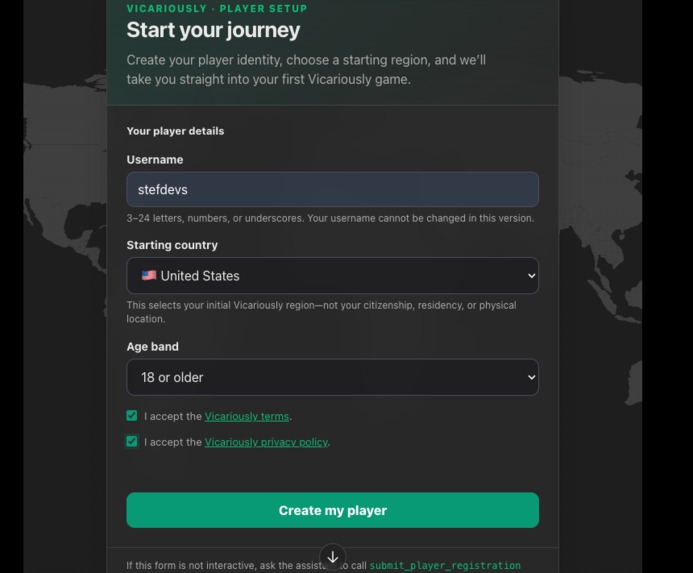
Register form in ChatGPT
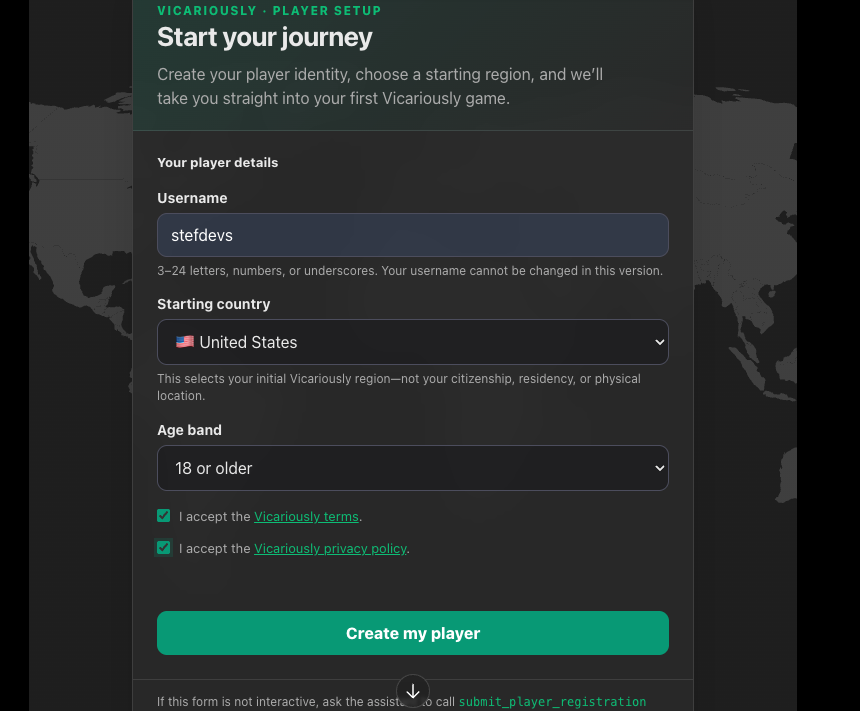
Inspiration
What if ChatGPT did not merely describe a world, but became the way you explored one?
Maps help us find places. Location-based games usually require us to be there physically. Vicariously explores a third possibility: travelling through the real world from a persistent virtual position, using conversation as the interface.
You begin somewhere real, discover what surrounds you, choose where to go, and continue from wherever your last journey ended.
What it does
Vicariously is a ChatGPT-native exploration game where the real world becomes the game board.
A player can:
- register a persistent identity;
- begin in one of eleven reviewed starting countries;
- explore meaningful nearby places;
- walk to a chosen destination;
- preserve the resulting position and journey;
- continue from the same state in a later conversation.
The embedded turn panel shows the player’s position, nearby discoveries, travel details, and a compass.
Players can also speak naturally:
“Let’s head south.”
ChatGPT interprets the intention. Vicariously validates the journey and records what actually happened.
Vicariously owns what is true. ChatGPT makes that truth explorable.
How we built it
Vicariously was developed through two complementary AI workflows.
ChatGPT 5.6 Sol supported ideation, research, product definition, architecture review, and the reduction of a broad vision into one credible gameplay loop.
Codex 5.6 Luna turned those decisions into the working application: authenticated tools, persistent player state, real-world exploration and travel, automated verification, and the registration and turn-panel experiences inside ChatGPT.
Sol helped us decide what Vicariously should be. Luna helped us make it real.
Underneath the conversation is a secure remote service that owns identity, position, journeys, and structured results. ChatGPT remains the interface and interpreter—not the database or source of truth.
Challenges we ran into
The hardest problem was separating conversational freedom from authoritative state.
ChatGPT should understand natural requests, explain places, and narrate journeys—but convincing language cannot be allowed to create a player, change a coordinate, or invent an arrival.
We separated the experience into three clear layers:
- real-world geographic evidence;
- durable Vicariously state;
- ChatGPT interpretation and narration.
Identity created a similar challenge. Player continuity had to survive across conversations without trusting model memory, a user-supplied identifier, or an email address as game authority.
We also had to resist building “maps with XP.” Before adding conventional game mechanics, we first needed to prove that position, movement, and persistence could be meaningful on their own.
Accomplishments that we’re proud of
Vicariously progressed from a speculative idea into a working authenticated ChatGPT application.
A player can currently:
- register through an embedded interface;
- reserve a unique username;
- begin at a reviewed real-world starting location;
- explore nearby learning, civic, heritage, and transport places;
- complete real walking journeys;
- preserve their new position;
- recover that state later;
- continue through an interactive turn panel.
We are especially proud that the experience does not depend on conversation memory.
The panel makes the state visible. ChatGPT makes it understandable. Vicariously makes it trustworthy.
What we learned
We learned that identity is part of gameplay in a persistent AI-native application.
Without a verified player, there is no trustworthy continuity between conversations and no meaningful ownership of progress.
We also learned that MCP works best when tools remain narrow and authoritative. ChatGPT can interpret:
“Head southwest.”
But Vicariously must still resolve the destination, validate the journey, update the position exactly once, and return the result.
Most importantly, we learned that real geography becomes playable through four properties:
Position. Choice. Consequence. Persistence.
A map becomes a game when where the player is changes what they can do next—and when the resulting journey continues to matter.
What’s next for Vicariously
The current proof is deliberately focused:
- persistent identity;
- reviewed starting regions;
- one authoritative position;
- nearby exploration;
- walking travel;
- real route evidence;
- ChatGPT-native interaction.
The next step is to deepen the meaning of place.
Future possibilities include:
- personal atlases;
- richer arrival experiences;
- shared place histories;
- transport networks;
- discoveries and collections;
- guided learning journeys;
- collaborative expeditions.
The long-term vision is not simply to browse the world through ChatGPT.
It is to build a geographic life inside it.
The real world is already enormous. Vicariously asks what happens when it becomes a world you can inhabit through conversation.
Built With
- auth0
- chatgpt
- codex
- git
- github
- gpt5.6-luna
- gpt5.6-sol
- javascript
- mcp
- openai
- tibo-credits
- typescript



Log in or sign up for Devpost to join the conversation.