-
-
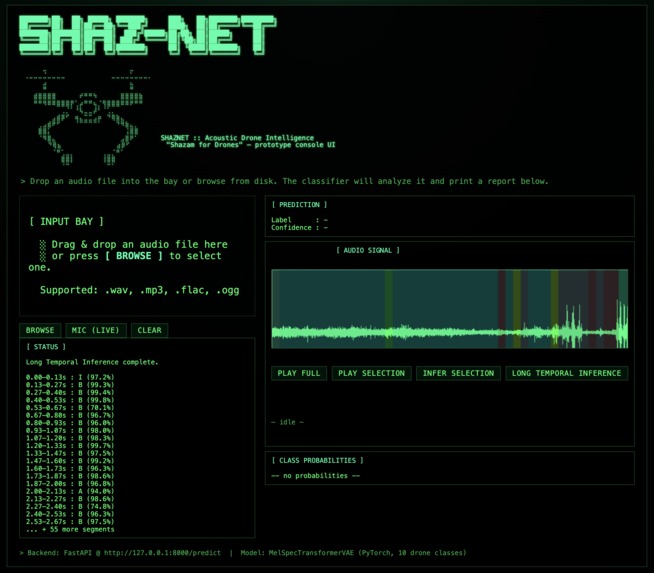
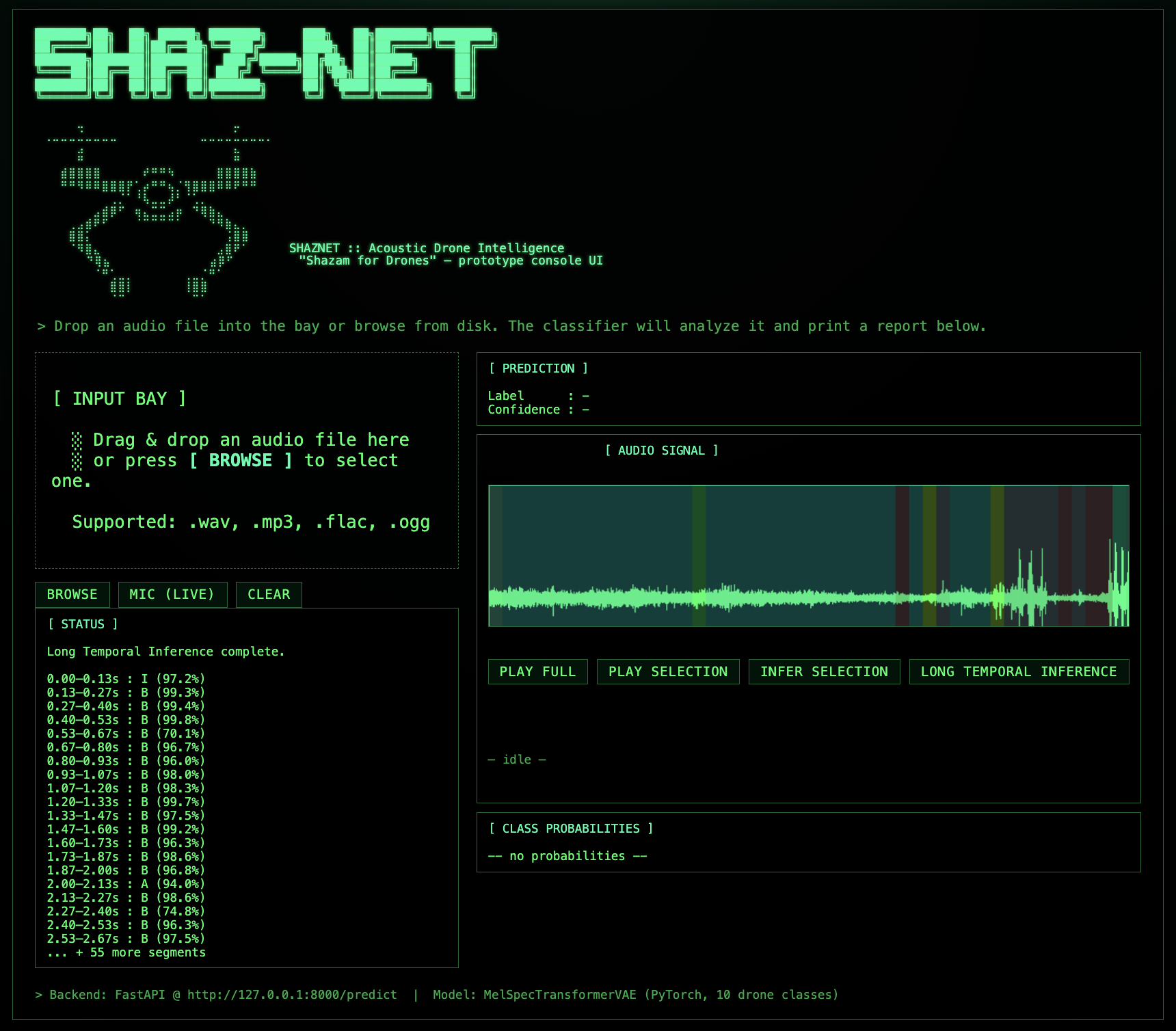
Shaz-Net web-app homepage
Inspiration
Modern drones are small, fast, and hard to detect — but their sound is unique. We wanted a lightweight, audio-based system that anyone could run without special hardware.
What it does
SHAZNET classifies drones from audio clips, performs real-time mic detection, analyzes selected waveform regions, and runs long-temporal inference with color-coded timelines.
How we built it
We trained a PyTorch audio model, built a FastAPI backend, and designed a modular front-end that stays stable even when models evolve. Everything runs locally with no special sensors.
Challenges we ran into
Inconsistent audio quality, environmental noise, variable clip length, and getting real-time streaming + waveform rendering perfectly synced.
Accomplishments we’re proud of
Accurate multi-drone classification, a fully modular model-swap architecture, live mic inference, and a clean UI with detailed temporal visualization.
What we learned
Handling audio in the wild is messy, preprocessing matters more than architecture, and modular design pays off when models change rapidly.
What’s next for VCLab Shaz-NET
Binary “drone/no-drone” detection, Doppler-based threat direction, continual learning for new UAV types, and scaling into a deployable field-ready acoustic security platform.

Log in or sign up for Devpost to join the conversation.