-
-
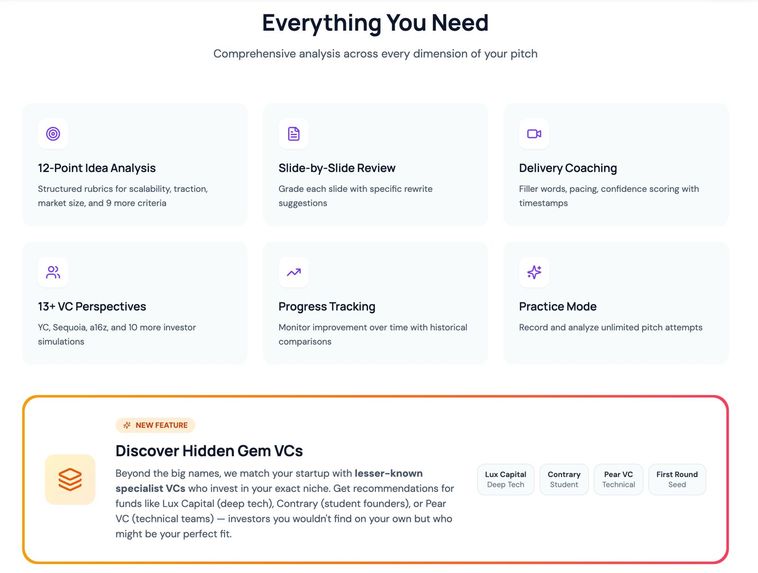
Landing Page: Features
-
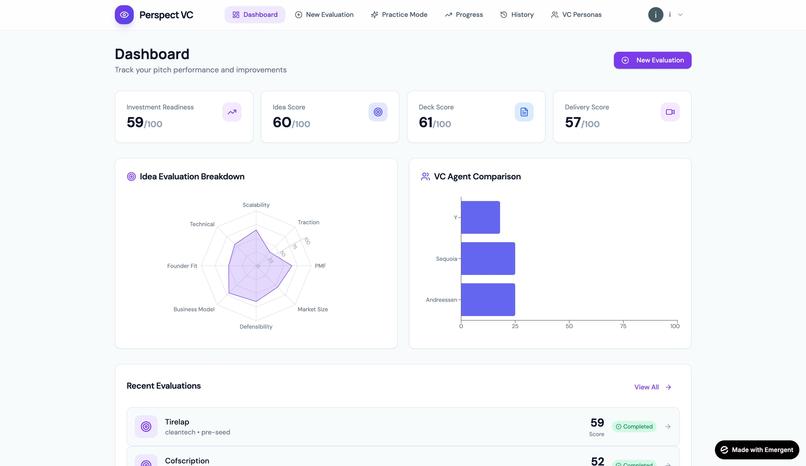
Landing Page: Sample analysis
-
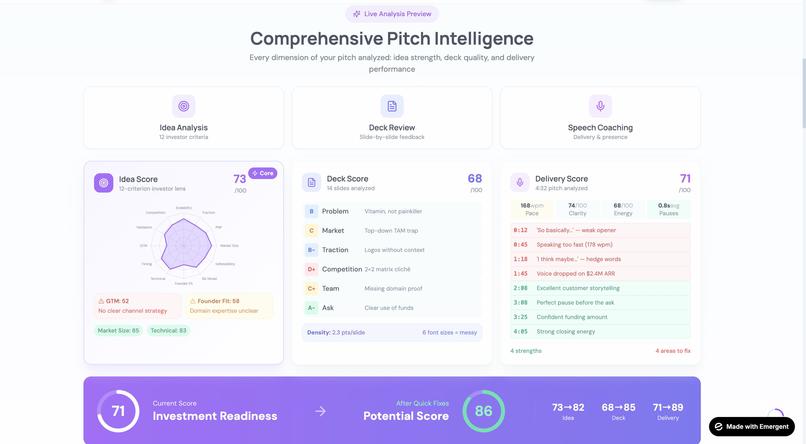
Result: Analysis of the startup pitch
-
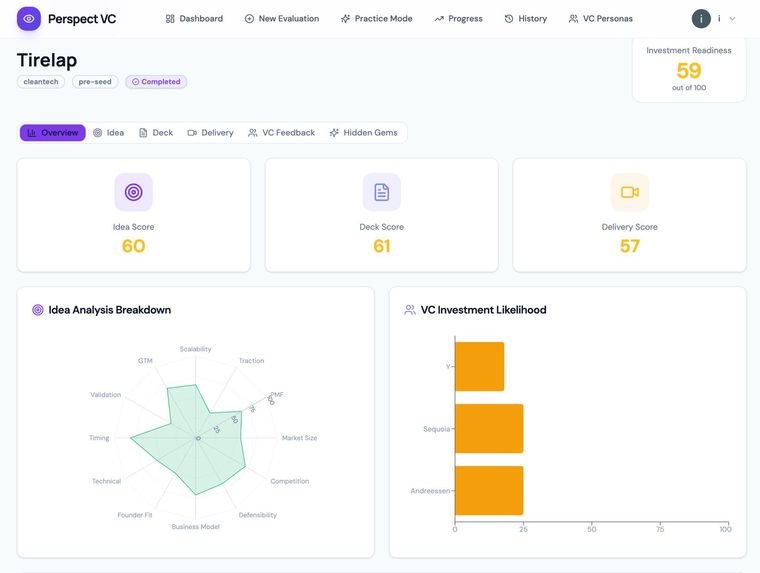
Result: Analysis of the startup pitch


**
Inspiration
In the middle of this AI gold rush, everyone is seemingly building the startup of the future but more importantly, pitching this future to VCs.
We noticed something critical in our own life when interning and talking to pre-seed startups: founders obsess over product features and code quality, yet when it comes to the pitching they fall short. Their often technical, non-business backgrounds limit their ability to view their product how VCs would. And even when they are applying to VCs, it’s only to the big names of YC & a16z when someone with a far better fit might be out there!!
What it does
That’s why we’re launching VC Perspect. A multi-agent AI system that comprehensively evaluates three critical components of a founder's pitch:
Startup idea
Slide deck
Pitch delivery (video)
But also, recommending hidden VCs that might have the best fit for your startup!
Idea Evaluation: The platform scores idea quality across investor-grade criteria including scalability, traction, market size, defensibility, and founder-market fit.
Deck Analysis: It analyzes slide decks for structure, clarity, narrative flow, and alignment with proven persuasion frameworks
Delivery Assessment: Using speech-to-text, NLP, and computer vision, it measures:
- Filler word frequency, Clarity and pacing, Vocal confidence, Gesture synchronization, Eye contact and posture
Each AI VC agent applies a distinct investment philosophy and weighting model, outputting Investment probability, Term sheet likelihood, Required milestones before funding
How we built it
We architected VC Perspect as a modular, multi-agent system with three core layers:
LLM Reasoning Layer
Frameworks: LangChain for agent orchestration and structured output parsing, spaCy, OpenCV, MediaPipe for body language and gesture tracking, Hugging Face Transformers and NLTK for linguistic analysis
Scoring System: Custom JSON schemas with Pydantic validation to enforce consistent rubric outputs
Built structured scoring rubrics to normalize outputs across different evaluation criteria
Infrastructure & Integration
Backend: Python (FastAPI) for API orchestration
Frontend: React with TypeScript for dashboard interface
Database: PostgreSQL for storing evaluations and user data
Deployment: Docker containers with cloud hosting for scalability
Challenges we ran into
- Multi-agent score normalization
Different VC agents use different weighting models and investment theses. Making their outputs comparable required building a sophisticated normalization layer so scores remain interpretable and actionable across diverse agent perspectives.
- Avoiding generic LLM feedback
Large language models naturally tend toward vague, general suggestions. We engineered structured scoring rubrics and enforced schema-constrained outputs to ensure actionable, investor-grade feedback that founders can actually implement.
- Real-time multimodal analysis constraints
Combining NLP (speech), computer vision (body language), and structured idea evaluation within hackathon time constraints required careful modular architecture and precise orchestration across multiple AI systems.
- Framework detection complexity
Detecting rhetorical compliance with IOU and AEIOUXE frameworks required discourse-level structure modeling, not simple keyword matching. We had to build pattern recognition systems that understand argumentative flow and persuasion architecture.
Accomplishments that we're proud of
Built a true multi-agent VC simulation system, not a single generic evaluator. Each agent operates with distinct weighting logic and investment philosophy, producing realistic investment disagreement that mirrors real partner meetings.
Unified multimodal analysis combining LLM reasoning (idea + deck), NLP speech analysis, and computer vision body language scoring into one coherent evaluation pipeline that provides comprehensive founder assessment.
Engineered structured, schema-constrained outputs to eliminate vague AI feedback and generate investor-grade, actionable recommendations that founders can immediately implement.
Implemented a persuasion enforcement layer that blocks "Investor Ready Mode" until clarity, structure, and confidence thresholds are met, ensuring founders don't pitch prematurely.
What we learned
Investor evaluation can be formalized. What feels subjective in venture decisions can be decomposed into weighted heuristics. Once structured, investment logic becomes computationally modelable oopening the door to scalable, consistent founder evaluation.
Clarity, logic, emotional framing, and delivery confidence are separable signals. Measuring them independently produces far more actionable feedback than a single "pitch score," allowing founders to improve systematically.
LLMs require strict scaffolding. Without structured rubrics and schema constraints, outputs become vague and generic. Strong system design and output formatting matter more than prompt engineering cleverness.
Multimodal systems introduce orchestration complexity. Combining text reasoning, speech analysis, and visual signals requires careful normalization and coordination across models — each with different output formats and confidence levels.
Feedback quality determines user trust. Founders quickly recognize generic AI commentary. High-specificity, investor-style critique that mirrors real VC evaluation dramatically increases perceived value and platform credibility.
**
What's next for VC Perspect
Expand AI VC Network: Add more agents simulating diverse investors, including Greylock, PE/VCs, and other top-tier firms, to provide founders with varied perspectives and uncover high-fit investors.
Monetization Strategy: Implement a tiered subscription model—free basic evaluations for early-stage founders, premium plans for deeper multi-agent insights, actionable deck & delivery feedback, and personalized investor recommendations.
Interactive Pitch Lab: Enable founders to iteratively test ideas, slides, and delivery, receiving realistic investor-style feedback in a structured, actionable format.
**
Built With
- aeiouxe-framework
- docker
- doker
- fastapi
- ffmpeg
- iou-framework
- json-scoring-rubrics
- langchain
- matplotlib
- mediapipe
- nltk
- numpy
- openai-api
- opencv
- pandas
- plotly
- postgresql
- pydantic
- pytorch
- react
- scikit-learn
- seaborn
- spacy
- speechrecognition
- tensorflow
- typescript
- whisper


Log in or sign up for Devpost to join the conversation.