Inspiration
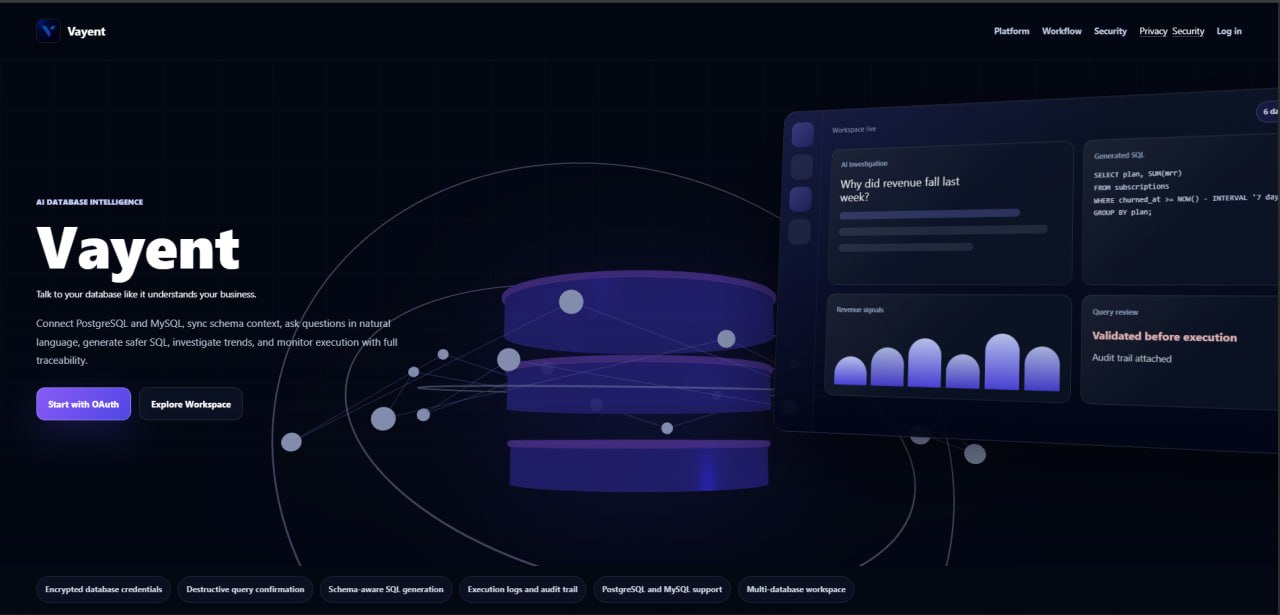
Vayent started from a simple idea: what if people could just chat with their database?
At first, the goal was straightforward, remove the need to write SQL queries or navigate complex dashboards. A user connects their data source, asks questions in plain language, and gets answers.
But while building and testing, we realized the bigger problem wasn't access to data...it was understanding it. To ground this in a real scenario, we tested Vayent with a persona we call Rachael: a university student running a small catering side hustle. She had sales data sitting in a spreadsheet, but no clarity on whether her idea was actually working or what to do next. That's the gap Vayent is built to close, not just retrieving data, but helping a founder understand what it means and what to do with that understanding.
What it does
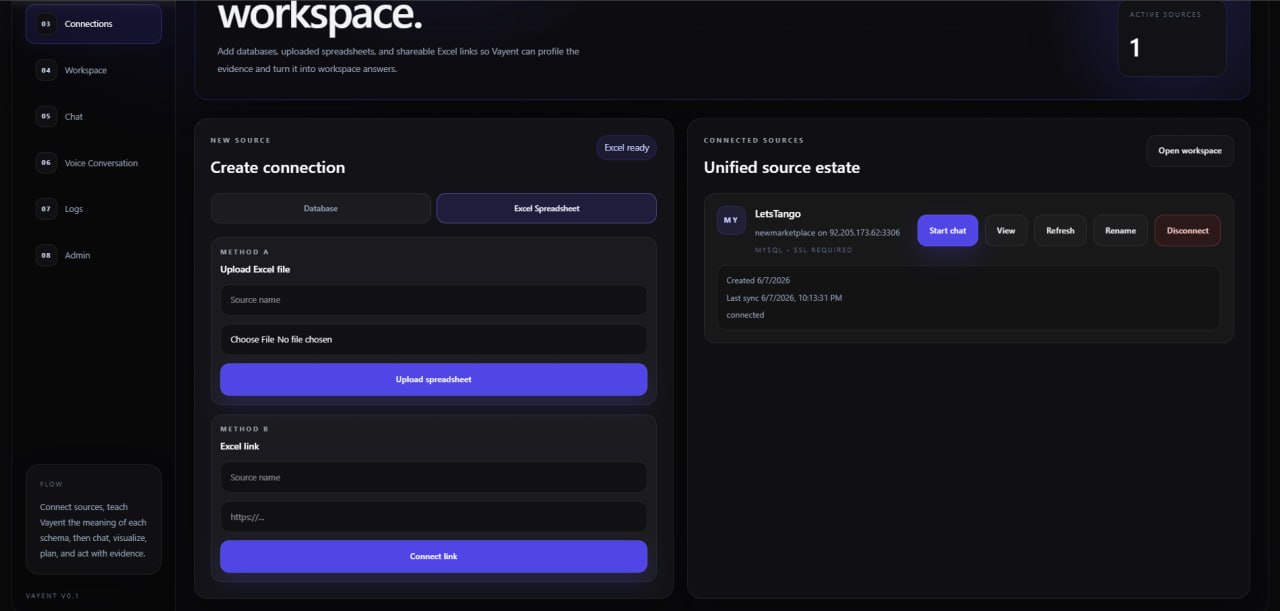
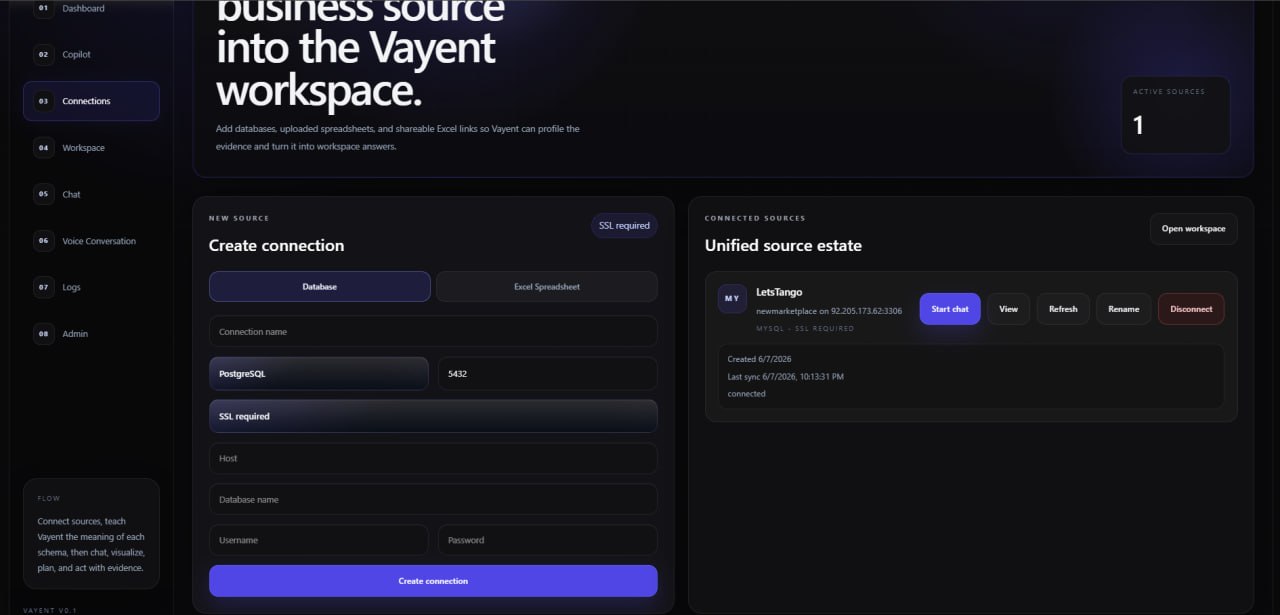
Vayent lets startup founders connect their business data—a database or an Excel/CSV file and interact with it using natural language. Instead of writing queries or spending hours analyzing reports, a founder can ask:
- Why are sales dropping?
- Which products or customers are performing best?
- What part of my business needs attention?
- What should I do next?
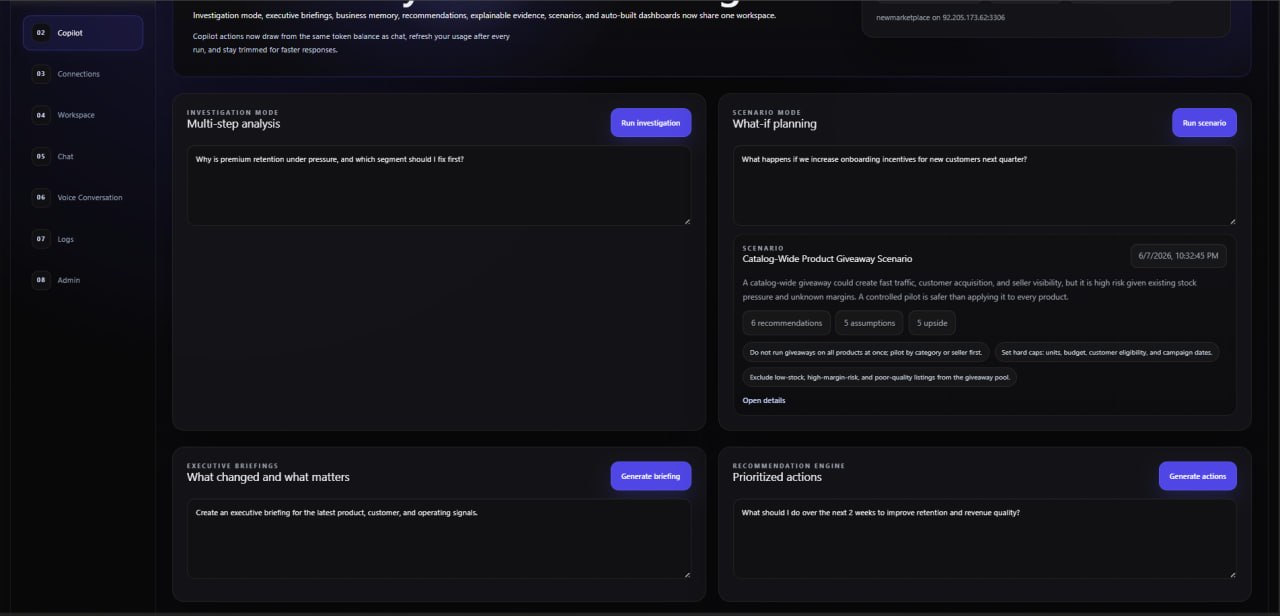
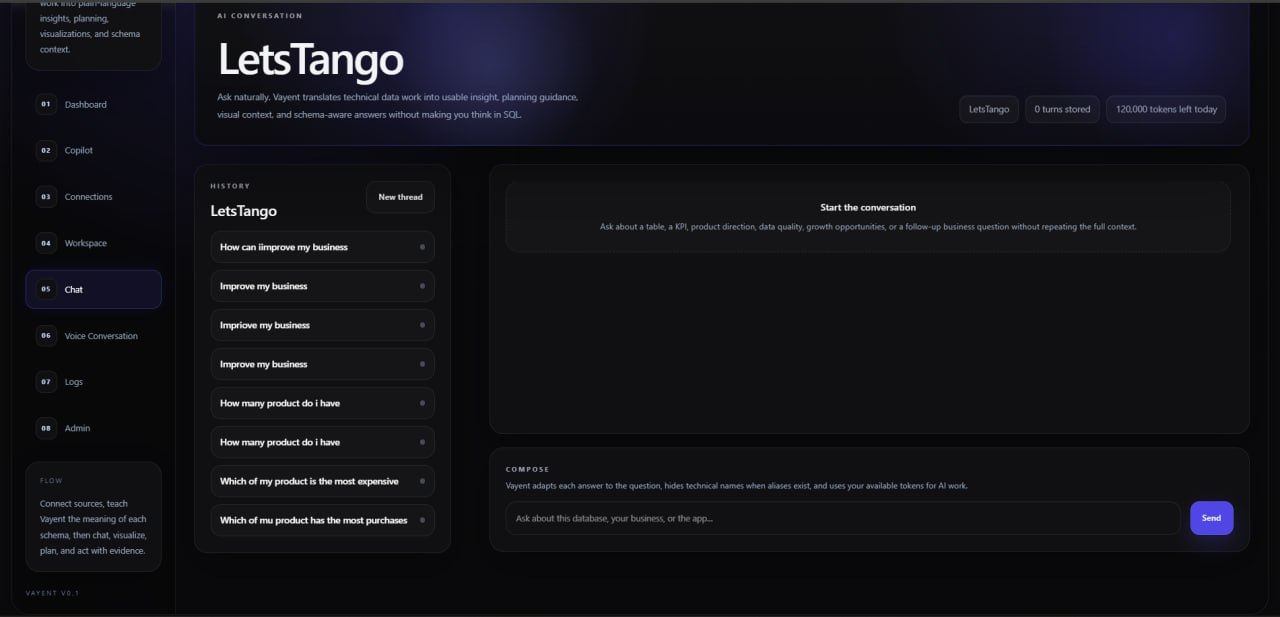
Input → AI Process → Output: A founder asks a question in plain English (input). Vayent's natural language processing layer interprets the question and converts it into a structured query against the connected data source. An LLM (OpenAI API) then generates a plain-language answer grounded strictly in the retrieved data — not general knowledge (AI process). The founder receives a direct answer paired with an auto-generated dashboard visualizing the evidence behind it (output).
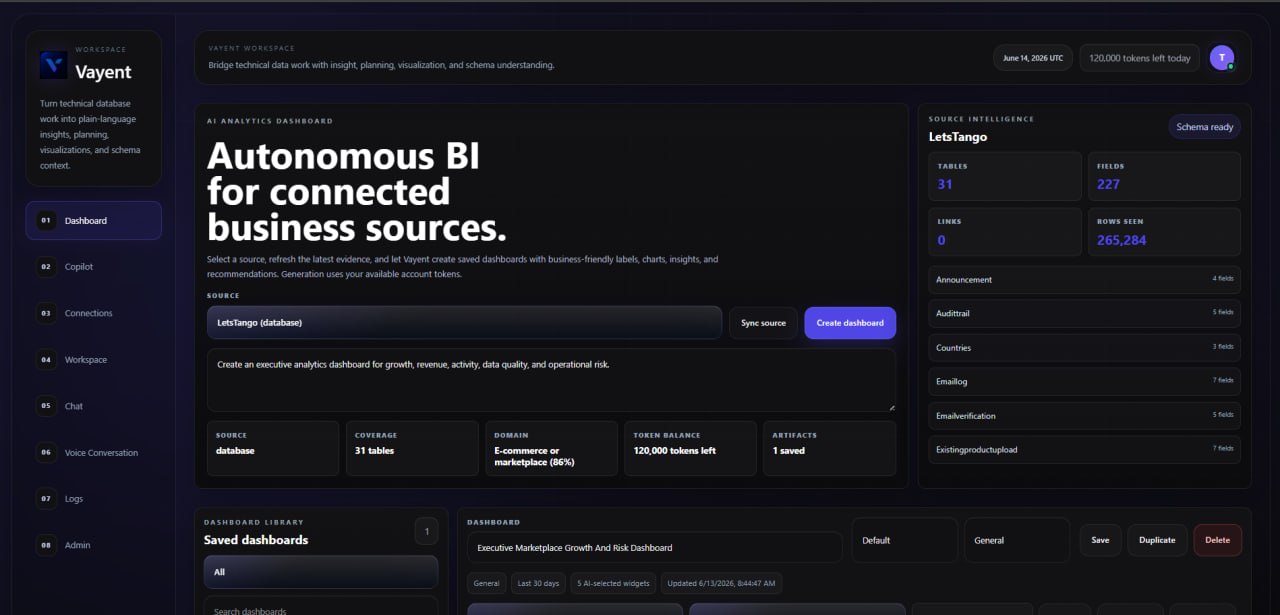
A real example: we connected Vayent to a live e-commerce database from LesTango, a Dubai-based e-commerce platform. The auto-generated dashboard visually surfaced a pattern — sales were heavily concentrated around a single vendor. That visual prompted our test user to ask Vayent directly: "what's driving this, and what's the risk?" Vayent's analysis confirmed the concentration and explained the risk clearly — if that vendor pulled out, revenue could collapse — and surfaced diversification as a next step worth considering.
That sequence: notice a pattern, ask a question, get a grounded answer is exactly how Vayent is designed to work. It doesn't replace the founder's judgment. It gives them evidence to use it.
How we built it
Our team combined:
- Database connectivity — for PostgreSQL, MySQL, and Excel/CSV data sources
- Natural language processing — to interpret a student founder's question in plain English
- Query generation — converting that question into a structured data retrieval
- LLM-based analysis (OpenAI API) — interpreting retrieved data and generating grounded answers
- A conversational interface paired with auto-generated dashboards — so non-technical founders see both the answer and the evidence behind it
Our focus throughout was making sure every answer was grounded in the user's actual data, not general AI assumptions.
Challenges we ran into
Our biggest challenge was ensuring the AI never generated confident-sounding answers without evidence for a business tool, that distinction matters, since a founder might act on what Vayent tells them.
We also had to convert natural human questions into reliable data queries while keeping the experience fast enough to feel conversational, not technical. And we had to think past just displaying numbers, a student founder doesn't only need a chart, they need the "why" behind it.
Accomplishments we're proud of
- Built a working platform where users connect real data sources and ask questions in natural language
- Created a workflow where every AI response is grounded in actual retrieved data not generic generation
- Made business insight accessible to non-technical founders without requiring SQL knowledge
- Tested Vayent against a real e-commerce database (LesTango) and surfaced a genuine business risk through that process
- Shifted our thinking from "showing data" to "helping someone understand what their data means and what to do next"
What we learned
The hardest part of building Vayent wasn't connecting AI to data...it was making AI responses reliable, useful, and grounded enough to act on.
Founders don't just want numbers. They want answers to: What's changing? Why is it happening? What should I pay attention to next?
We also learned that in a business context, a confident but wrong answer is worse than no answer which shaped how carefully we grounded every response in retrieved data rather than general AI knowledge.
What's next for Vayent
Right now, Vayent answers what a founder asks. The clearest next step is making Vayent more proactive, surfacing risks and patterns "before" a founder thinks to ask, the way the LesTango dashboard visually hinted at vendor concentration before any question was typed.
Planned improvements include:
- Proactive risk and anomaly detection, moving from "ask and we'll answer" to "we'll tell you what to look at"
- Support for more data sources and business tools
- Deeper business intelligence across sales, customers, operations, and finance
- Continued focus on accuracy, speed, and trust when AI touches real business decisions
Our long-term goal is to make data-driven decision-making accessible to every founder, regardless of technical background or company size.
Built With
- fastapi
- git
- github
- natural-language-processing
- openaiapi
- postgresql
- python
- react
- sql-generation
- tailwind
- typescript
- vercel
- vscode


Log in or sign up for Devpost to join the conversation.