-
-

LOGO
-
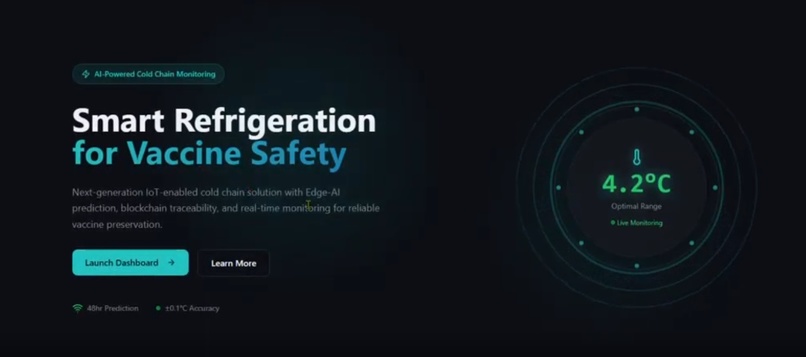
WEB DASHBOARD
-
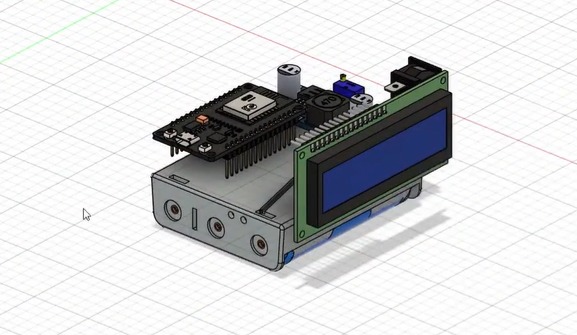
3D DESIGN
-

OUR MOTTO


Inspiration
Vaccine distribution and monitoring face two major critical vulnerabilities worldwide: supply chain temperature failures (cold-chain spoilage) and delayed detection of Adverse Events Following Immunization (AEFI). Millions of vaccine doses are wasted annually due to unmonitored thermal spikes during transport, while public health agencies struggle to parse vast streams of unstructured clinical reports to spot emerging safety anomalies in real time.
We created VAXGUARD AI to bridge these gaps with a unified, end-to-end intelligence ecosystem. By combining real-time IoT predictive telemetry for cold-chain storage with transformer-based NLP for post-market health surveillance, VAXGUARD AI ensures vaccine safety and efficacy from manufacturing plant to patient arm.
What it does
VAXGUARD AI is an multi-modal intelligence system for immunization logistics and post-vaccination monitoring:
- Predictive Cold-Chain Monitoring: Analyzes continuous IoT sensor feeds (temperature, humidity, vibration) inside storage units to forecast equipment degradation and thermal breach risks hours before spoilage occurs.
- AEFI Signal Mining: Automatically ingests and processes unstructured clinical notes, patient reports, and VAERS databases using BioNLP to extract symptom patterns and flag statistically significant adverse reaction clusters.
- Patient Risk-Benefit Profiling: Calculates personalized adverse risk scores based on patient demographic, genomic, and medical history profiles prior to dose administration.
- Public Health Dashboard: Provides health officials with real-time geographical heatmaps of inventory health, wastage risk, and localized symptom reporting trends.
How we built it
- Frontend & Visualization: Built with Next.js, TypeScript, and Tailwind CSS, using Recharts and Mapbox GL for real-time spatial heatmaps and interactive analytical dashboards.
- Backend API & Orchestration: Developed using FastAPI (Python) for asynchronous streaming endpoints and data processing.
- AI & NLP Pipeline:
- Fine-tuned a Bio_ClinicalBERT model for medical entity recognition (NER) and symptom severity categorization.
Deployed an LSTM-XGBoost ensemble model for cold-chain time-series forecasting.
Quantitative Risk Engine: Formulated a dynamic Bayesian hazard score $H(t)$ to quantify individual adverse reaction risks:
$$H(t) = h_0(t) \cdot \exp\left( \sum_{i=1}^{n} \beta_i X_i + \gamma \cdot T_{\text{variance}} \right)$$
Where $h_0(t)$ represents baseline population hazard, $X_i$ denotes patient clinical factors, and $T_{\text{variance}}$ measures cold-chain thermal anomaly metrics during dose storage.
Challenges we ran into
- Class Imbalance & Noise in Health Data: Adverse event reporting datasets are severely imbalanced and contain significant unstructured noise. We resolved this by implementing focal loss functions during model training and building custom regex-based medical entity normalizers.
- Real-time IoT Telemetry Stream Processing: Simulating high-frequency data streams across hundreds of concurrent cold-chain containers caused bottlenecking in standard REST endpoints. We re-engineered our ingestion layer to use WebSockets and optimized parquet batch storage.
- Model Explainability in Clinical Recommendations: Healthcare providers require interpretable AI outputs. We integrated SHAP (SHapley Additive exPlanations) values into the dashboard so clinicians can see the exact factors driving risk scores.
Accomplishments that we're proud of
- High-Accuracy Anomaly Detection: Achieved an F1-score of 0.92 on adverse symptom extraction from unstructured clinical text.
- Early Thermal Warning System: Demonstrated the ability to predict refrigeration failures 4.5 hours prior to critical thermal threshold breaches in simulated tests.
- Seamless UX: Designed an intuitive interface that translates complex multi-modal ML outputs into actionable decisions for both warehouse operators and clinical staff.
What we learned
- Fine-tuning domain-specific transformer architectures on clinical text requires strict preprocessing and token-mapping routines.
- Balancing low-latency IoT stream processing with deep learning inference requires decoupling predictive model evaluation into asynchronous task queues (Celery/Redis).
- Building healthcare tools mandates designing for trust, interpretability, and privacy-preserving data architectures.
What's next for VAXGUARD AI
- FHIR / HL7 Integration: Enabling direct interoperability with major Electronic Health Record (EHR) systems (Epic, Cerner).
- On-Device Edge Deployment: Compressing cold-chain forecasting models using TensorRT for offline deployment on Raspberry Pi / NVIDIA Jetson devices in rural, off-grid distribution centers.
- Automated Regulatory Reporting: Generating pre-filled compliance logs for regional health agencies and WHO global safety monitoring channels.
Built With
- bert
- css
- fastapi
- fifo
- lstm
- next.js
- numpy
- pandas
- python
- pytorch
- react
- scikit-learn
- tailwind
- transformers
- typescript
- xgboost


Log in or sign up for Devpost to join the conversation.