Inspiration
I built Vaulty Skeleton for the Skeleton Crew track to give developers a lean, zero-dependency cryptographic foundation they can clone and use in their projects to give them local-first, zero-knowledge web app capabilities in minutes. Most browser apps that claim to protect sensitive data still leak metadata, store unencrypted keys in localStorage, or rely on backend servers that can be subpoenaed or breached. At the same time, building true zero-knowledge encryption in the browser—with proper key wrapping, memory zeroing, and Origin Private File System (OPFS) isolation—is notoriously easy to get wrong.
What It Does
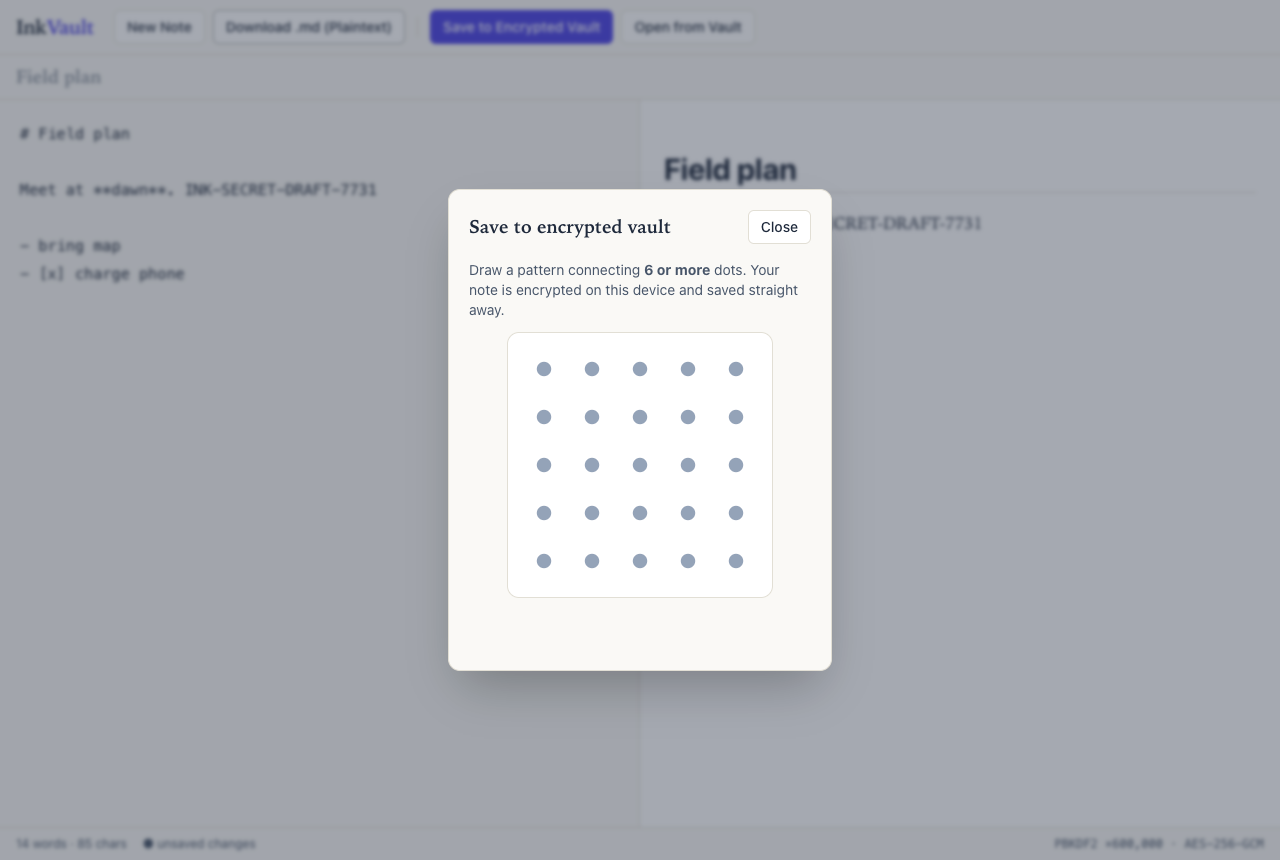
Vaulty Skeleton consists of a reusable TypeScript/React SDK (@vaulty/core and @vaulty/core/react) paired with two functionally distinct showcase applications that prove its flexibility across both binary media streams and reactive structured JSON records:
The Skeleton (@vaulty/core) provides out-of -the -box:
- 5×5 Pattern Key-Wrapping: Derives a Key Encryption Key via PBKDF2-HMAC-SHA256 (600,000 iterations) to unwrap a random 256-bit AES-GCM Master Vault Key—never deriving file keys directly from user input.
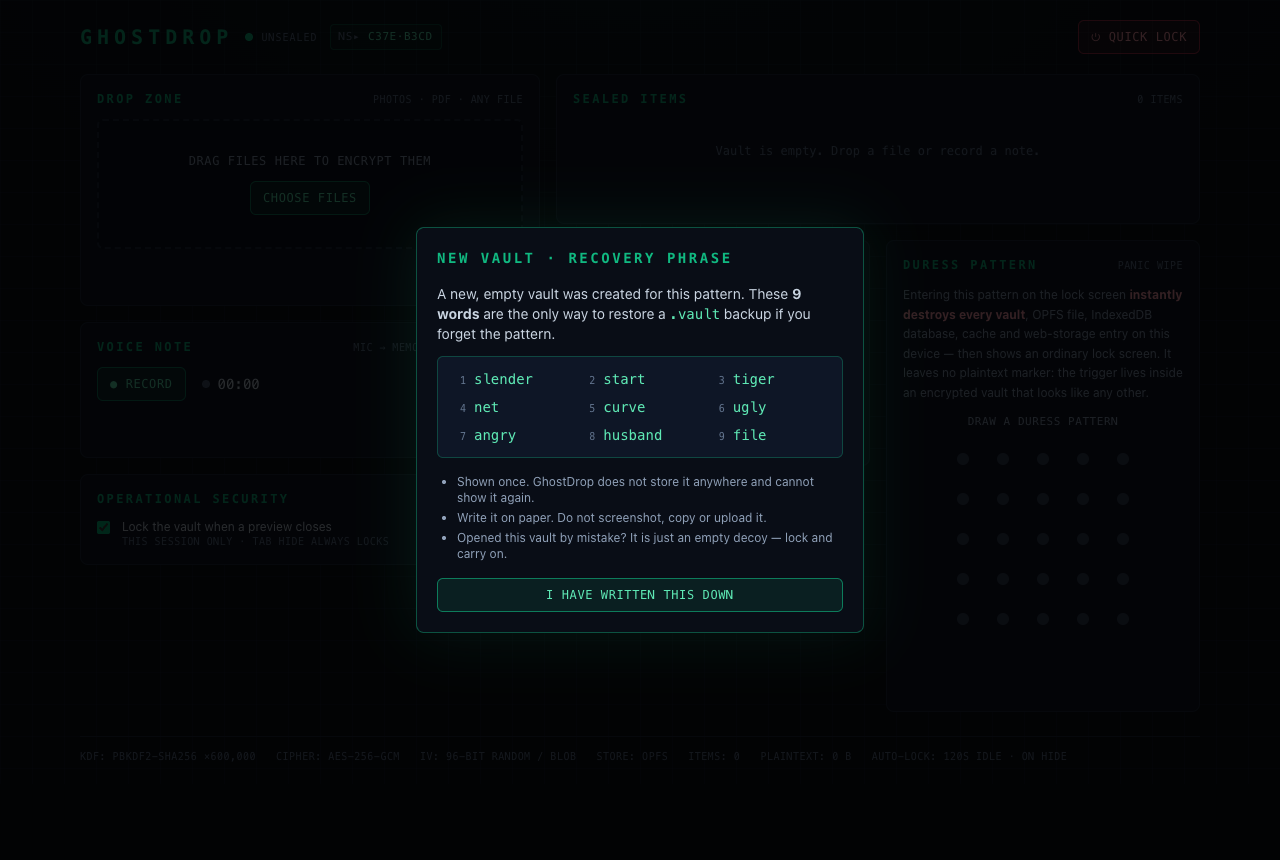
- 9-Word Recovery Phrase: Generates an independent BIP-39 recovery envelope so users can restore lost patterns without compromising zero-knowledge guarantees.
- Plausible Deniability & Multi-Vault Routing: Deterministically routes patterns to isolated namespaces via domain-separated PBKDF2 without storing global vault lists or returning "wrong password" errors.
- Forensic-Safe Duress Wipe: Supports an encrypted in-vault duress pattern that synchronously zeroes active key buffers and purges OPFS, IndexedDB, Cache API, and web storage on trigger.
- Portable .vault Archives: Exports and imports authenticated, encrypted binary snapshots ready for offline backup or personal cloud storage.
The Demo apps:
 |
 |
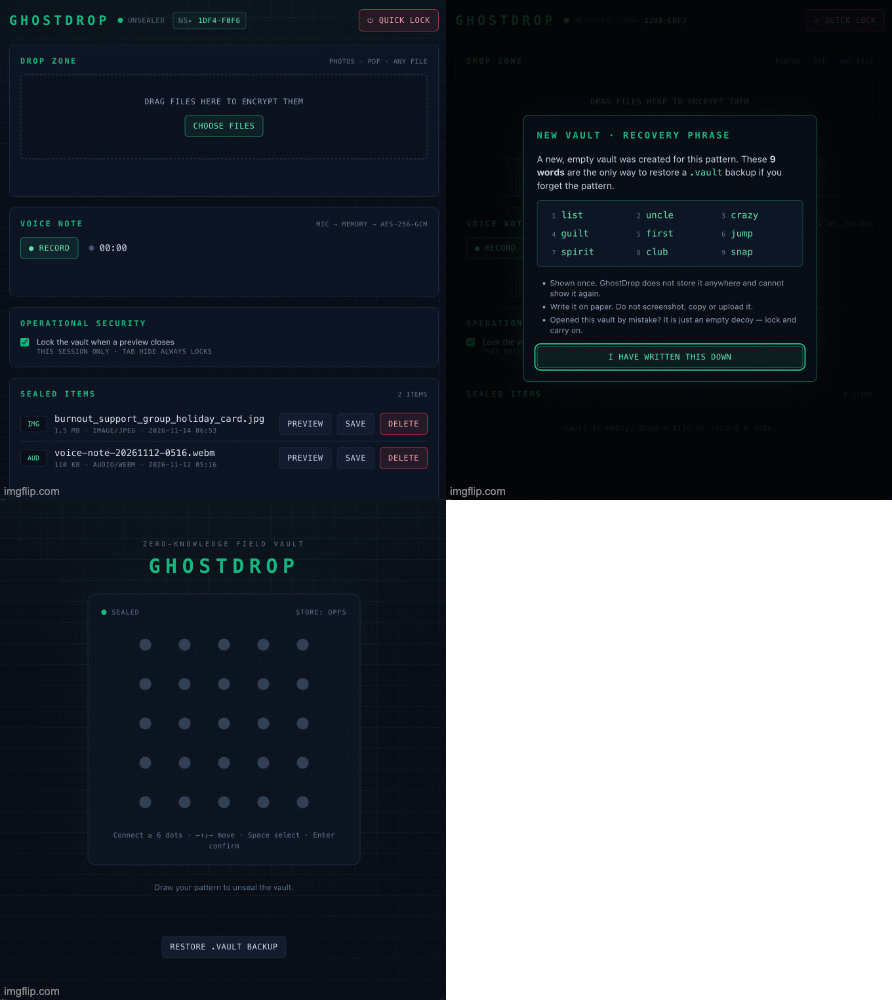
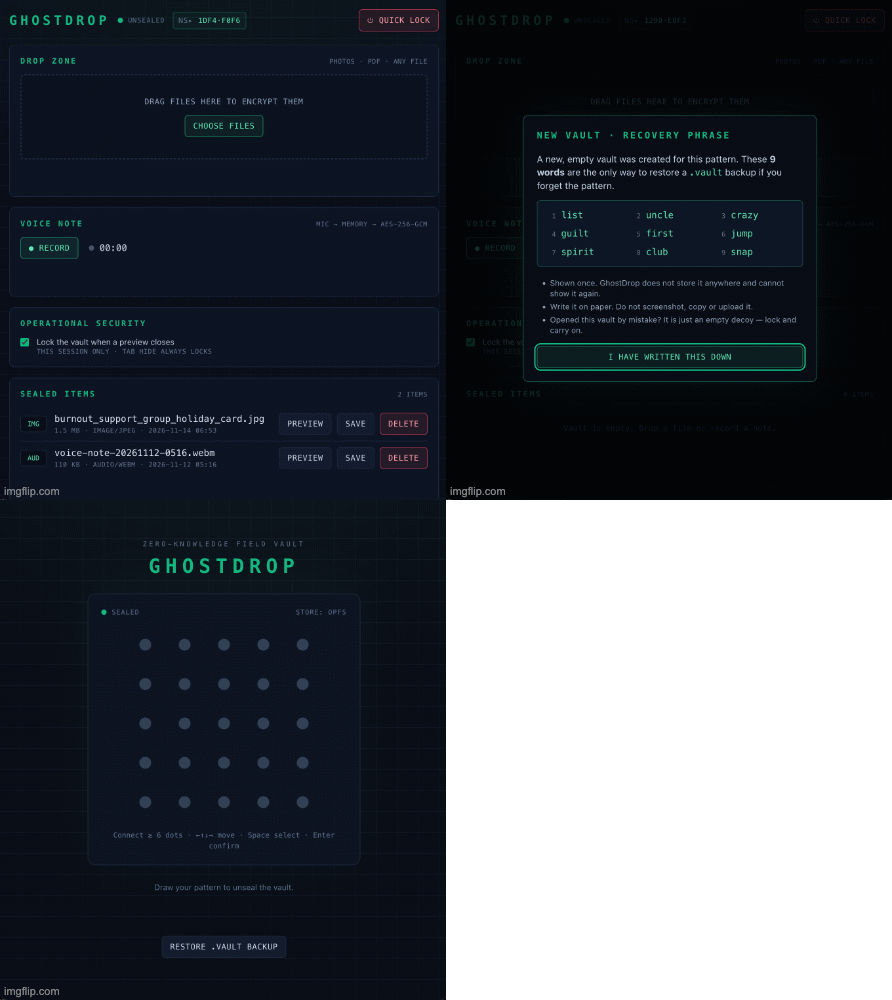
| GhostDrop (Binary & Media Field Vault) • Built for investigative journalists and whistleblowers using @vaulty/core's binary file APIs. • Features drag-and-drop media encryption, an in-browser encrypted voice note recorder that never touches disk unencrypted, zero-leak in-memory previews, decoy vaults, and an instant duress wipe. |
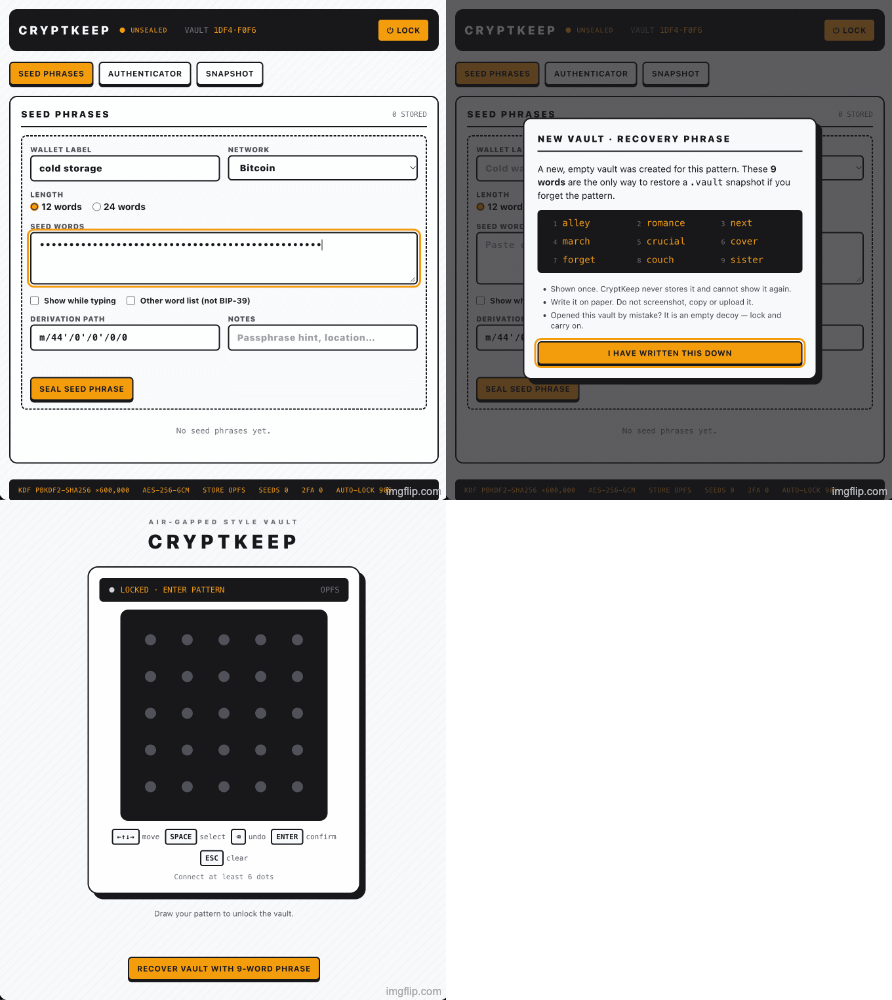
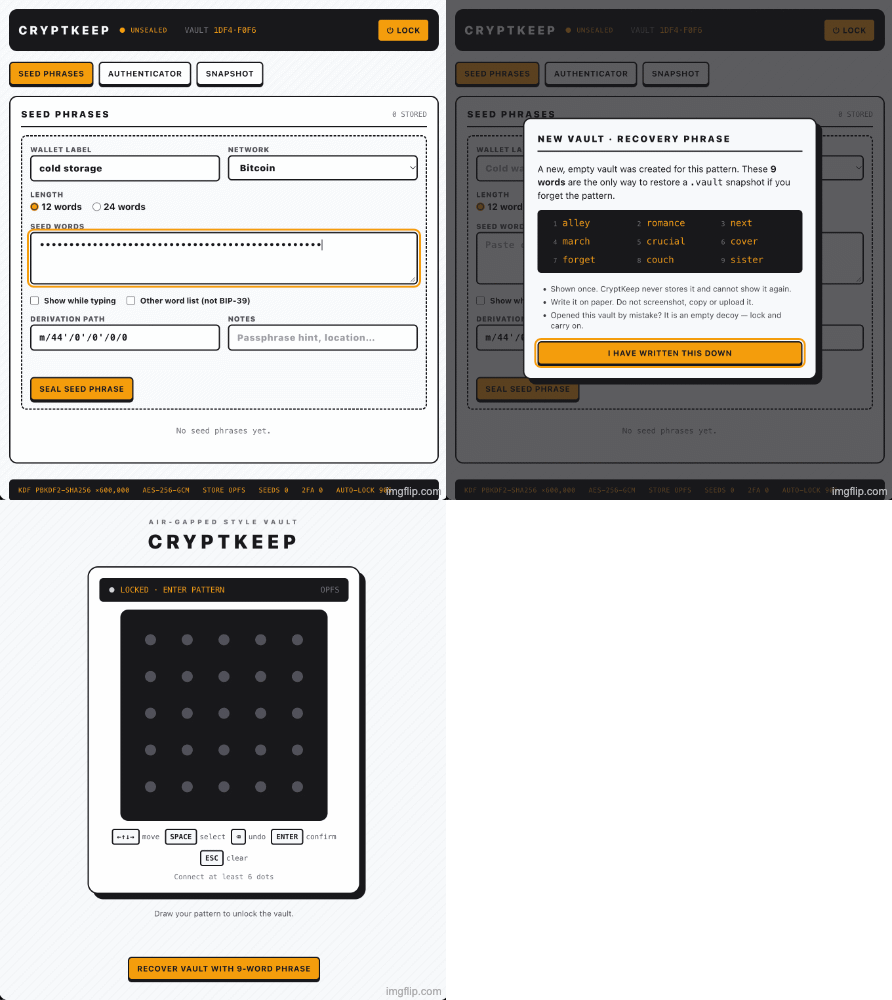
CryptKeep (Air-Gapped Seed & 2FA Vault) • Styled as a minimalist hardware security module using @vaulty/core's typed JSON record APIs. • Features masked crypto seed phrase storage with 15-second clipboard auto-clear, a live offline RFC 6238 TOTP 2FA authenticator with a 30-second countdown ring, and 9-word phrase vault recovery. |
How I Built It
I built the entire monorepo using Kiro and spec-driven development:
.kiro/specs/: Formal EARS requirements, byte-level cryptographic layouts, and threat-model documentation guiding both the core SDK and showcase apps..kiro/steering/: Custom cryptographic invariants enforcing memory buffer zeroing, unique 12-byte IV generation, and zero plaintext storage across every agent session..kiro/hooks/: Automated file-save security checks auditing Web Crypto API hygiene whenever core SDK files are modified.- Zero Runtime Dependencies: Built strictly on native Web Crypto (
crypto.subtle), OPFS (navigator.storage.getDirectory()), IndexedDB fallback, TypeScript, Vite, and React.
Challenges I Ran Into
Kiro CLI made the scaffolding easy and kept it lean. Starting from a short spec, a few steering rules, and one hook, and the project took shape from there without a pile of boilerplate. Specs gave the agent a clear target, steering kept the crypto rules in front of it on every task, and the hook caught policy violations as soon as they were saved, streamlining the creation of any additional components.
- Preventing Forensic Metadata Leaks: Ensuring that neither vault counts nor duress configurations leave plaintext footprints on disk required storing duress flags inside encrypted vault metadata and using domain-separated PBKDF2 for namespace derivation.
- Cross-Realm Memory & Storage Reliability: Ensuring
Uint8Arraybuffer wiping and OPFS/IndexedDB storage adapters behave consistently across browsers and test environments required realm-safe type guards and automated fallback probing.
What's Next for Vaulty Skeleton
• Publishing @vaulty/core to npm with a 1-command npm create vaulty-app scaffolding CLI. • Adding optional client-side Google Drive (drive.file scope) encrypted .vault archive sync and Shamir's Secret Sharing multi-guardian recovery.
Built With
- aes-256-gcm
- github
- github-actions
- indexeddb
- jsdom
- kiro
- next.js
- node.js
- npm-workspaces
- opfs
- pbkdf2
- pnpm
- puppeteer
- pwa
- react
- remotion
- service-workers
- tailwindcss
- tsup
- typescript
- vite
- vitest
- web-crypto-api
- xterm.js
