-
-
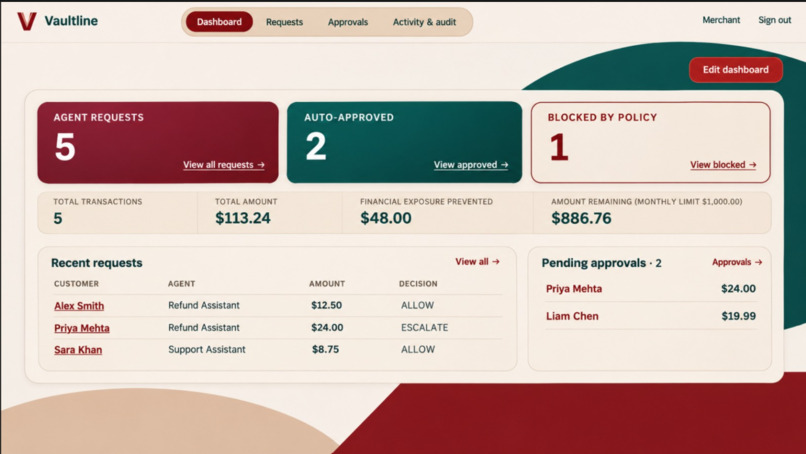
dashboard
Inspiration
As AI agents evolve from answering questions to taking real-world actions, they are increasingly interacting with APIs, business systems and financial services. This creates an important question: Who controls an AI agent when it has the ability to move money?
We realized that giving autonomous agents access to financial systems without enforceable authorization boundaries creates significant risks. A manipulated instruction, excessive refund request or compromised agent could result in unauthorized financial transactions.
Existing payment infrastructure enables transactions, but we wanted to address the layer of governance between an autonomous agent and the financial system.
This inspired us to build Vaultline — an AI financial security and governance layer that gives agents controlled financial authority without granting them unrestricted access to money.
What We Built
Vaultline introduces a centralized security layer between AI agents and financial execution systems.
Our implementation combines:
- MCP (Model Context Protocol): Provides agents with three restricted tools to request refunds, retrieve request statuses and access their financial policies.
- FastAPI Security Gateway: Authenticates agents, validates requests and enforces merchant-level permissions.
- Deterministic Policy Engine: Evaluates financial actions and produces three outcomes: ALLOW, ESCALATE or BLOCK.
- Human-in-the-Loop Approval: Requires merchant authorization for transactions that exceed automatic approval limits.
- PayPal Sandbox Integration: Executes authorized refunds through a dedicated backend adapter and verifies transaction outcomes.
- Tamper-Evident Audit Trail: Records decisions, approvals and execution events for accountability and traceability.
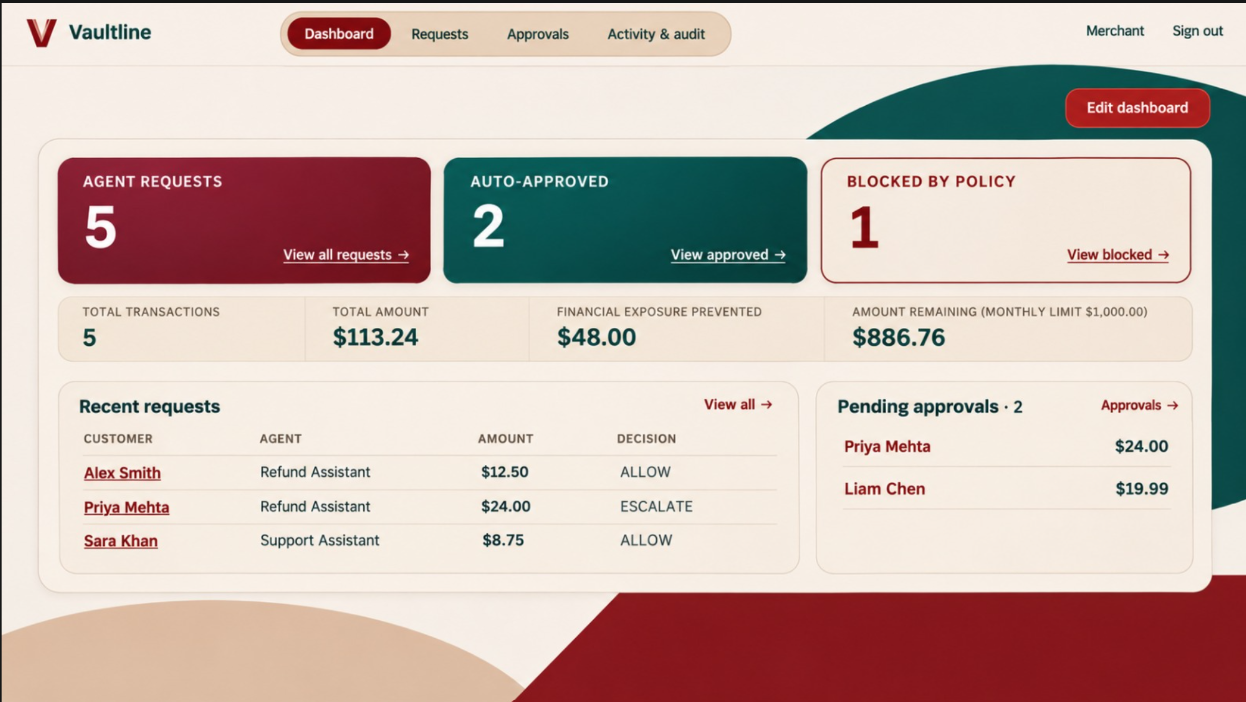
- Merchant Dashboard: Provides visibility into refund requests, approvals, transaction execution and audit history.
A fundamental design principle is that AI agents can propose financial actions, but they cannot authorize themselves. Only the backend execution service can communicate with PayPal.
How We Built It
We developed Vaultline using Python, FastAPI, React, MCP, SQLite and the PayPal REST API.
The backend handles authentication, request validation, deterministic policy evaluation, approval verification and controlled execution. Our MCP server exposes restricted capabilities to agents, while the React dashboard allows merchants to monitor requests and manage approvals.
We designed our financial policy workflow around three outcomes:
- ALLOW: Transactions within the automatic authorization threshold can proceed.
- ESCALATE: Transactions requiring additional authorization are sent to the merchant.
- BLOCK: Transactions exceeding the permitted limits are rejected before financial execution.
We also integrated PayPal Sandbox to demonstrate actual refund execution rather than relying exclusively on simulated payment responses.
Challenges We Faced
One of our biggest challenges was maintaining clear security boundaries between the AI agent, authorization backend and payment provider.
We had to ensure that an agent could never bypass the policy engine or directly execute a financial transaction.
Another challenge was integrating independently developed components, including the MCP server, backend services, PayPal adapter and React dashboard, while maintaining consistent API contracts.
Payment execution introduced additional complexity. We needed to handle idempotency, ambiguous timeouts, refund verification and uncertain execution states without accidentally issuing duplicate refunds.
We also worked on ensuring that merchant approvals were bound to the exact transaction being authorized and that important decisions remained traceable through the audit system.
What We Learned
Building Vaultline taught us that reliable AI systems require more than intelligent models. They need deterministic authorization, secure integrations, carefully defined permissions and human oversight.
We gained practical experience with MCP, API security, payment integrations, backend architecture, database management, distributed component integration and transaction lifecycle handling.
Most importantly, we learned that AI autonomy and human accountability should not be opposing ideas. With the right governance infrastructure, businesses can benefit from autonomous agents while maintaining control over their financial operations.
Our Vision
We envision Vaultline becoming a trusted financial control layer for autonomous agents across business environments.
As AI agents become increasingly capable of initiating financial actions, Vaultline aims to ensure that every action is authorized, every execution is controlled and every decision is accountable.
Vaultline — Give AI the ability to act, not the freedom to act without permission.
Built With
- fastapi
- httpx
- javascript
- mcp
- model-context-protocol
- oauth
- paypal-rest-api
- pydantic
- python
- react
- rest-api
- sqlalchemy
- sqlite
- typescript
- vite
