-
-
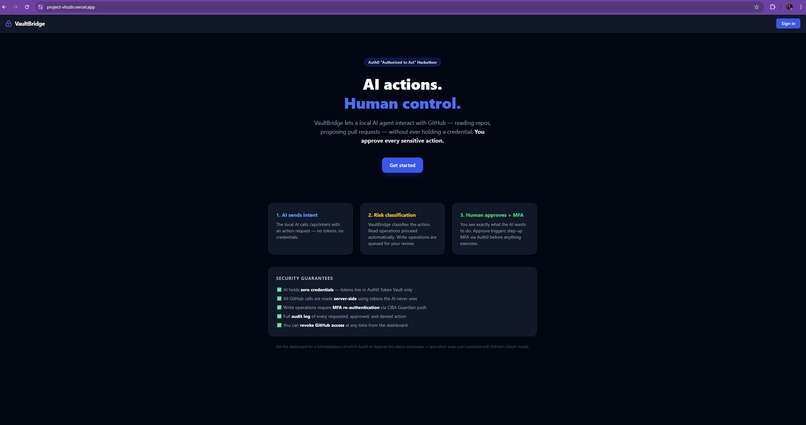
Homepage
-
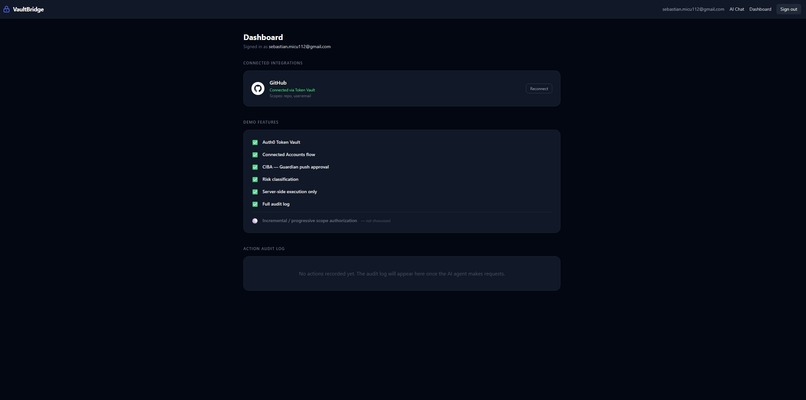
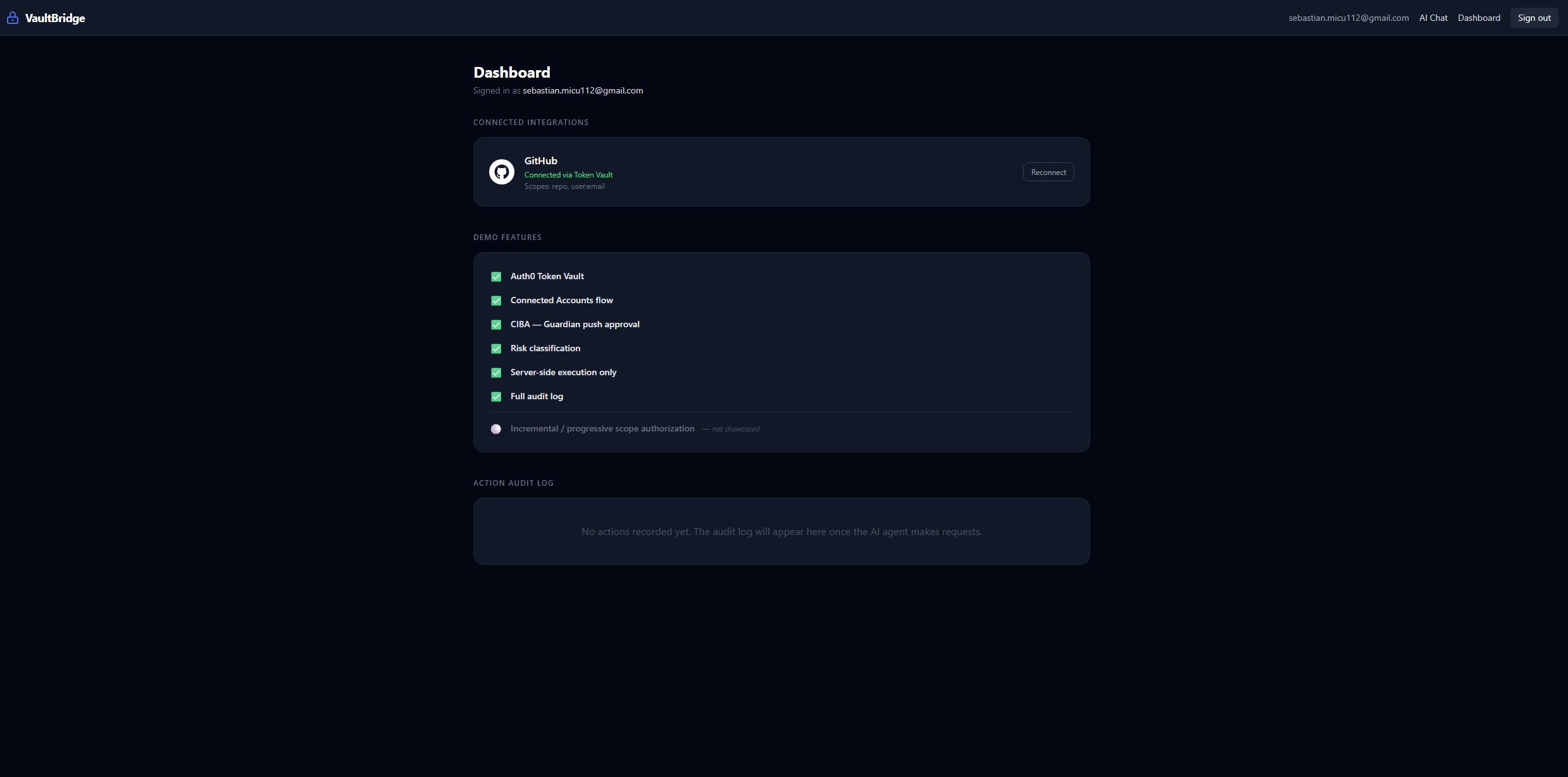
Dashboard
-
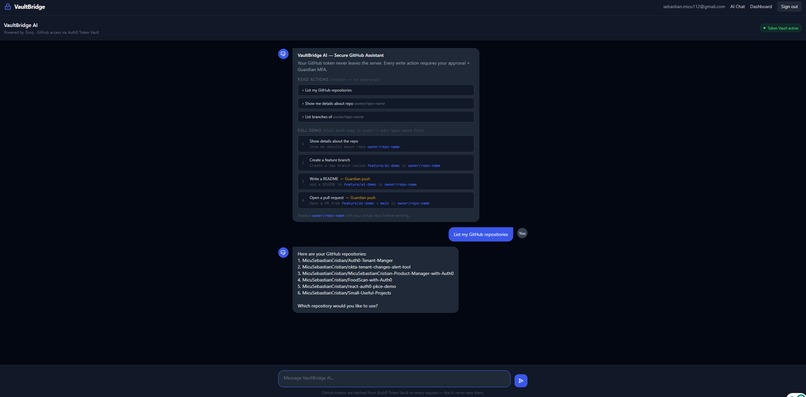
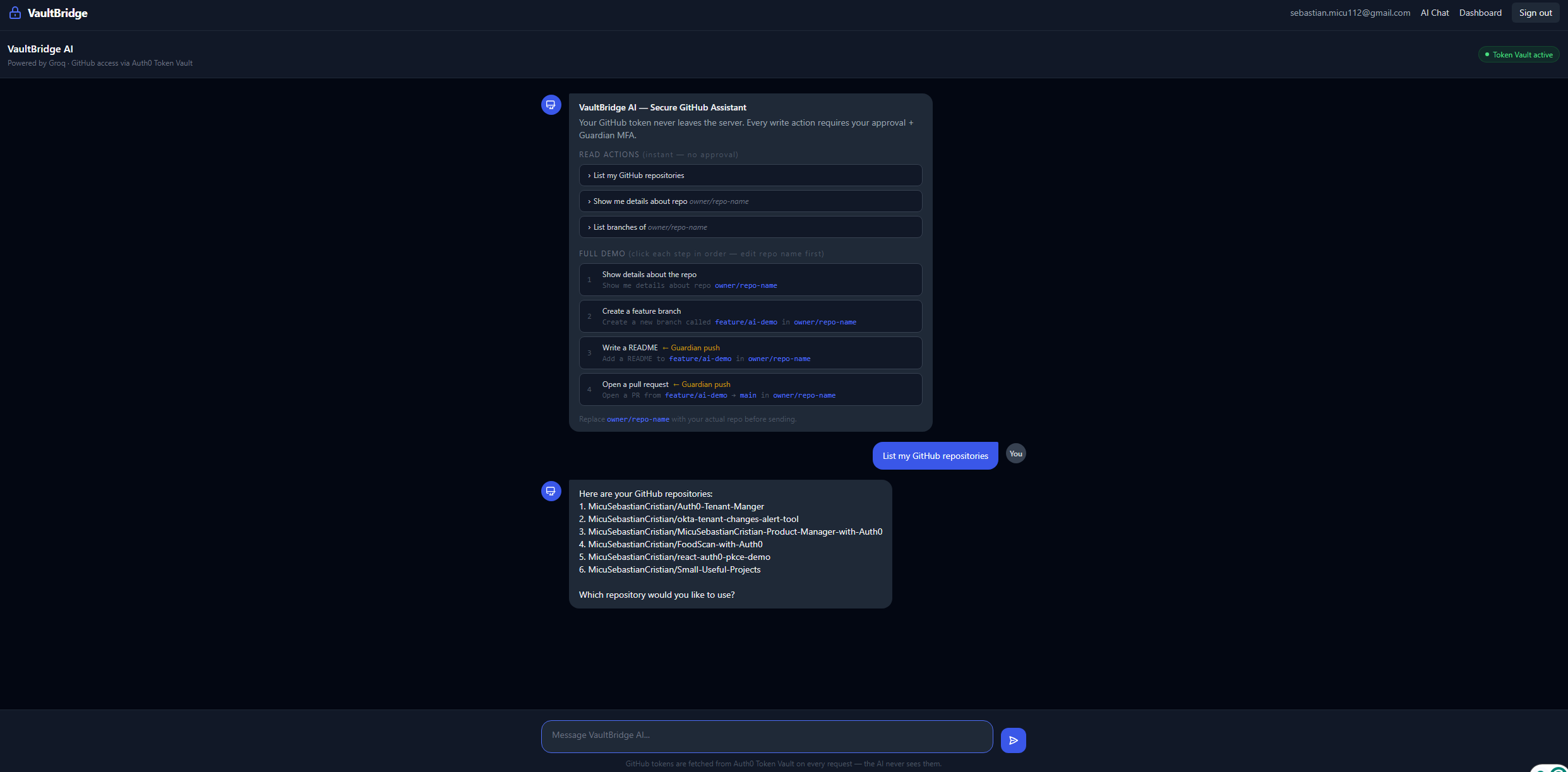
AI Chat
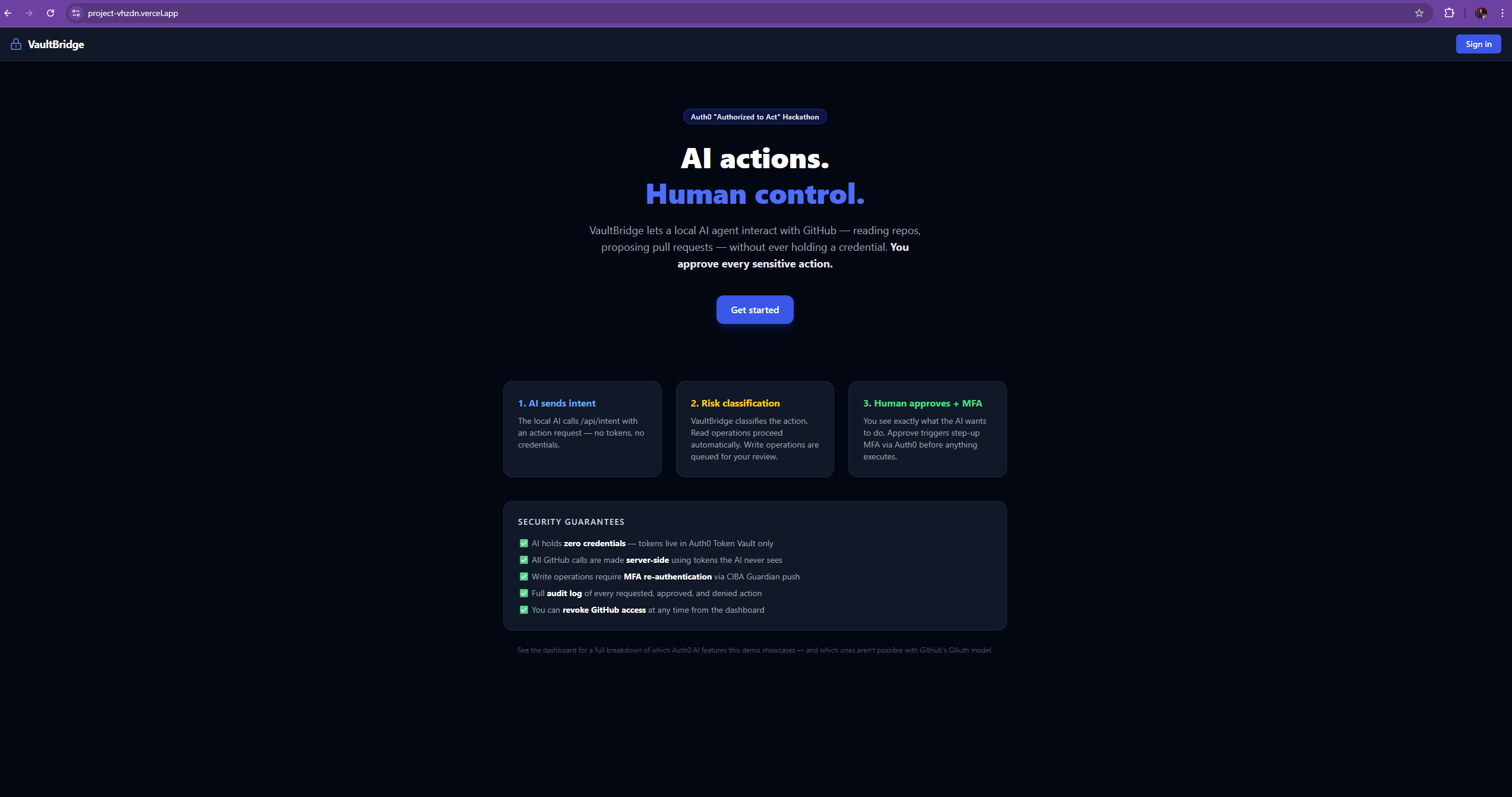
VaultBridge — AI Actions. Human Control.
Inspiration
AI agents are becoming increasingly powerful — from local models to browser-based automation.
However, connecting these agents to real user accounts remains unsafe.
Most current approaches rely on:
- Long-lived API keys
- Tokens stored in prompts or configuration files
- Secrets leaking into agent memory
This creates a fragile and insecure model.
We wanted to redefine this interaction:
The agent should be able to propose and execute actions, but never hold sensitive credentials.
The hackathon theme — Auth0 for AI Agents and Token Vault — aligned perfectly with this vision. Identity, consent, and token custody should live in a secure identity layer, not inside the agent runtime.
What it does
VaultBridge is a secure AI-to-GitHub gateway that enables agents to act on behalf of users without exposing credentials.
Flow overview:
- The user authenticates with Auth0
- GitHub is connected as a linked account
- When the agent needs to act:
- The application exchanges tokens through Auth0 Token Vault
- A short-lived GitHub access token is issued dynamically
- The application exchanges tokens through Auth0 Token Vault
- Execution depends on risk level:
- Read operations may proceed automatically
- Write operations require explicit user approval via step-up authentication (CIBA + MFA)
- Read operations may proceed automatically
Core principle
VaultBridge implements capability without custody:
The agent can perform actions, but:
- It never sees tokens
- It never stores credentials
- It cannot bypass user control
Auth0 acts as the secure intermediary between AI agents and external systems.
How we built it
The system was designed to be simple in structure, but secure by default.
Web application
Flask-based backend managing authentication, sessions, dashboard, and approval flowsAuthentication and identity
Auth0 with OpenID Connect and refresh token supportToken Vault integration
RFC 8693-style token exchange to obtain GitHub access tokens on demandConnected accounts
GitHub linked via Auth0 instead of acting as the primary identity providerStep-up authentication
CIBA-based approval flow for high-risk operationsAI layer
Groq and Gemini APIs used for planning and interactionDeployment
Serverless deployment on Vercel with Python runtime
Challenges we ran into
The main complexity was not in code, but in configuration and orchestration.
Auth0 configuration required precise alignment across:
- Token Vault enablement
- Refresh token support
- Connected accounts setup
- My Account API configuration
- Token Vault enablement
Debugging required tracing the full flow: login → connect GitHub → token exchange → API execution
OAuth-related errors were often non-obvious and required careful inspection
Accomplishments that we're proud of
Zero secrets in the agent path
No GitHub tokens, API keys, or credentials are ever exposed to the agent.
All sensitive operations are mediated through Auth0 Token Vault.
A real “authorized to act” model
The system enforces a clear policy:
- Read operations are seamless
- Write operations require explicit user approval
End-to-end working system
The project is fully functional:
- Auth0 authentication
- GitHub account connection
- AI-driven action proposals
- Secure execution through GitHub APIs
Transparent security experience
The system exposes:
- Consent flows
- Approval steps
- Error states
This improves trust and usability in real-world scenarios.
What we learned
Token Vault changes application architecture
Traditional models store secrets within the application.
In this approach:
- Auth0 manages identity and token custody
- The application performs controlled token exchanges
This significantly reduces risk.
Product constraints shape implementation
Key considerations included:
- Connected accounts versus primary login
- Scope and consent management
- Handling access denial and edge cases
These are critical to building a reliable system.
Visibility of policy builds trust
The system demonstrates different behaviors clearly:
- Read operations execute immediately
- Write operations require approval
This transparency makes the system intuitive and trustworthy.
What's next
VaultBridge can be extended in several directions.
Audit and persistence
- Store actions and approvals
- Build a verifiable audit trail of user decisions
Fine-grained policy control
- Repository-level permissions
- Action-level rules
- Dynamic risk classification
Additional integrations
Extend the same model to other platforms:
- Slack
- Jira
- Notion
Maintaining a single identity and token control layer.
Production hardening
- Rate limiting
- Session and CSRF protection
- Structured logging and monitoring
- CI/CD validation
Final thought
AI agents should not hold credentials.
They should operate based on permission:
- Scoped
- Time-bound
- Explicitly approved by the user
VaultBridge demonstrates how this model can be implemented in practice.
AI actions remain powerful, while control stays with the user.

Log in or sign up for Devpost to join the conversation.