-
-
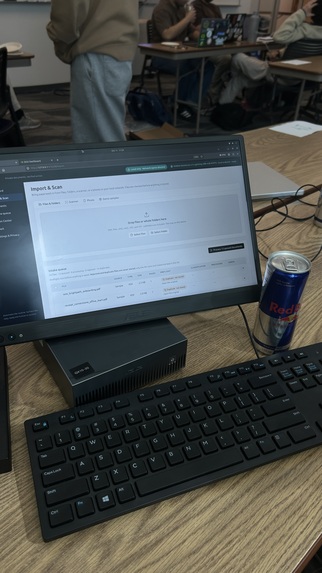
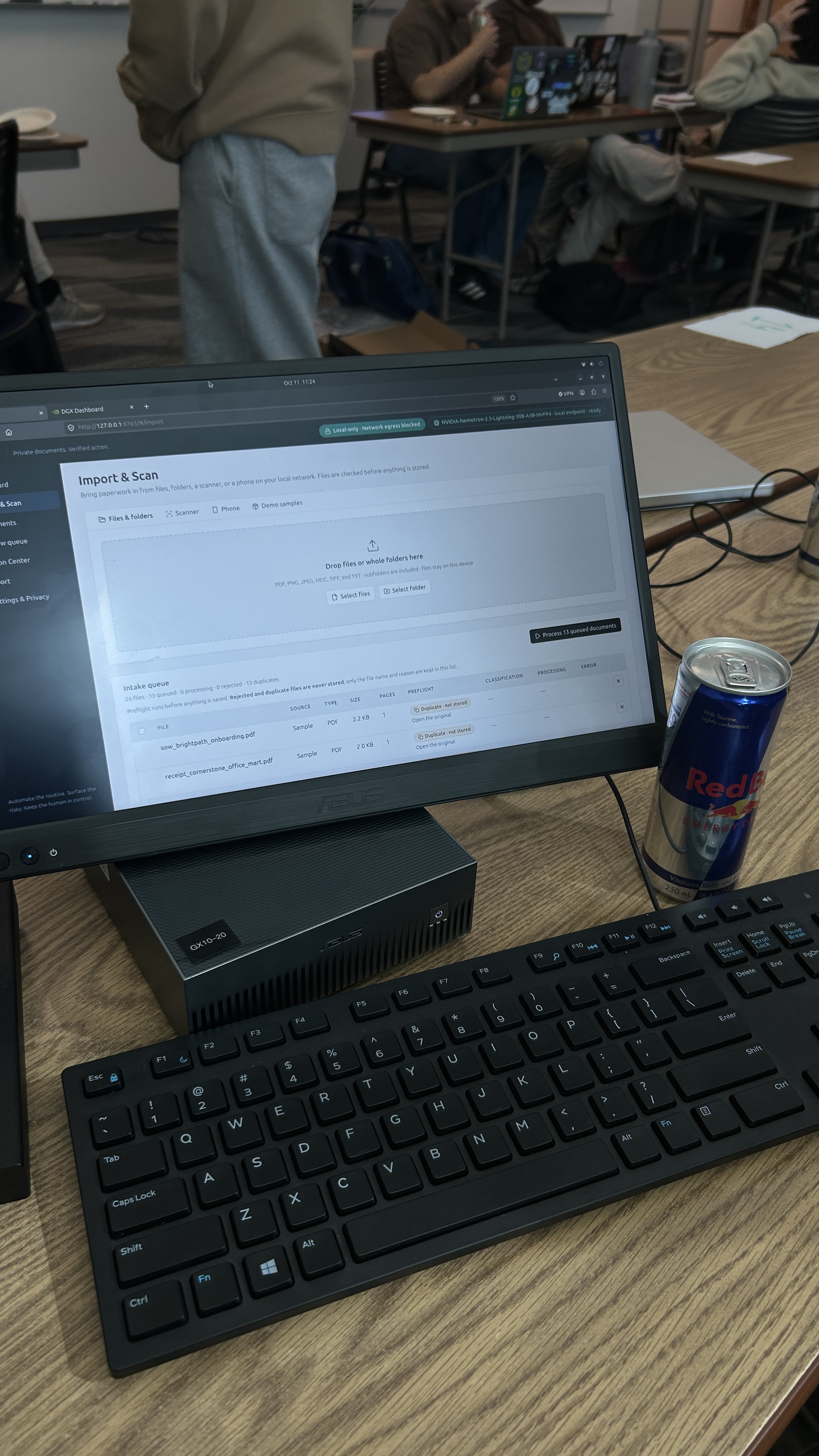
Picture of it running
Inspiration
My cousin’s family owns a convenience store. After closing, he would stay up from midnight to 9 AM manually entering check information into Excel. The process was slow, repetitive, and vulnerable to typos. We wanted to build something that could handle this work while protecting private business data. That idea became VaultAI: a local AI system that understands documents without sending them to the cloud.
What it does
VaultAI imports business documents such as checks, receipts, invoices, contracts, agreement letters, statements of work, policies, and scanned images. It extracts important fields, organizes documents in a file-explorer-style interface, identifies obligations and deadlines, and exports structured data to spreadsheets. Every important answer is tied back to evidence from the original document so employees can review how the AI reached its result.
How we built it
VaultAI runs locally on an NVIDIA GX10 using Nemotron served through vLLM. Documents are processed through sandboxed parsers and OCR before being passed to the local model. The system uses structured JSON responses, document-type-specific prompts, source line IDs, exact quotes, validation rules, confidence scoring, and human review. Unsupported or poorly grounded answers are rejected instead of being silently accepted.
Challenges we ran into
The biggest challenges were getting the model to return reliable structured data and preventing it from inventing information. We also had to handle scanned documents, OCR errors, rotated images, multi-page layouts, model reasoning fields, malformed JSON, unsupported deadlines, and citations that did not exactly match the source. Running the entire system locally on the GX10 also required careful configuration and testing.
Accomplishments that we’re proud of
We built a working end-to-end local document workflow that imports files, extracts information, displays evidence, supports review, and exports business data. On the GX10, VaultAI achieved:
- 100% field accuracy on clean text documents
- 98.69% field accuracy on stress-tested documents
- 94.12% field accuracy on OCR documents
- Zero rejected model outputs in the latest evaluation Most importantly, VaultAI is designed so the model suggests, the system validates, and a person makes the final decision. ## What we learned We learned that improving document AI is not only about using a larger model. Reliable results also depend on clean text preparation, document-specific prompts, strict schemas, source citations, grounding checks, and human review. We also learned that local AI can be practical for sensitive business workflows when the system is designed around privacy and measurable evaluation. ## What’s next for VaultAI Next, we want to improve OCR quality, support more document formats, add better table and handwriting recognition, and make spreadsheet exports more customizable. We also want to add correction-based evaluation so approved user edits can safely improve future extraction without exposing private documents or automatically changing the model.
Built With
- docker
- excel/csv
- json-schema
- local-sandboxed-document-parsers
- nemotron-3.5-lightning
- nvidia-gx10
- python
- react
- tesseract-ocr
- typescript
- vllm


Log in or sign up for Devpost to join the conversation.