Inspiration
In modern digital operations, data integrity is everything. Whether managing sensitive files, compliance logs, or critical assets, a single undetected modification or broken chain of custody can completely destroy the credibility of your records. We were inspired to build VaultBox to solve this exact vulnerability—creating a modern digital evidence locker that makes digital assets completely tamper-proof from the instant they are logged, without sacrificing user experience.
What it does
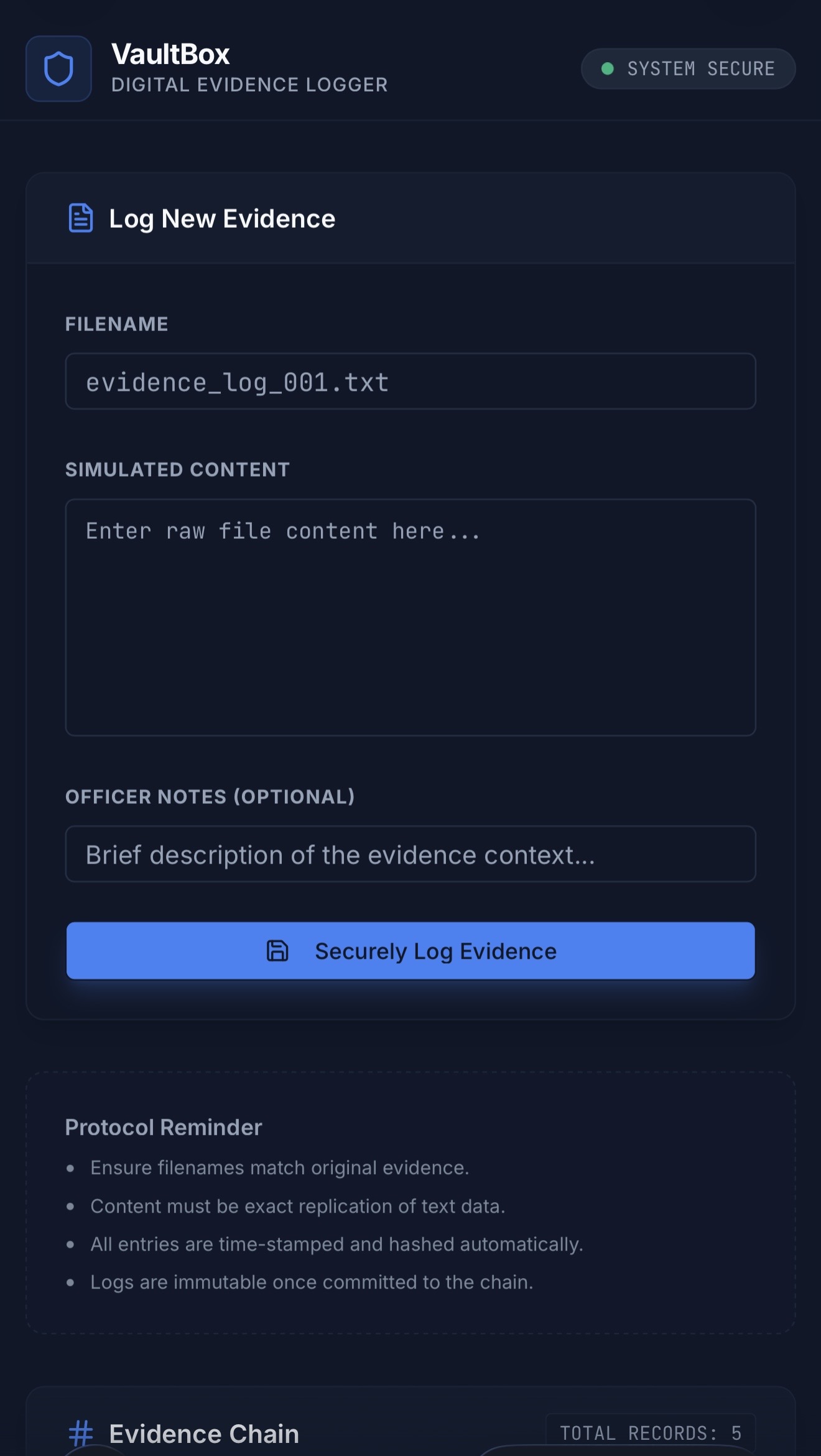
VaultBox is a high-performance digital evidence locker that provides tamper-proof asset logging, immutability verification, and real-time auditability. Secure Evidence Logging: Captures critical file details, custom metadata, and notes through a high-contrast, zero-friction dashboard. Server-Side SHA-256 Hashing: The moment evidence is submitted, the backend calculates an immutable 256-bit cryptographic fingerprint (\bm{H(m) = \text{SHA-256}(m)}) to guarantee data integrity. Persistent PostgreSQL Storage: Safely stores all evidence records, file hashes, and precise system timestamps in a relational database. Real-Time Audit Trail: Displays a live, chronological "Evidence Chain" table that lets investigators and administrators instantly verify hashes and track asset history without manual cross-referencing.
How we built it
VaultBox is a high-performance, full-stack digital evidence locker engineered to provide complete data integrity and real-time auditability without sacrificing user experience. Built using React, Node.js, and PostgreSQL, the platform allows users to input sensitive files, custom notes, and metadata through a sleek, high-contrast dashboard. Upon submission, the Node.js backend automatically processes the payload using server-side SHA-256 cryptographic hashing, locking the data with an immutable 256-bit mathematical fingerprint represented as \bm{H(m) = \text{SHA-256}(m)}. All logs, cryptographic hashes, and precise timestamps are then securely stored in a PostgreSQL database. The application renders this data in a live, chronological Evidence Chain dashboard, giving users instant, tamper-evident proof that their critical digital records have remained completely uncompromised.
Challenges we ran into
Our primary technical challenge was bridging the gap between strict cryptographic verification and a zero-friction user experience. We needed to execute server-side SHA-256 hashing and commit transactions to PostgreSQL near-instantly, ensuring the interface stayed responsive without blocking UI rendering or delaying live updates to the Evidence Chain. Managing complex full-stack data flow across React state synchronization, Node.js validation layers, and database calls required careful architectural design to keep the real-time audit dashboard smooth, fast, and completely reliable under load.
Accomplishments that we're proud of
Building VaultBox in my very first year of university has been an incredible milestone. I am incredibly proud of turning a complex security concept into a fully functional, battle-tested full-stack web prototype during this hackathon. Going beyond simple mockups to deliver a live, production-ready system—complete with seamless React UI interactions, server-side SHA-256 cryptographic hashing, and persistent PostgreSQL transactions—proved that high-security data integrity tools can be built fast, look modern, and work flawlessly in real-time.
What we learned
Through building VaultBox, we deepened our technical expertise in full-stack TypeScript development, asynchronous state synchronization, and practical data integrity design. As a first-year university student, this project was a hands-on masterclass in connecting React frontends with Node.js backends and PostgreSQL databases under tight deadlines. We learned how to seamlessly integrate server-side cryptographic verification into intuitive web workflows, proving that high-security tools can be modern, fast, and accessible without sacrificing data integrity.
What's next for Vault Box - Digital Evidence Locker
Looking ahead, the roadmap for VaultBox focuses on expanding from passive evidence logging to active, intelligent data verification. Automated AI Detection Integration: Our primary next milestone is building an native AI detection pipeline. Before evidence is committed to the database, incoming audio, images, and documents will be scanned by multimodal deepfake and generative media detection models. The system will flag synthetic alterations, compute a media authenticity confidence score, and attach a detailed forensic breakdown directly to the evidence entry. Granular Role-Based Access Controls (RBAC): We plan to implement multi-tenant permission layers, ensuring that field officers, evidence custodians, and forensic analysts have strictly scoped read/write access. Exportable Forensic Audit Bundles: We will introduce a one-click reporting engine that packages the complete evidence file, its SHA-256 hash certificate, AI detection analysis, and the PostgreSQL audit trail into a single, digitally signed PDF verification report.
Built With
- cryptography
- express.js
- gemini-api
- google-ai
- google-cloud
- javascript
- node.js
- postgresql
- react
- sha-256
- typescript

Log in or sign up for Devpost to join the conversation.