-
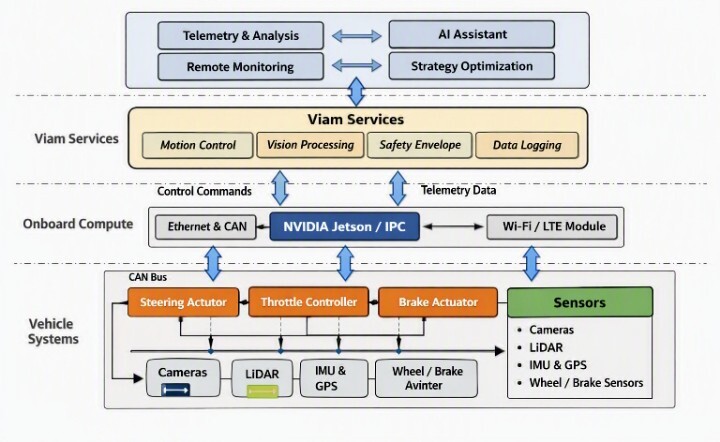
Viam solution
-
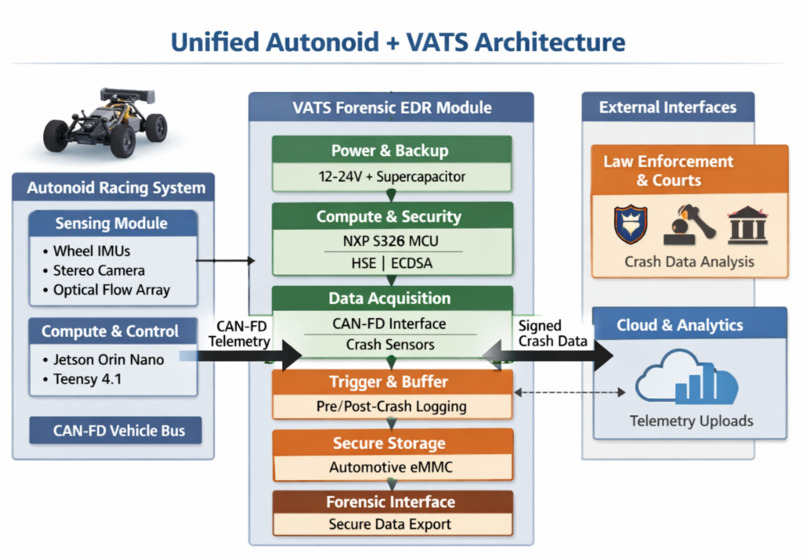
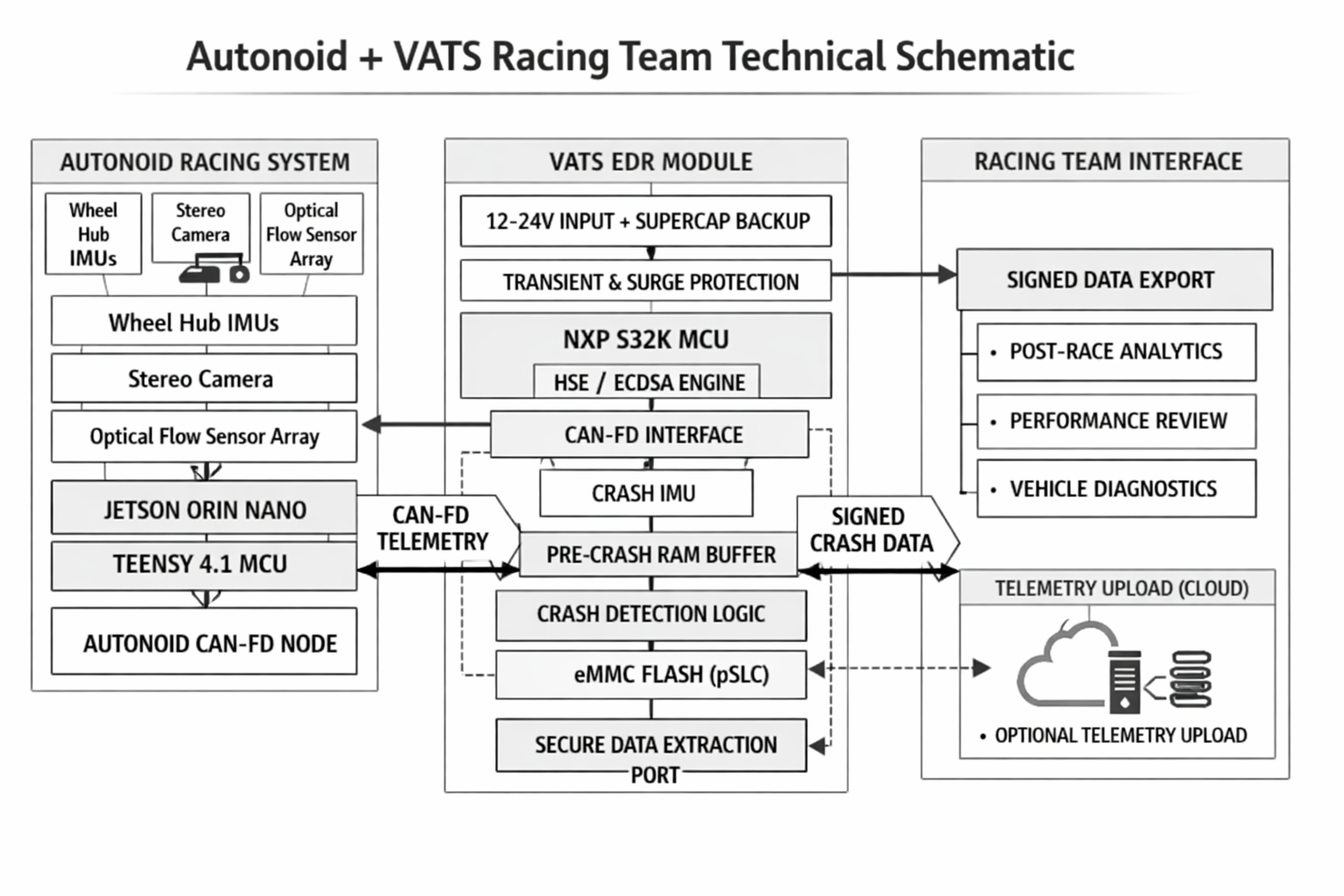
Unified Autonoid + VATS Architecture
-
VATS hardware
-
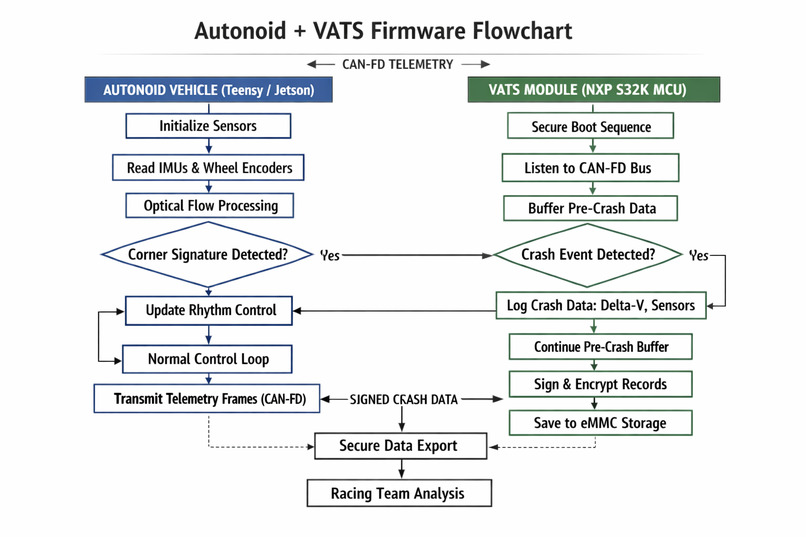
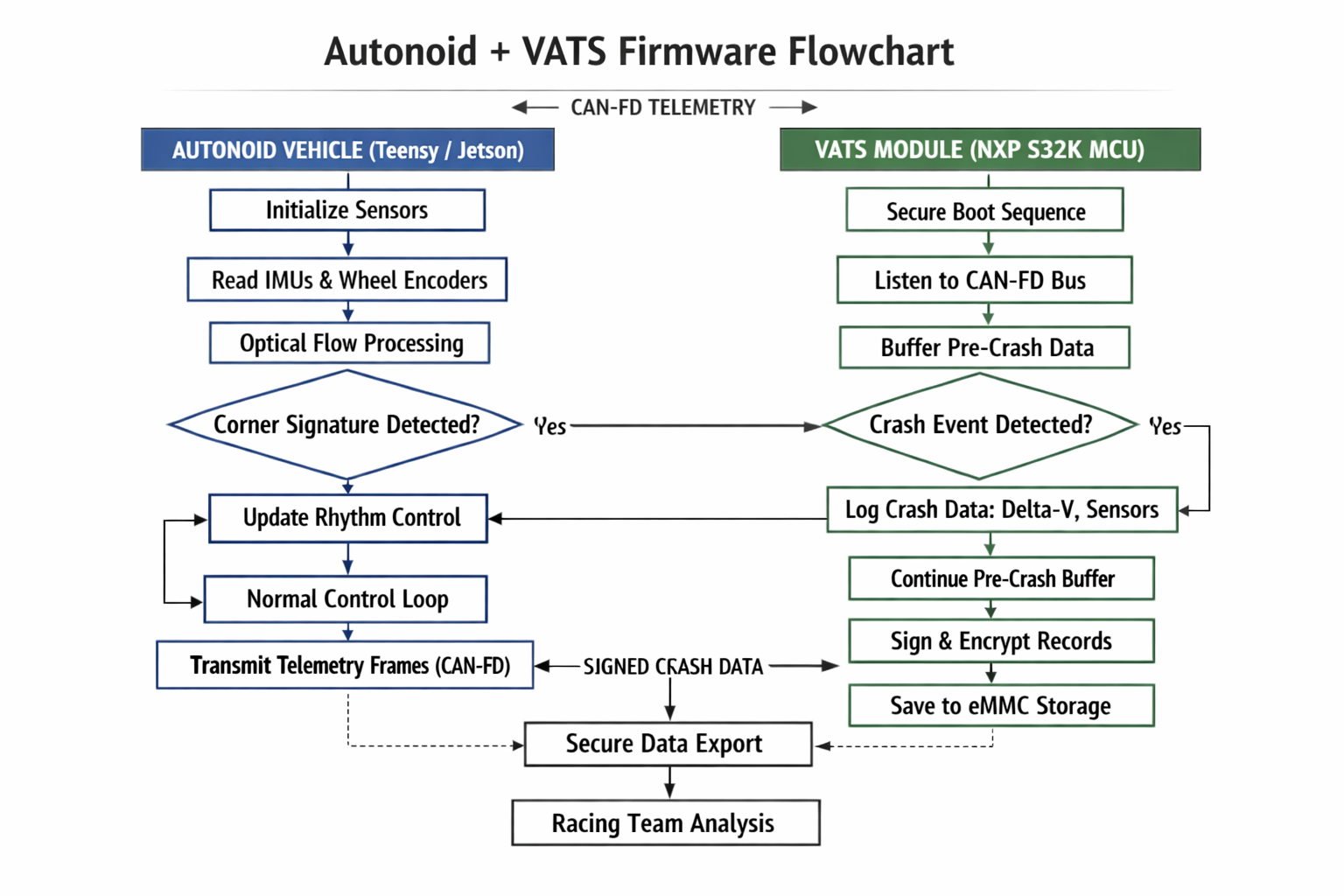
Firmware
-
Inspiration
Bridging Autonomous Racing with Human Mastery: Adapting core autonomous racing technology (Autonoid) into a human-driven sports car platform that augments driver skill rather than replacing it.
Eliminating the "Black Box" Problem: Solving the liability and data opacity of high-performance vehicles by embedding a forensic Event Data Recorder (VATS) that acts as an unalterable digital witness during extreme dynamic events.
Fusing Visceral Power with Legal Rigor: Combining a 960+ hp hybrid powertrain (0–60 mph in 2.8 seconds, 242 mph top speed) with strict regulatory compliance across US 49 CFR Part 563, UNECE R160/R169, and ISO 26262 functional safety standards.
What It Does
Human-in-the-Loop Co-Pilot: Translates autonomous perception into real-time driver coaching, providing active HUD warnings and haptic steering feedback based on the Corner Aggression Index and Consistency Score.
Proprioceptive Track Awareness: Uses wheel-hub IMUs, under-chassis optical flow arrays, and biometric cockpit sensors (1080p IR cameras, seat ECG/PPG) to measure localized surface friction, driver fatigue (PERCLOS), and chassis twist in real time.
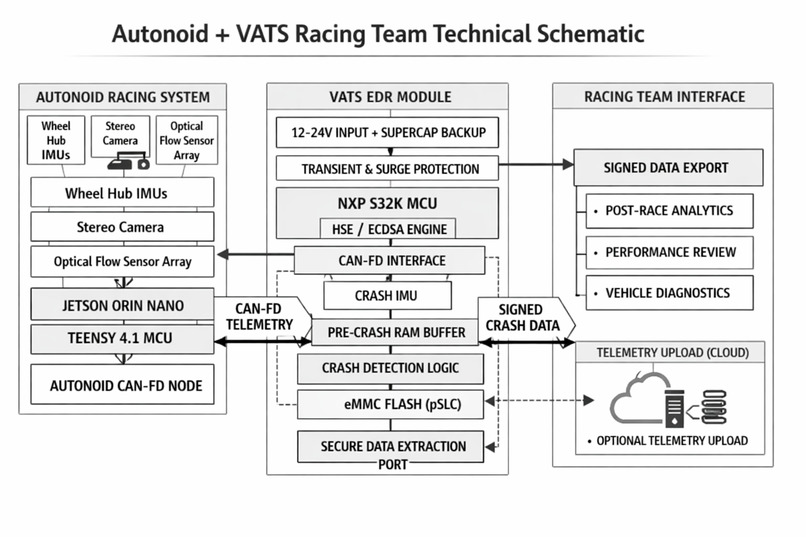
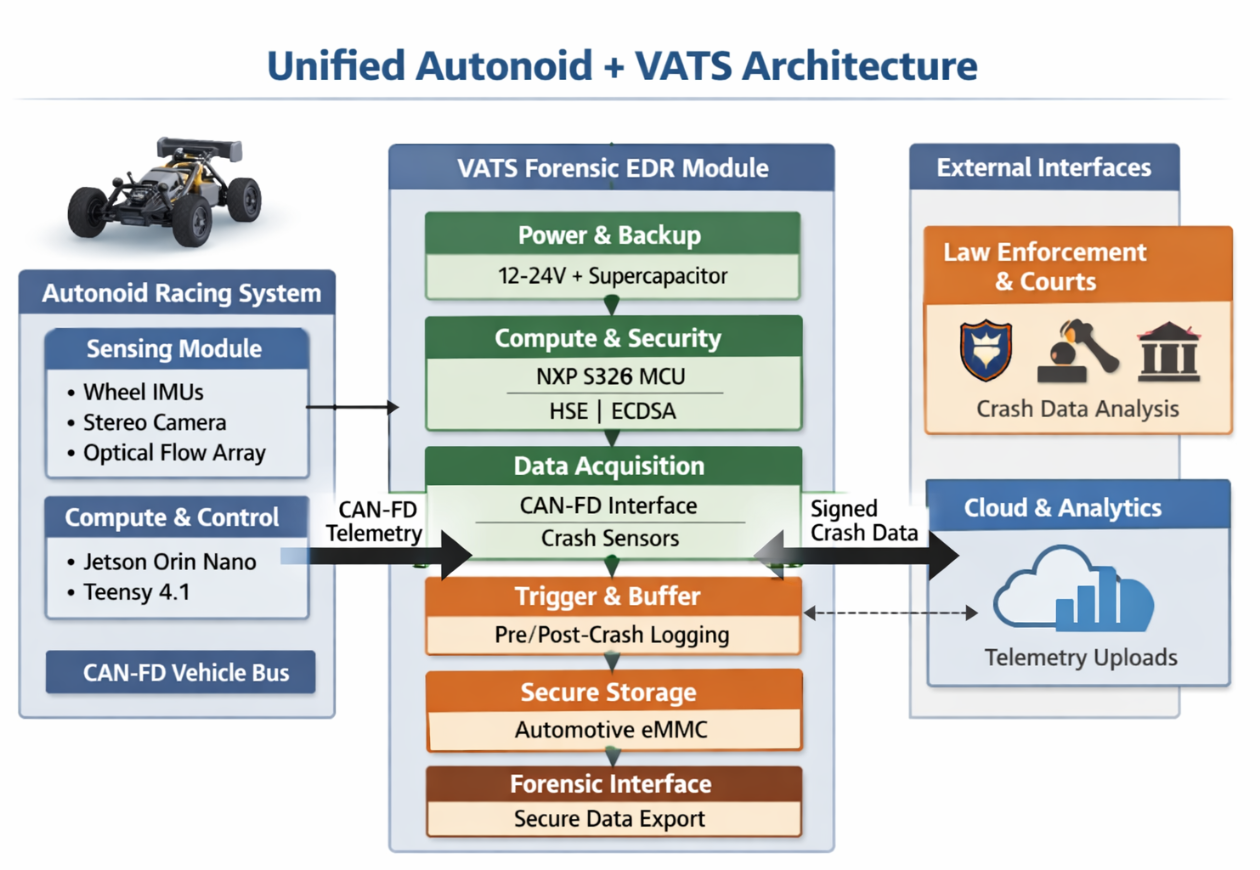
Cryptographic Forensic EDR (VATS): Continuously records a 20-second pre-crash CAN-FD telemetry buffer. Upon impact or crash trigger, an NXP S32K MCU with a Hardware Security Engine (HSE) signs the data using ECDSA encryption and saves it to pseudo-Single-Level Cell (pSLC) eMMC flash storage backed by supercapacitors.
3D AR Biomechanical Reconstruction: Generates a Signed Reconstruction Package (SRP) that cryptographically binds raw telemetry to the chassis 3D CAD mesh, allowing instant, court-admissible 3D AR replays with color-coded impact stress heatmaps.
How I Built It
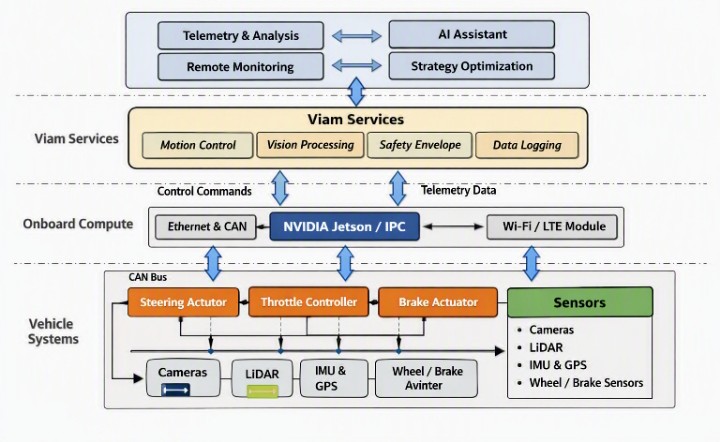
Bifurcated "Brain-Heart" Architecture: Separated high-level vision and heuristic track mapping on an NVIDIA Jetson Orin Nano ("Brain") from low-latency, deterministic PWM braking and safety execution on a Teensy 4.1 MCU ("Heart").
Clean-Sheet Space Frame: Designed a 4130 Chromoly steel space frame with centerline-intersecting nodes, incorporating a dedicated non-deformable central "VATS Vault Node" and a suspended compute spine.
Advanced Powertrain & Power Grid: Integrated a 4.2L twin-turbo V8 with a 250 kW MGU-K kinetic motor, a 15 kW MGU-H intake wind-turbine generator, an 800V silicon carbide inverter, and a 48V zone E/E architecture managed by semiconductor smart eFuses.
Hardened VATS Hardware Enclosure: Formed a power-fail resilient logging system utilizing an LT4363 active surge stopper, an LTC3350 supercapacitor controller, and a LittleFS copy-on-write (COW) filesystem to prevent file corruption during main battery disconnects.
Challenges I Ran Into
High-G Vibration & Sensor Distortion: High-frequency chassis harmonics distorted central IMU and vision readings during aggressive cornering. Solved by mounting compute nodes on alpha-gel vibration dampers and implementing an Error-State Extended Kalman Filter (ES-EKF) for sensor fusion.
Power-Loss Data Finalization: Main battery disconnection during crash impacts threatened to corrupt volatile write queues. Solved by sizing a 2-cell supercapacitor stack providing 5.0 seconds of backup hold time at 5.0 W to flush LittleFS metadata atomically.
Real-Time Cryptographic Speed vs. Admissibility: Executing ECDSA NIST P-256 signatures on 500 Hz telemetry streams without inducing control loop latency (<0.5 ms). Solved by offloading all cryptographic signing to the isolated NXP HSE secure enclave.
Accomplishments That I'm Proud Of
Sub-30 ms Biometric & Telemetry Sync: Achieved an end-to-end system latency of 28 ms between driver biometric state detection (heart rate/grip) and cockpit seat/torque curve adaptation.
Tamper-Proof SRP Data Binding: Successfully created a cryptographic binding algorithm that invalidates the digital signature if any coordinate or telemetry point in the 3D AR replay mesh is altered.
8.5% Real-World Drag Reduction: Validated an active exterior morphing system using Shape Memory Alloy (SMA) composite panels controlled by an onboard Genetic Algorithm in wind tunnel campaigns.
Full Regulatory Alignment: Met courtroom admissibility criteria under Federal Rule of Evidence 702 (Daubert Standard) and satisfied global EDR mandates.
What I Learned
Proprioception Outperforms SLAM in Extreme Dynamics: Sensing chassis state directly through wheel-hub IMUs and ground-speed optical flow provides far lower latency and higher reliability on unpredictable track surfaces than vision-heavy SLAM.
Deterministic Isolation Is Non-Negotiable: Decoupling the heuristic AI ("Brain") from the deterministic safety controller ("Heart") guarantees that an AI software freeze automatically triggers a safe physical stop via software watchdogs.
Forensics Requires Hardware-Enforced Root of Trust: Software-level logging cannot withstand legal scrutiny; legal admissibility requires non-exportable hardware keys, power-fail energy buffers, and copy-on-write filesystems.
What's Next for Sports Cars + VATS Forensic System
Phase-4 AI Rhythm Tuning: Fine-tuning the Corner Aggression Index and Consistency Score during closed-circuit track trials while validating telemetry export under extreme lateral G-loads.
Neural Load & Bioadaptive Multi-Fuel Integration: Expanding the bioadaptive combustion control module to synthetic and hydrogen fuels while integrating EEG driver headwear for predictive load estimation.
Commercial Law Enforcement & Insurance SaaS: Scaling the CJIS-compliant police-sync interface and cloud telemetry API to partner with auto insurance carriers for automated, court-ready claim processing
Built With
- development
- firmware
- github
- product
- production
- vibe

Log in or sign up for Devpost to join the conversation.