-
-
IDEA!

Inspiration
The idea for VasudhaNagaraAI came from my observations of everyday problems in cities I have lived in. Overflowing garbage bins, traffic jams that waste fuel, unpredictable water shortages, and poor air quality are issues I have personally experienced. I realized that while cities have smart devices and sensors, they often operate in isolation. Traffic data rarely influences air quality alerts, and energy optimization hardly ever considers waste management. I was inspired by the thought: what if all these systems could communicate with each other through AI? If AI agents could share their data and take coordinated actions, we could create cities that are not only smart but also truly sustainable. I believe that small improvements in multiple areas including waste, traffic, water, air, and energy can collectively lead to significant reductions in carbon emissions, better public health, and a higher quality of life. This hackathon provided the perfect opportunity for me to experiment with this idea and develop a working prototype that simulates how such a system could function in real cities.
What it does
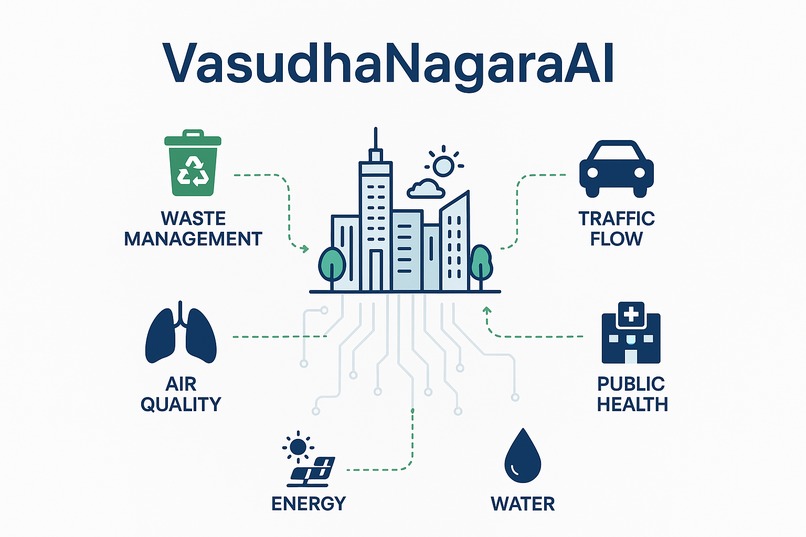
VasudhaNagaraAI is a modular, AI-powered city management system where multiple specialized AI agents work together to make cities cleaner, greener, and more efficient. Each agent focuses on a specific sustainability area—E-Waste Management, Clean Energy Optimization, Smart Water Management, Traffic Flow Prediction, Air Quality Monitoring, Public Health Monitoring, and Waste Collection Optimization. The system takes real-time or user-provided data as input, processes it through AI models, and generates actionable insights. For example, it can estimate the carbon footprint of discarded electronics, recommend nearby recycling centers, optimize solar energy usage with EV battery storage, detect water leaks, predict traffic congestion, send health advisories based on pollution levels, and even plan garbage collection routes more efficiently. All agents share their data so decisions are made in a coordinated way—for instance, traffic reroutes consider air quality data, and water conservation measures factor in public health alerts. The final goal is to help city administrators and citizens take quick, data-driven actions that improve sustainability, reduce emissions, and enhance urban living.## How we built it I built VasudhaNagaraAI using Python, Pandas, NumPy, Matplotlib, Seaborn, Streamlit, and Jupyter Notebook. I used Kaggle for dataset hosting and exploration, GitHub for version control, and integrated CSV datasets, REST APIs, and simulated IoT data streams to test the system.
Challenges we ran into
While building this project, I encountered several challenges. One of the main difficulties was sourcing accurate, real-time datasets for all the different modules, especially for municipal-level data such as live traffic feeds, localized air quality readings, and water usage statistics. In many cases, I had to rely on open datasets or simulated data to approximate real-world conditions. Another challenge was designing a system architecture that could integrate multiple independent AI agents while still allowing them to share data efficiently. Balancing real-time processing needs with limited computational resources required careful planning and optimization. Additionally, ensuring that the solution remained simple enough for cities with minimal technological infrastructure, yet advanced enough to provide meaningful insights, was a constant design consideration. Finally, coordinating all these modules into a smooth, interactive interface within the limited timeframe of the hackathon tested my time management and problem-solving skills.
Accomplishments that we're proud of
I am proud to have developed a modular and scalable AI system capable of addressing multiple smart city challenges within a single unified platform. Within the limited timeframe of the hackathon, I successfully built functional prototypes for several specialized agents, including E-Waste, Energy, Water, Traffic, Air Quality, Public Health, and Waste Management. One key achievement was the integration of both real-time and simulated datasets, enabling effective testing of the system even in the absence of complete live municipal data. This adaptability ensures that the solution can be implemented in cities with varying levels of technological infrastructure. I am also proud that the project contributes meaningfully to environmental sustainability and public health improvement. By combining AI-driven decision-making with an intuitive and interactive interface, I was able to simplify complex urban management tasks and make them more actionable. Furthermore, the modular architecture ensures that the system can expand and adapt to address future urban challenges, making it both practical and future-ready.
What we learned
I learned how powerful AI can be when different systems work together instead of separately. I explored how to connect multiple AI agents so they can share data and improve decision-making across areas like waste management, energy, water, traffic, and air quality. I also gained a deeper understanding of sustainability, especially how small efficiency improvements across multiple city systems can significantly reduce carbon emissions and environmental impact. This project strengthened my skills in data analysis, real-time input handling, and building interactive visualizations, while also reinforcing the importance of designing solutions that are practical, scalable, and environmentally responsible.
What's next for VasudhaNagaraAI
The next step for VasudhaNagaraAI is to move beyond simulations and test it with real-world municipal datasets. I plan to integrate live IoT sensor feeds from waste bins, traffic cameras, air quality monitors, and solar energy systems to evaluate the system’s performance in real-time. Expanding the platform to include predictive maintenance for city infrastructure, EV charging optimization, and flood or drought prediction is also a priority. I aim to collaborate with local authorities and sustainability organizations to pilot the solution in a small urban area, gathering feedback to refine the AI agents. Ultimately, I envision VasudhaNagaraAI evolving into an open, modular platform that cities worldwide can adopt to reduce emissions, conserve resources, and improve quality of life for their residents.