-
-
VASTX
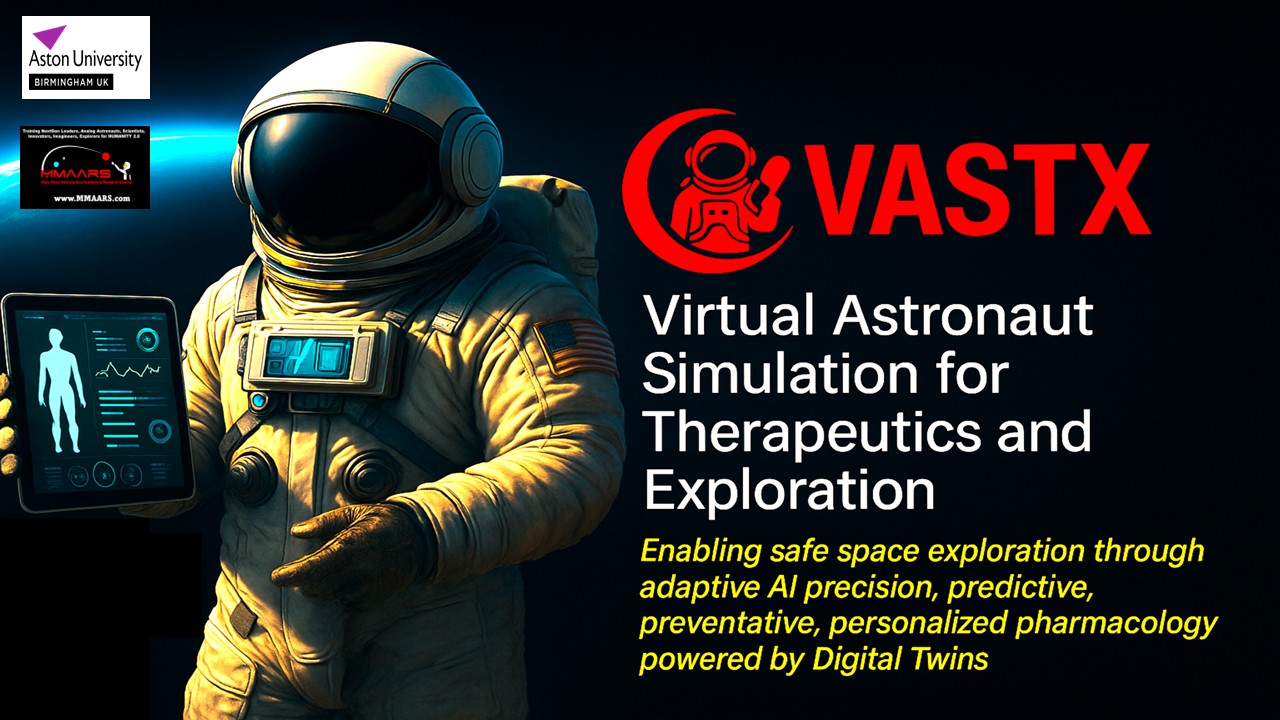
WHAT IS VASTX? An AI-Powered Digital Twin in Personalized, Precision, Predictive, Preventive Pharmacokinetics System
ABOUT: VASTX (Virtual Astronaut Simulator for Therapeutics and Exploration) is an AI-enabled digital twin platform that models human physiology and drug behavior in microgravity and extreme environments. It integrates physiologically based pharmacokinetic (PBPK) modeling, wearable biosensor data, and machine learning to simulate how medications behave in spaceflight conditions. VASTX addresses a critical gap: there is currently no validated AI-enabled system for predicting drug efficacy, safety, and dosing in space or analog astronaut missions.
PROBLEM: Human physiology changes significantly in space and extreme environments (I.C.E. – Isolated, Confined, Extreme), including:
- Altered drug absorption, distribution, metabolism, and excretion (ADME)
- Fluid shifts and cardiovascular changes
- Bone density loss and immune dysregulation
- Cognitive and behavioral stress under isolation
CURRENTLY:
- Drug dosing in space is largely extrapolated from Earth-based data
- There is no real-time adaptive pharmacology system This creates serious safety risks for astronauts and remote populations
SOLUTION: VASTX creates a personalized digital twin of each astronaut (or participant) to:
- Simulate drug behavior under microgravity and extreme conditions
- Provide AI-assisted dosing recommendations
- Integrate real-time wearable biosensor data
- Enable predictive modeling of physiological changes
- Support clinical decision-making in remote or autonomous environments
This transforms healthcare from reactive → predictive → precision-based.
HOW WE BUILT IT: The VASTX system integrates:
Physiological-Based Pharmacokinetics (PBPK) Modeling Engine
- Simulates drug kinetics across organ systems
- Models microgravity-induced physiological changes
AI/ML Layer:
- Predictive models for dosing optimization
- Classification models for risk escalation
- Human-in-the-loop safety governance
Digital Twin Architecture
- Individualized physiological profiles
- Adaptive updates based on real-time data
Wearable Integration
- Biometrics (HRV, sleep, stress, activity)
- Planned integration with DBS (dried blood spot) sampling
Analog Mission Validation
- Virtual analog astronaut cohorts (N≈45)
- Planned in-person missions (Mojave Desert, underwater habitats)
TECHNOLOGIES USED:
- Python
- Machine Learning (classification + predictive models)
- Physiologically Based Pharmacokinetics (PBPK)
- Digital Twin Modeling
- Wearable Biosensor Integration
- Data Pipelines (CSV-based evaluation + simulation outputs)
- Human-in-the-loop AI governance frameworks
BUILT WITH: Languages & Core Development: Python SQL
Machine Learning & AI: Scikit-learn TensorFlow / PyTorch (for predictive modeling) SHAP (SHapley Additive exPlanations) for model interpretability
Modeling & Simulation: Physiologically Based Pharmacokinetic (PBPK) modeling frameworks Custom simulation pipelines for ADME modeling Digital Twin architecture for human physiological systems
Data Processing & Analysis: Pandas NumPy CSV-based structured data pipelines
Visualization & Prototyping: Matplotlib / Plotly Jupyter Notebooks
Wearables & Biometric Integration (Planned + In Progress)" Hexoskin Smart Garments Garmin / Apple HealthKit (integration layer) Dried Blood Spot (DBS) sampling workflows
Infrastructure & Platforms: GitHub (version control and collaboration) Cloud (AWS / Google Cloud – scalable compute and storage) Local/offline-first deployment for isolated environments (LAN-based systems)
AI Governance & Safety Layer: Human-in-the-loop decision architecture Rule-based escalation systems (monitor → guide → escalate) Multi-agent system integration (KIRK, EVE, SpaceGuardianGPT)
INNOVATION: VASTX is the first integrated system combining:
- AI + PBPK modeling
- Digital twins for space pharmacology
- Real-time physiological adaptation
- Analog astronaut validation environments It moves beyond static models to adaptive, personalized, mission-ready healthcare systems.
IMPACT: VASTX has dual-use applications: A. Space
- Astronaut safety in long-duration missions
- Lunar and Mars habitat healthcare
- Autonomous medical systems for deep space B. Earth
- Remote and austere healthcare (military, disaster zones)
- Precision medicine for underserved populations
- Telemedicine and AI-assisted clinical decision systems
ACCOMPLISHMENTS:
- Developed a working simulation framework for AI-driven PBPK modeling
- Validated system behavior with virtual analog astronaut cohorts
- Accepted to major conferences (AIAA ASCEND, Aerospace Medical Association)
- Winner of the Humans In Space (HIS) Challenge (AI accelerator track) - Boryung,
- Built a cross-disciplinary team spanning AI, medicine, and space science
CHALLENGES:
- Lack of real microgravity pharmacokinetic datasets
- Integrating biological models with AI systems
- Ensuring safety and governance in AI decision-making
- Designing systems for low-resource, disconnected environments
WE ADDRESSED CHALLENGES THROUGH:
- Analog mission environments
- Human-in-the-loop governance models
- Incremental validation strategy
WHAT WE LEARNED:
- AI in healthcare must be governed, explainable, and human-centered
- Analog environments are essential for validating space systems
- Cross-disciplinary integration is both the biggest challenge and strength
- Safety-first design is critical for life-and-death applications
WHAT NEXT:
- In-person analog astronaut mission validation (2026)
- Integration with DBS-based pharmacokinetic sampling
- Expansion of drug libraries beyond model compounds (e.g., acetaminophen)
- Deployment in underwater and high-fidelity I.C.E. environments
- Scaling toward clinical and spaceflight applications## Inspiration website: www.VASTX.space GitHub: https://github.com/Drjewellmd Youtube: https://youtu.be/y3eGw3Ic4Nw

Log in or sign up for Devpost to join the conversation.