Inspiration
Financial fraud involving mule accounts continues to be a major challenge for financial institutions. Most existing systems rely heavily on predefined rules, making them ineffective against evolving fraud patterns. We wanted to create a solution that could proactively identify suspicious behavior by leveraging machine learning and behavioral analysis rather than relying solely on static thresholds.
The goal was to build a platform capable of uncovering hidden relationships between accounts, providing meaningful risk insights, and helping organizations act before fraud causes significant damage.
What it does
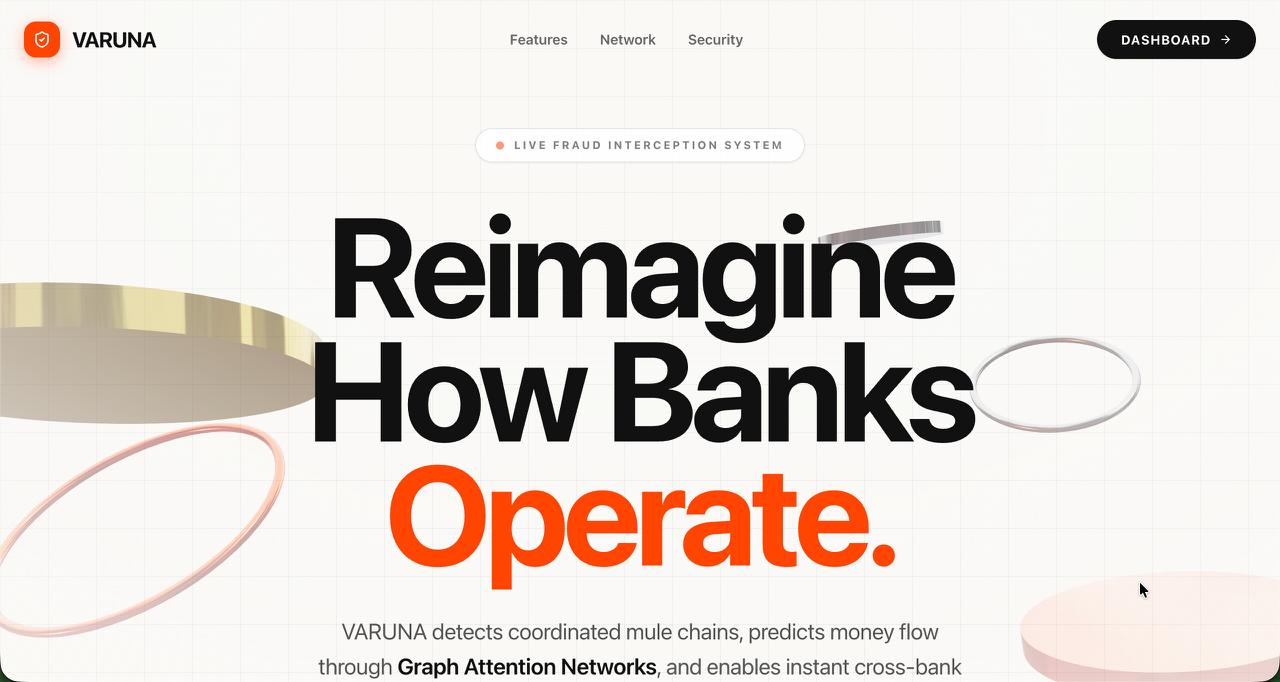
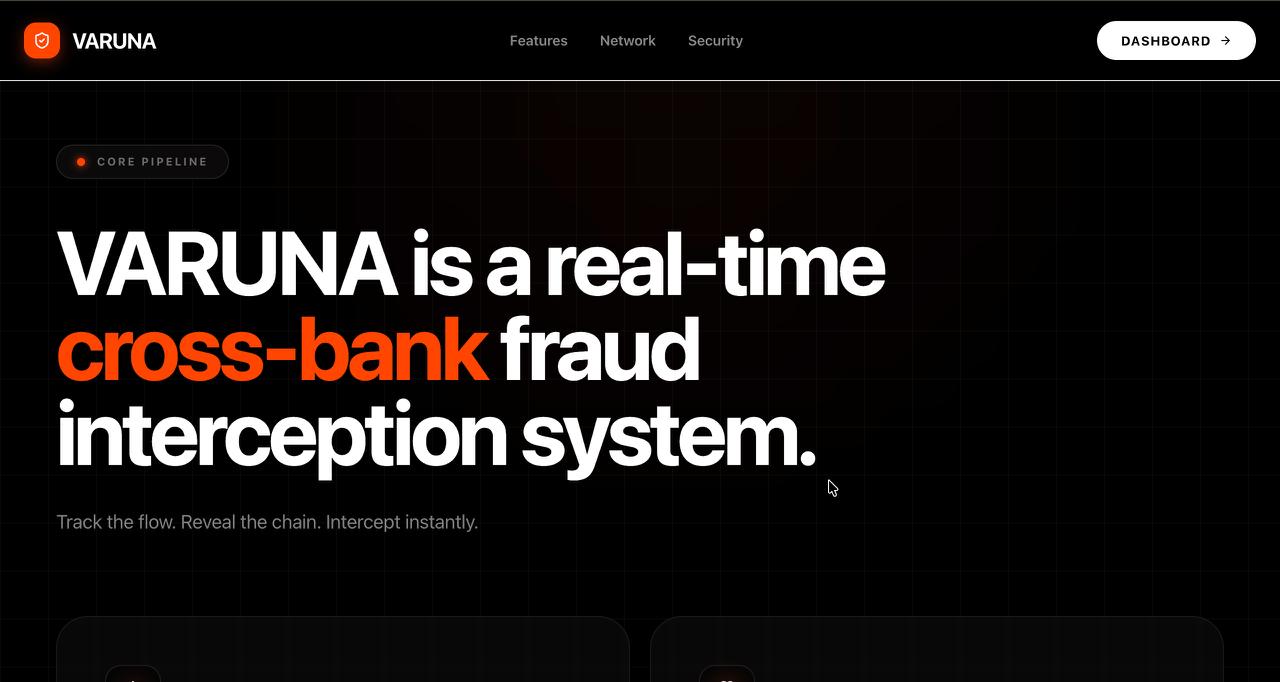
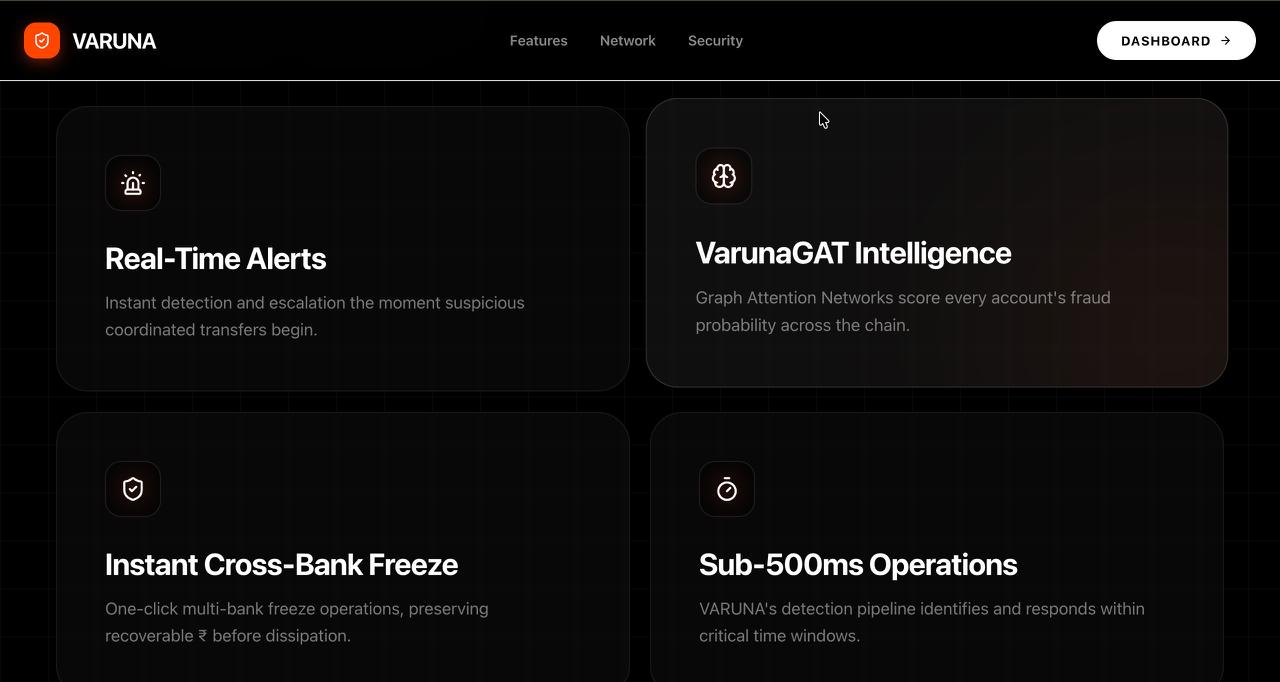
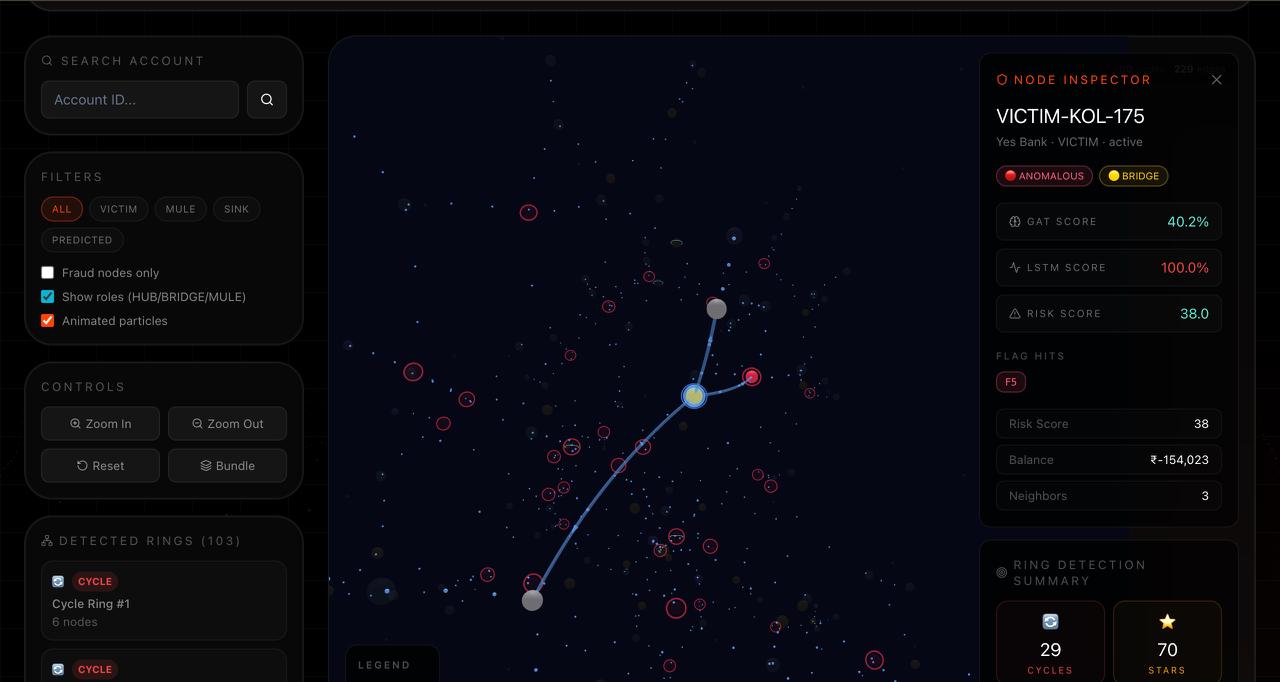
VARUNA is an AI-powered fraud detection platform that identifies potentially fraudulent and mule accounts in real time. The system analyzes transaction behavior, account interactions, and risk indicators to uncover suspicious activity and hidden fraud networks.
The platform provides an intuitive dashboard where users can monitor risk scores, investigate flagged accounts, and visualize suspicious patterns, making fraud detection more accessible and actionable.
How we built it
VARUNA was developed as a full-stack application using React.js and Tailwind CSS for the frontend, Node.js and Express.js for backend services, and Python with scikit-learn, Pandas, and NumPy for the machine learning pipeline.
A significant portion of the project involved developing and integrating the machine learning model. The model was trained to identify suspicious patterns and then connected to the backend APIs so that predictions could be delivered seamlessly to the frontend dashboard.
On the frontend side, we used Framer assets to create a modern and engaging user experience that could effectively communicate complex fraud insights through intuitive visualizations.
Version control and collaboration were managed through Git and GitHub, with deployment handled through Netlify. Throughout development, I took ownership of a large part of the ML integration process, frontend refinement, and resolving complex merge conflicts to ensure smooth collaboration and stable releases.
Challenges we ran into
One of the biggest challenges was integrating independently developed components into a single stable product. As multiple features were being built simultaneously, merge conflicts became frequent and sometimes complex. Resolving these conflicts while maintaining stability required careful coordination and testing.
Another challenge was ensuring that machine learning outputs translated into meaningful and actionable insights. Training a model is only part of the process; making those predictions understandable and useful within the application required significant refinement and integration work.
Balancing technical complexity with user experience was also challenging, as we wanted the platform to remain accessible even when presenting advanced fraud detection insights.
Accomplishments that we're proud of
We successfully developed an end-to-end fraud detection platform that combines machine learning, backend services, and an interactive frontend experience into a cohesive product.
We are particularly proud of creating a system that not only detects suspicious activity but also presents insights in a clear and actionable manner. The project stood out for its technical depth, practical relevance, and polished execution in a competitive environment.
We also successfully integrated machine learning, backend services, and frontend visualization into a seamless workflow while maintaining a stable codebase throughout development.
What we learned
Through VARUNA, we gained hands-on experience in machine learning deployment, full-stack development, API integration, collaborative software engineering, and project management.
We learned the importance of maintaining clean development workflows, resolving integration issues efficiently, and designing systems that balance technical sophistication with usability.
The project also strengthened our understanding of how machine learning can be applied to solve real-world financial security challenges and reinforced the importance of teamwork when building complex systems.
What's next for VARUNA
We plan to enhance VARUNA by incorporating larger datasets, more advanced anomaly detection techniques, and graph-based network analysis for identifying sophisticated fraud rings.
Future iterations will focus on real-time transaction monitoring, improved explainability of model decisions, stronger scalability, and deeper analytics capabilities to help institutions investigate fraud more effectively.
Ultimately, we aim to evolve VARUNA into a comprehensive fraud intelligence platform capable of supporting real-world financial ecosystems at scale.
Built With
- express.js
- framer-motion
- git
- github
- node.js
- numpy
- pandas
- python
- react.js
- rest-apis
- scikit-learn
- tailwind-css

Log in or sign up for Devpost to join the conversation.