Inspiration
Management decisions are hard: no one can play out a company's future in their head. Hire five engineers, raise prices, outsource delivery, reserve GPU capacity: each choice ripples through cash, clients and people for months, and real risks interact (a vendor raises prices in the same quarter that a key engineer leaves and a big client gives notice). Weighing that takes rare intuition or a team of business analysts. So leaders often fall back on one simple criterion: they underestimate the risks and miss the winning move at the right moment. When a decision can cost your company $1M, spending $1,000 to test it first is an easy call.
The demand is real. Businesses bring these requests to our team members:
- challenge key management decisions before they are made;
- run a what-if simulation of a key decision.
We are inspired by ideas from reinforcement learning and robotics:
- AlphaZero: what is your next move? Look many moves ahead, then pick the best direction.
- World Models (Ha & Schmidhuber, 2018): learn a model of the environment, then plan inside it.
- Motion planning for delivery robots: sample many trajectories, score them, take the safe one.
- Monte Carlo in quantitative finance: risk is a distribution, not a number.
The missing piece was a world model that already knows how businesses work. Large language models are that world model. They carry general knowledge about companies, markets and people. Shown a company's own records few-shot, they extract its specific habits.
TL;DR
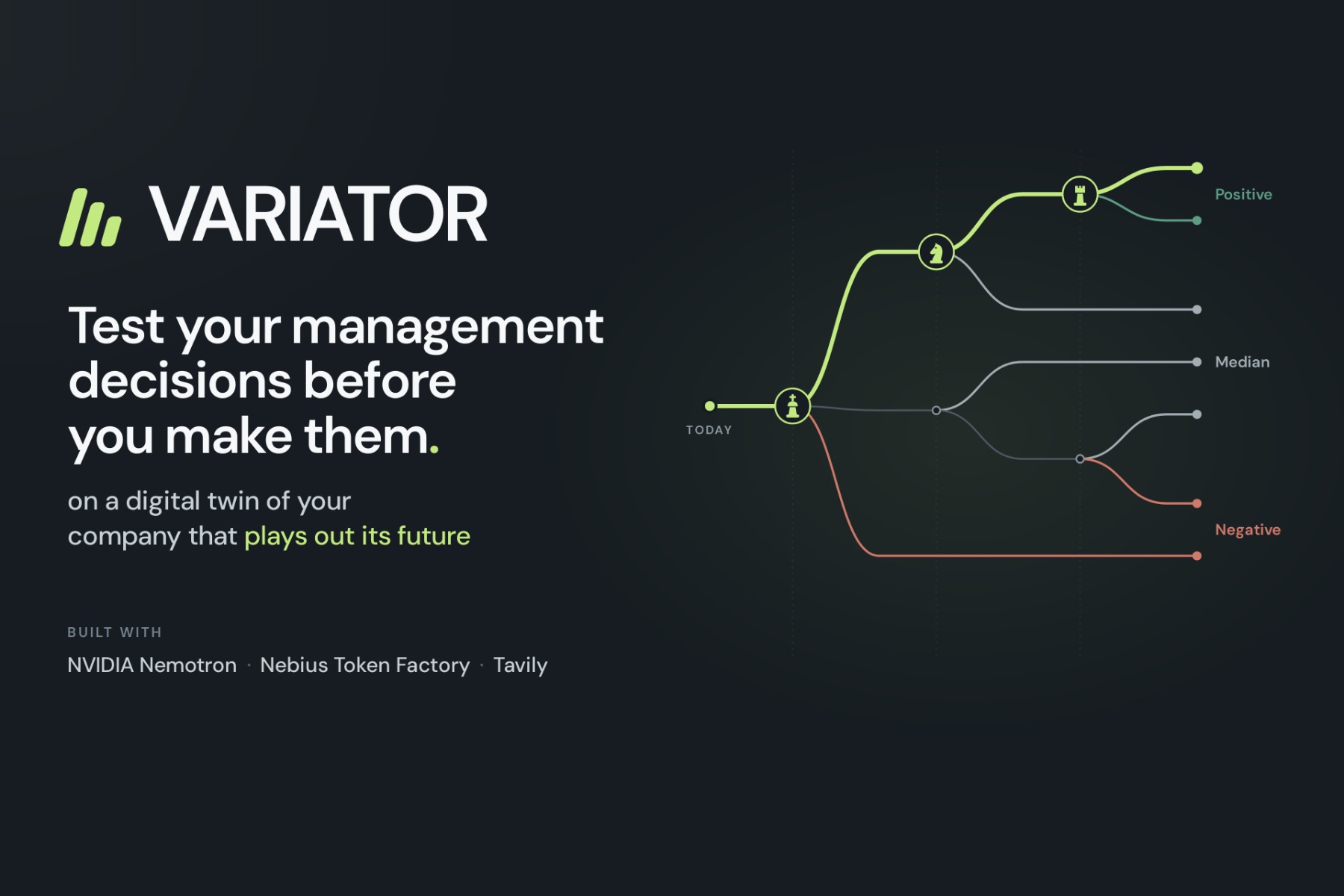
- Test your management decisions before you make them. Variator is a digital twin of a company. It answers "what happens if we do X?" with thousands of simulated futures, not one forecast: like a chess engine, it looks many moves ahead before it picks a move.
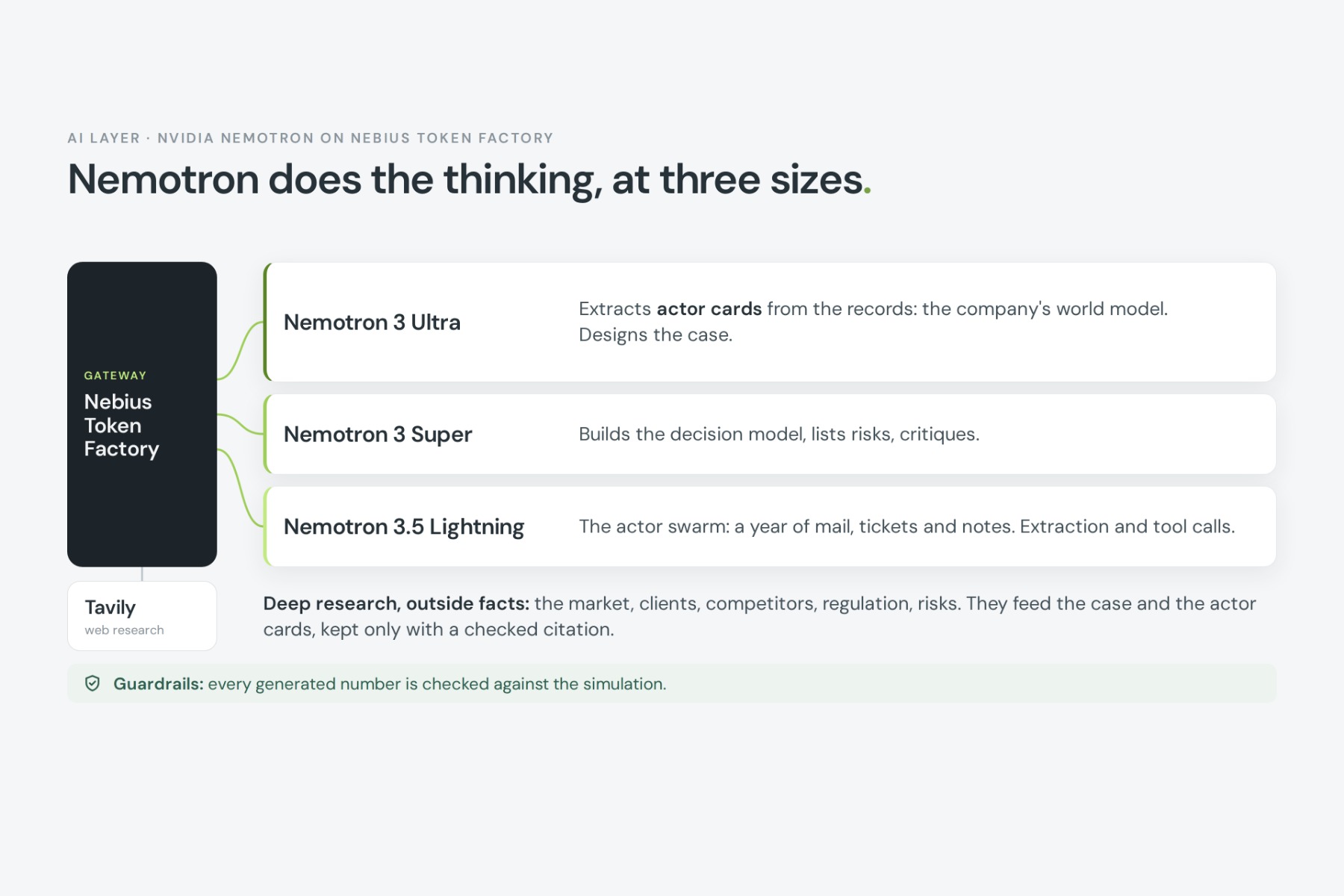
- NVIDIA Nemotron on Nebius Token Factory builds the model of the business.
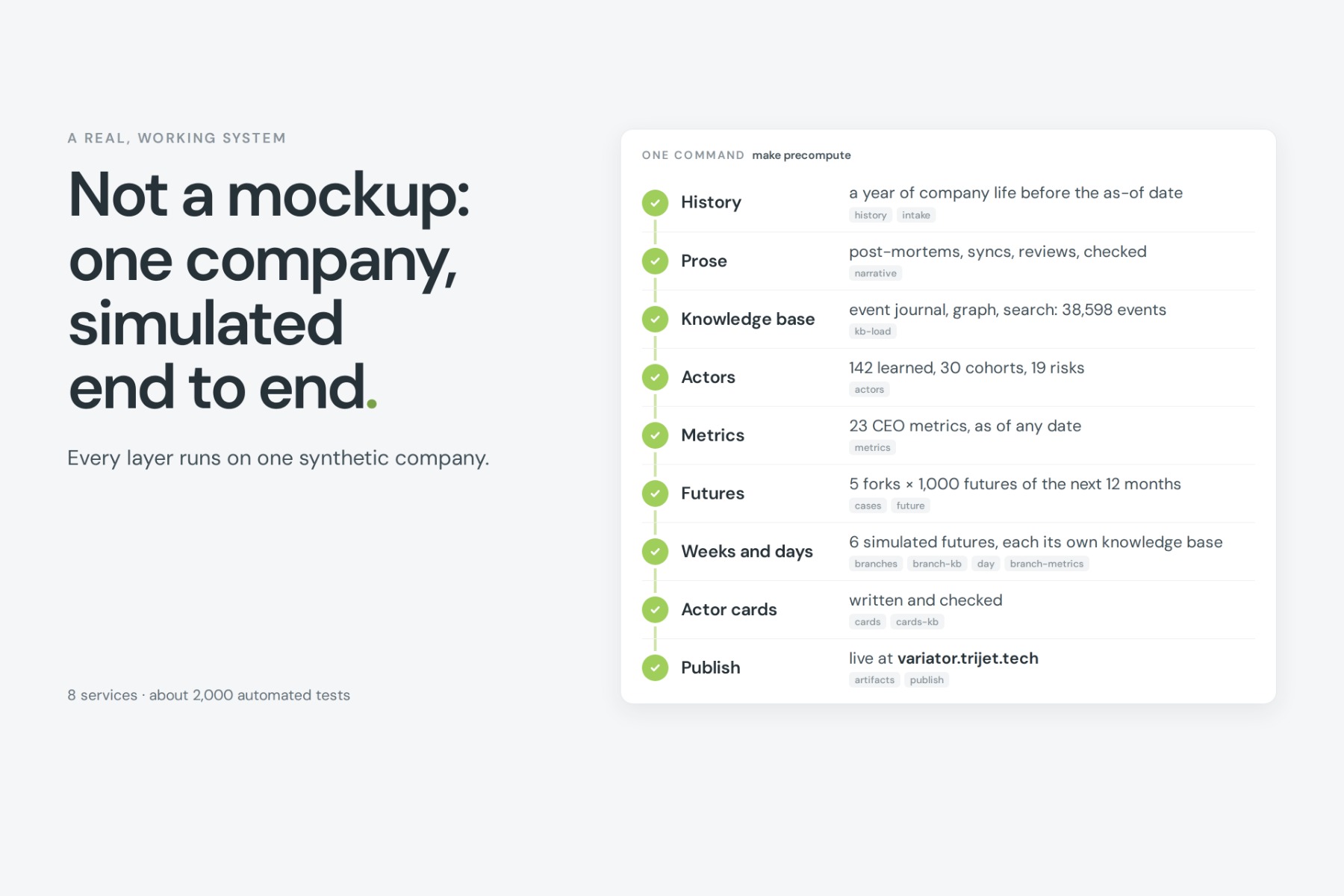
- It reads the company's whole history and extracts actor cards: how the business, its people, clients and vendors behave. Together the cards serve as the world model.
- It drives a swarm of agents that write the company's daily life.
- Tavily deep research brings the outside facts: the domain, the clients, regulation, typical failures.
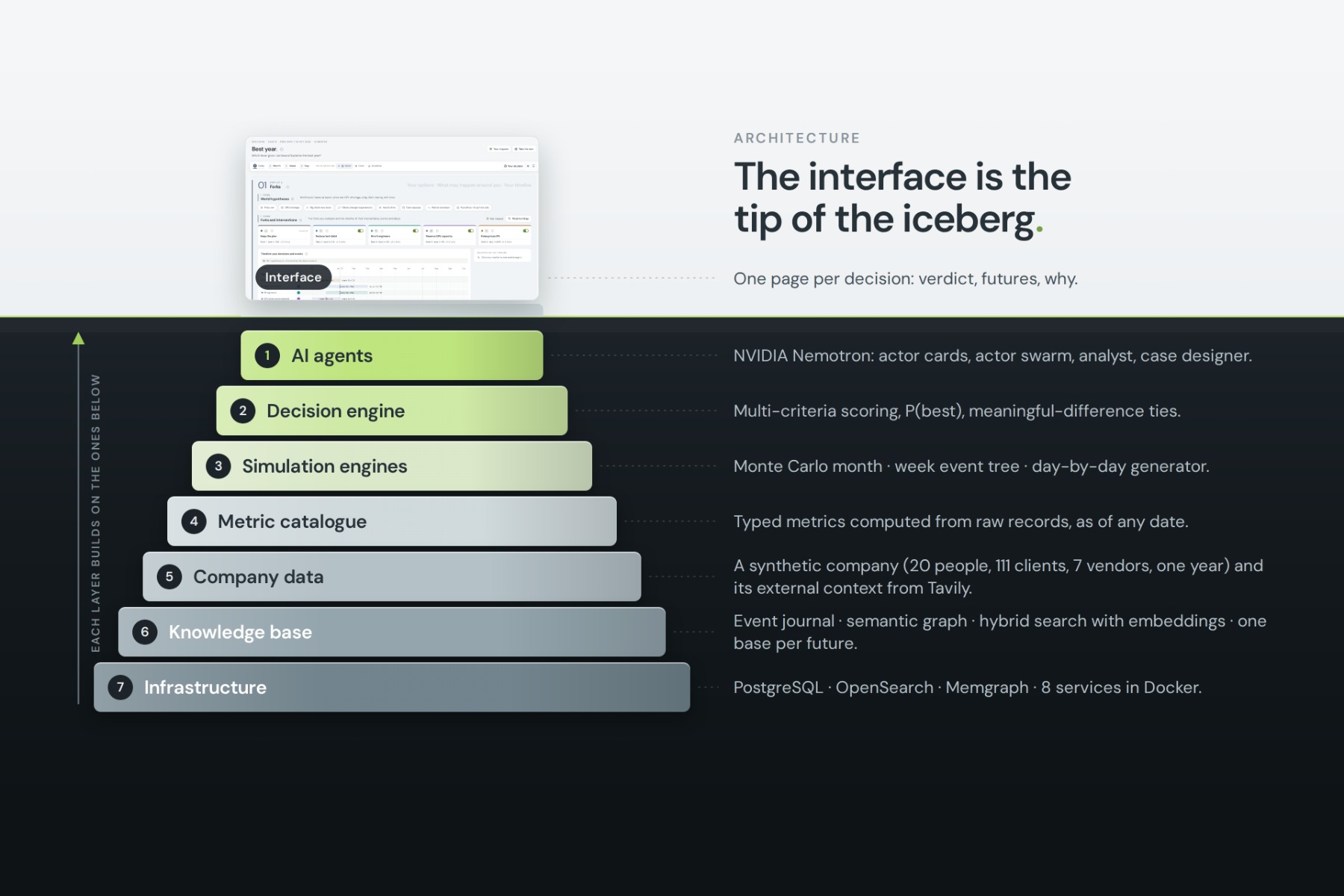
- The engines underneath:
- Monte Carlo month by month over the next 12 months, 1,000 runs per decision;
- a week-level event tree;
- a day-level generator whose output is loaded into its own knowledge base, with an event journal, a semantic graph and hybrid search.
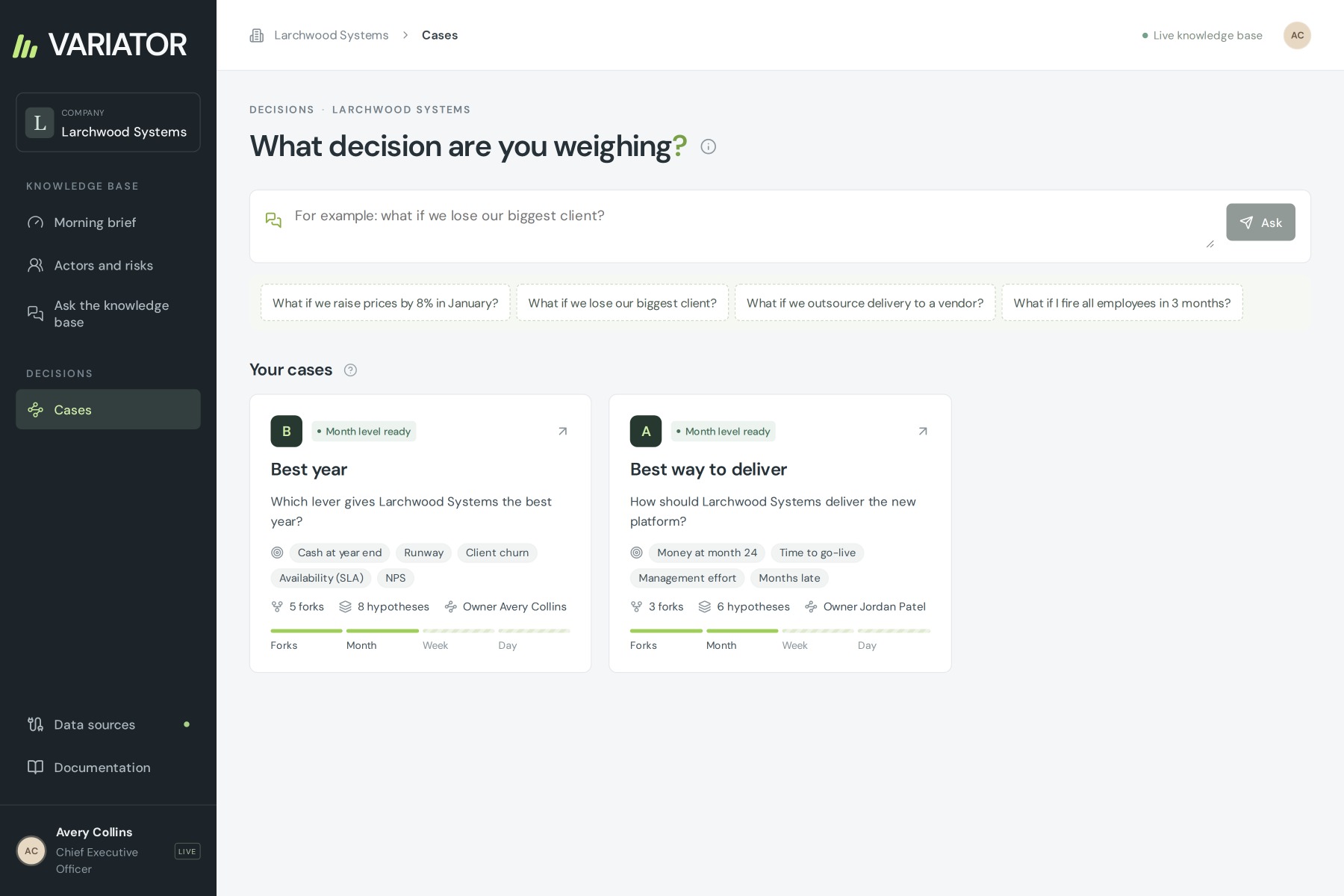
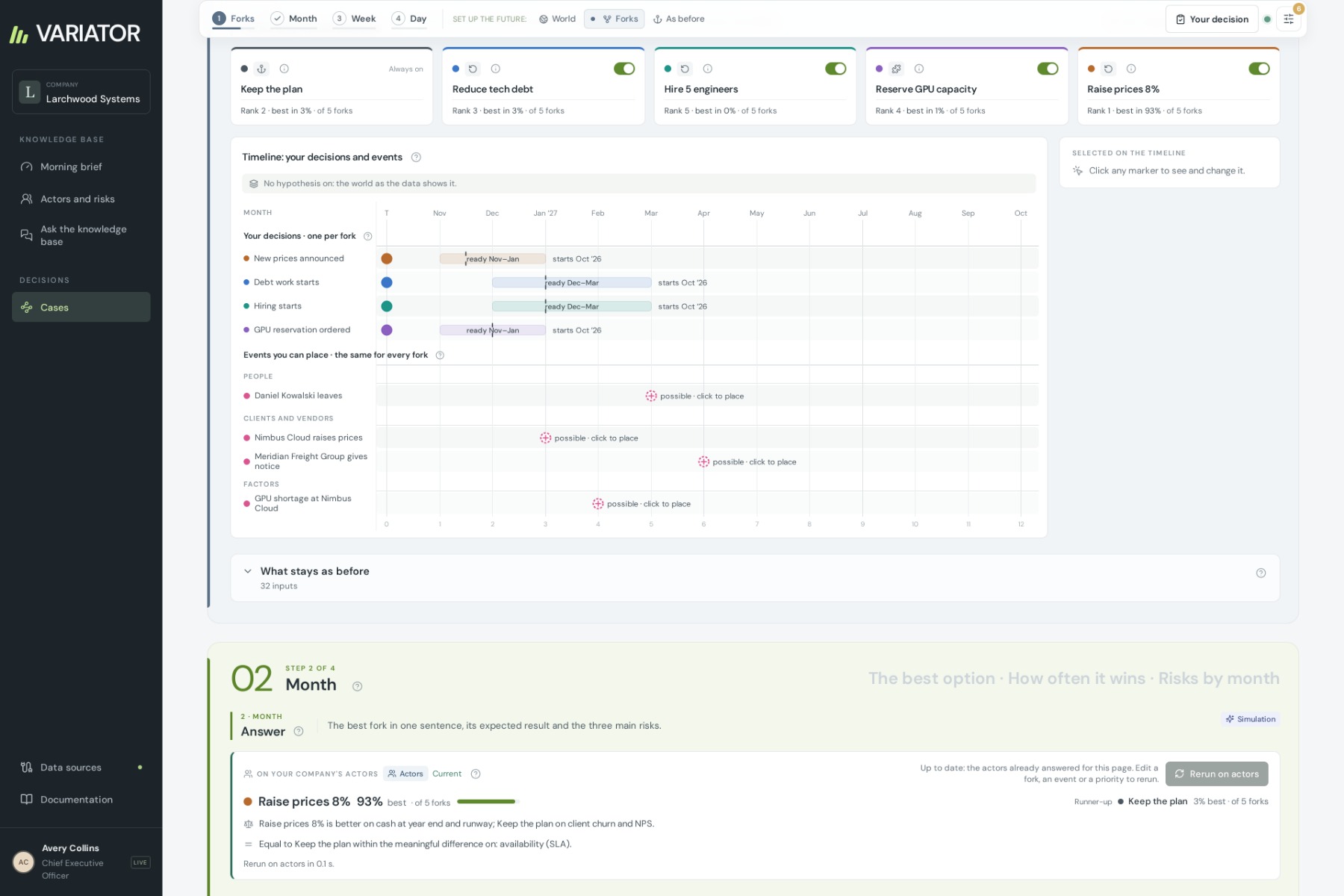
- The leader sees one page per decision:
- which option wins, in what share of futures, and what would flip it;
- drill-down to the week, a typical day, and the records behind every number.
- Live: https://variator.trijet.tech/workspace/brief?tour=reviewer, a 3-minute guided tour.
What it does
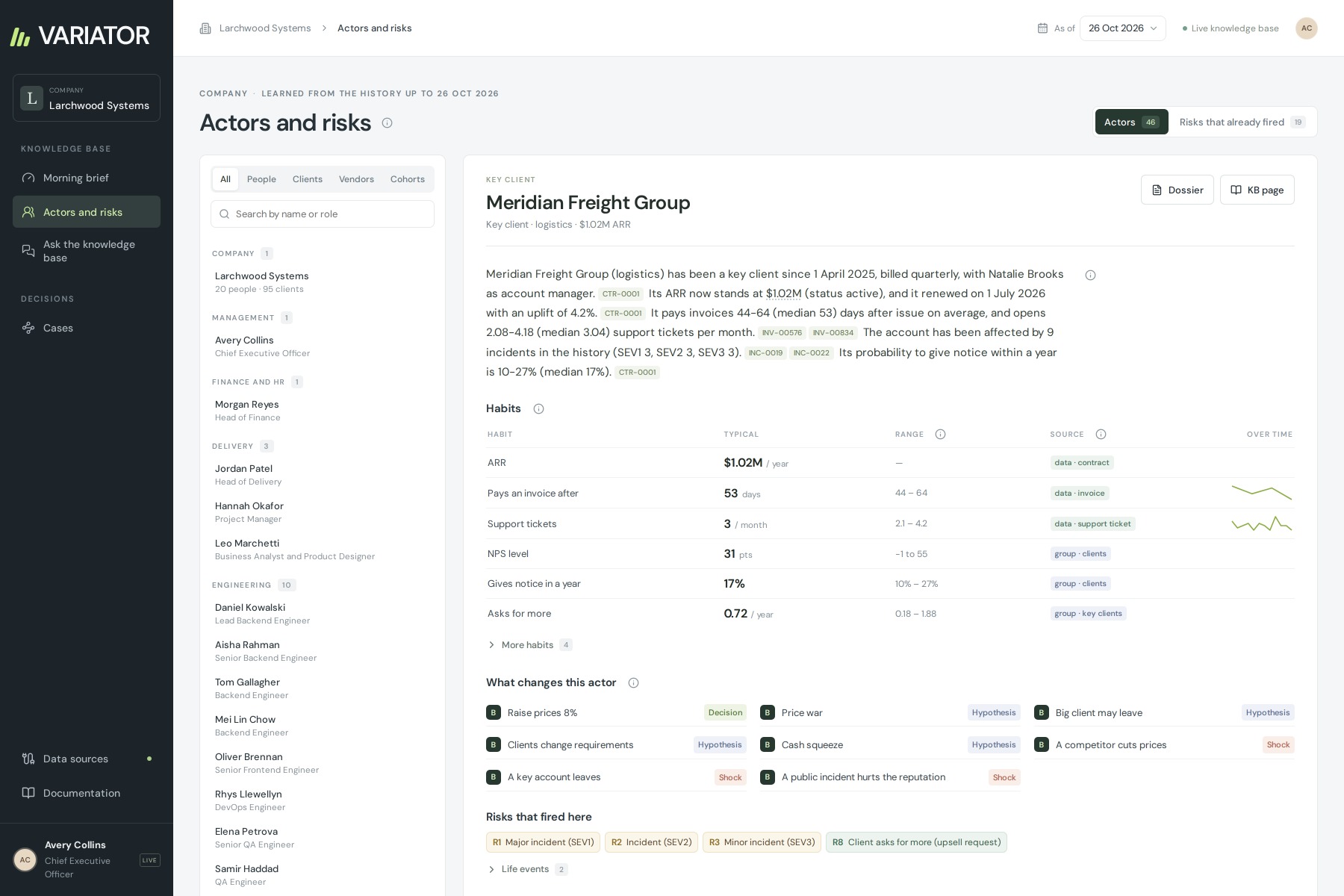
Models the company. From the company's whole history (mail, tickets, meetings, CRM, bank, cloud bills), Variator fits the habits of actors: clients, people, vendors and a regulator, cohorts and risks that already fired. Nemotron LLM writes each one up as an actor card. Tavily research adds what the records do not say: the domain, its clients, regulation, typical failure modes.
Frames the decision. A question such as "How should we run next year?" becomes a case:
- forks (decisions);
- world hypotheses, e.g. a price war, a GPU shortage, a big client leaving, payroll tax +5 pp from July;
- criteria with goals, e.g. cash, runway, churn, SLA, NPS.
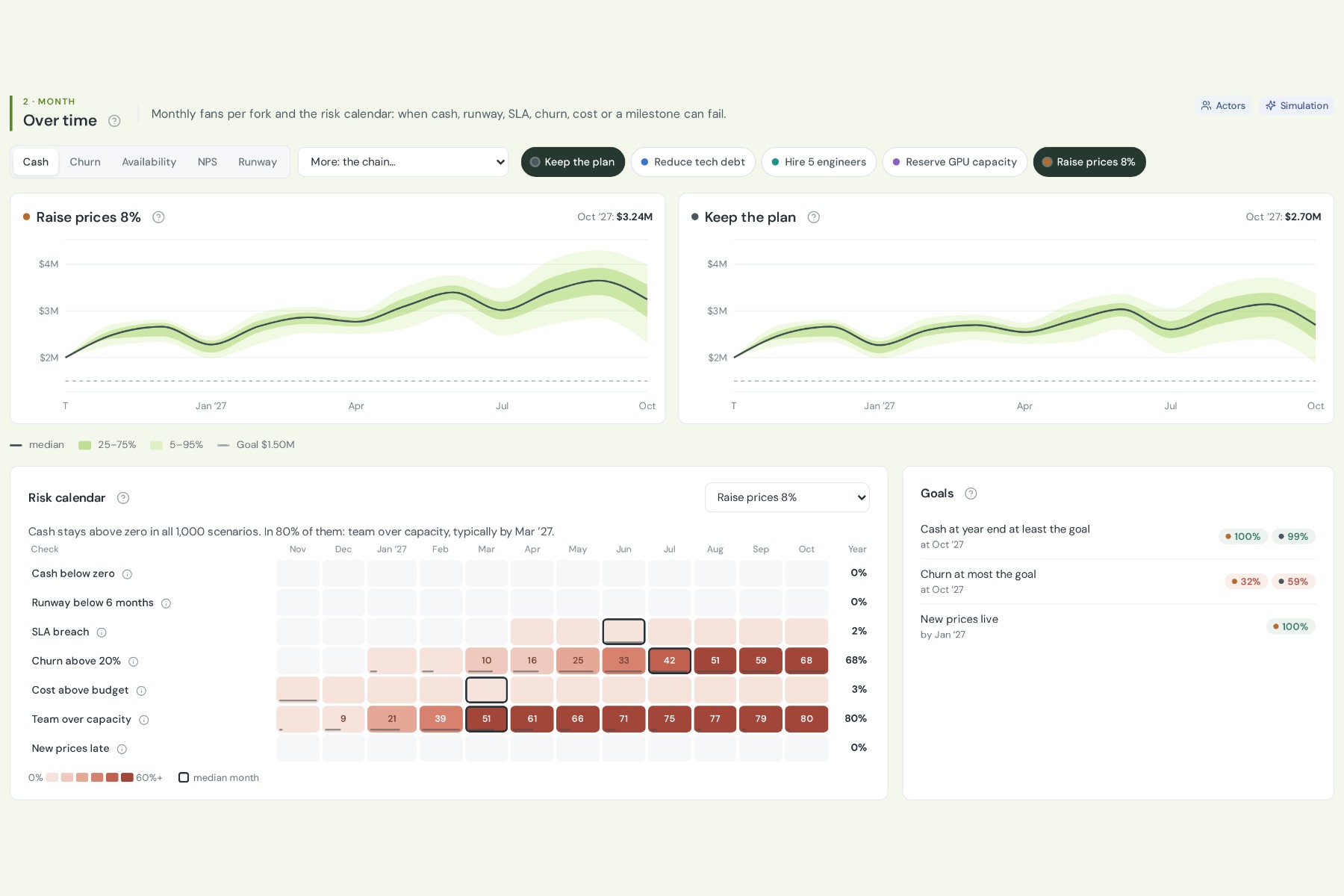
Plays out the futures. We imitate the company's work step by step: for every fork, 1,000 Monte Carlo runs over the next 12 months on the learned habits, with common random numbers so forks are compared on the same luck.
Decides honestly.
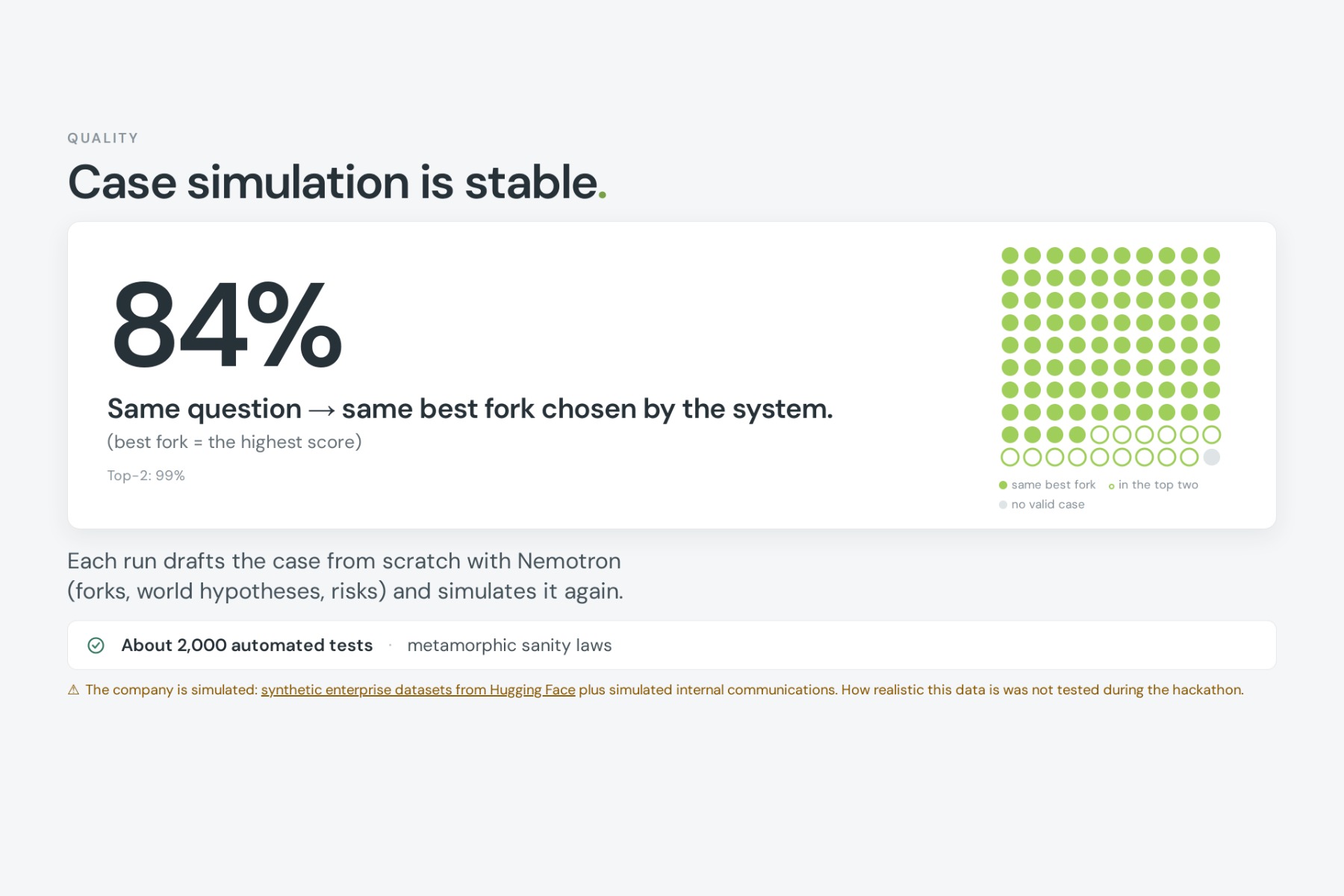
- It reports the score and also \(P(\text{best})\), the share of futures in which a fork is the best. It also reports ties within a meaningful difference, and what would flip the answer.
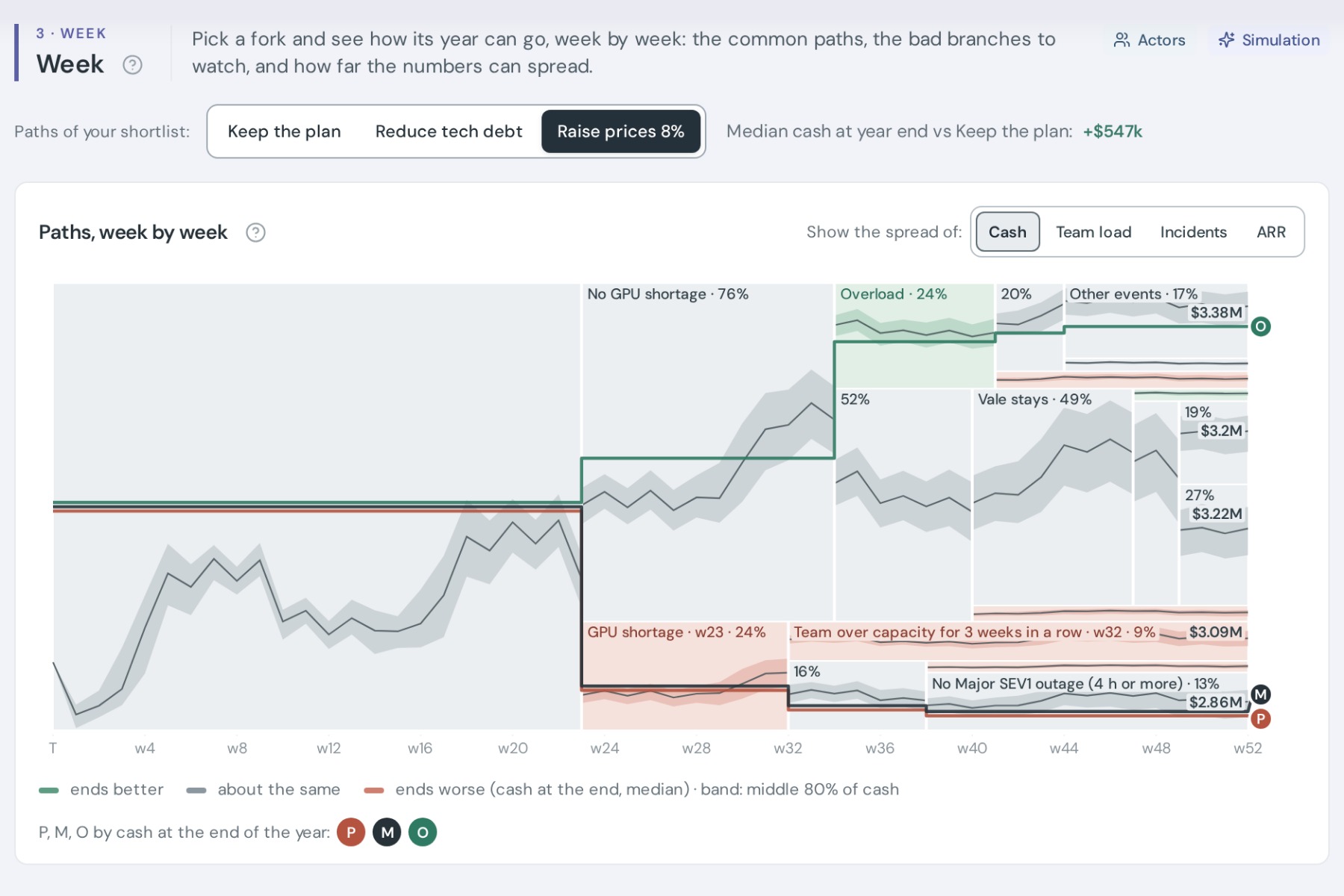
- In our showcase case the CEO puts cash first, and Variator answers: raise prices 8%. It is the best fork in 93% of futures and brings about $547k more cash at year end (median); the price, shown up front, is +6.1 pp churn and −3.3 NPS. With balanced priorities the same case is a close call between cash and clients, and Variator says so.
Explains, from general to specific.
- Month: the company's overall picture: cash, ARR, churn, NPS, runway, as a fan of 1,000 futures of the next 12 months per fork.
- Week: what happens over the sprints; an event tree shows which events split good futures from bad.
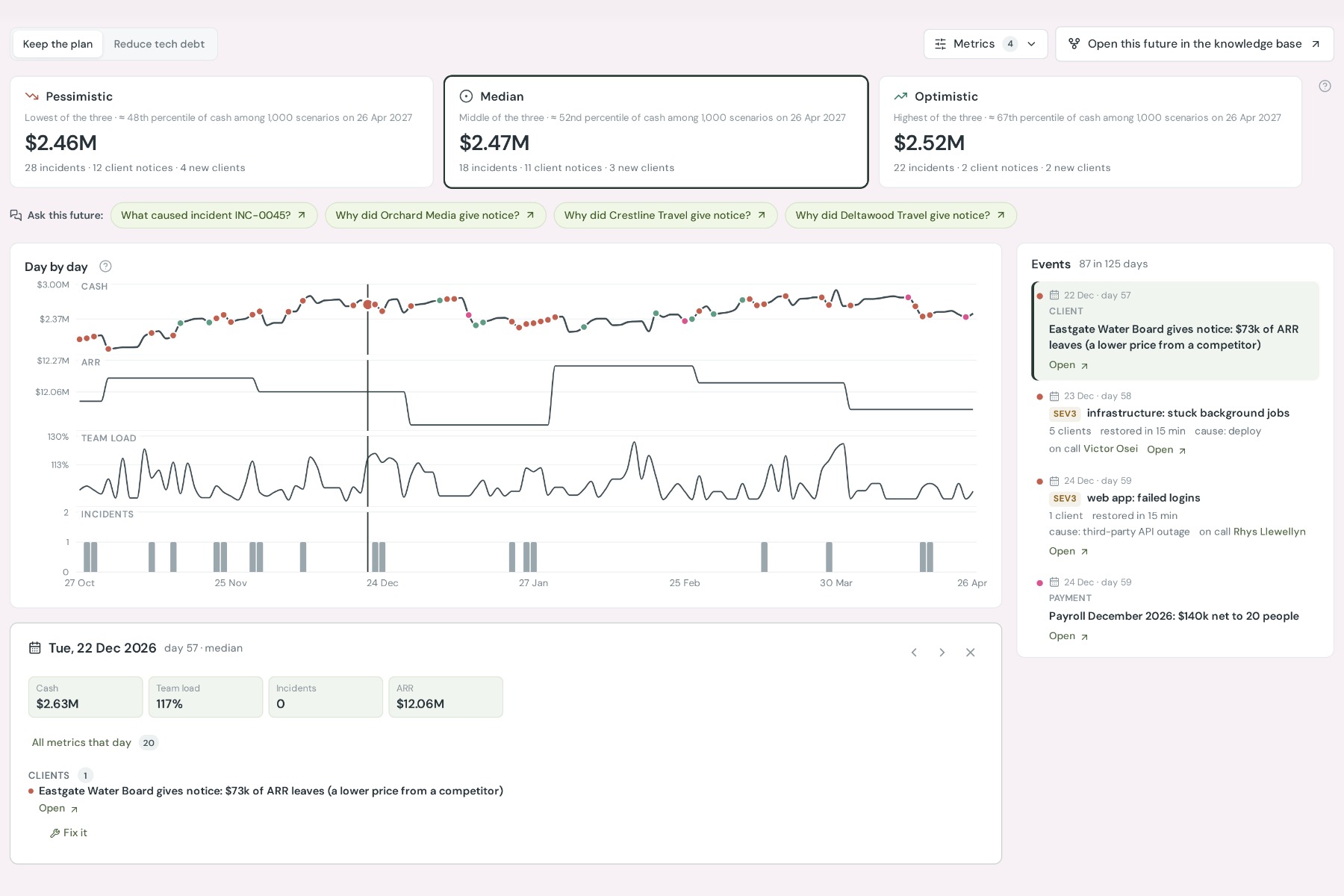
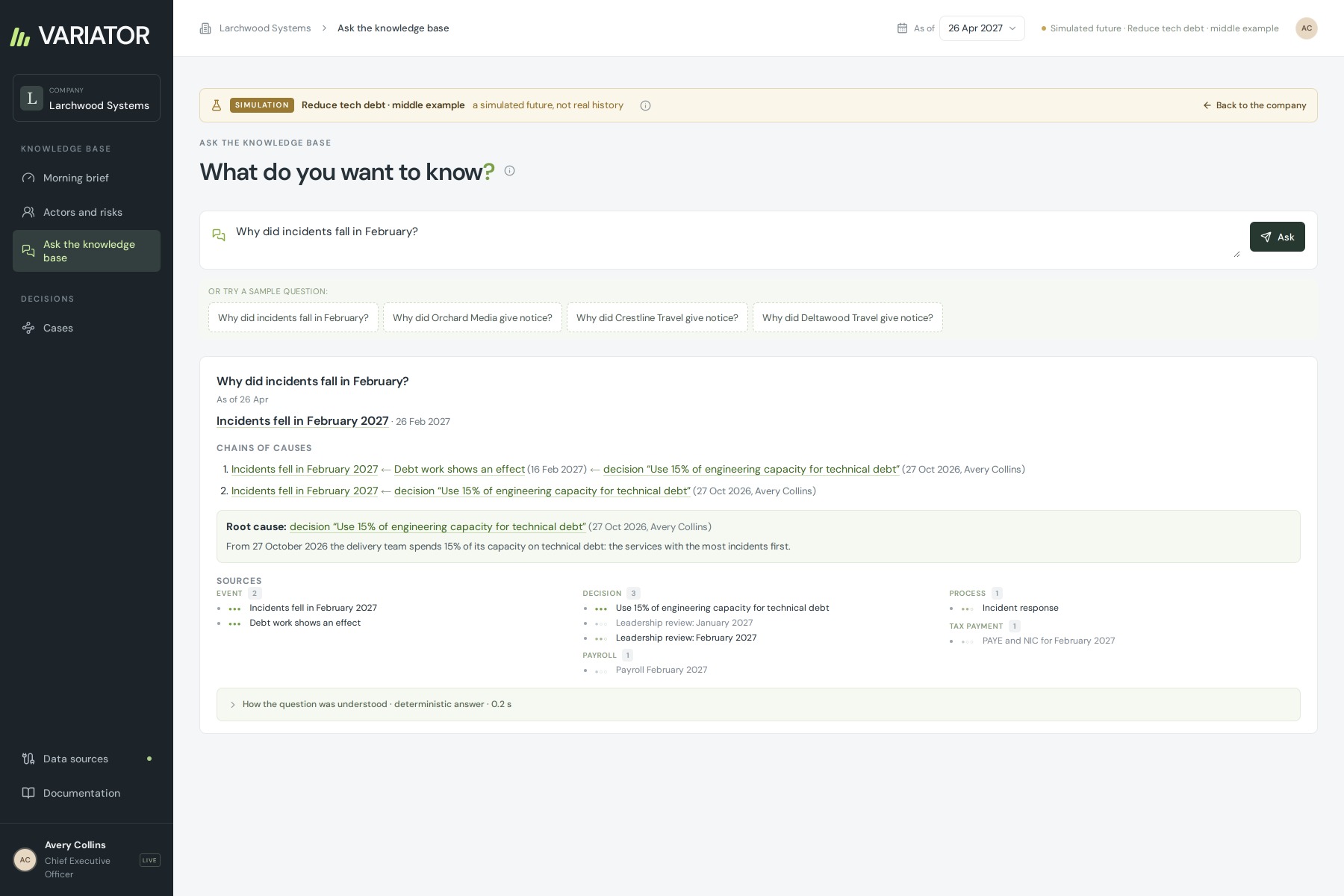
- Day: team performance and atomic events (a payment, an incident, a client giving notice): three example scenarios (pessimistic, median, optimistic) are generated in full: every email, ticket and meeting the actors produced. Each day is loaded into its own knowledge base, so you can ask the simulated future why something happened, and the answer cites its records.
$$P(\text{best})_a=\frac{1}{N}\sum_{i=1}^{N}\mathbb{1}\Big[a=\arg\max_{b}\,S_b(\omega_i)\Big],\qquad S_b(\omega)=\sum_k w_k\,u_k\big(m_{b,k}(\omega)\big)$$
where \(\omega_i\) is one simulated future, \(m_{b,k}\) is metric \(k\) under fork \(b\), \(u_k\) is a utility on fixed anchors (so one option's edit never reorders the others), and \(w_k\) are the leader's weights.
How we built it
We built the solution from scratch within a week, bringing all the expert knowledge and experience of 3 of us as product requirements and feature descriptions.
Stack:
- Python: NumPy and SciPy for the engines, FastAPI, MCP;
- TypeScript, React and Astro for the workspace;
- PostgreSQL, OpenSearch, Memgraph, FastEmbed;
- Docker Compose behind Caddy;
- Playwright for end-to-end tests.
About 2,000 automated tests.
Challenges
- Consistency across scales. Month, week and day are three engines; a leader must see one story. The month and the day disagreed by $322k on cash until we traced it to vendor-bill timing; they now agree within about ±$50k on a $2.7M scale.
- Honest ranking. Min-max normalisation made one option's edit reorder the others. Fixed anchors and meaningful-difference ties fixed it. The page now says "close call" instead of inventing a winner.
- No leakage from the future. Every metric and every knowledge-base answer is computed as of the decision date.
- Cost. A full simulation of one organization writes a year of company life: tens of thousands of documents and around $25 for LLM API usage. Model routing (Ultra, Super, Lightning) and caching make it affordable; that is why the MVP runs one organization.
Accomplishments
- A complete product, not a notebook: a CEO brief, Ask with evidence, two decision cases, an actor register, a guided reviewer tour. Deployed publicly, with the first view under 3 s.
- Three simulation engines that agree with each other, on a world model extracted from records.
- A knowledge base per simulated future: you can interrogate a future that has not happened.
What we learned
- An LLM is a strong world-model prior, but it needs a numeric engine and hard checks around it. The LLM imagines and explains; the engine counts; the checker refuses unsupported numbers.
- Probabilities beat point forecasts for leaders, but only if the page says plainly when two options are a close call.
What's next
- Multi-step decisions: re-plan every month and search the decision tree, AlphaZero-style.
- More agents with their own goals: clients, users, partners, regulators.
- Many organizations: one world model across companies; benchmarks across a portfolio.
- A learned surrogate: a fast model trained on simulations, for instant plan search.
- A case from one sentence: describe the situation; Nemotron drafts the forks and runs the twin.
- Scale on Nebius: Serverless Jobs for simulation swarms.
Built With
- caddy
- claude-code
- docker
- express.js
- fastapi
- fastembed
- knowledge-graph
- mcp
- memgraph
- monte-carlo
- multi-agent
- nebius-token-factory
- node.js
- numpy
- nvidia-nemotron
- opensearch
- playwright
- postgresql
- python
- react
- recharts
- scipy
- tavily
- typescript
- vite


Log in or sign up for Devpost to join the conversation.