The problem
The problem we want to solve is one of the most important challenges we face right now, namely: How can we collaborate across countries and regions to ensure that all hospitals have access to an adequate amount of equipment and resources? Given the progress of covid-19 globally, we can expect more regional resource shortages to come. Hence, we have focused on the capacity of ICUs for different regions and countries.
Our solution
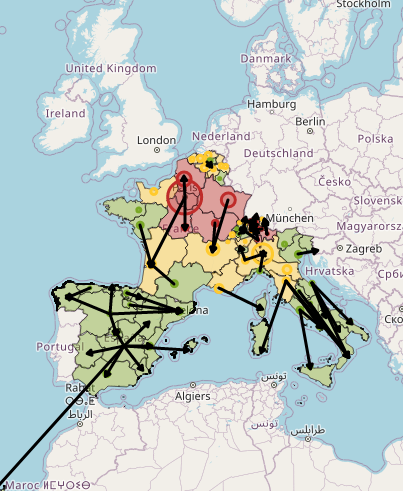
Co-vidia is a two-pronged approach for ensuring that COVID-19 patients have access to the healthcare they need in a certain region or country. By first applying machine learning to forecast the future demand ICU beds in each region, we can see where to expect shortages. We then apply mathematical decision optimization techniques to suggest the optimal way to move patients between regions in order to avoid local shortages. The result can be consumed in an interactive website where the user can choose what countries to optimize for and also the trade-off between parameters.
Technology
The solution is a web-app developed with open-source tools in Python containerized in Docker and deployed on Microsoft Azure. For machine learning predictions, we used the XGBoost library, for optimization we used PuLP, for the webserver, we used Dash and the graphs were made in Plotly. All tools are open-source.
Development during this Hackaton
Before this hackaton, we had mostly data for Sweden and Spain and the optimization were done only for one country. During this hackaton, the following features were added:
- Made the solution independent of country
- Found and added data for Italy, France, Belgium and Switzerland
- Created automatic data pipelines for fetching new data
- Created machine learning pipelines for creating new forecasts
- Refactored the solution to use pre-calculated results instead of doing them live, for speed and stability
- Improved the UX and layout of the web-app
- Made the web-app responsive so it also works on mobile
The solution’s impact to the crisis
Different regions are hit by Covid-19 at different times and to varying degrees. The surges are often rapid and intensive, causing regional healthcare systems to break down and patients to die due to lack of ICU-beds and ventilators. At the same time, neighboring regions may not yet be as badly hit and may have surplus of healthcare capacity. Some countries, such as France have already started reallocating patients from more to less affected regions in order to provide them with adequate care. In doing this, they face two challenges:
The uncertainty about the future– If they decide how the patients should be transferred given the current capacity and allocation of the healthcare system, the targeted ICU-beds may already be occupied upon arrival some days later.
The complex logistic optimization problem– there are infinitely many possible ways to reallocate patients between different regions. Often, several factors needs to be accounted for. For instance, there is a trade-off between moving patients long distances (in which case they may worsen during transportation), and achieving completely level capacity surplus in the healthcare system. Finding the optimal solution to complex, multivariate problems such as this is outside the capacity of any individuals.
Co-vidia is a datadriven and scalable approach to tackle these problems.
The necessities in order to continue the project
The main concern is the availability of data, we had to do some assumptions to get the correct data today for some countries. We also wanted to add e.g. Germany, but historical data was not available. Co-vidia needs three categories of data to work:
Data about historical covid-19 trends – e.g. the number of covid-19 patients needing ICU treatment in each region.
Data about resource availability - e.g. the amount of available ICU beds per region.
Data about the region, like population density and average age.
Except for access to good data, the most important factor for the project to continue would be feedback from some authority that want and need the solution.
The value of your solution(s) after the crisis
As said earlier, the solution is scalable to whatever type of region or resource allocation problem. While Co-vidia was initially built for the problem of optimizing patient reallocations, the optimization objective could be changed without difficulty. Resource allocation problems share a common structure, and as long as the data requirements are met, the platform could be used for moving capacity (e.g. doctors and equipment) instead of patients. While the optimization is currently done on a regional level, it could be changed to an intraregional level (e.g. moving patients between areas or hospitals within a region).
What's next for Co-vidia?
Our team works as Data Science consultants in a company called Advectas, recently aquired by Capgemini (which has hundreds of Data Scientists in Europe). As Capgemini has a large network with the public sector all over Europe, we are trying to get in touch with relevant stakeholders to show our solution and support them with datadriven insights in their time of need.


Log in or sign up for Devpost to join the conversation.