Check out the Product Demo
https://vantaledge.vercel.app/
Inspiration
Business financial decisions often happen too late. Teams work with old data, separate files, and reports that only show the past. When things change-like costs going up, contracts ending, or market shifts-the impact builds up before anyone sees the full picture. VantaLedge changes this flow. Instead of reporting what happened, it forecasts what will happen, researches why it's happening, and simulates the impact across every partner in the transaction. The output is not just a dashboard. It's a clear system that delivers projections, sourced explanations, and clear next steps
What it does
VantaLedge works as a live financial intelligence layer. Users upload operational data, and the system sorts it into structured revenue, cost, asset, and obligation streams. A multi-agent pipeline then runs parallel analyses: a forecasting engine projects future scenarios, a research agent ingests market signals, and a note-taking agent structures findings into a persistent Knowledge Vault using markdown and entity-linked references.
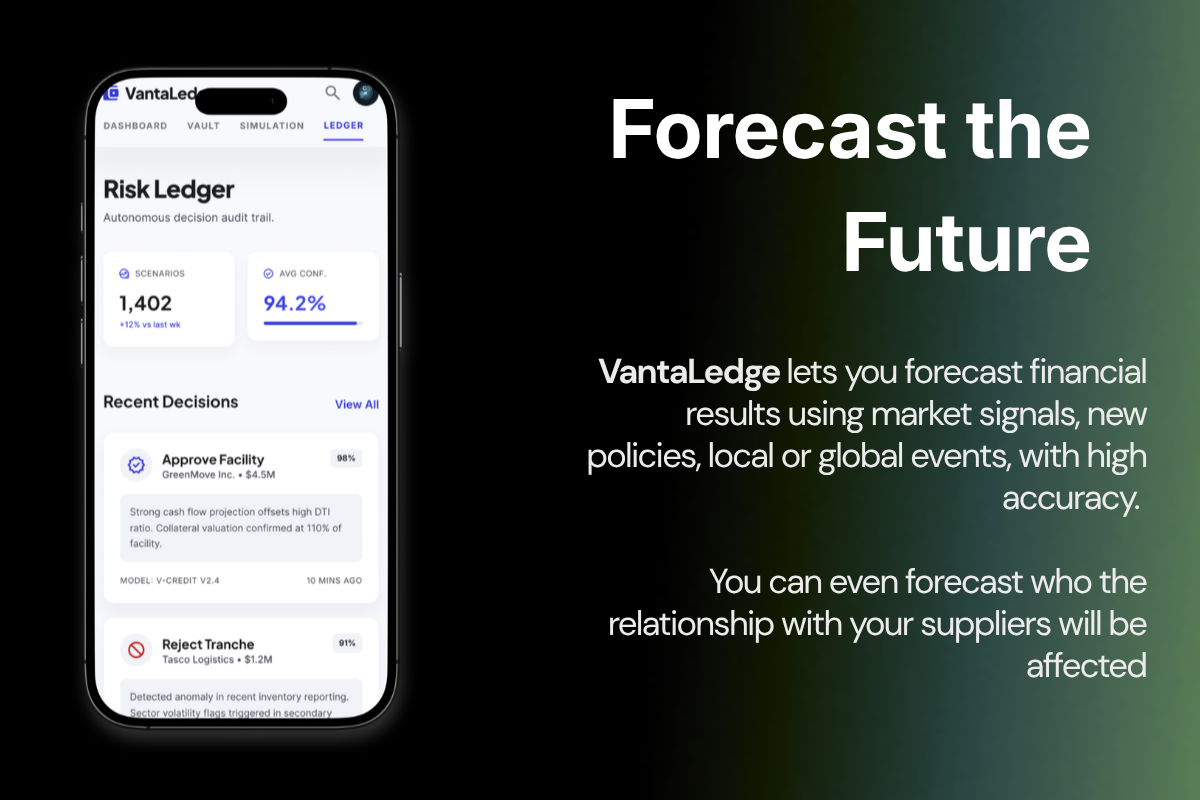
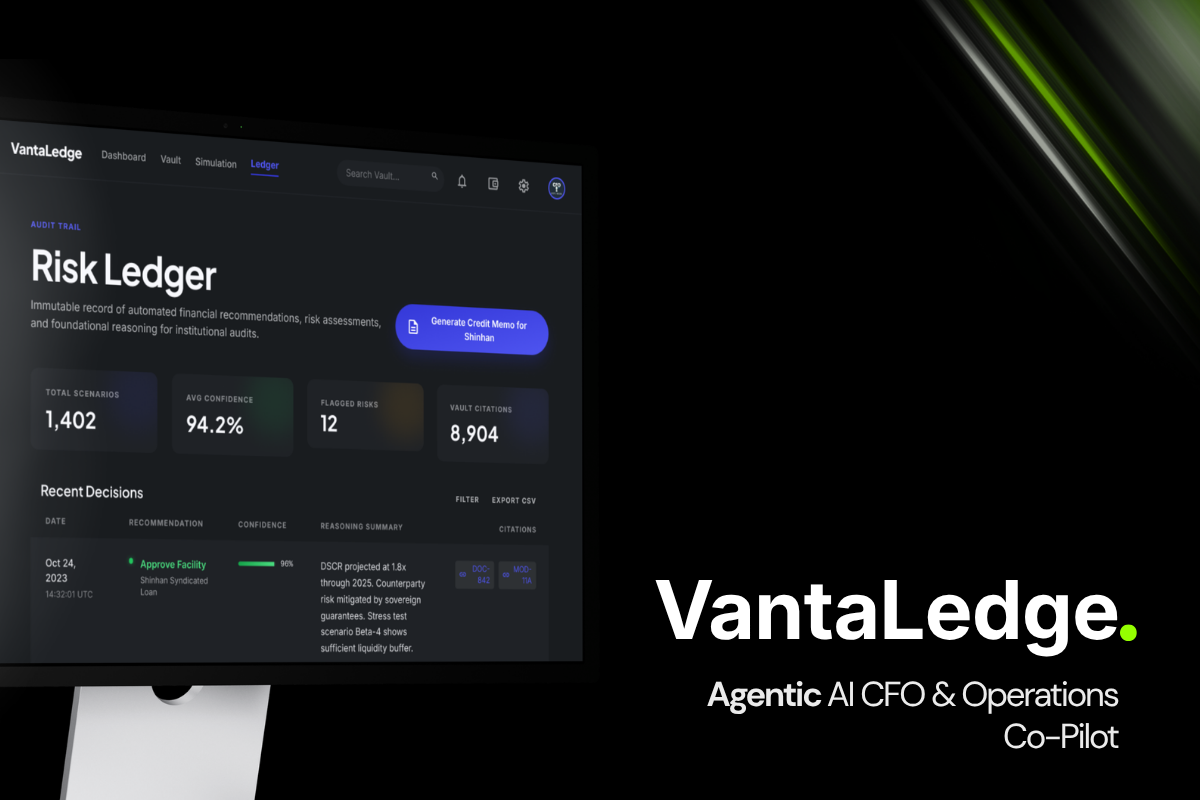
When metrics change, Qwen agents query the vault to find root causes with sourced citations and confidence scores. Users can run collaborative scenario simulations-changing one variable instantly updates projections across all views, paired with context-specific action recommendations. Every output is logged in a Risk Ledger that captures data snapshots, model versions, reasoning chains, and vault source paths. The result is a transparent, traceable financial operating system that replaces guesswork with verified projections.
Built For
For a Bank: SME Loan Underwriting A lender reviews a small business loan application. Upload the applicant's financials. Qwen agents classify revenue and costs, forecast 12–36 month cashflow, and research sector trends. The system flags early warnings, like receivables aging or margin pressure, and outputs a draft credit memo with cited sources and confidence scores. One view. Full audit trail.
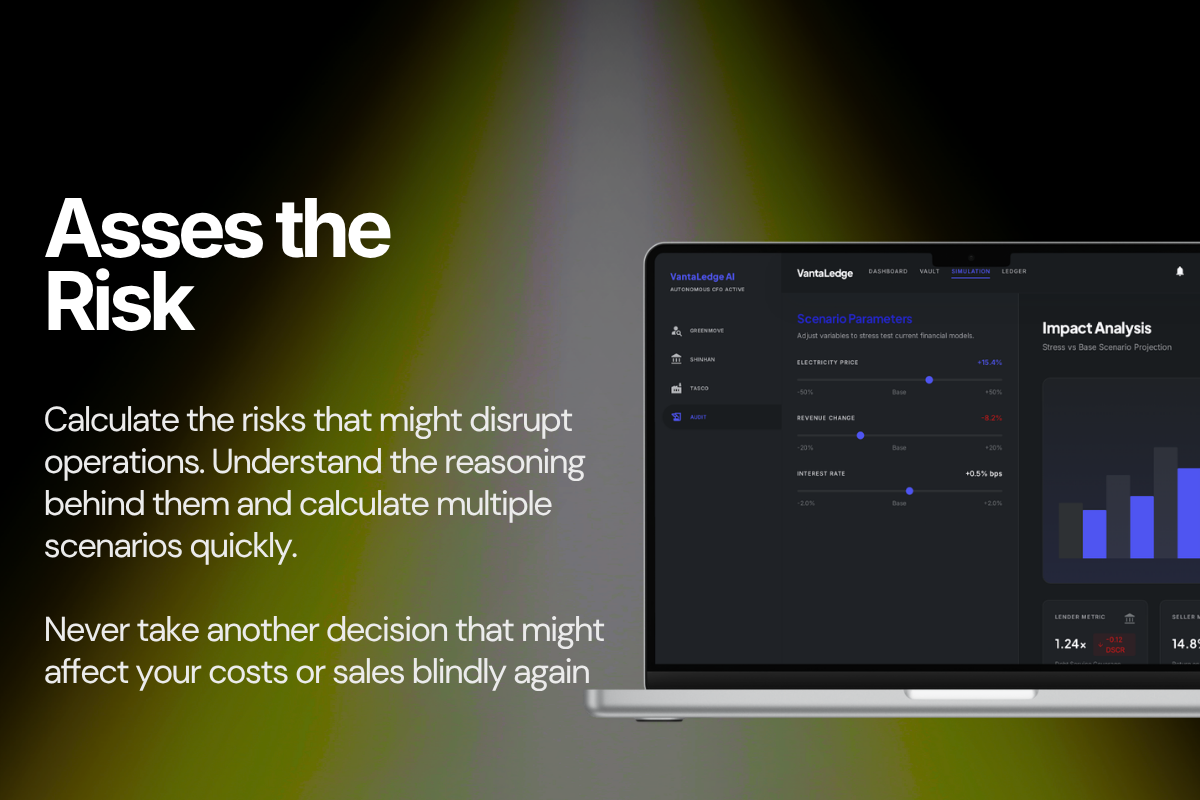
For a Dealership: Fleet Sale with Financing A customer buys vehicles with a loan. Upload the deal terms + fleet specs + buyer financials. VantaLedge forecasts cashflow, loan serviceability, and maintenance costs. Change one variable, like energy prices +15%, and see the impact on buyer, lender, and dealer views instantly. Every insight links to sourced research in the Knowledge Vault.
For an Operator: Asset Lifecycle Planning A business manages high-value assets with recurring costs. Upload asset data + operating history. The system forecasts maintenance peaks, depreciation curves, and optimal renewal timing. Ask "What if usage rises 20%?" and see cascading impact across finance and operations. Actions are specific, sourced, and stakeholder-aware.
For a Finance Team: Revenue Concentration Risk A company relies on a few large contracts. Link contract timelines to cashflow forecasts. When a major contract nears expiry, the system triggers an alert, simulates revenue loss scenarios, and recommends actions—like diversifying clients or adjusting costs. All stakeholders see the same timeline and impact assessment.
For an Insurer: Dynamic Risk Pricing Price risk for a customer with variable operations. Feed usage patterns, maintenance history, and market signals into a risk forecast. The system projects loss ratios, recommends premium adjustments, and explains drivers with sourced research—for example, "high mileage + asset age = +12% maintenance risk." Transparent. Adjustable. Auditable.
How we built it

We use an architecture that rely on using the Qwen model family, time series projections and Obsidian for the Knowledge Vault. These are the key components:
Qwen-Max/Plus (Alibaba Cloud): Core reasoning engine. Handles intent classification, financial data mapping, vault-sourced explanation generation, and scenario routing. Tool-calling is strictly bounded to prevent hallunation on data.
Qwen-Agent Framework: Manages the six-step pipeline (a Classifier, a Forecaster, a Researcher, a Note-Taker, an Explainer, and an Advisor). Agents operate on overlapping data, cross-validate outputs, and resolve conflicts before surfacing results.
TimeFM + Forecast Engine: Time-series model for multi-horizon forecasting on different fronts. NeuralProphet/statsmodels run in parallel as fallback. We also manage confidence bands apply to all outputs to have a precision range.
Knowledge Vault: Plain-text markdown files with
[[wiki-links]]and a lightweight regex parser. Obidian help us retrieve data much faster and more precisely. Agents write structured notes to/raw/and/vault/directories. The result is a comprehensive map for easy desicion making.Risk Ledger & Backend: SQLite + JSON logs capture every decision, threshold, and source path. FastAPI handles data ingestion, model routing, and session state. Streamlit renders the interface with tabbed views, scenario overlays, and audit export.
Challenges we ran into
Preventing wrong financial outputs: LLMs can struggle with multi-step ratio calculations and context drift. We enforced structured JSON outputs, grounded every numerical claim to a vault file path, and implemented confidence thresholds with explicit human-in-the-loop overrides.
Multi-Agent Cascade Routing: Running a single simulation across different financial models required decoupling the forecast engine from the presentation layer. We built a unified JSON schema that Qwen dynamically reframes per stakeholder lens without recalculating the underlying projection.
Auditability at Speed: Traditional RAG buries reasoning in vector space. We pivoted to a deterministic Knowledge Vault with explicit entity linking and regex parsing. This turned opaque AI outputs into a transparent, line-by-line research trail that survives compliance review.
Cross-Continent Hybrid Build: One core developer was overseas and had to travel mid-hackathon to sync with the team. We architected async-first pipelines, containerized agent services, and implemented strict interface contracts so development continued uninterrupted across time zones and network constraints.
Accomplishments that we're proud of
We shipped a complete agentic pipeline with classification, forecasting, research, explanation, simulation, and audit logging-in five days that is fully functional.
We tested the Knowledge Vault architecture with an AI that helps to understand market conditions and the reasoning behind them relying on unoptimized databases.
Used Qwen's capability as a financial reasoning core, and manage to deployed it on different levents to structured explanations, cite data cross sources, and recommended high grade decisions based on the forecast.
We kept full development across our team, despite one of our members traveling between countries in the middle of the hackathon.
What we learned
The product is the reasoning, not the forecast. We learned that any model can project a number, but what's important is the reasoning behind it. Analysts and decision makers need to understand whats behind the change, what to do about it, and proof behind it.
Simple structures beat complex systems. When we started, we started with ideas for databases and complex agent orchestration. However, when we realized we didn't got time, we pivoted to a much lighter architecture. The result was a faster development, less debugging, and clarity.
Trust requires transparency, not just accuracy. We added the Risk Ledger later in the build, but it became a core feature because of how useful it was. The reason behind it is because decision makers need to see what data was used, which model version ran, what confidence score applied, and which vault notes supported the conclusion. This audit helps us to provide peace of mind and transparency so better actions can be taken.
What's next for VantLedge - Live-Signal Forecasting Agent
- Replace pre-curated inputs with live DMS, POS, and banking API feeds.
- Extend scenario simulation to portfolio-wide stress testing with parameter sweeps.
- Integrate telematics and external signal pipelines for dynamic risk pricing.
- Scale the Knowledge Vault to multi-tenant architectures with isolated entity graphs and cross-portfolio intelligence sharing.
- Implement automated restructuring workflows triggered by early-warning thresholds.


Log in or sign up for Devpost to join the conversation.