Inspiration VANTA was inspired by a simple problem: most banking apps help users see their money, but not control it. People can check balances, review transactions, and set budgets, but they still struggle with the hardest part of personal finance, which is making good decisions in the moment.
We noticed that overspending often does not happen because people lack data. It happens because they lack timely guidance. A raw bank balance can be misleading, and most financial apps only react after money has already been spent. We wanted to build a product that acts earlier, helping users understand what they can safely spend, warning them before risky purchases, and building better habits over time. We were also inspired by the rise of AI in everyday decision-making. If people are already comfortable asking AI for help, why not create an AI financial copilot that uses real financial context to provide smarter, more useful advice?
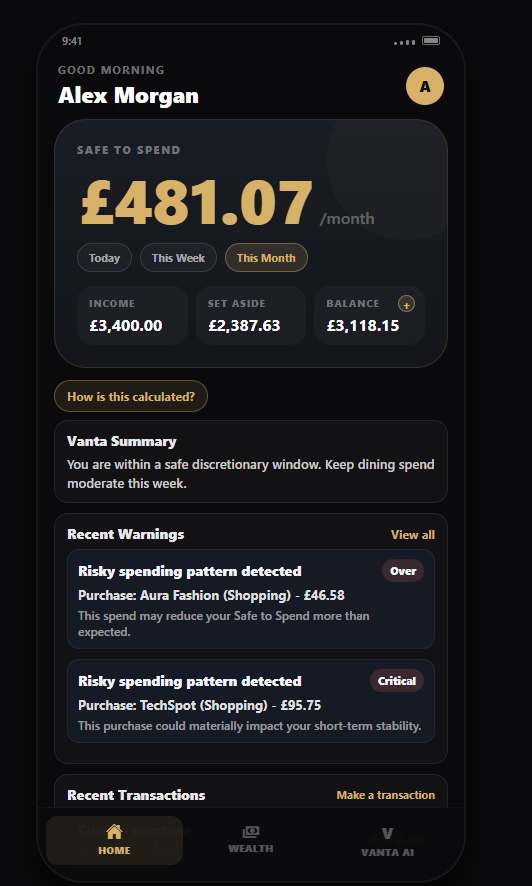
What it does VANTA is an AI financial copilot designed to turn banking from a passive dashboard into an active decision-making tool. It does three main things:
- Safe-to-Spend: calculates what users can genuinely afford after accounting for bills, savings, and goals.
- AI Financial Chat: lets users ask money questions in plain language, such as whether they can afford something or how to reach a savings target faster.
- Regret Prediction: learns from user behaviour and flags purchases that may lead to regret before the money is spent. Instead of just tracking spending after the fact, VANTA helps users make better choices in real time.
How we built it We built VANTA as a concept around a clear product loop: track, explain, intervene, and learn. First, we designed the financial logic behind the Safe-to-Spend feature. The goal was to simplify money management into one trusted number rather than forcing users to interpret a raw balance on their own. Next, we layered an AI chat interface on top of that logic so users could interact with their money more naturally. Rather than clicking through different tabs, they could simply ask questions and receive answers grounded in their own financial situation.
Finally, we developed the idea of a regret-based learning system. By collecting feedback on past purchases, VANTA could identify behavioural patterns and use them to predict and prevent future regret. We also grounded the project in real-world infrastructure, such as open banking, transaction monitoring, and real-time spend controls, to make sure the concept felt feasible as well as innovative.
Challenges we ran into One major challenge was balancing helpfulness with friction. VANTA is meant to intervene before bad spending decisions, but if those interventions feel too frequent or too restrictive, users may ignore them or turn them off completely.
Another challenge was trust. Since this is a financial product, the system has to feel accurate, clear, and reliable. We had to think carefully about how to make the product simple enough for everyday users while still being grounded in solid financial logic.
We also faced the challenge of making the AI feel meaningful rather than gimmicky. In finance, users do not just want clever responses. They want advice that is relevant, personalised, and based on real data.
Accomplishments that we're proud of We are proud that VANTA is not just another budgeting app concept. We identified a more specific gap in the market: helping users make better financial decisions before they spend, rather than after. We are also proud of the product structure we created. The combination of Safe-to-Spend, AI chat, and regret prediction gives VANTA a clear and differentiated value proposition.
Most importantly, we are proud that the idea is both ambitious and realistic. It feels innovative because of the behavioural intervention and AI layer, but it is also grounded in infrastructure and user behaviours that already exist today.
What we learned We learned that the biggest opportunities in fintech are not always about adding more features. They often come from solving the right behavioural problem.
We also learned how important timing is. A financial product becomes much more valuable when it supports the user at the exact moment a decision is being made.
Another key lesson was that AI works best in finance when it supports deterministic logic rather than replacing it. Users need transparency and trust, so the core outputs should be explainable, while AI should enhance the experience through personalisation, conversation, and behavioural insight.
What's next for Vanta The next step for VANTA is to move from concept to validation.
In the short term, we would focus on building a lean MVP centred on Safe-to-Spend and basic AI guidance. Then we would test it with early users, especially Gen Z and early-career professionals, to see whether it genuinely changes spending behaviour.
After that, we would refine the product based on real user feedback, improve the intervention system, and strengthen retention. Longer term, we see potential to scale through a premium model, referral-led growth, and partnerships with banks or fintech platforms.
Our long-term vision is for VANTA to become the decision layer of personal finance: not just a place where users view their money, but a system that helps them make smarter choices every day.

Log in or sign up for Devpost to join the conversation.