-
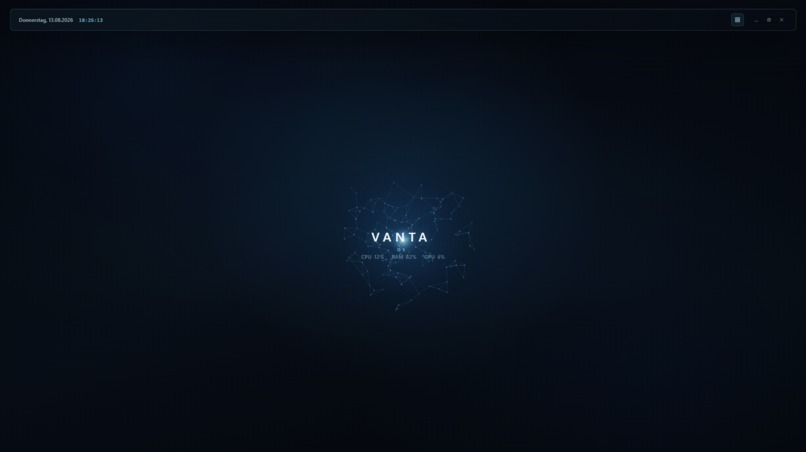
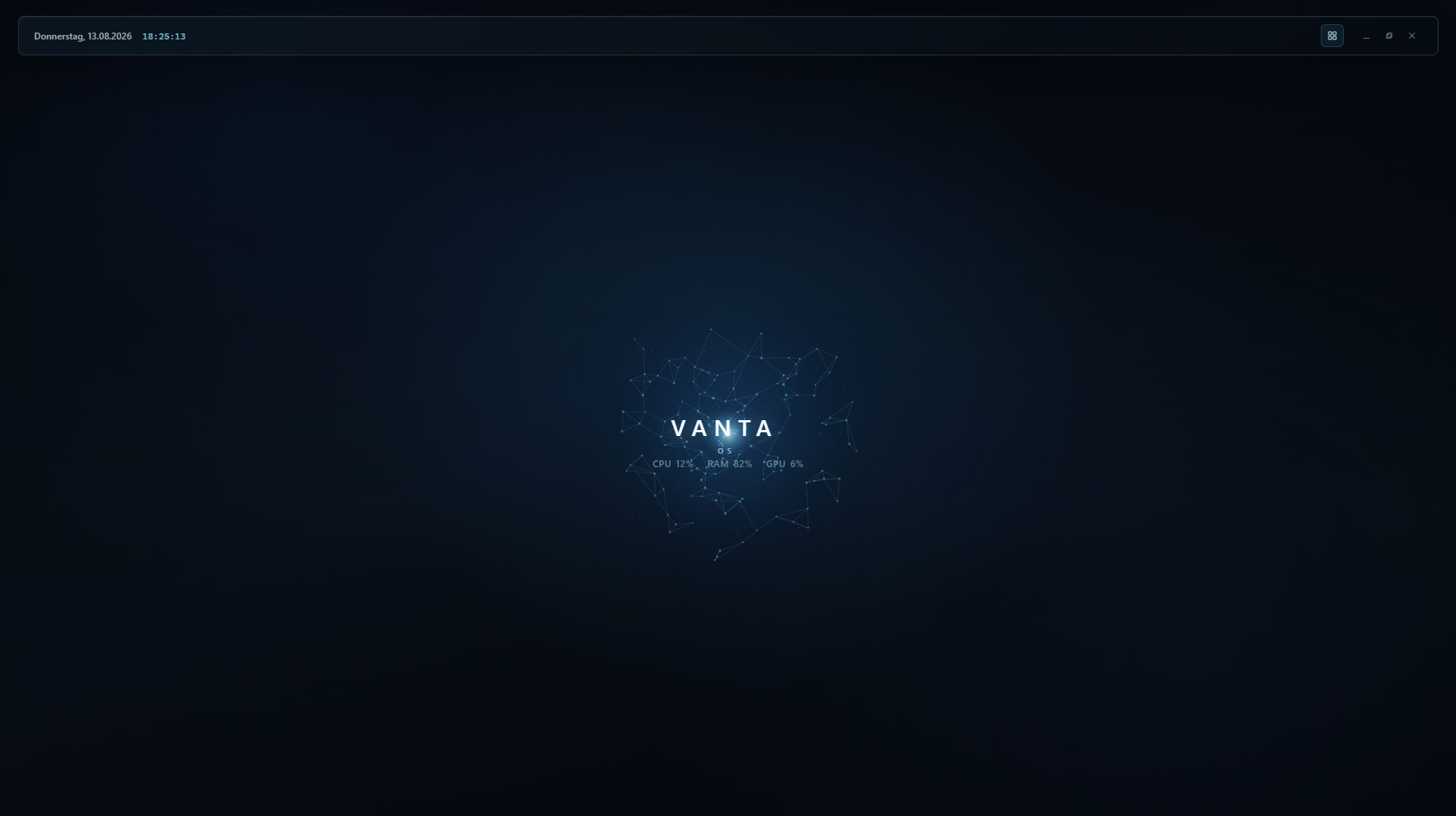
VANTA.OS Overview — the central local-first desktop environment and visual core of the system.
-
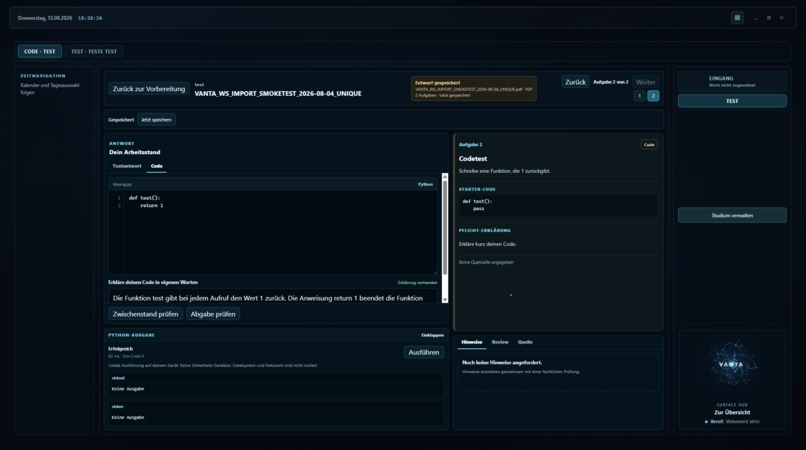
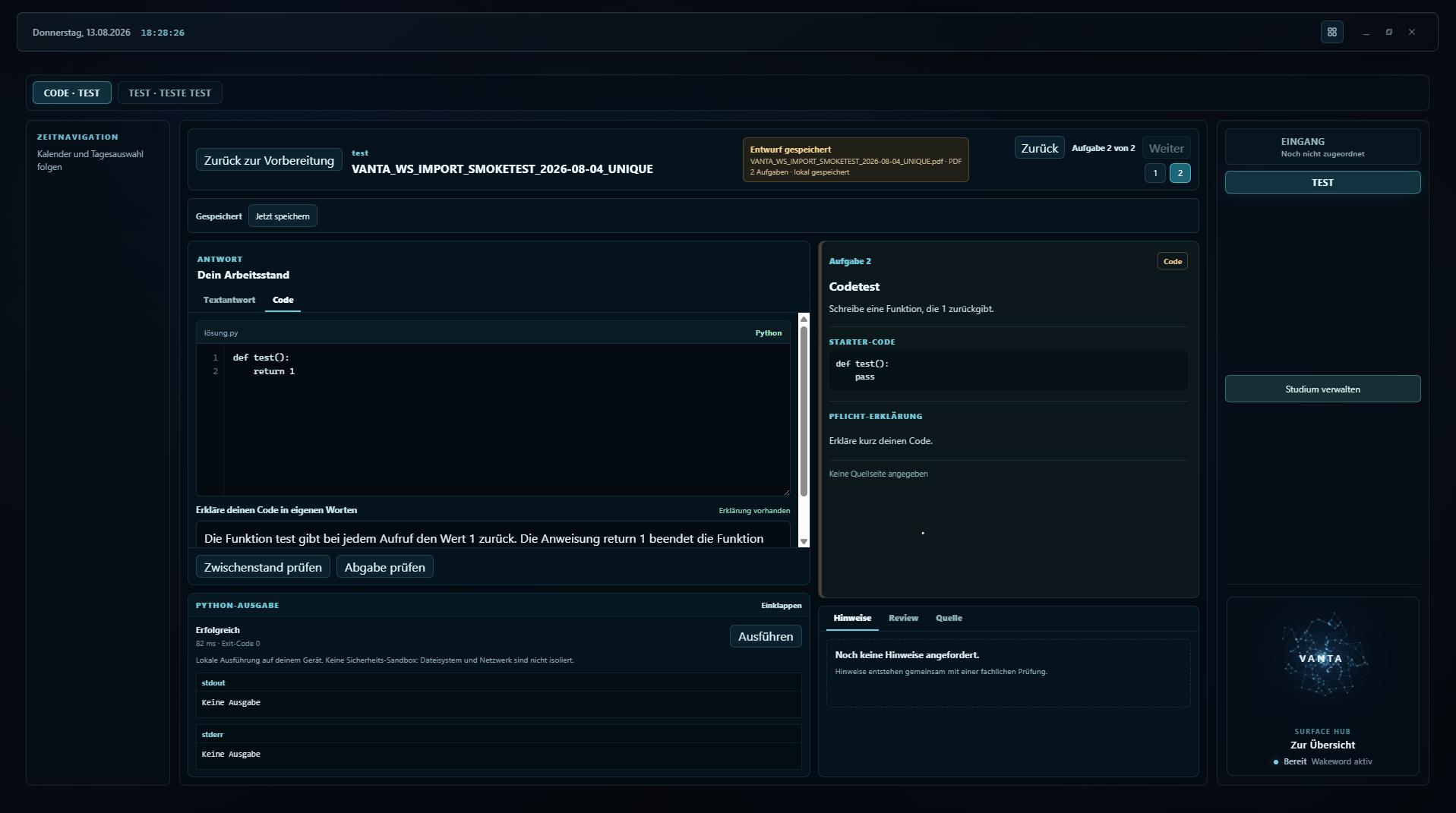
Solve persistent worksheet tasks, receive guided feedback, and execute Python locally with explicit runtime status and output.
-
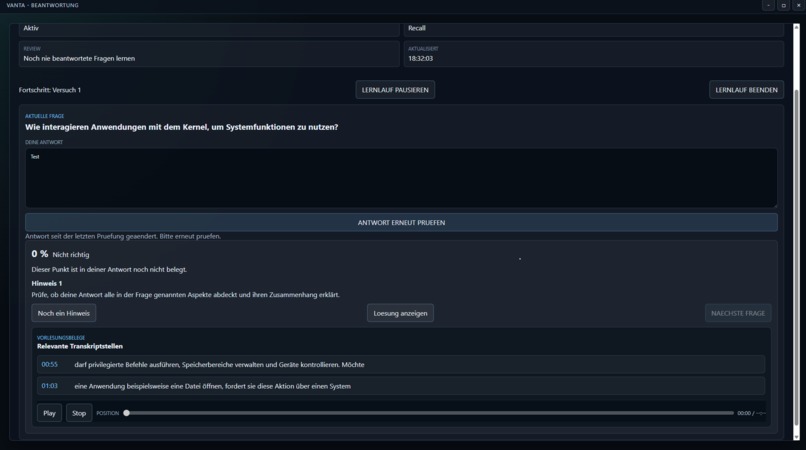
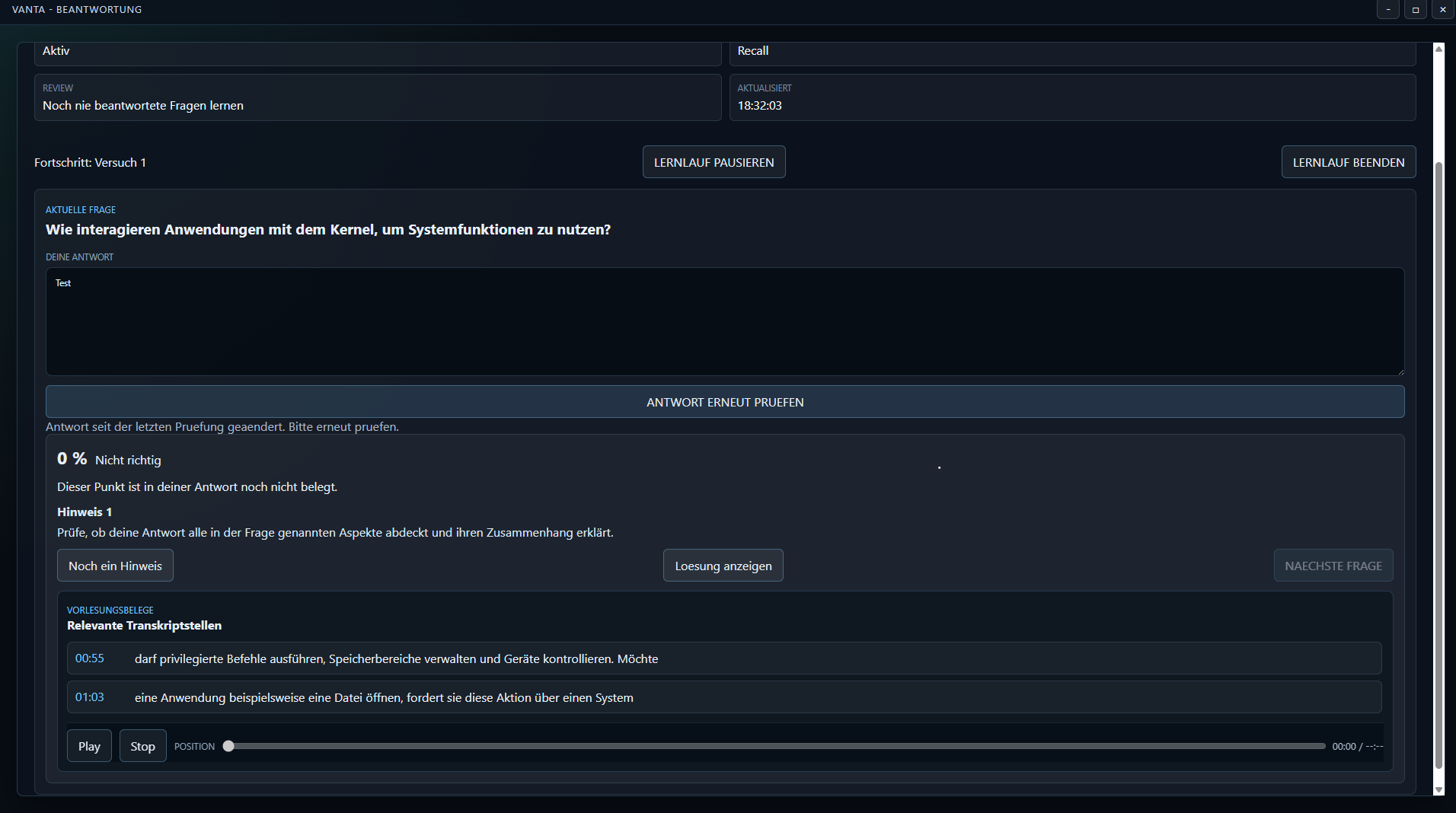
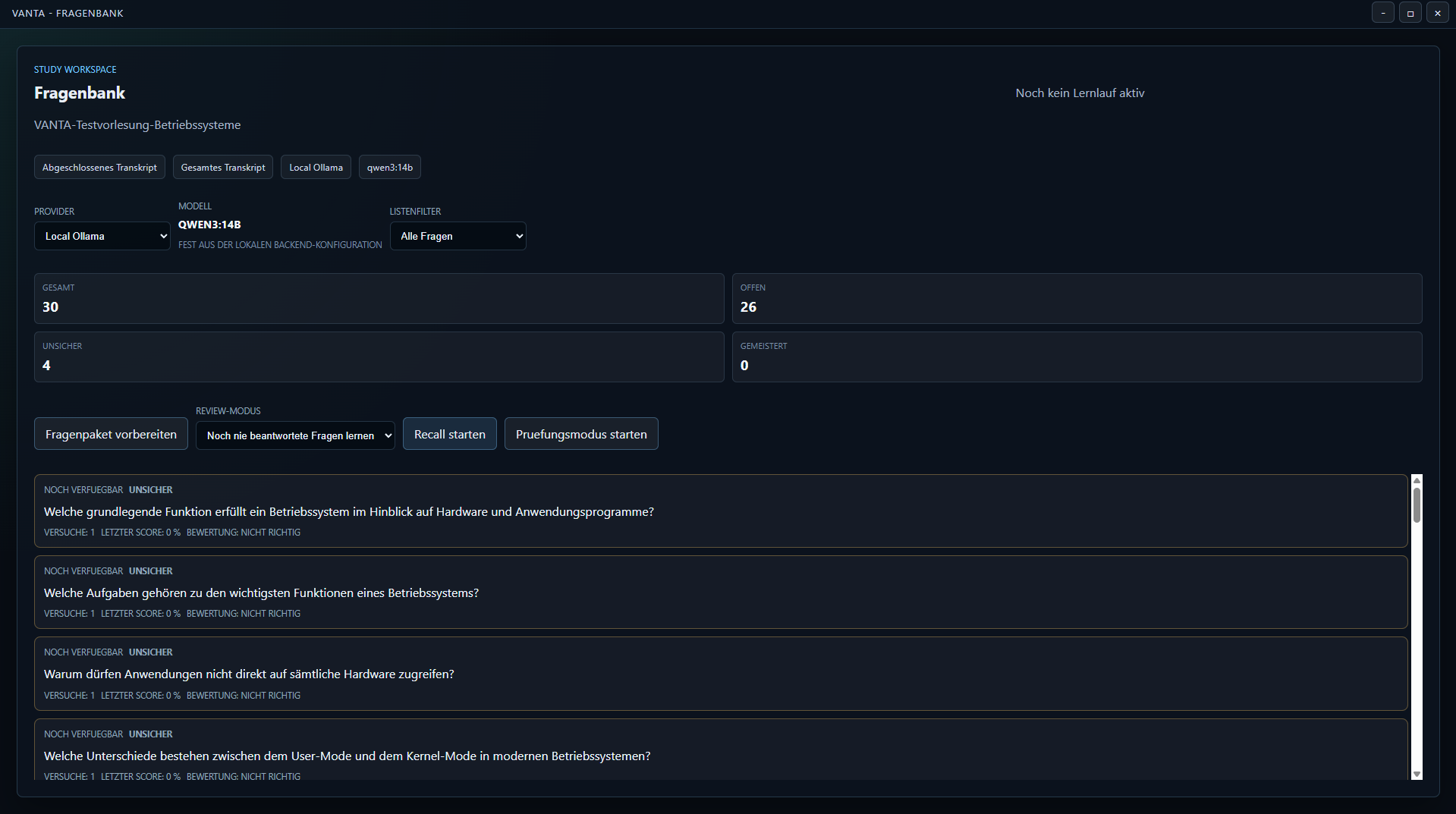
Active recall with editable answers, progressive hints, stale-result protection, and transcript evidence linked back to the original lecture
-
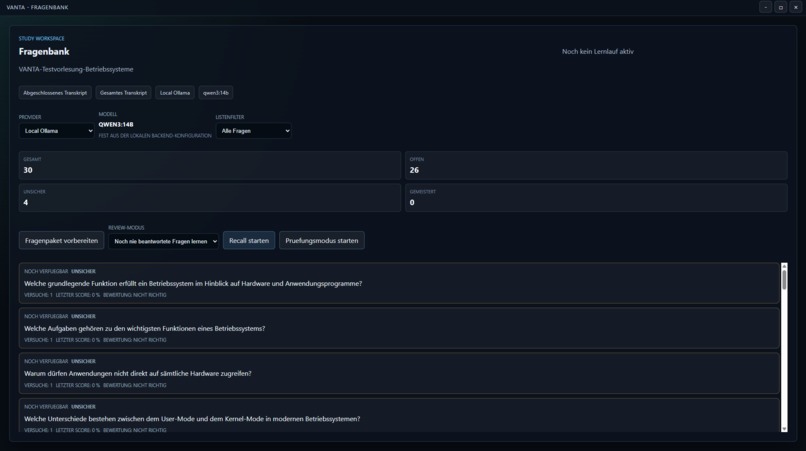
Persistent question bank with mastery tracking, weak-point review, recall mode, exam mode, and local Ollama integration.
-
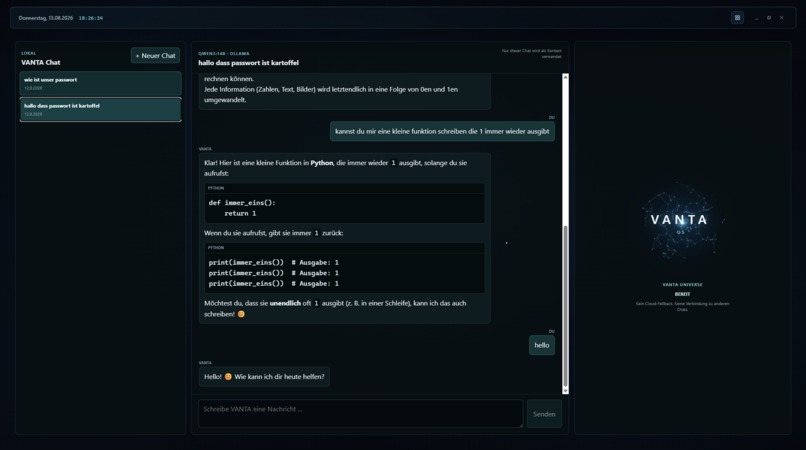
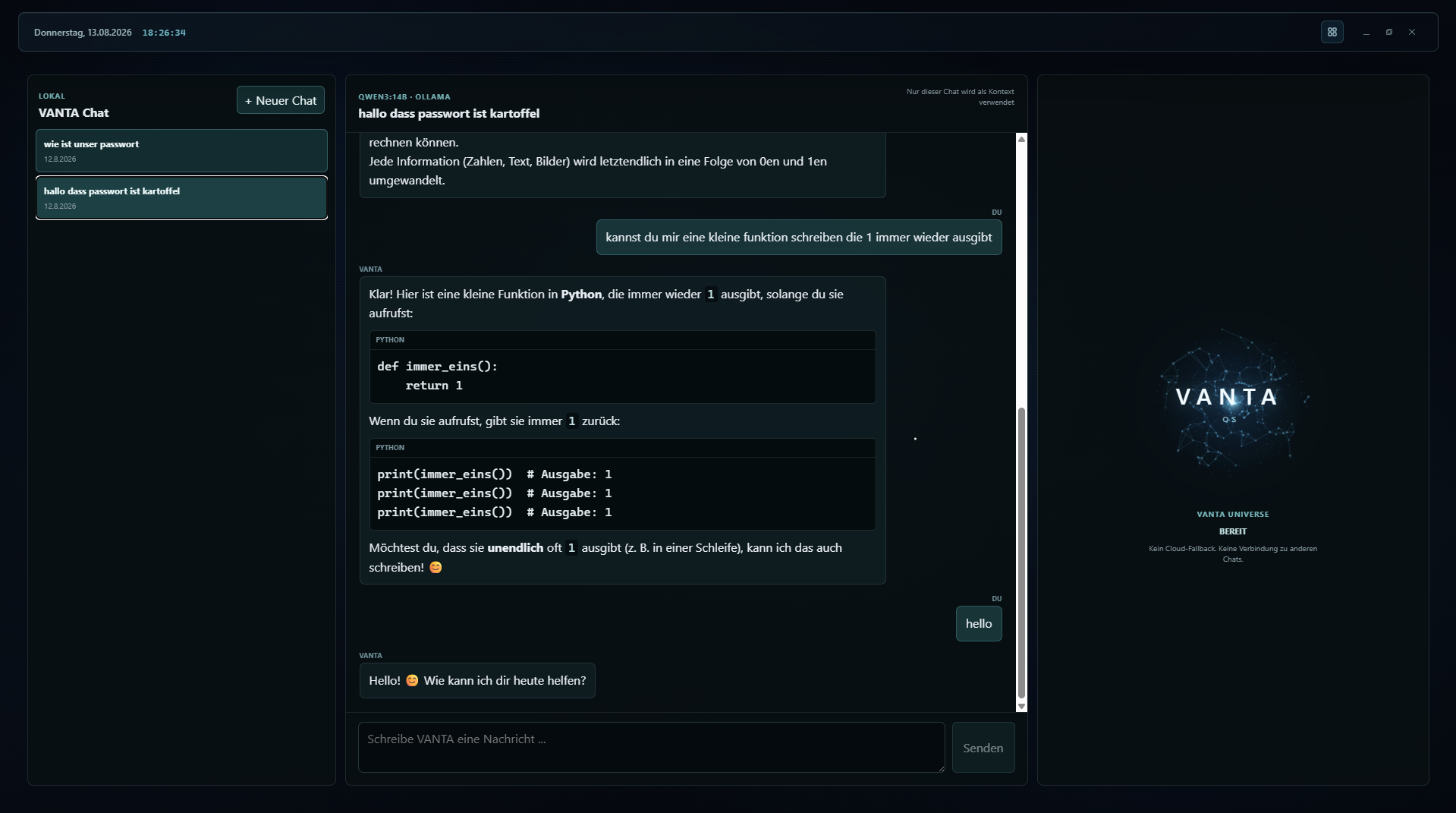
Persistent multi-chat powered by Ollama with isolated per-chat context, code rendering, and the VANTA Universe as a shared surface identity.
Inspiration
Most AI tools still live inside isolated chat windows. I wanted to explore a different idea: what if AI was not another app inside your workflow, but the environment around it?
VANTA.OS started as my personal attempt to build a JARVIS-like desktop assistant. Over time, it evolved into a local-first AI desktop environment with persistent workspaces, voice interaction, local tools and specialized surfaces that share one system instead of feeling like separate apps.
What it does
VANTA currently has three connected main surfaces:
Overview — the central VANTA environment and voice-controlled entry point. Study — a persistent academic workspace for semesters, courses, lectures, worksheets, recall and AI-guided review. VANTA Chat — a persistent local multi-chat interface powered by Ollama.
The Study workspace is currently the deepest example of the concept. Users can organize real course material, work through worksheets, save drafts, receive criterion-based feedback and progressive hints, build recall mastery and execute Python code locally.
The Python runtime is deliberately separated from AI evaluation. VANTA may academically review a solution, but only the local runtime determines whether the code actually executes successfully.
VANTA Chat follows the same local-first philosophy. Chats are stored locally, each conversation has its own isolated context, and the current implementation uses a local Ollama model without a cloud fallback.
How I built it
VANTA.OS is a Windows desktop application built with Tauri 2, Rust, React, TypeScript and SQLite.
Rust handles native application logic, local persistence, runtime execution and backend commands. React and TypeScript power the desktop interface and workspace state.
Local AI and audio components include Ollama, Whisper and OpenWakeWord.
A major architectural goal was to keep different kinds of authority separate:
deterministic application commands do not depend on an LLM guessing what action to execute AI review is separate from real code execution chat context is scoped to the selected conversation persistent user data is stored locally asynchronous results are checked so stale responses are not presented as current
The animated VANTA Universe is reused across the main surfaces, with shared transitions and only one active renderer at a time.
Challenges
The hardest parts were often not the AI calls themselves, but everything around them.
I had to solve problems such as:
keeping late asynchronous responses attached to the correct chat, task or window preventing an old successful Python run from being shown as current after the code changed handling Python timeouts, cancellation and inherited process pipes safely keeping multiple Study windows scoped to the correct session persisting and migrating local data without breaking existing workspaces separating model-generated academic evaluation from deterministic application truth maintaining the lifecycle of the animated VANTA Universe across surface transitions
Testing these edge cases became an important part of the development process.
Accomplishments that I'm proud of
I am most proud that VANTA now feels less like a collection of experiments and more like one connected environment.
A user can move from the central VANTA interface into Study, work inside a persistent course, solve a worksheet, receive hints, execute Python locally, practice recall, switch into a general local VANTA conversation and return without leaving the same application model.
VANTA Chat also made an important part of the original vision tangible: Study is not the entire product. It is one specialized surface inside a broader personal AI environment.
What I learned
Building VANTA taught me that useful AI software is about much more than choosing a model.
State ownership, persistence, race conditions, execution boundaries, security assumptions and user experience can matter just as much as model quality.
I also learned the value of keeping the architecture provider-agnostic and local-first where practical. AI models will continue to change, but the workflows and data contracts around them should remain useful.
What's next
VANTA is designed to grow through additional specialized surfaces rather than becoming one giant chat interface.
Future directions include richer voice conversation, controlled tool calling, explicit long-term memory, handwriting and tablet workflows, optional device synchronization and a more visual VANTA Universe navigation system.
The long-term goal is not to build a bigger chatbot.
It is to explore what a personal AI environment can become when conversation, tools, knowledge and workflows are designed as one system.
Built With
- ollama
- openwakeword
- python
- react
- rust
- sqlite
- tauri
- typescript
- vite
- whisper

Log in or sign up for Devpost to join the conversation.