-
-
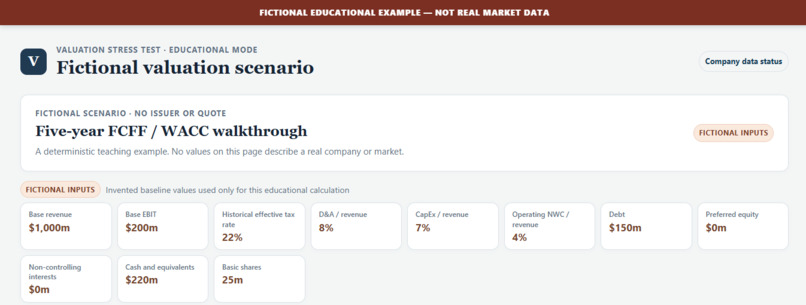
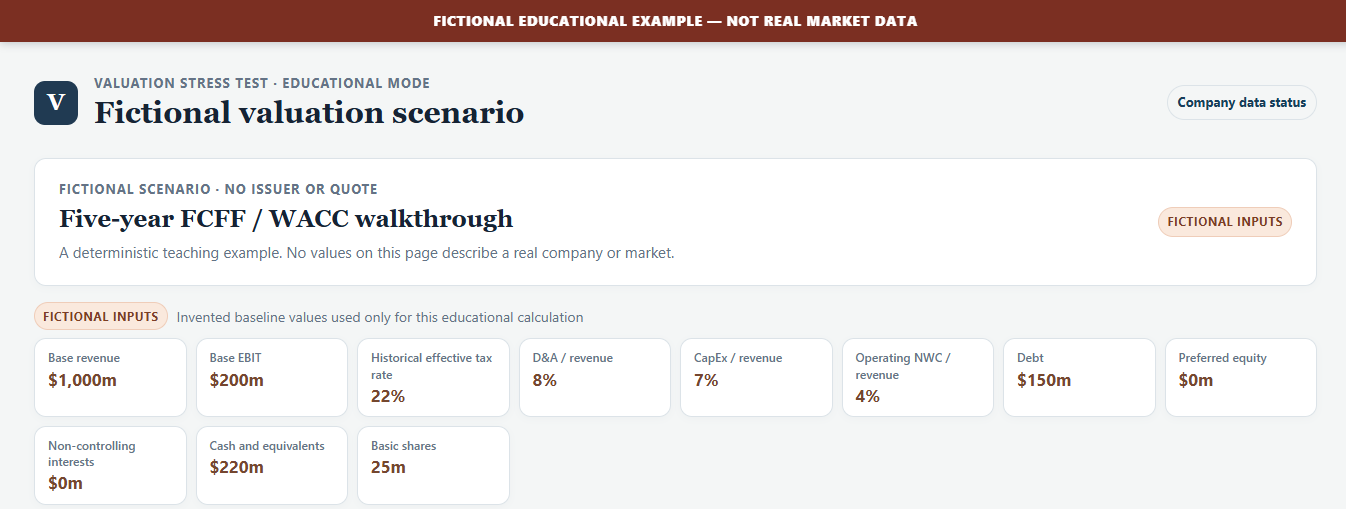
Shows the fictional scenario and baseline financial inputs.
-
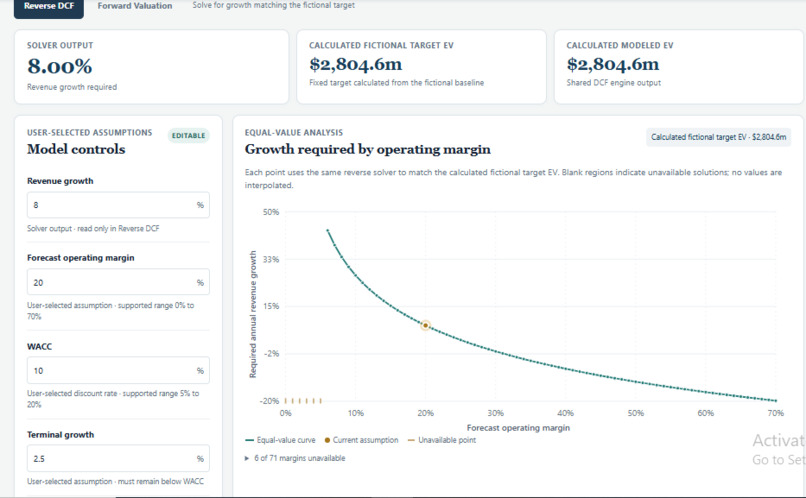
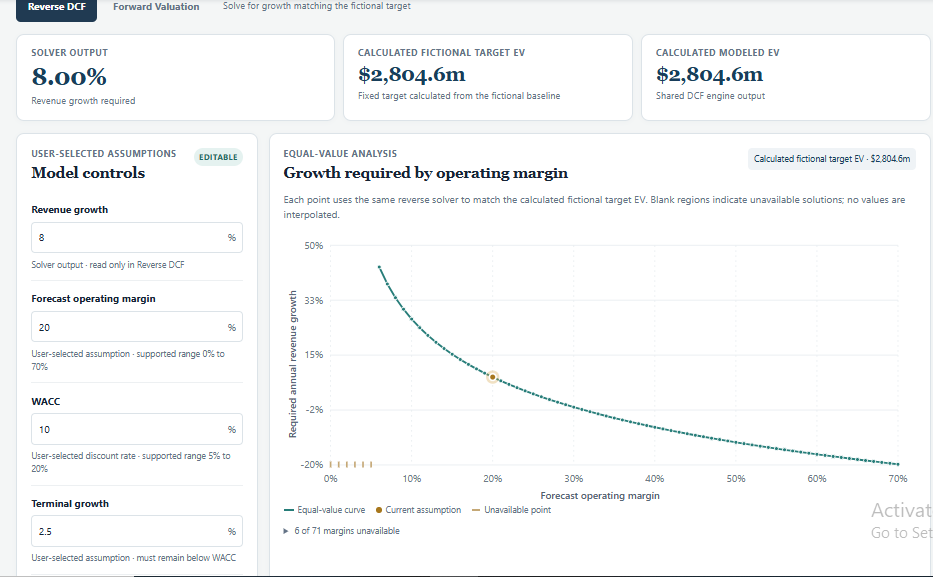
Shows implied revenue growth and the equal-value sensitivity curve.
-
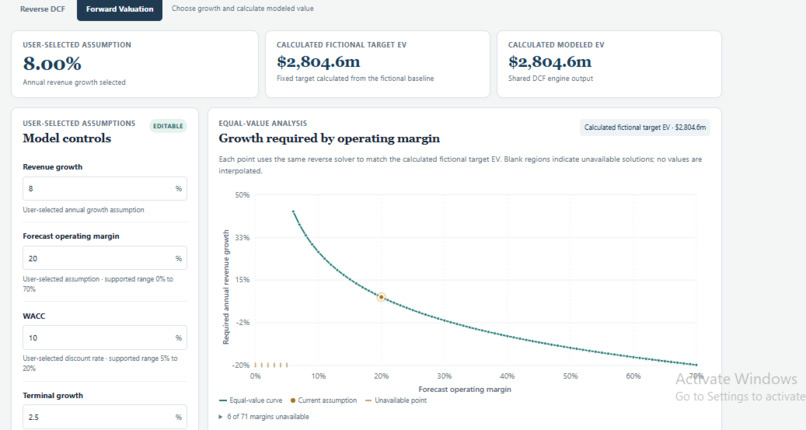
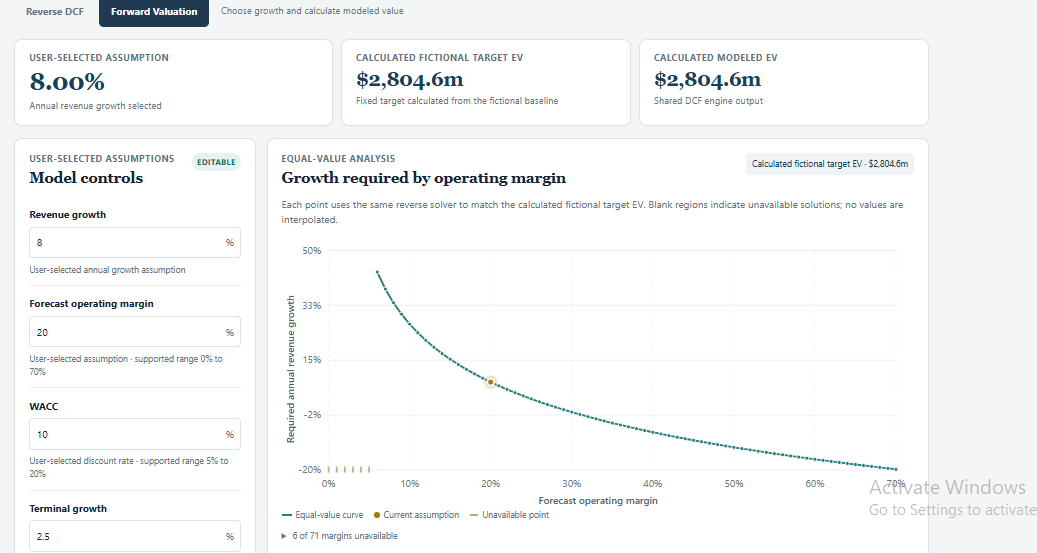
Shows how growth and operating margin assumptions determine enterprise value.
-
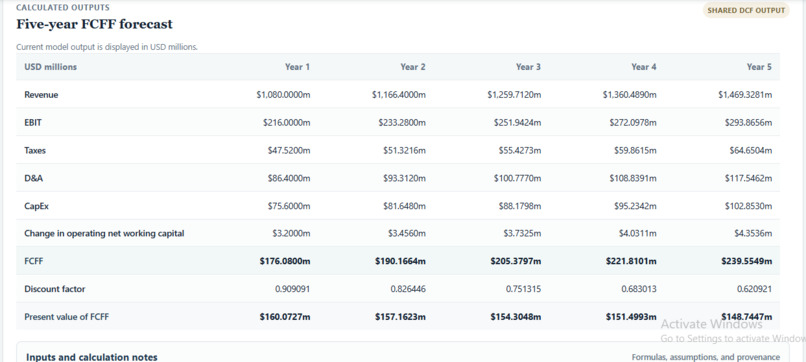
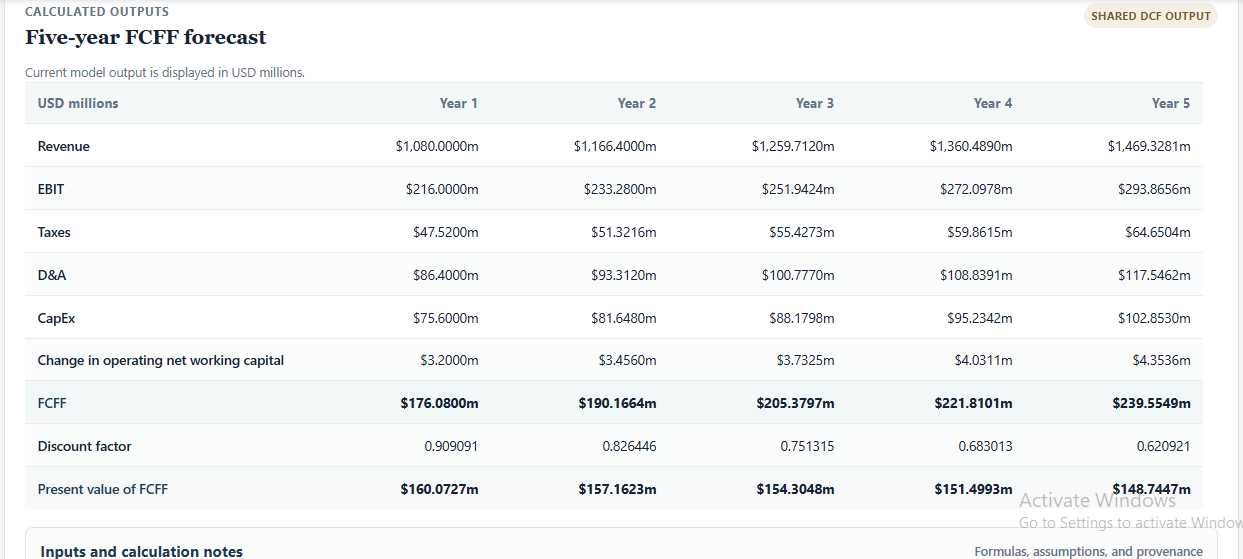
Shows projected revenue, EBIT, taxes, capital expenditures, FCFF, and discounted cash flows over five years.
-
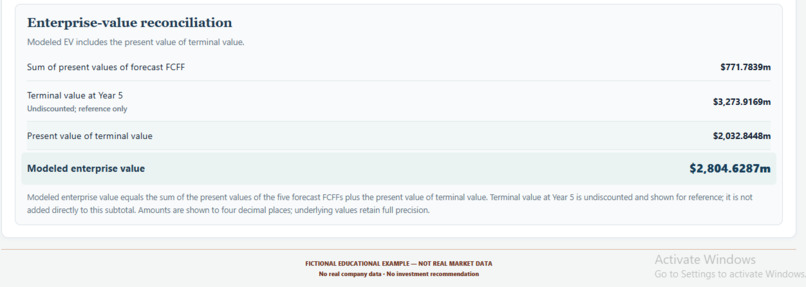
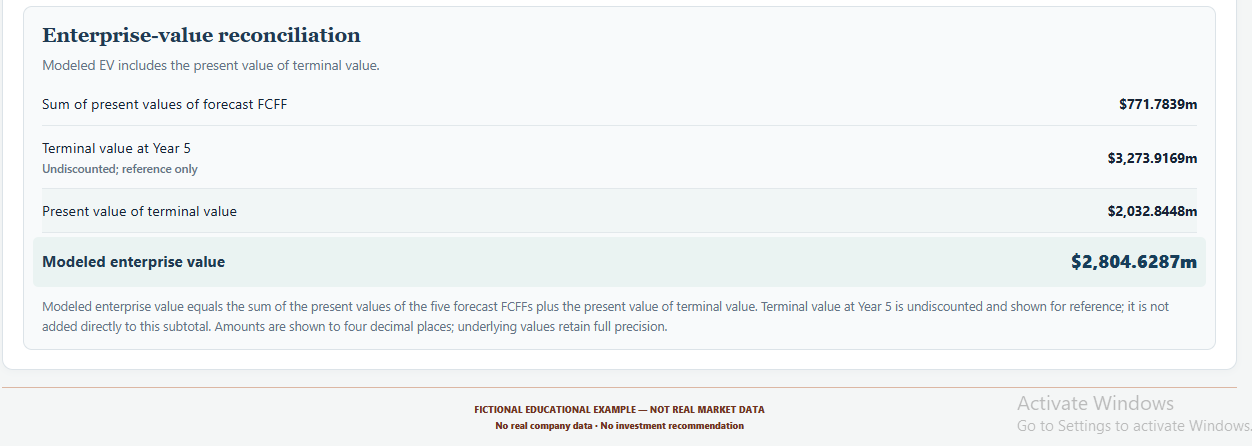
Breaks down modeled enterprise value into the present value of forecast cash flows and the present value of terminal value.
Valuation Stress-Test Engine
Inspiration
A company's valuation is not just a number produced by a financial model. It reflects assumptions about future growth, operating profitability, risk, and long-term performance.
I wanted to build a tool that helps users understand not only what a business might be worth, but also what assumptions would need to be true for that valuation to make sense.
This led to the Valuation Stress-Test Engine, an interactive financial modeling application that combines Forward DCF, Reverse DCF, and sensitivity analysis to help users explore the relationship between financial assumptions and enterprise value.
What It Does
The Valuation Stress-Test Engine provides an interactive environment for exploring business valuations and testing financial assumptions.
- Forward DCF: Estimates enterprise value using projected financial performance and discounting assumptions.
- Reverse DCF: Calculates the revenue growth rate implied by a target enterprise value, helping users understand the expectations embedded in a valuation.
- Sensitivity Analysis: Explores how different combinations of revenue growth and operating margin affect estimated enterprise value.
- Financial Input Validation: Detects invalid or non-finite inputs and prevents unreliable calculations from being presented as valid results.
- Enterprise-to-Equity Value Bridge: Shows how debt, cash, preferred equity, and non-controlling interests affect the transition from enterprise value to equity value.
The goal is to move beyond the question, “What is this business worth?” and encourage users to ask, “Which assumptions drive this valuation, and how sensitive is it to change?”
The current demo uses fictional financial inputs for educational purposes.
How I Built It
I developed the project as an interactive web application, using an AI coding assistant to help implement and refine the application.
The work involved building the DCF calculation engine, implementing a Reverse DCF solver, connecting the financial assumptions to the results and sensitivity analysis, and developing input validation to prevent misleading outputs.
I also focused on testing edge cases, including invalid inputs, non-finite calculations, solver limitations, and situations where certain valuation metrics are mathematically undefined.
Keeping the financial calculations, validation logic, and user interface consistent was an important part of making the application more reliable and understandable.
Challenges I Faced while building this project
One of the biggest challenges was obtaining and validating real-company financial data in a form that could be reliably used by the valuation engine.
Real-world financial information comes from different sources and reporting formats. Before it can be used in a valuation model, it may need to be extracted, standardized, mapped to the correct financial statement items, and checked for missing values, inconsistent units, and differences in reporting periods.
Without a dependable data pipeline, an automated valuation could produce a precise-looking result based on incorrect or incomplete information.
Rather than presenting unverified real-company valuations as trustworthy, I chose to use fictional financial inputs in the educational demo. This allows the valuation methodology to be demonstrated transparently while acknowledging that reliable real-company data integration remains an important challenge to solve.
Another challenge was making the model behave responsibly in unusual mathematical scenarios. For example, Reverse DCF must account for cases where a valid solution cannot be established, while metrics expressed as percentages can become undefined when enterprise value is zero.
These challenges reinforced the importance of validating both the financial data and the calculations that depend on it.
What I Have Learned
This project helped me connect financial analysis with software engineering and data validation.
I strengthened my understanding of discounted cash flow valuation, reverse valuation, sensitivity analysis, numerical solver behavior, and automated testing.
I also learned that a reliable financial application requires more than implementing formulas. It needs transparent assumptions, traceable inputs, appropriate validation, clear error messages, and tests that cover edge cases.
Working with an AI coding assistant also reinforced the importance of planning before implementation, reviewing generated code, and testing behavior rather than assuming that code is correct simply because it runs.
What's Next
The next major goal is to build a reliable real-company financial data pipeline and connect it to the existing valuation engine.
The future roadmap includes:
- Automated Financial Data Extraction: Retrieve company financial statements and relevant metrics from dependable, appropriately licensed sources.
- Data Normalization: Standardize currencies, units, reporting periods, and financial statement line items so that the inputs are consistent.
- Data Validation and Provenance: Detect missing or inconsistent data and retain information about the source, reporting period, and transformations applied to each input.
- Automated Valuation: Feed validated financial data into the existing Forward DCF and Reverse DCF models with less manual input.
- Real-Company Stress Testing: Explore alternative growth, margin, and discount-rate assumptions to understand how different scenarios affect estimated enterprise value.
The long-term vision is to evolve the Valuation Stress-Test Engine from an interactive educational prototype into a transparent, data-driven valuation analysis platform.
The objective is not simply to automate financial calculations. It is to make the data behind those calculations traceable, validated, and trustworthy, so users can understand not just the valuation result, but also the assumptions and evidence supporting it.
Built With
- ai-assisteddevelopment
- automated-testing
- data-validation
- dcf-valuation
- financial-analysis
- financial-modeling
- git
- github
- next.js
- node.js
- react
- reverse-dcf
- sensitivity-analysis
- tailwind-css
- typescript
- vercel
- vitest

Log in or sign up for Devpost to join the conversation.