-
-
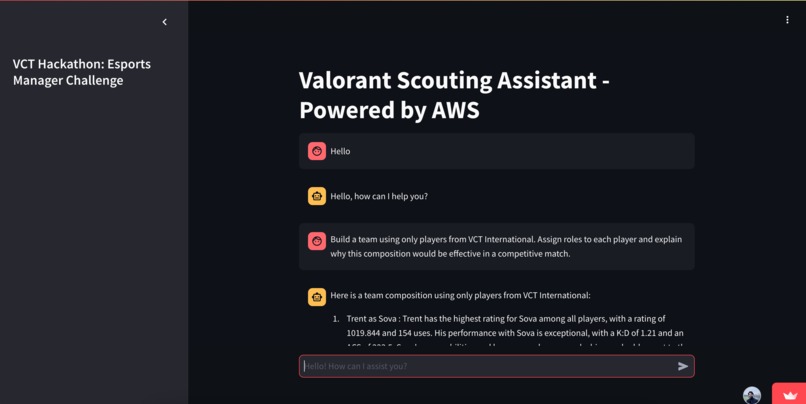
Valorant Scouting Assistant Chat
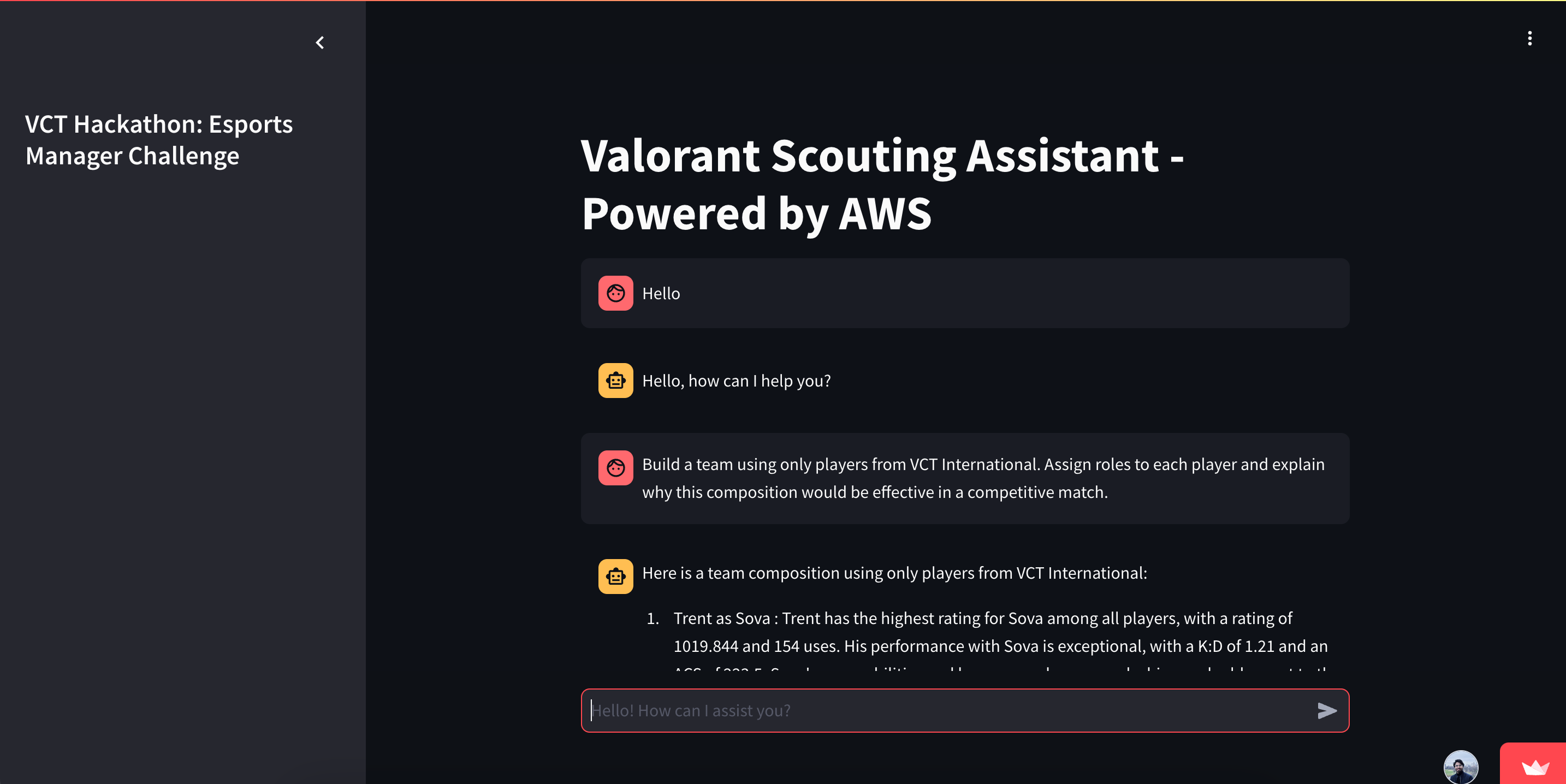
Inspiration
The VALORANT Esports scene has rapidly grown into one of the most exciting competitive gaming landscapes, captivating us with its blend of tactical gameplay, intense gunfights, and strategic use of agent abilities. As avid VALORANT players and fans, we've spent countless hours enjoying the game's fast-paced action, mastering agents, and keeping up with the latest tournament results. Our deep connection to the game and its competitive scene fueled our enthusiasm for this project, inspiring us to create a digital assistant that could genuinely impact how teams are built and scouted.
Our passion for VALORANT isn't just about playing the game—it's about fully immersing ourselves in the community, understanding the nuances of high-level play, and watching the meteoric rise of esports talents. This appreciation for the game motivated us to design an AI-powered tool using Amazon Bedrock’s capabilities, aiming to streamline the recruitment process and assist teams in identifying and selecting top talent. By leveraging large language models (LLMs) for effective information retrieval and data analysis, we set out to bring the same energy and passion we have for VALORANT into a tool that can support the growth and development of teams across the scene.
What it does
The VALORANT TeamBuilder: AI-Powered Esports Scouting Assistant is an AI-powered digital assistant designed to support team managers and scouts in building optimal rosters. Key functionalities include:
Player Data Retrieval: Gathers player statistics, past performances, and scouting reports from esports data sources (such as vlr.gg). Team Composition Analysis: Evaluates existing rosters and recommends the best team compositions based on a mix of skill metrics, play styles, and agent preferences. Player Comparisons: Allows scouts to compare players across different metrics (e.g., kill/death ratio, agent versatility, tournament experience). Q&A Functionality: Answers questions about individual players, teams, and tournament history, providing data-driven insights for team-building strategies.
How we built it
Data Integration: We integrated esports data from approved Riot sources such as VLR.gg, including player stats, match history, and agent usage. This was stored in a knowledge base accessible by the LLM. Amazon Bedrock: Leveraged Amazon Bedrock’s capabilities to train a small, cost-effective LLM with Agents for specific tasks like player scouting, Q&A, and team composition analysis. Knowledge Bases: Created structured data repositories for player statistics, tournament data, and agent information to improve retrieval accuracy. Chat Interface: Built a chat interface for the digital assistant, allowing users to interact with it and access various functionalities.
AWS Services Used: Amazon Bedrock: For hosting and training LLM-powered agents. Amazon S3: To store raw esports data.
Challenges we ran into
Data Integration: Integrating various esports data sources while ensuring data quality and consistency was a significant challenge. Cost Optimization: Finding the balance between model performance and cost-efficiency required careful configuration of Amazon Bedrock settings. Model Fine-Tuning: Ensuring the LLM provided accurate and relevant player insights without hallucinating required iterative fine-tuning.
Accomplishments that we're proud of
Effective Team-Building Tool: Created a powerful assistant that can recommend team compositions and scouting strategies based on in-depth player analysis. User-Friendly Chat Interface: Developed an intuitive and interactive interface, enabling users to easily access the digital assistant’s capabilities. Scalable Solution: Built a solution that can be expanded to other esports titles, potentially revolutionizing how teams approach talent acquisition across the industry.
What we learned
Esports Data Dynamics: Gained a deeper understanding of how player performance metrics and tournament data can influence scouting decisions, allowing us to create more insightful and relevant outputs for team managers and scouts.
Cost-Effective AI Practices: Learned to optimize LLM usage on Amazon Bedrock to keep the solution cost-effective while maintaining high-quality results, finding the right balance between model performance and operational expenses.
Iterative Model Development: Fine-tuning the LLM’s performance required continuous iteration and testing with different model configurations, as we adjusted the model to provide accurate and data-driven insights for the VALORANT esports scene.
Adapting to New Software: This project also required us to quickly adapt to new tools and services, such as Amazon Bedrock and various AWS offerings. As newcomers to these technologies, it was both a challenging and rewarding experience to learn how to use their full potential. The hands-on approach allowed us to dive into the practical aspects of integrating AI services and managing cloud infrastructure, making the entire process a fun and immersive learning journey. We embraced the steep learning curve and took every opportunity to deepen our understanding of the tools while applying them creatively to solve real-world esports challenges.
This not only expanded our technical skills but also enhanced our appreciation for cloud-based AI development, making the experience both an educational and enjoyable endeavor.
What's next for VALORANT TeamBuilder: AI-Powered Esports Scouting Assistant
AI-Powered Esports Scouting Assistant involves several exciting developments. We plan to expand the range of data sources integrated into the system, allowing for even more comprehensive and accurate scouting insights. In addition, we aim to incorporate AI-powered video analysis to evaluate player performance with greater precision, enabling the assistant to provide deeper context to statistical data. We also envision adding custom user profiles, which will allow users to create tailored recommendations based on their specific scouting preferences or team requirements. Beyond VALORANT, we see potential in broadening the assistant’s functionality to support other esports titles, such as League of Legends or Counter-Strike, ultimately making it a versatile tool across the competitive gaming industry.


Log in or sign up for Devpost to join the conversation.