
Inspiration
The idea for Valora came from watching the problem happen firsthand.
At the organization where I work, the finance team would spend extra hours manually reviewing invoices before payments could be processed. They had to check VAT, withholding tax, invoice totals, calculations, and whether the amount being paid was correct.
It was not a hypothetical business problem. It was repetitive work happening in front of us every month.
We believed AI could reduce that burden while keeping humans in control of the final decision.
Development of Valora Invoice Checker started in June 2026, and the product launched publicly on July 1, 2026.
What it does
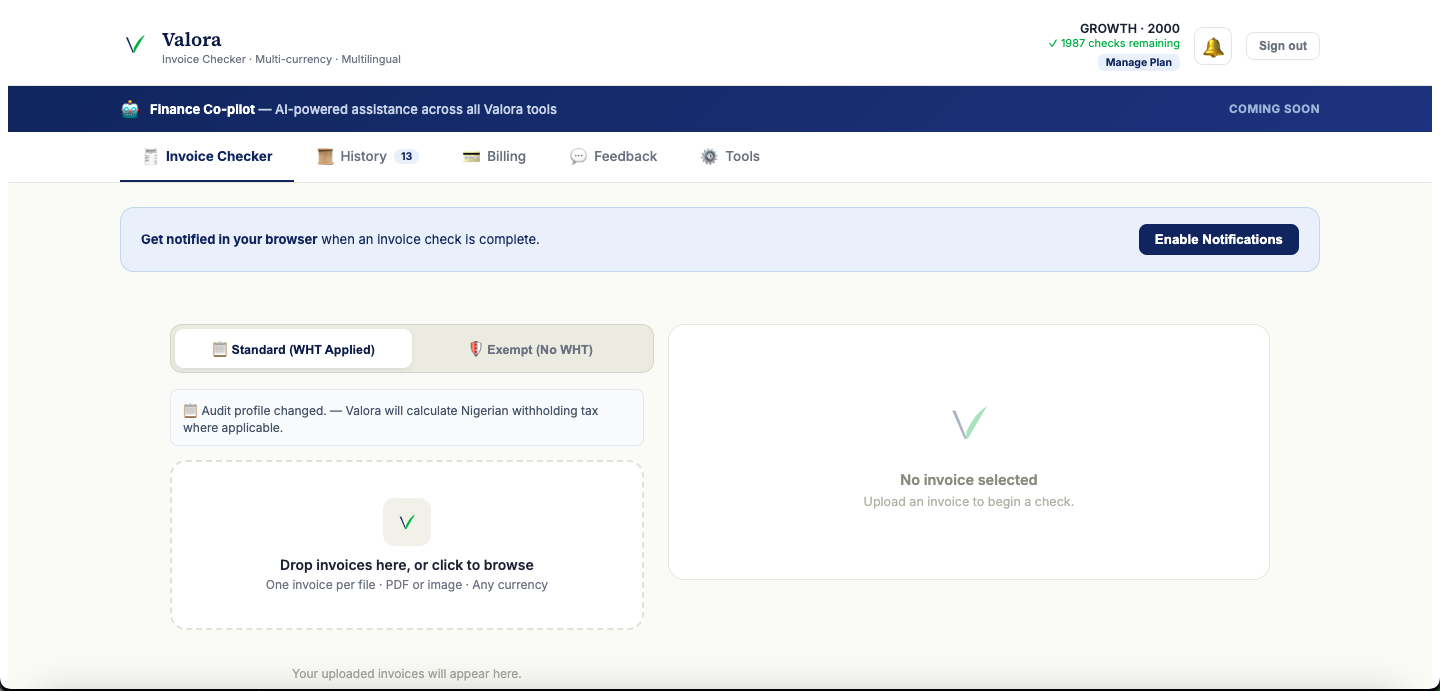
Valora Invoice Checker is an AI-powered invoice verification tool for businesses.
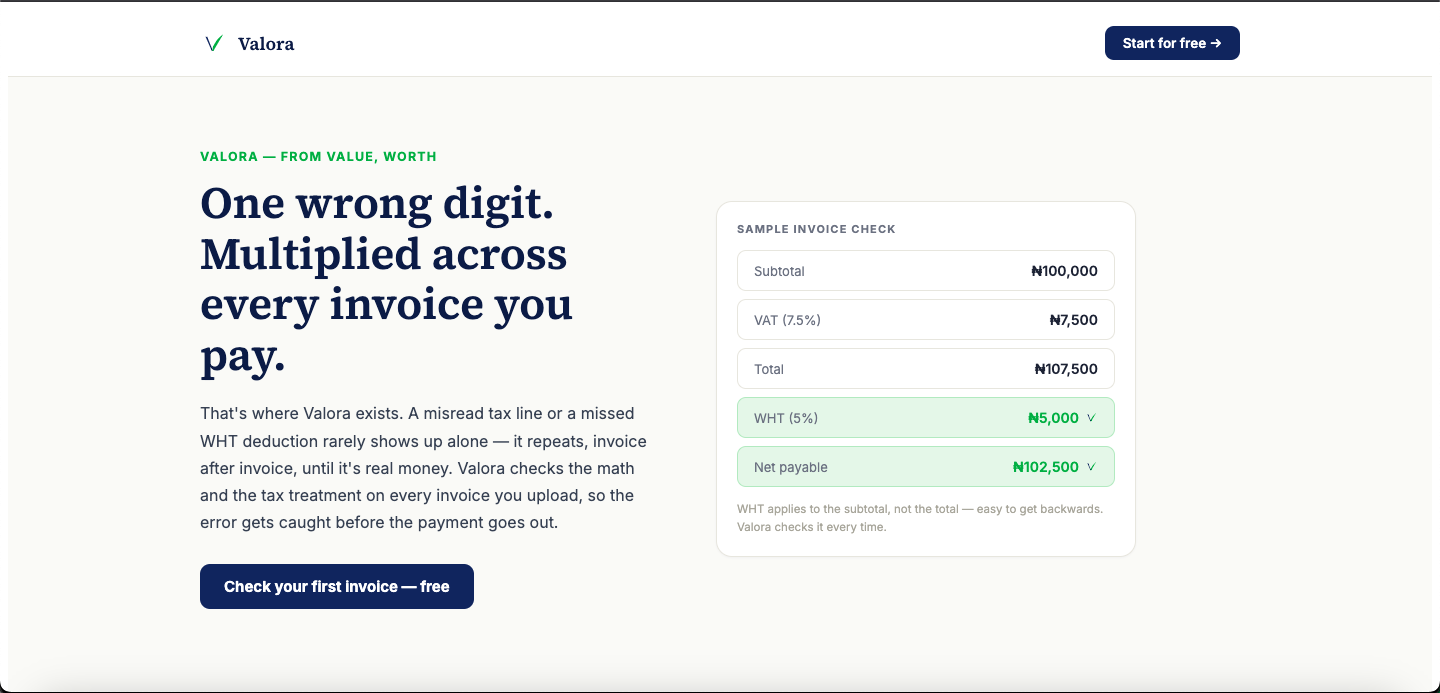
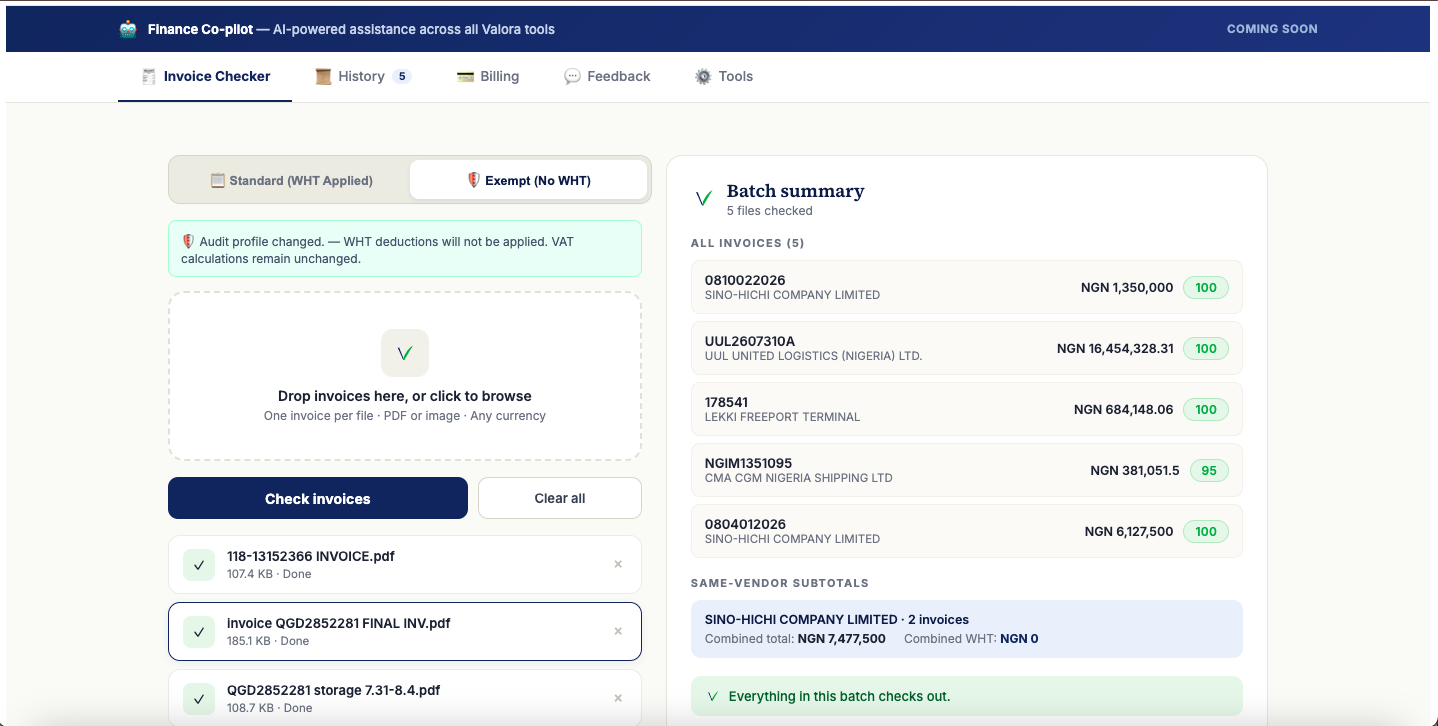
A user uploads an invoice, and Valora analyzes the document and checks areas including VAT, withholding tax, calculations, totals, and potential payment inconsistencies.
The goal is not to replace accountants or finance teams. Valora acts as an additional verification layer that helps users identify issues faster and understand what may need further review before money is paid.
An important part of the product is explanation. When Valora identifies an issue, the goal is to help the user understand why it was flagged rather than simply presenting a different number.
How we built it
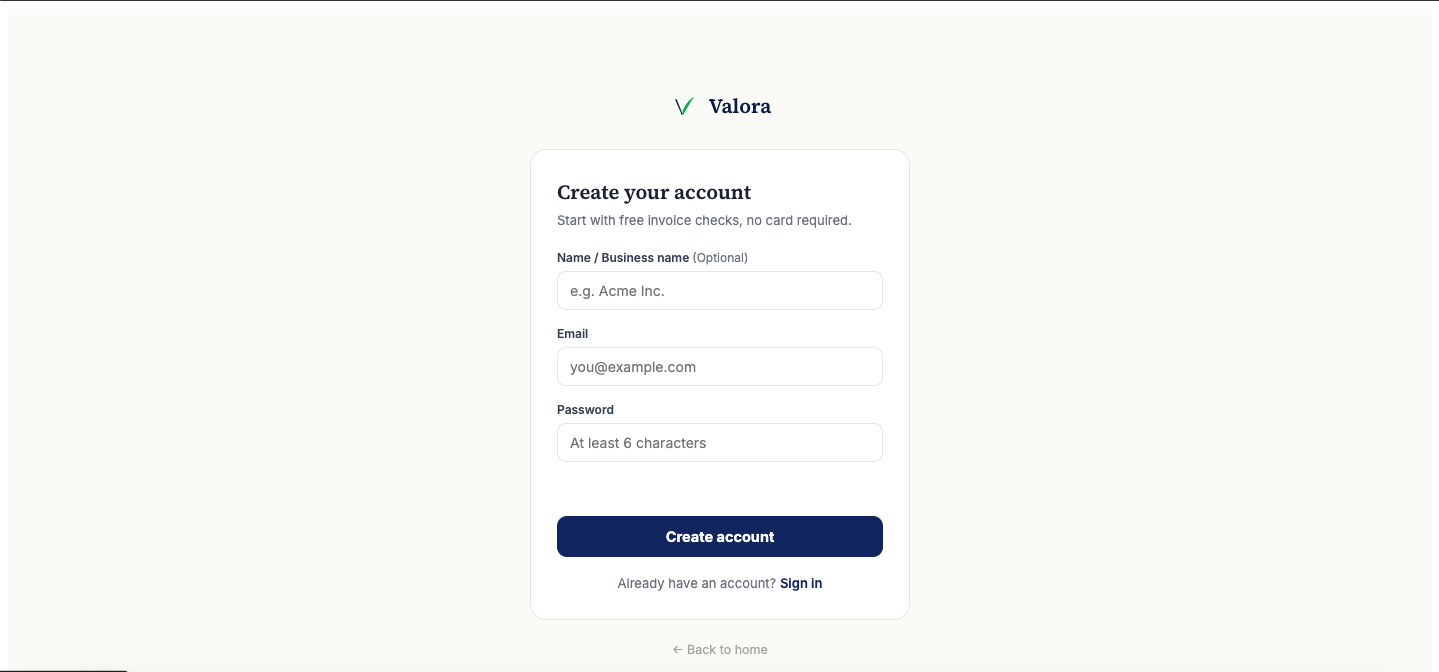
Valora is built as a web application with a React frontend and a Node.js/Express backend.
The AI layer uses Google Cloud Vertex AI and Gemini for multimodal invoice analysis and structured information extraction. The extracted information is then passed through deterministic verification logic designed around Nigerian tax and mathematical checks.
This combination was deliberate. AI is useful for understanding invoices and handling varied document structures, while deterministic rules provide a second layer for calculations and verification.
The production system uses Turso for database storage, Redis for caching, Cloudflare for the frontend and edge layer, Hetzner Cloud for backend infrastructure, Paystack for payments, and Resend for transactional email.
After the initial launch, we used real user feedback to improve the verification logic and make the results more useful.
Challenges we ran into
The biggest challenge has been making invoice verification both intelligent and reliable.
Invoices are not always structured the same way, and Nigerian tax treatment can include edge cases where the correct treatment depends on the transaction or context. A useful system therefore cannot rely on one fixed calculation for every invoice.
We addressed this by combining AI-powered document analysis with deterministic verification logic and by using feedback from real users to identify where the logic needed to become more precise.
The first release helped us discover these gaps. We then tightened the calculation and verification logic and released an improved version.
Another challenge has been reaching the right users. The people who experience this problem most directly are often working in finance, procurement, logistics, and operations rather than spending their time looking for tools online. This has made direct outreach and organizational validation an important part of our approach.
Accomplishments that we're proud of
We are proud that Valora moved from an observed problem to a live product in a short period of time.
Since the July launch, we have put the product in front of real users, collected feedback, identified weaknesses in the verification process, and improved the logic based on what we learned.
The finance team at the organization where I work has provided practical feedback and used the product as part of our validation process.
We have also begun conversations outside our immediate network. We are currently in discussion with UNI-MEDICAL after an introduction to its business manager, with additional outreach and conversations developing with other organizations. Community and church outreach has also created opportunities to introduce Valora to business owners and people involved in finance and operations. A youth leader who learned about the product also asked us to present it to a wider audience.
These conversations have given us early validation that the problem extends beyond the environment where the idea originated.
What we learned
Our biggest lesson has been that building an AI product for financial workflows requires continuous feedback.
The first version showed us what worked, but real users also exposed situations where the verification logic needed to be more precise. That feedback directly influenced the second release.
We also learned that accuracy alone is not enough. Users need to understand why something has been flagged so they can make an informed decision.
Most importantly, we learned that AI should support the person responsible for the financial decision, not remove their judgment from the process.
What's next for Valora Invoice Checker
With the current paid version now live, our next focus is expanding organizational outreach and getting Valora into the hands of more businesses in finance, procurement, logistics, and related operations where invoice verification is a recurring problem.
We also plan to expand Valora beyond invoice verification into a broader set of financial and compliance tools, while exploring integrations with the ERP, accounting, procurement, and other business systems companies already use.
We will continue improving Valora through real customer feedback, especially around Nigerian tax edge cases and more complex invoice scenarios.
The long-term goal is to make Valora a reliable verification layer across business financial workflows, making those processes faster, clearer, and more reliable while keeping people in control of the decisions that matter.
Built With
- cloudflare-pages
- express.js
- gemini-2.5-flash
- google-cloud-vertex-ai
- hetzner
- javascript
- node.js
- paystack
- react-19
- redis
- resend
- turso-(libsql/sqlite)


Log in or sign up for Devpost to join the conversation.