-
-
-
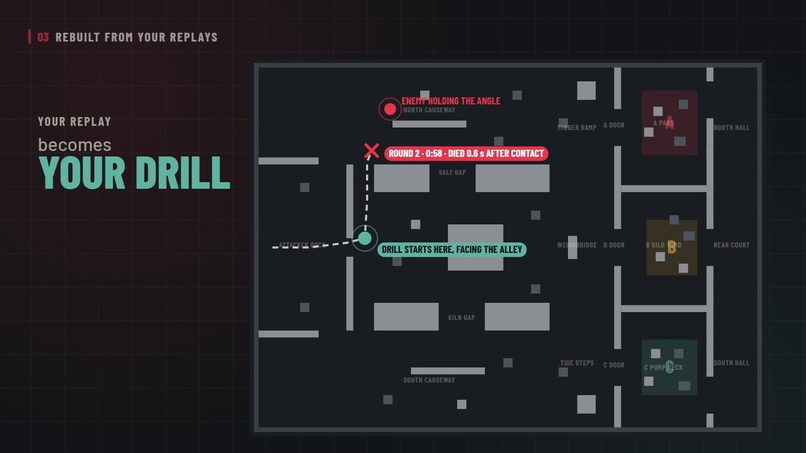
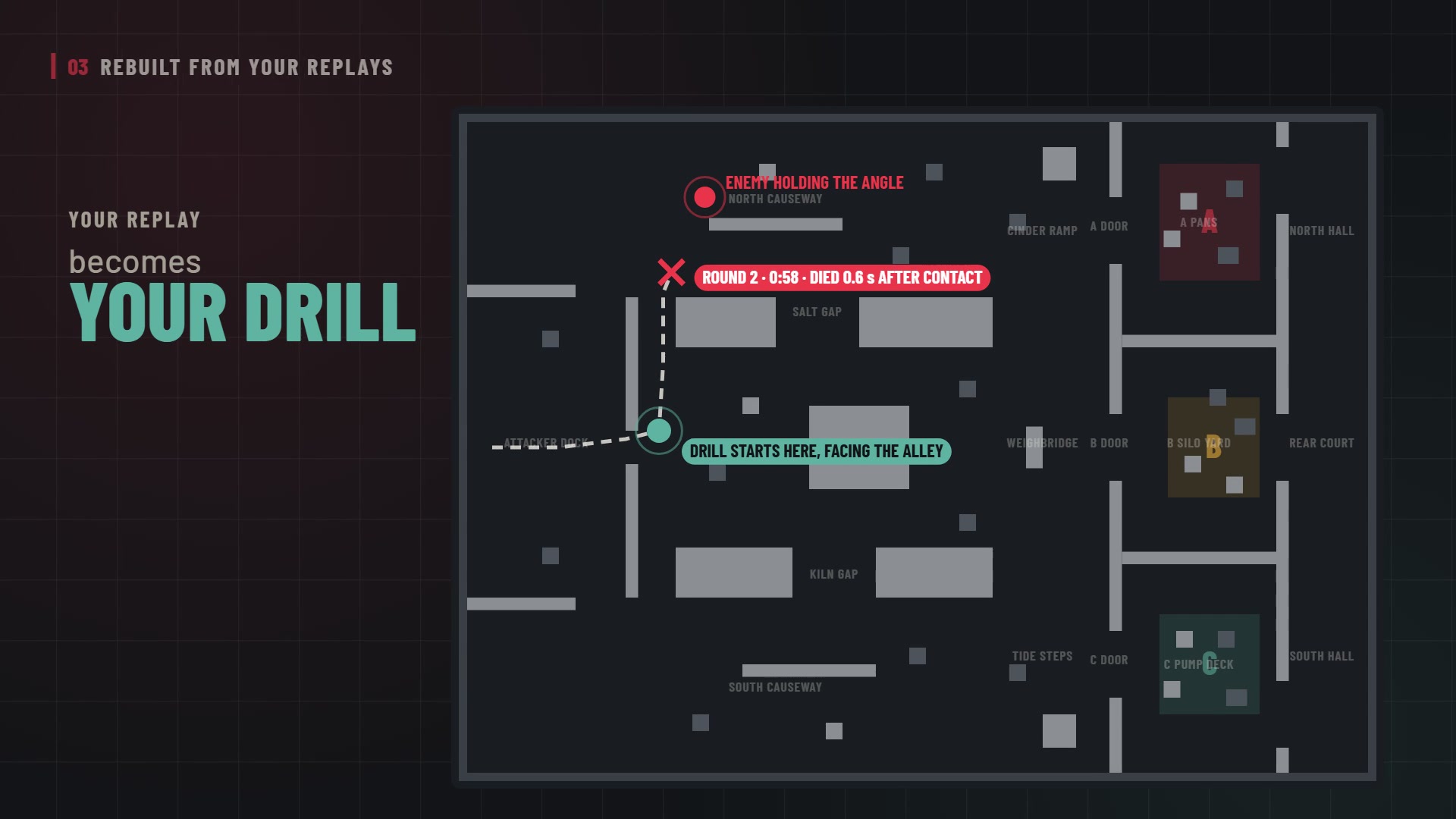
Replay becomes your drill (map)
-
-
-
-
-
-
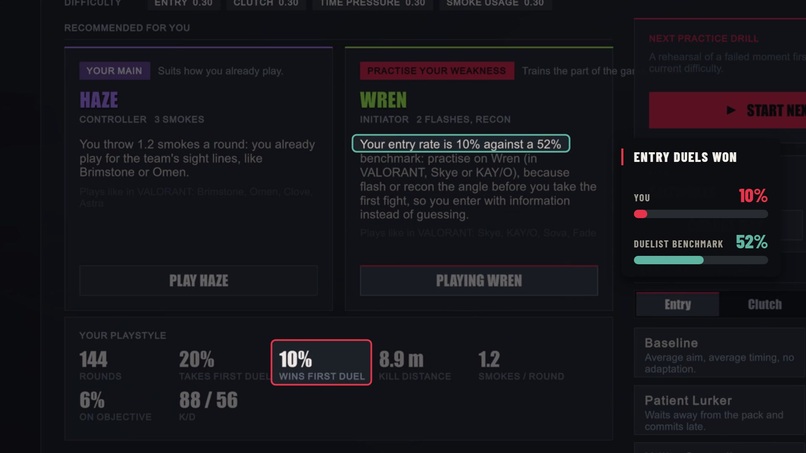
Weakness report with the 10% vs 52% evidence bars
-
Inspiration
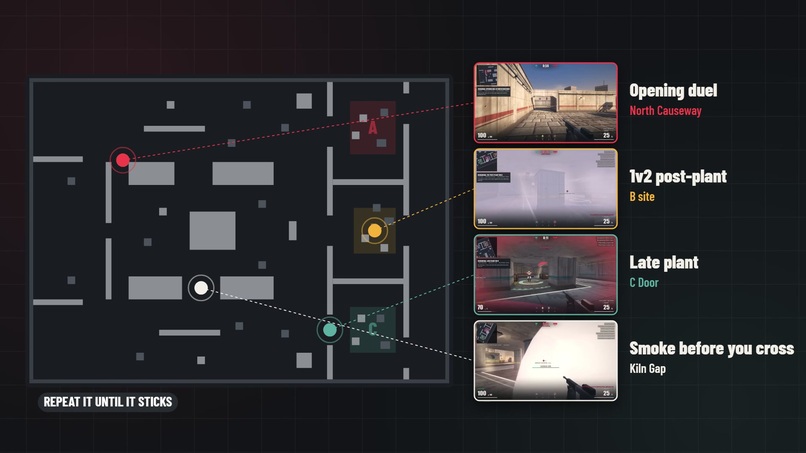
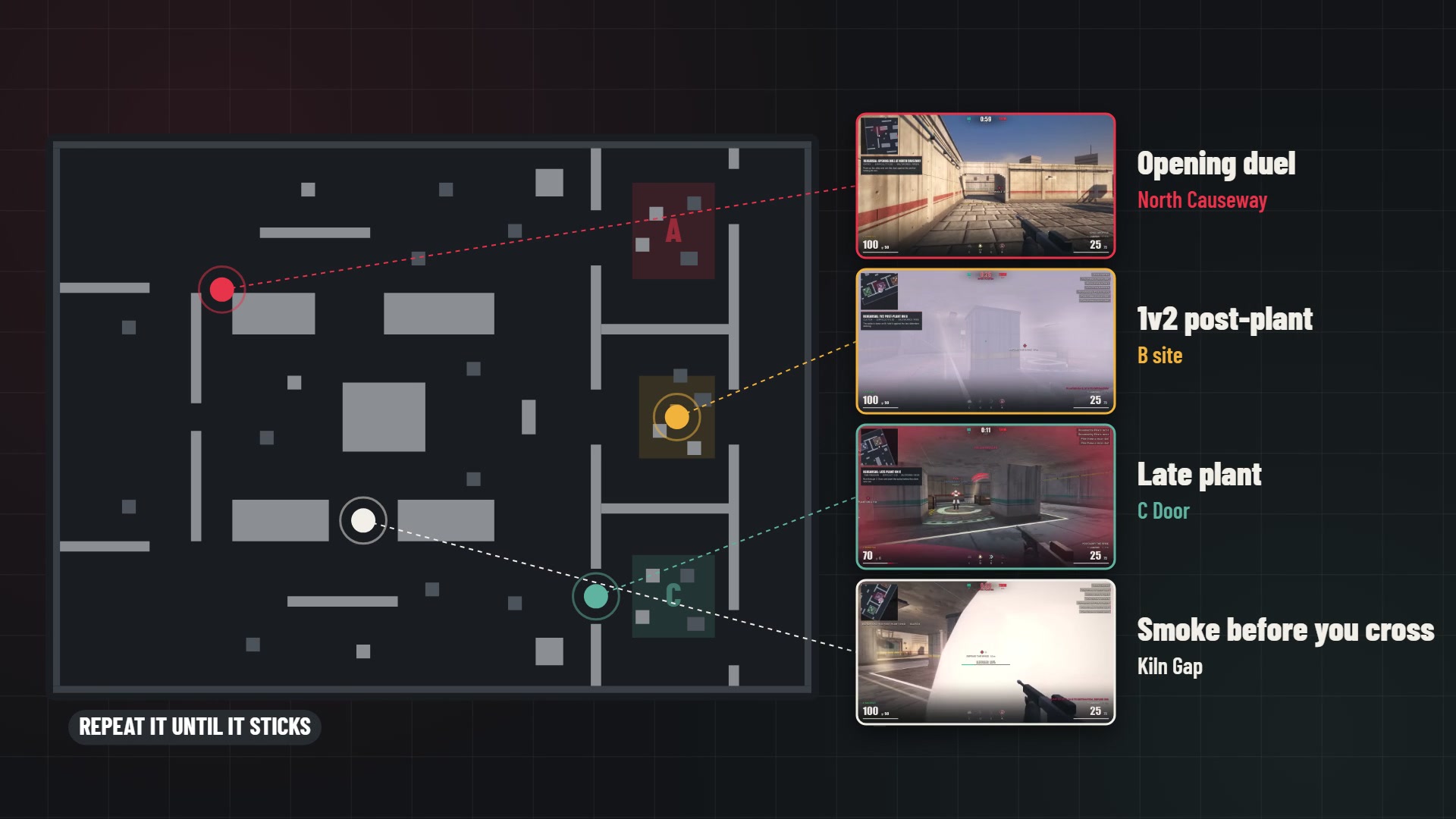
Every player knows the feeling: you lose the same round the same way, again and again. The same angle, the same swing, the same death. You don't lose rounds to aim alone. You lose to situations: the opening duel into a held angle, the 1v2 after the plant, the late plant with seconds left, the cross you didn't smoke.
Aim trainers never recreate those moments. Deathmatch doesn't either. The only way to practise a situation is to wait for it to happen again in a real match, and lose it again. We wanted a tool that takes the exact moment you lost and hands it back to you as a drill.
What it does
ValoDrill turns the rounds you lose into drills, rebuilt from your own matches, against bots that play like people.
- Read: it reads your match logs: every duel, death, plant and smoke.
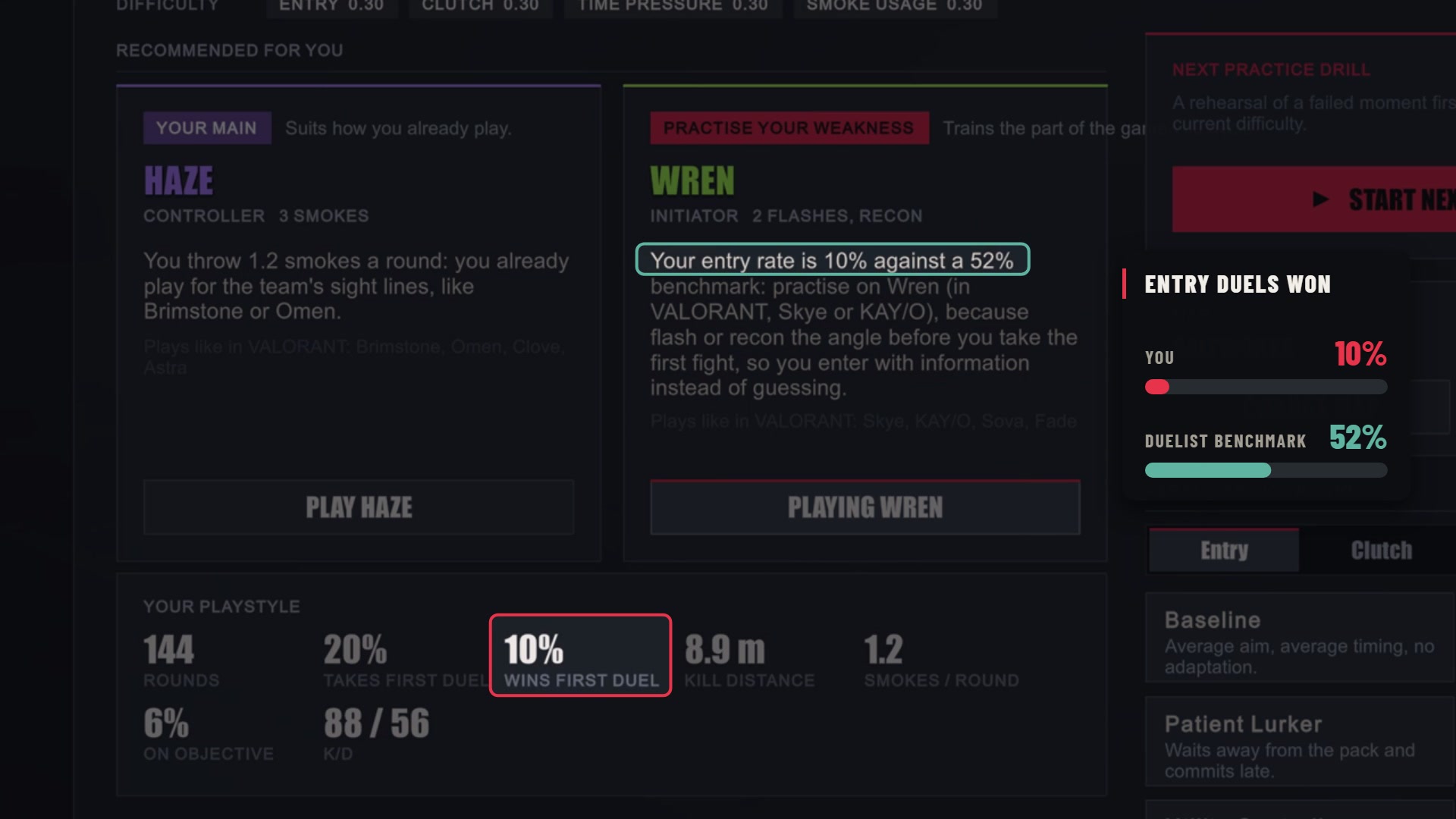
- Diagnose: it finds the situation you lose most, and shows the evidence. For example: entry duels, 10% won against a 52% benchmark for a duelist.
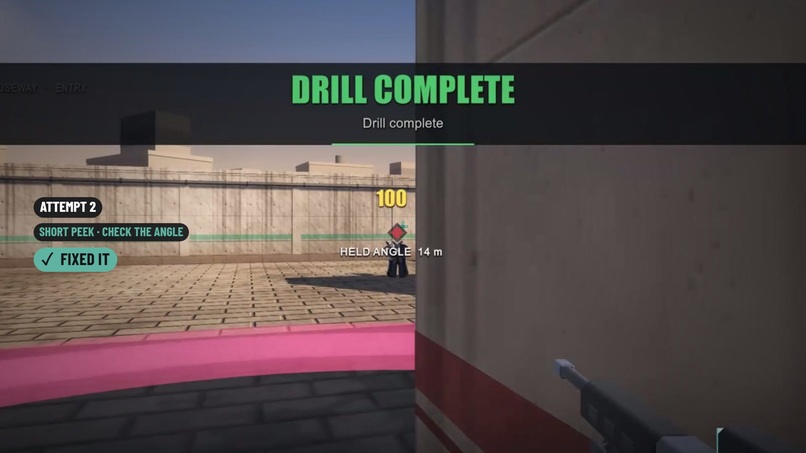
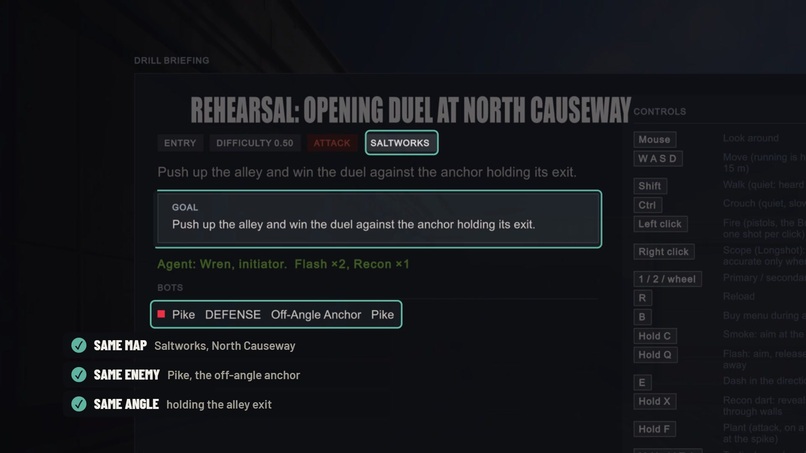
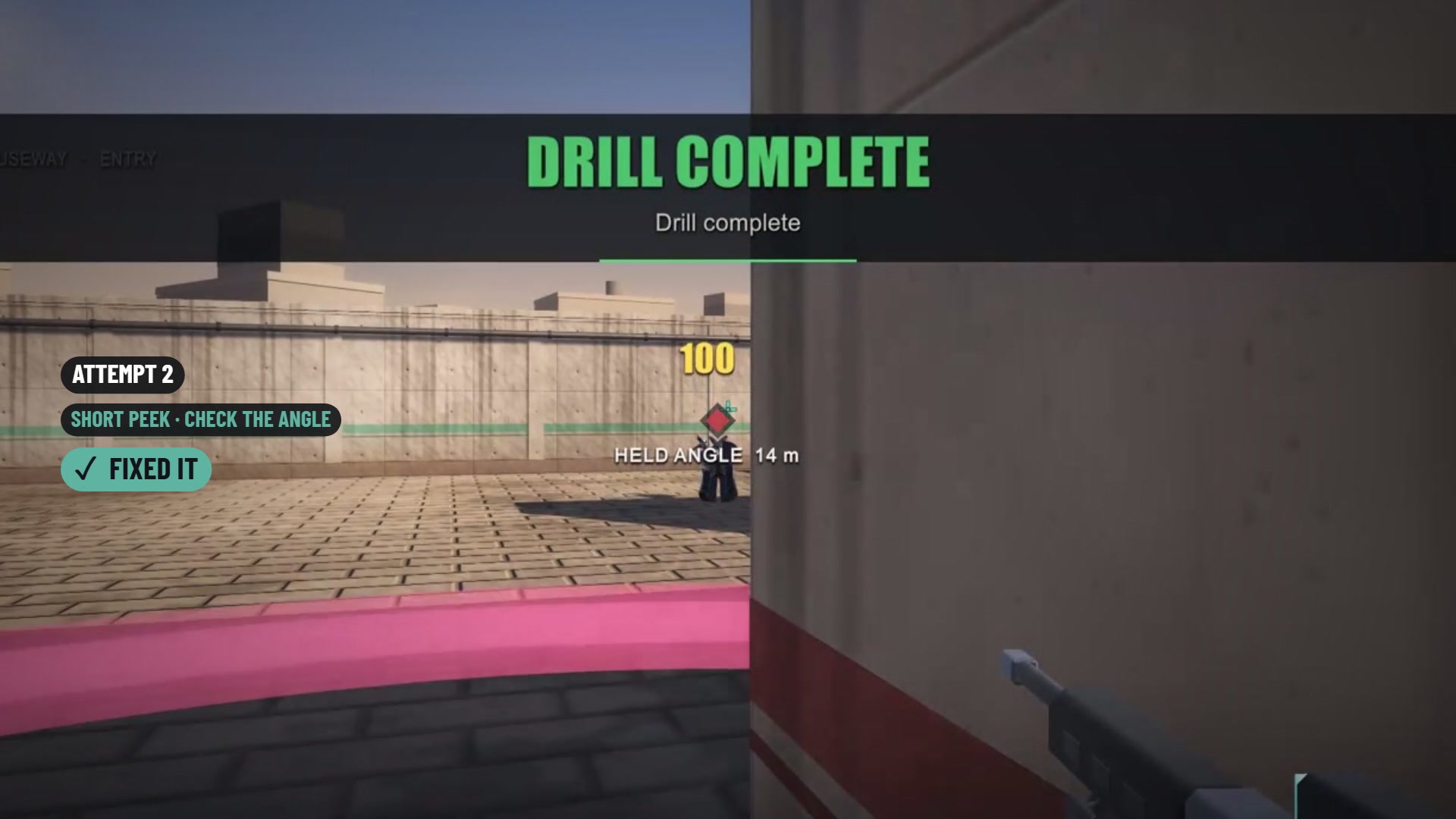
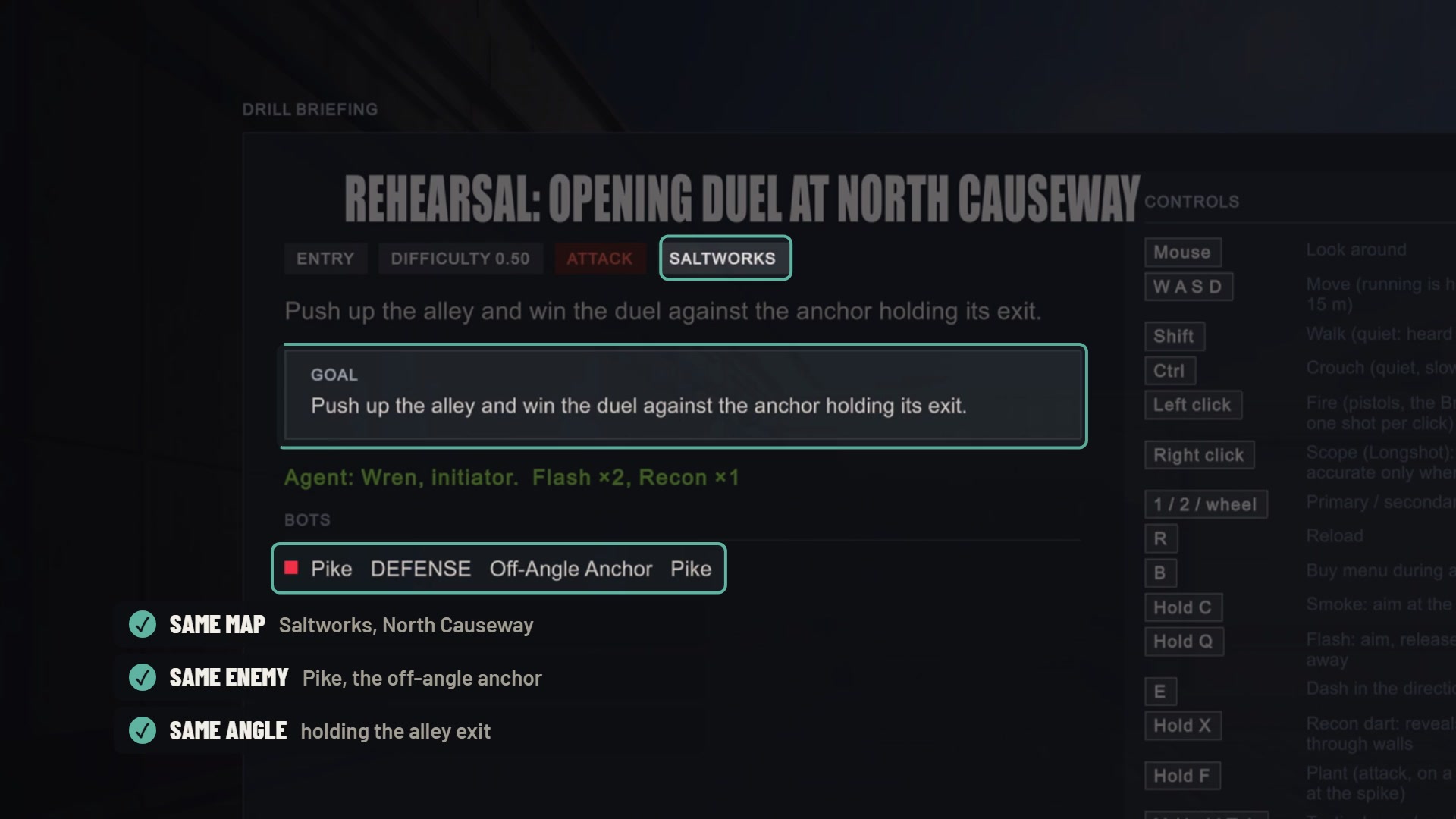
- Rehearse: it rebuilds that exact moment as a drill: same map, same positions, same enemy holding the same angle, same clock.
- Coach: after each attempt, a debrief tells you the one thing to change ("take a short peek to check the angle first").
- Adapt: difficulty goes up after a win and down after a loss.
On top of that:
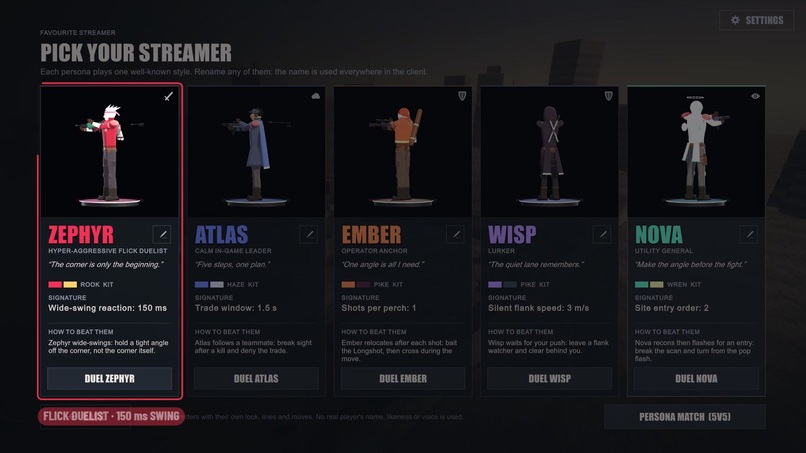
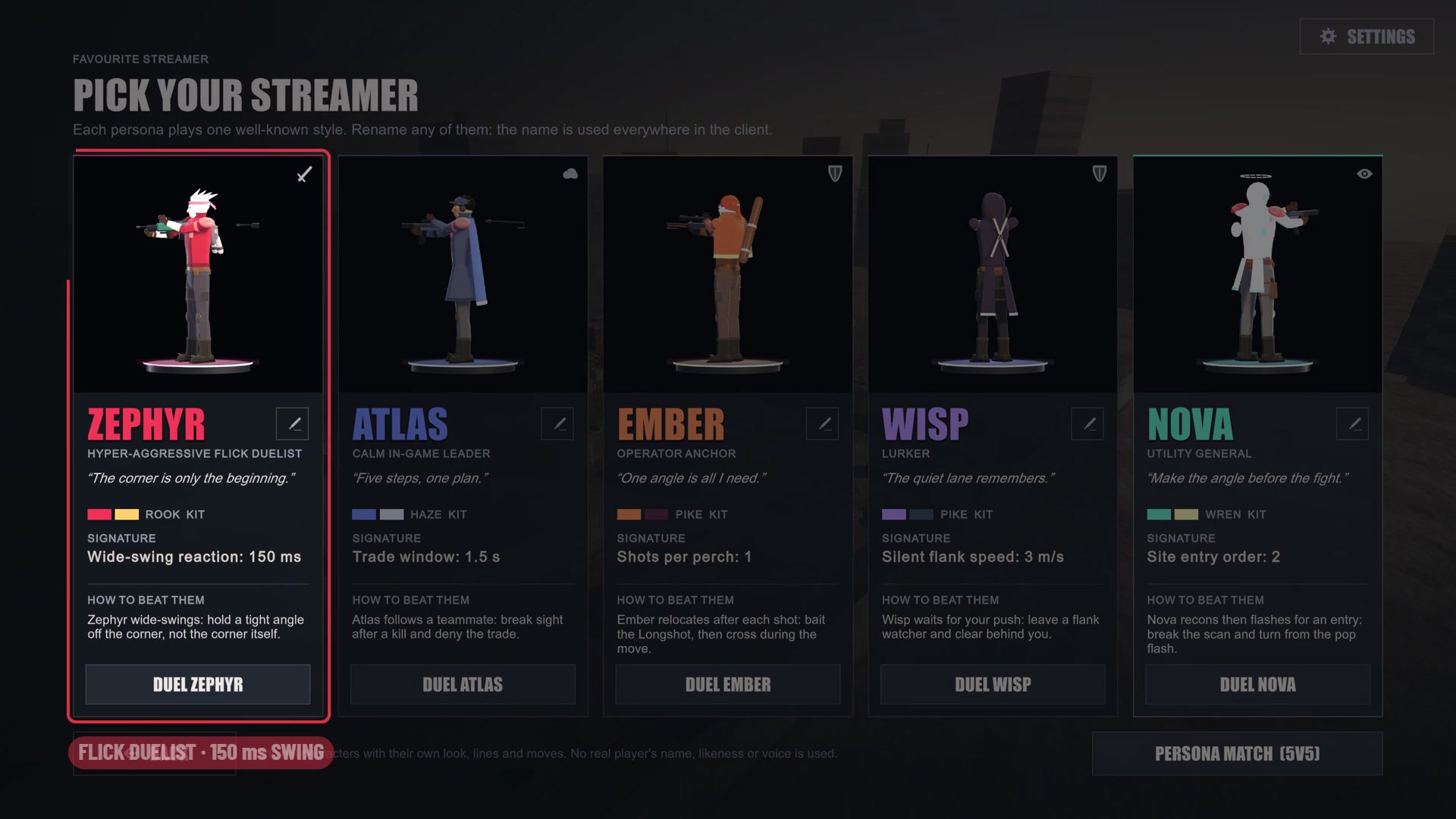
- Streamer duels: duel a bot that plays in the style of your favourite streamer. Our five original personas are Zephyr (flick duelist), Atlas (in-game leader), Ember (operator anchor), Wisp (lurker) and Nova (utility general). Each comes with a coach tip on how to beat its habit. The personas copy a playstyle, not a person: no real player's name, likeness or voice is used.
- Every round feeds the report: matches, drills and duels all update your weakness report.
How we built it
- The game: a 3D tactical shooter built in Unity (C#), with our own map (Saltworks, three sites), our own agents (Rook, Haze, Wren, Pike) and original characters.
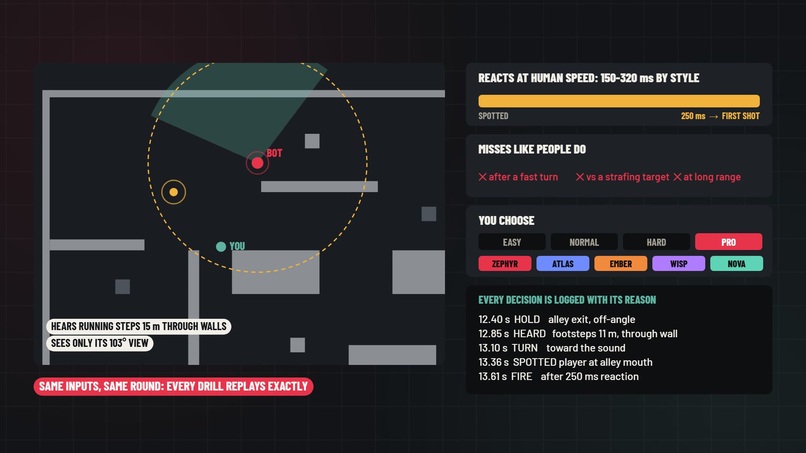
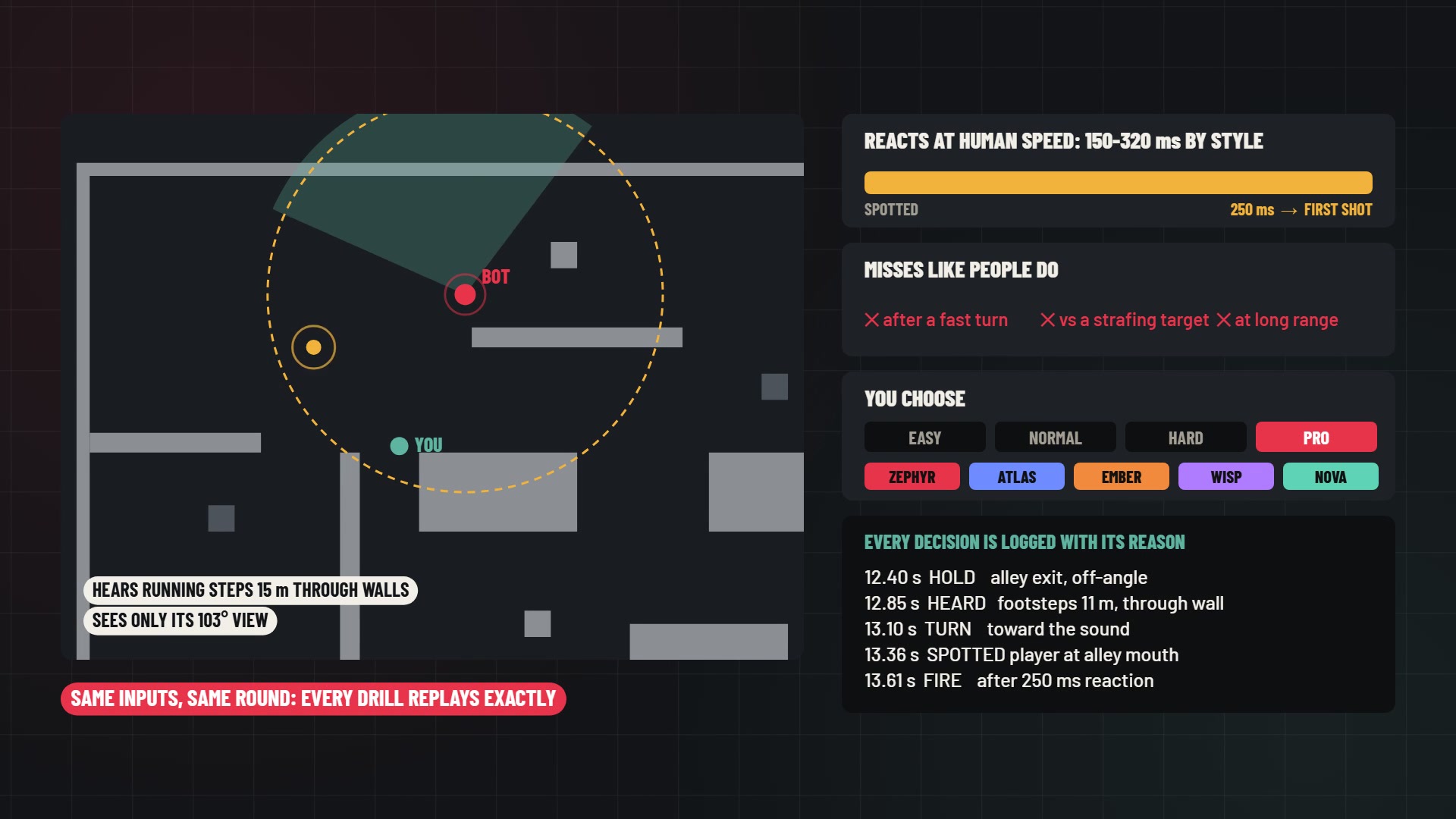
- Fair bots: the bots are behaviour trees, not a black box. They only know what they can see (a 103° view cone) or hear (running footsteps up to 15 m, even through walls). They react at human speed (150–320 ms depending on style) and miss like people do: after a fast turn, against a strafing target, at long range. Difficulty ranges from Easy to Pro.
- Replayable drills: every bot decision is logged with its reason (
HOLD alley exit,HEARD footsteps 11 m,SPOTTED player,FIRE after 250 ms reaction). With the same inputs, a drill replays exactly. - Rebuilding the moment: the drill rebuilder places you and the enemies where the lost round happened. We also check that your start position is hidden from every bot, so the drill isn't decided before it starts.
- The coach: an LLM writes the debrief, and every number in it is checked against the round data before you see it.
- Tooling: the analysis, bot runtime and evidence harness are written in TypeScript/Node.js and tested with Vitest.
Does it actually work? (Evidence)
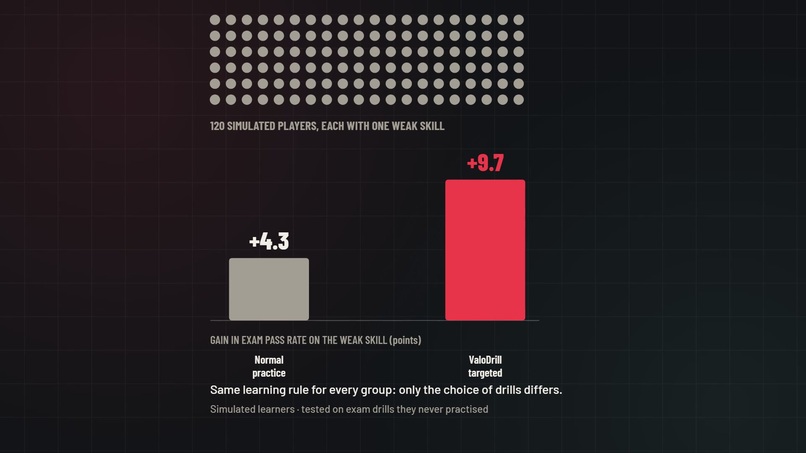
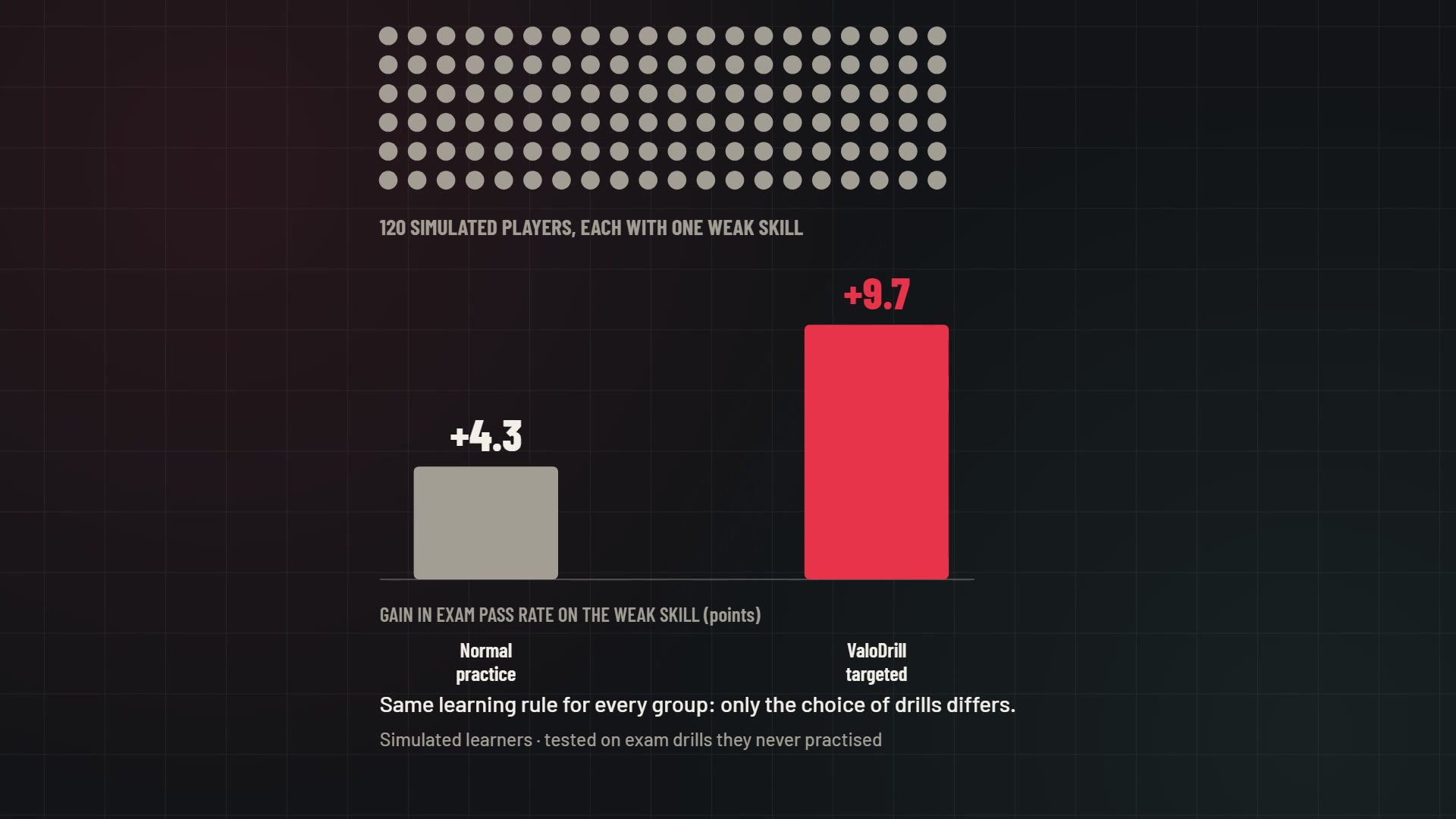
We built an evaluation harness with 120 simulated players, each with one weak skill. Every group follows the same learning rule; only the choice of drills differs. We measured the gain in exam pass rate on the weak skill, using exam drills the players never practised:
| Practice | Gain (points) | 95% CI |
|---|---|---|
| Normal practice | +4.3 | [2.7, 5.9] |
| Random drills | +5.5 | [3.8, 7.3] |
| ValoDrill targeted | +9.7 | [7.3, 12.2] |
Targeted practice beat normal practice by \(+5.4\) points (95% CI \([3.9, 6.9]\)) and random drills by \(+4.2\).
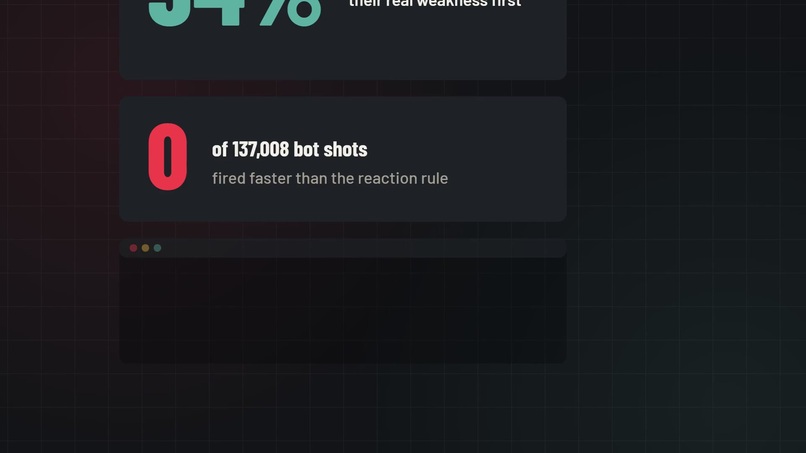
- Finding the right weakness: the analyzer found each player's real weakness first 94% of the time.
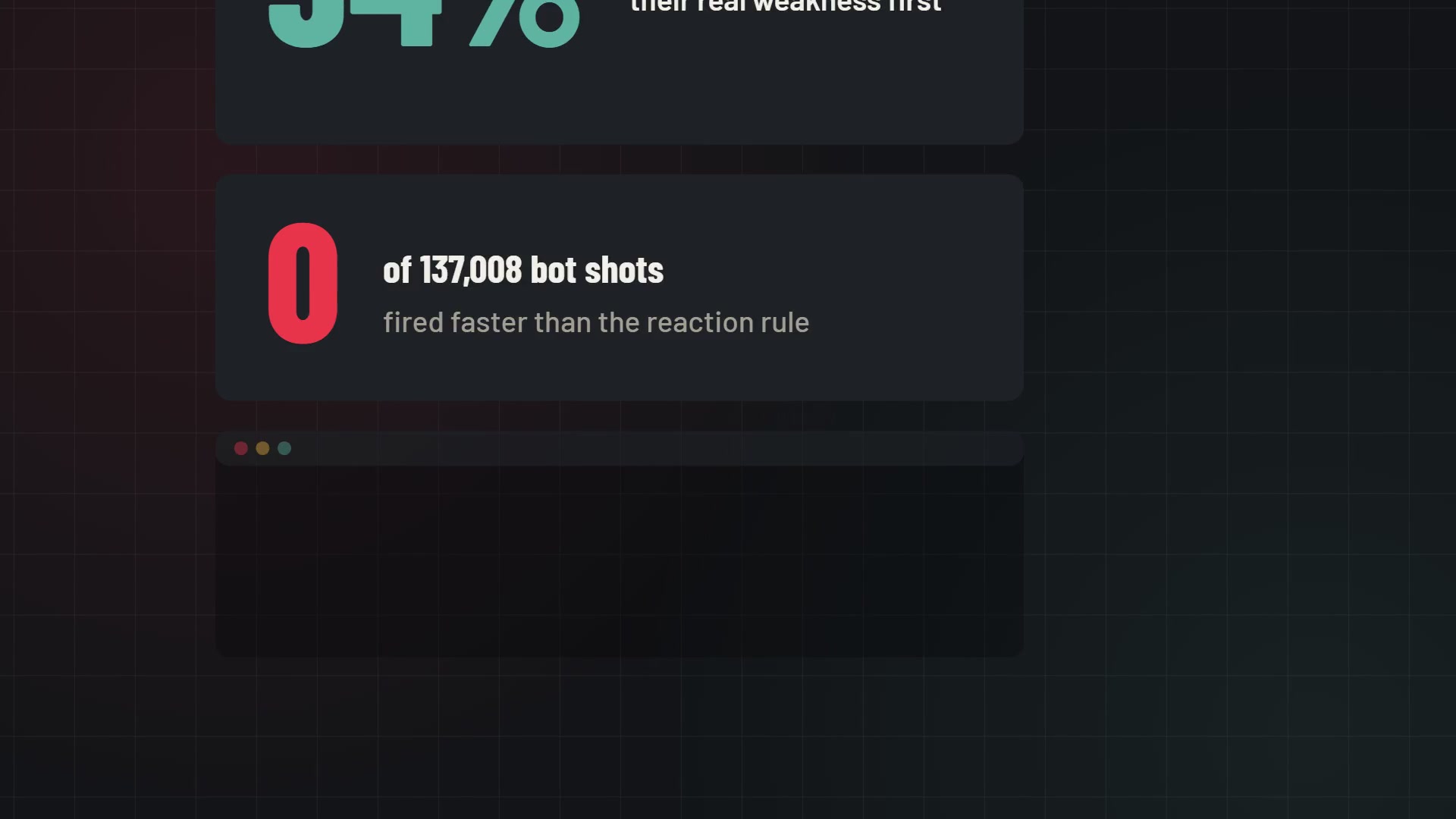
- Fairness: out of 137,008 bot shots, 0 were fired faster than the human reaction rule.
- Reproducible: one command reruns the whole evaluation:
node evidence/run.ts.
These are simulated learners, not real players. The point is to show that the targeting logic picks the right drills, not to claim a real-world skill gain yet.
Challenges we faced
- Making bots human, not perfect. Our first bots were either aimbots or useless. Getting reaction time, misses and perception right without cheating (no wall-hacks, no instant flicks) took the most iteration. A player said our early bots "shot like a first-timer"; another version was inhumanly fast. The fix was a hard reaction rule plus style-specific timing.
- Drills that feel like the real moment. Early drills spawned you far away, facing a wall, with no enemy in sight. We rebuilt them around a precise start position and facing, an objective marker, and an enemy guaranteed to be in the fight.
- Fairness checks. Proving that the bots never react faster than a human meant logging every shot and testing it, not just tuning by feel.
- Two codebases, one game. Our team built in parallel, and merging gameplay, UI and bot work into one Unity project without breaking each other's changes was a project in itself.
- Time. A hackathon clock forced us to choose: we cut features to make the core loop solid (lose → drill → coach → win).
What we learned
- Fair AI is a design problem, not just an accuracy problem: what the bot is allowed to know matters more than how well it aims.
- Explainable systems (behaviour trees and decision logs) made debugging and trust much easier than an opaque model would have.
- Evidence needs a control group. Comparing against random drills, not just "no practice", is what made our result meaningful.
What's next
- Import real match histories automatically.
- Test with real players, not only simulated ones.
- More maps, more situations (retakes, eco rounds), and community-made personas.

