-
-
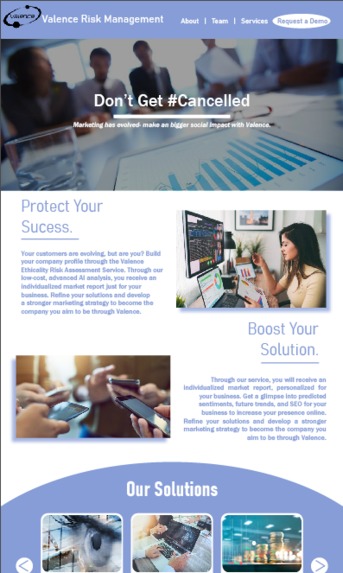
Website Prototype
Inspiration
Over the past few years, several instances of failed marketing attempts have made it to the news (including, for instance, the infamous Pepsi advert with Kendall Jenner or Burger King’s “Women belong in the kitchen” tweet). Many of these failed attempts were because of a lack of cultural awareness about what has been deemed “acceptable” by the public. Our team recognized that this risk assessment could be valuable in a world where the success or failure of a company could be dependent on its social media presence. While the larger companies were able to recover from the aforementioned mistakes, smaller businesses generally lack the resources to survive such backlash. This issue resonated with our team, and we sought to investigate further what socioeconomic issues could widen the gap between resource-rich and resource-lacking businesses.
What it does and what is solves
In recent years, society’s reliance on technology has grown exponentially. Social media, the World Wide Web, and phones have connected businesses and people of all backgrounds. The rise in rapid communication has ushered in the age of pop culture, a rapidly changing snapshot of the current point in time.
Due to the potential for wide-spread promotion, many business owners have turned to social media and mass communication platforms in an attempt to appeal to the younger generation. In order to navigate this sector of the market, companies —- especially public-oriented businesses —- are tasked with keeping up with the dynamics of the environment. This process is both time and work intensive, requiring the rapid recognition of emerging trends in the social media landscape.
Companies with sufficient funding or those that have been in existence for some time typically have the funds to allocate towards breaking into the market. The distribution of venture capital is uneven, with 109.36 billion USD going towards male-owned businesses and only 2.86 billion USD going towards female-owned businesses —- only 2% of total venture capital.
According to Morgan Stanley, investors report investing in women and multicultural-owned businesses at 80% less than businesses overall – however, 4 of 5 investors surveyed say that these same businesses “get the right amount, or more, of capital they deserve to run and grow their businesses”.
The clear disconnect between what is perceived as the magnitude of investment in such businesses and what is actually received is clear, and there is a need for accessible tools for the subset of the population containing overlooked businesses and those who have not yet obtained funding.
The Valence Ethicality Analysis Service seeks to provide a little-to-no-cost tool for businesses that seek to analyze the existing market. We use natural language processing and data scraping from a number of social media and communication sites. The resultant model is then used to analyze potential material our clients seek to release to the public. The public reaction to these materials is predicted and analyzed. Clients may then take the generated reports and use the information to further refine their business plans, solutions, or public portfolio to further their business model.
Our company requests company information and materials access in order to develop a well-rounded image of the client. This information may be shared with other entities, so as to maintain a source of profit and sustainability for the company.
How we built it
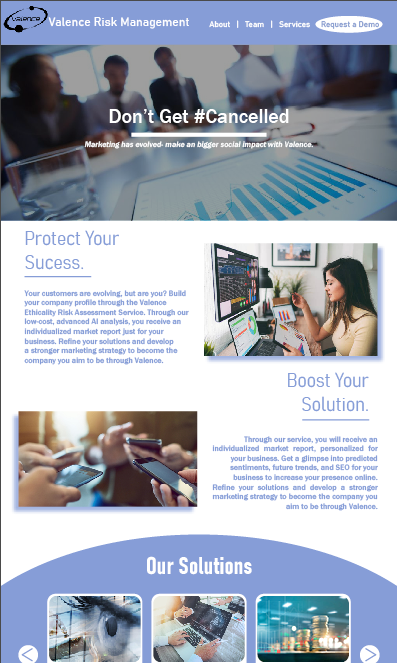
The service itself was developed using Python 3 and utilized the Flair (NLP), NumPy, Tweepy, and pandas packages. The website prototype was made using Adobe InDesign, although we anticipate using HTML or CSS for the actual development, if given more time.
Challenges we ran into
In terms of purely logistical challenges, our team, in part due to a number of other commitments (e.g. travel, sports, commutes), was rather strapped for time. Due to previous projects, however, we already had a strong understanding of each others’ tendencies and strengths and, thus, were able to delegate tasks rather effectively. This allowed for most of the work to be completed asynchronously, with the several hours we spent physically together working on the project divided efficiently as a result.
In terms of technical challenges, we were unable to obtain an API key, which greatly limited the full development of an implementation algorithm for the idea, as we had hoped. Nevertheless, we were still able to develop some semblance of code (although the data scraping was not entirely successful for our purposes given this reason), which is representative of what we aim to produce as a product for the company.
Accomplishments that we're proud of
Our team went into UniHacks hesitantly. Most of our members have little to no experience in hackathons and, as a result, we were uncertain of what to expect. We are rather proud for making it through our first hackathon together, and certainly happy that we were able to produce a product at all, given the time pressure. We are incredibly thankful for this opportunity and hope to further dive into areas such as these.
What we learned
On the one hand, we certainly learned the importance of being able to manage our time effectively. Our team members had not anticipated the workload to be quite so large in such a short span of time and, as a result, due to prior commitments, we learned how to more effectively communicate and delegate tasks, which we appreciate.
What's next for Valence Risk Management Service
We believe this is a viable solution that is overlooked in the business world. We are curious to see if we will be able to take this to the next level and create a functional business entity - or, at the very least, product - that may then be shared. We grew to love this project and are excited to develop, for instance, a more complex business model (e.g. the introduction of paid tiers or a customer service supplement to the model). Regardless of where this may lead, we are excited to share this project with you.

Log in or sign up for Devpost to join the conversation.