Inspiration
We have more information than ever, but figuring out what to trust is getting harder. AI can confidently hallucinate, while news and social media often mix facts, statistics, predictions, and opinions in ways that all look equally convincing.
Even when someone wants to verify a claim, the process is tedious: copy it, search for it, open multiple sources, compare wording, and go down a rabbit hole.
We wanted to make that process easier without asking users to blindly trust another AI verdict. That became ValaDoc.
What it does
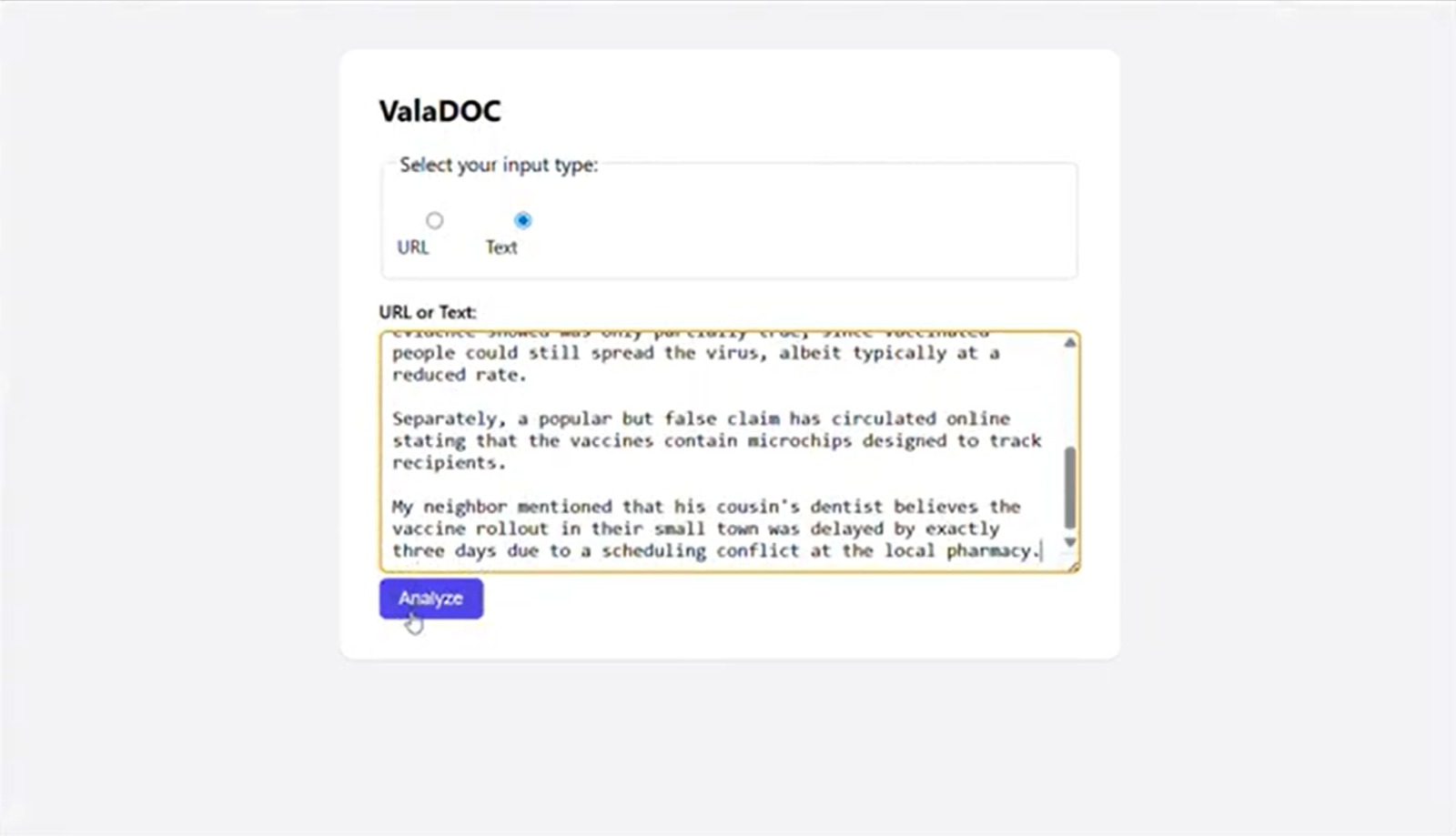
ValaDoc turns an article into a claim-level evidence report.
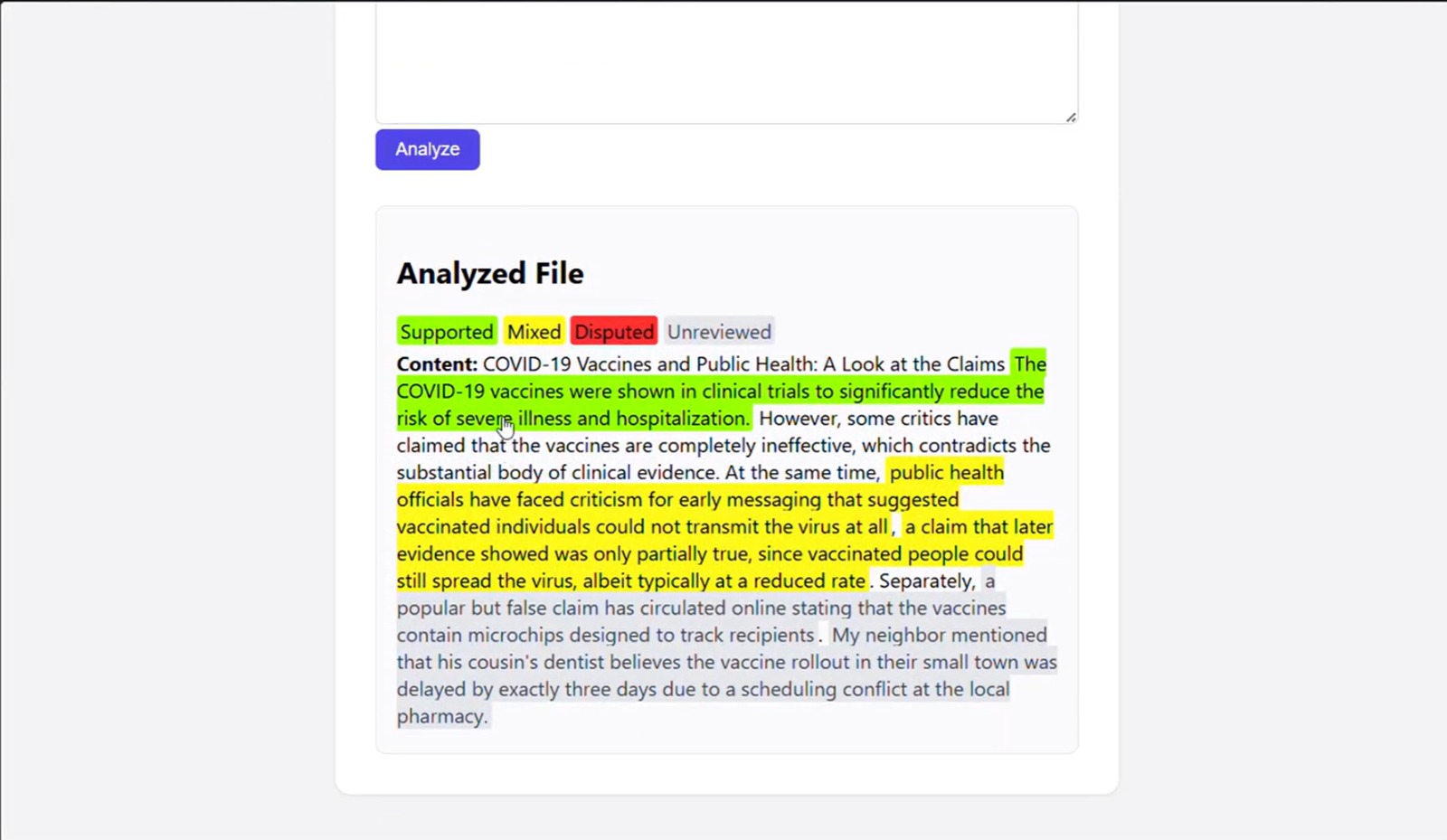
A user provides an article or URL, and ValaDoc identifies factual and quantitative claims while separating them from opinions and predictions. Verifiable claims are then matched with published fact-check information.
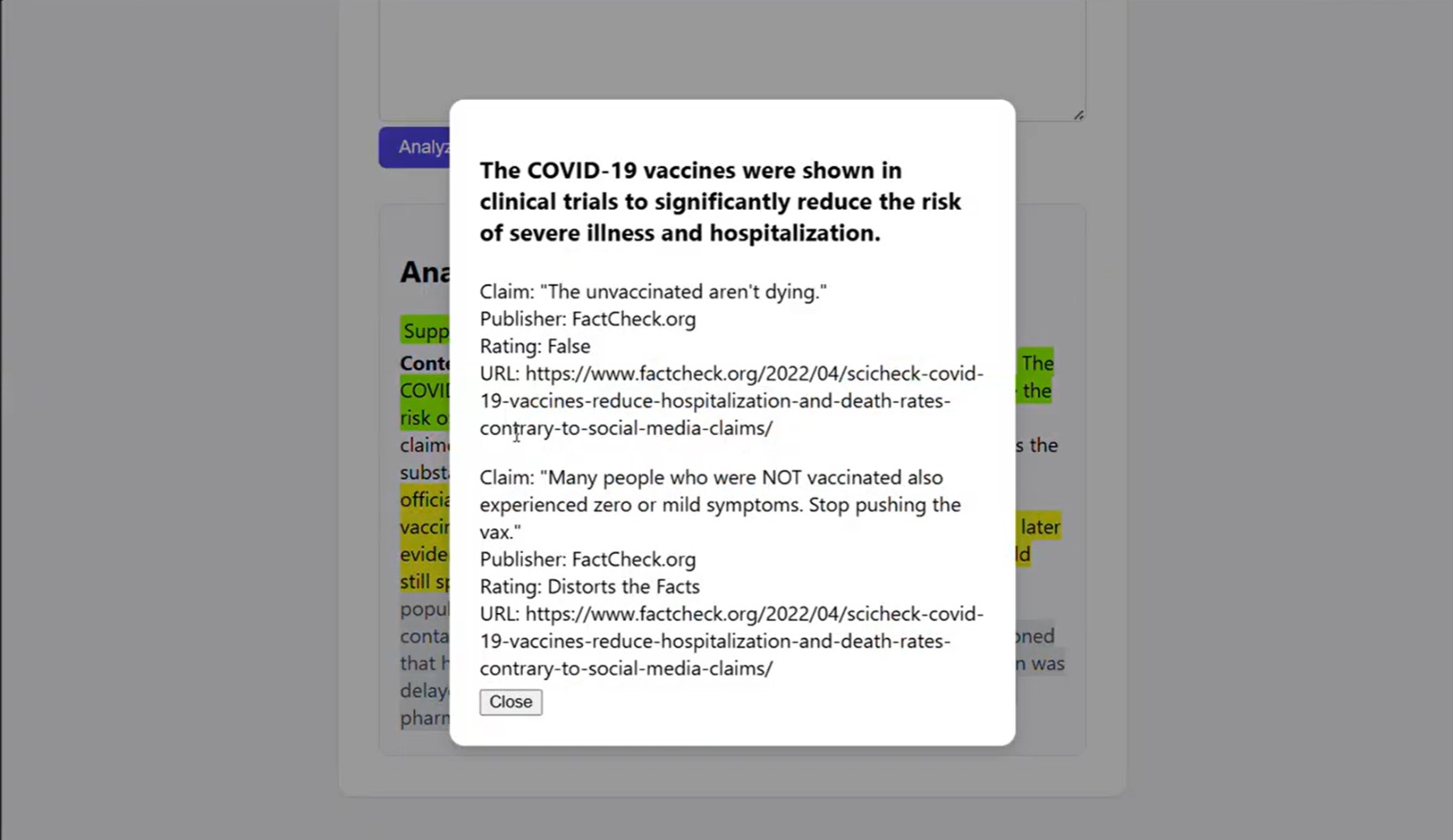
Instead of assigning an entire article a single “trust score,” EvidenceLens shows users the claim, its status, and the underlying source so they can inspect the evidence and decide for themselves.
How we built it
EvidenceLens uses a modular Python pipeline.
We use Trafilatura to extract clean article text, then send that text to NVIDIA Nemotron to identify and classify verifiable claims. Those claims are passed to a fact-check retrieval layer, and Nemotron is used again to normalize inconsistent ratings like “Mostly True,” “Misleading,” or “False” into clearer categories such as supported, mixed, disputed, and unreviewed.
The structured results are then sent to the frontend, where claims can be highlighted and linked back to their evidence.
Challenges we ran into
One of our biggest challenges was realizing that fact-checking and evidence retrieval are not the same thing. Existing fact-check databases only contain claims that have already been reviewed, so a missing result does not mean a claim is true or false.
We also wanted to avoid creating the same trust problem we were trying to solve. Rather than asking Nemotron to simply decide what is true, we use it for focused tasks like claim extraction, classification, and rating normalization while keeping the original evidence visible.
We also explored self-hosting Nemotron through Brev, but GPU and vLLM compatibility issues led us to switch to NVIDIA’s hosted endpoint so we could focus on the core product.
Accomplishments that we're proud of
We are proud that ValaDoc does not rely on a black-box reliability score.
Instead, AI helps organize the information while the evidence remains visible and inspectable by the user. Nemotron operates beyond a chatbot by extracting claims, separating fact from opinion, and standardizing inconsistent fact-check ratings.
We also designed the system to communicate uncertainty honestly by labeling claims with no matching published fact-check as unreviewed.
What's next for ValaDoc
The next step is broader evidence retrieval. If no published fact-check exists, ValaDoc could search trusted sources and surface supporting or conflicting evidence without automatically declaring a verdict.
We would also like to add PDF support or video support through speech-to-text, stronger source provenance, cross-article comparison, and eventually a browser extension that lets users inspect evidence while they read.

Log in or sign up for Devpost to join the conversation.