Inspiration
Communication is one of the most important skills a student can develop, yet improving it is usually reduced to generic advice, expensive coaching, or watching YouTube videos that don't know anything about you specifically.
I built VakShala because I wanted to create the communication coach I wished every student had access to, personalized, interactive, available 24/7, and actually built around what you're working toward. My own experience as a 2x TEDx speaker, Toastmasters Global Groups Champion, and someone who has personally coached 200+ students across 9 international schools showed me exactly how much communication can determine outcomes. I wanted to turn that experience into something scalable.
What it does
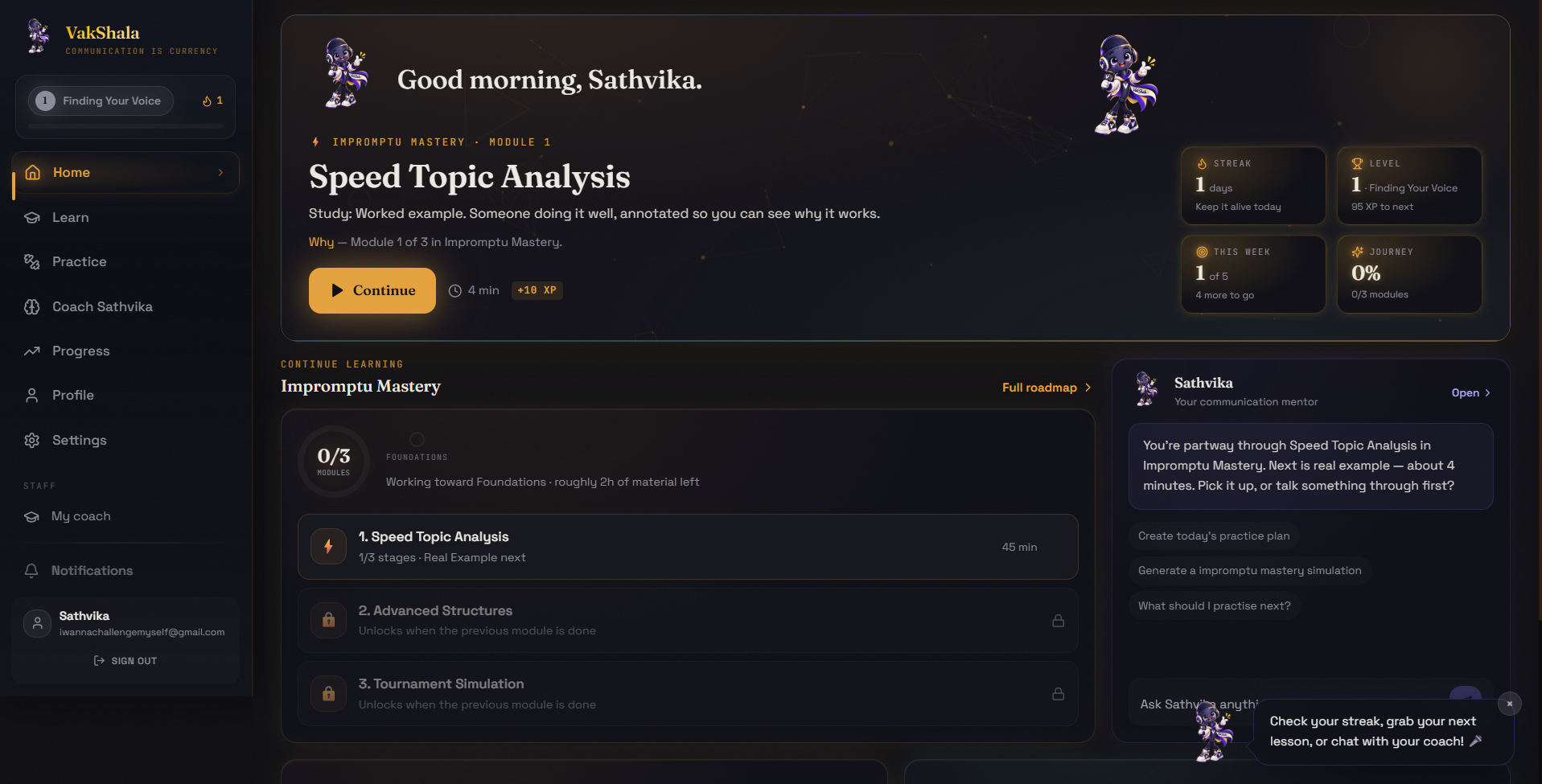
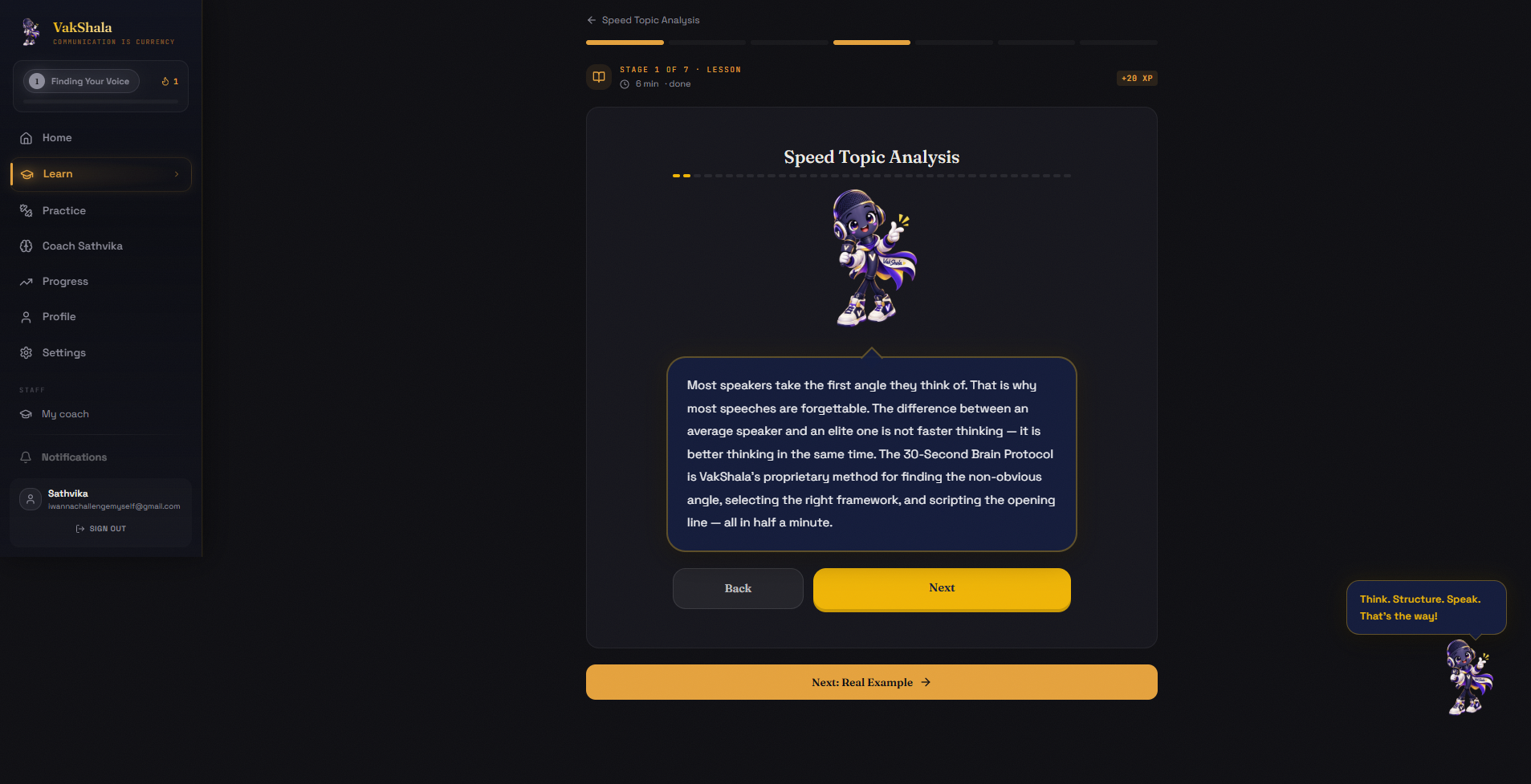
VakShala is a personalized, gamified communication learning ecosystem, part structured curriculum, part AI coaching, part speech analysis engine, part simulation platform.
Students set a real goal (debate tournament, IELTS exam, job interview, college application, investor pitch) and VakShala rebuilds the entire experience around that goal. The learning pathways, practice prompts, scoring dimensions, and AI feedback all change based on what the student is actually preparing for.
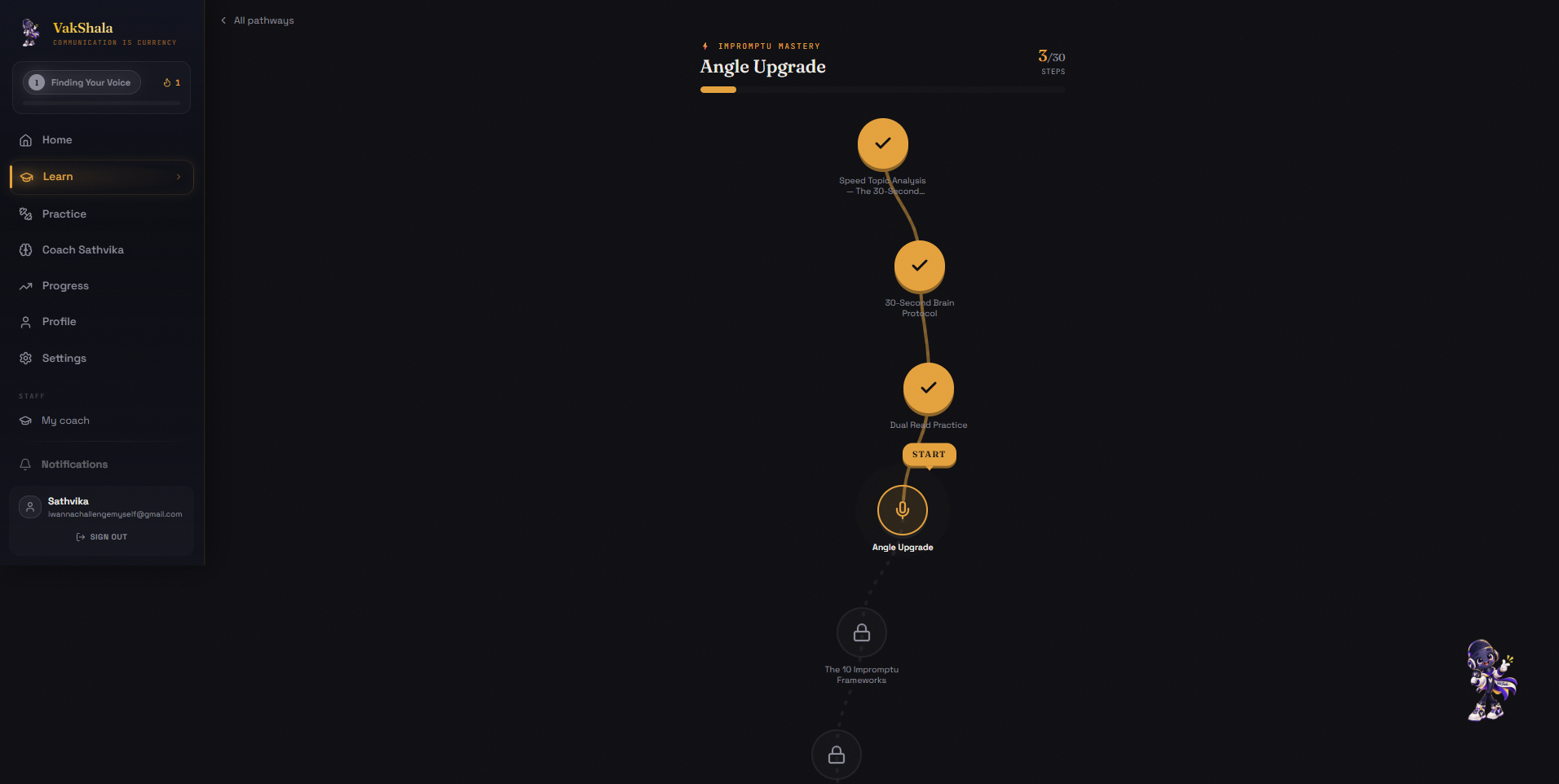
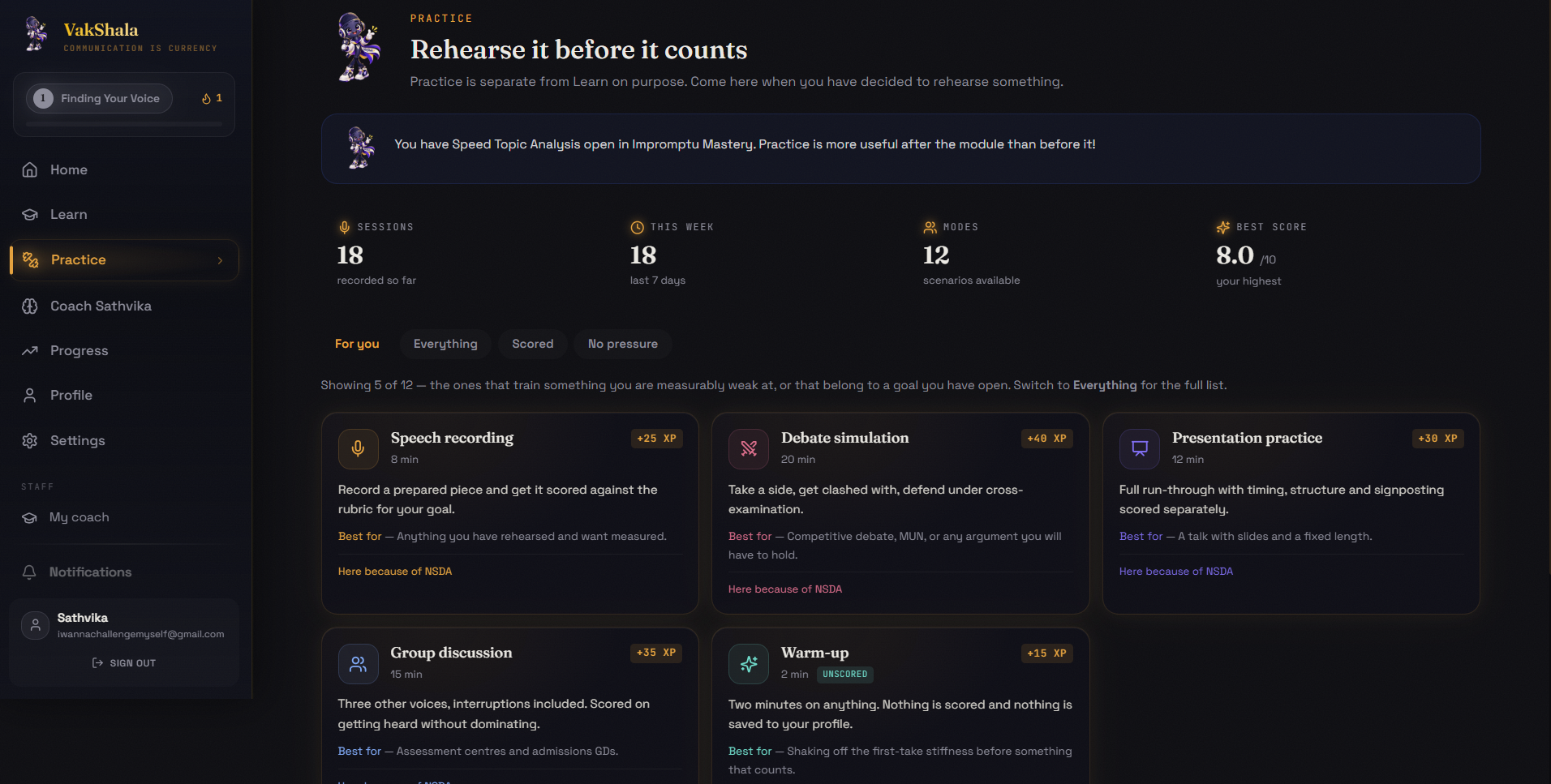
The platform includes 17 structured journeys with 510+ steps across communication categories including Foundations, Impromptu Mastery, Debate and Argumentation, Delivery and Presence, Speech Events, Life Skills, Career, Entrepreneurship, and more. Students practice through 12+ simulation modes including interview simulations, debate rounds, IELTS speaking tests, startup pitches, group discussions, and difficult conversations, each with distinct AI characters that respond dynamically to how the student actually answers.
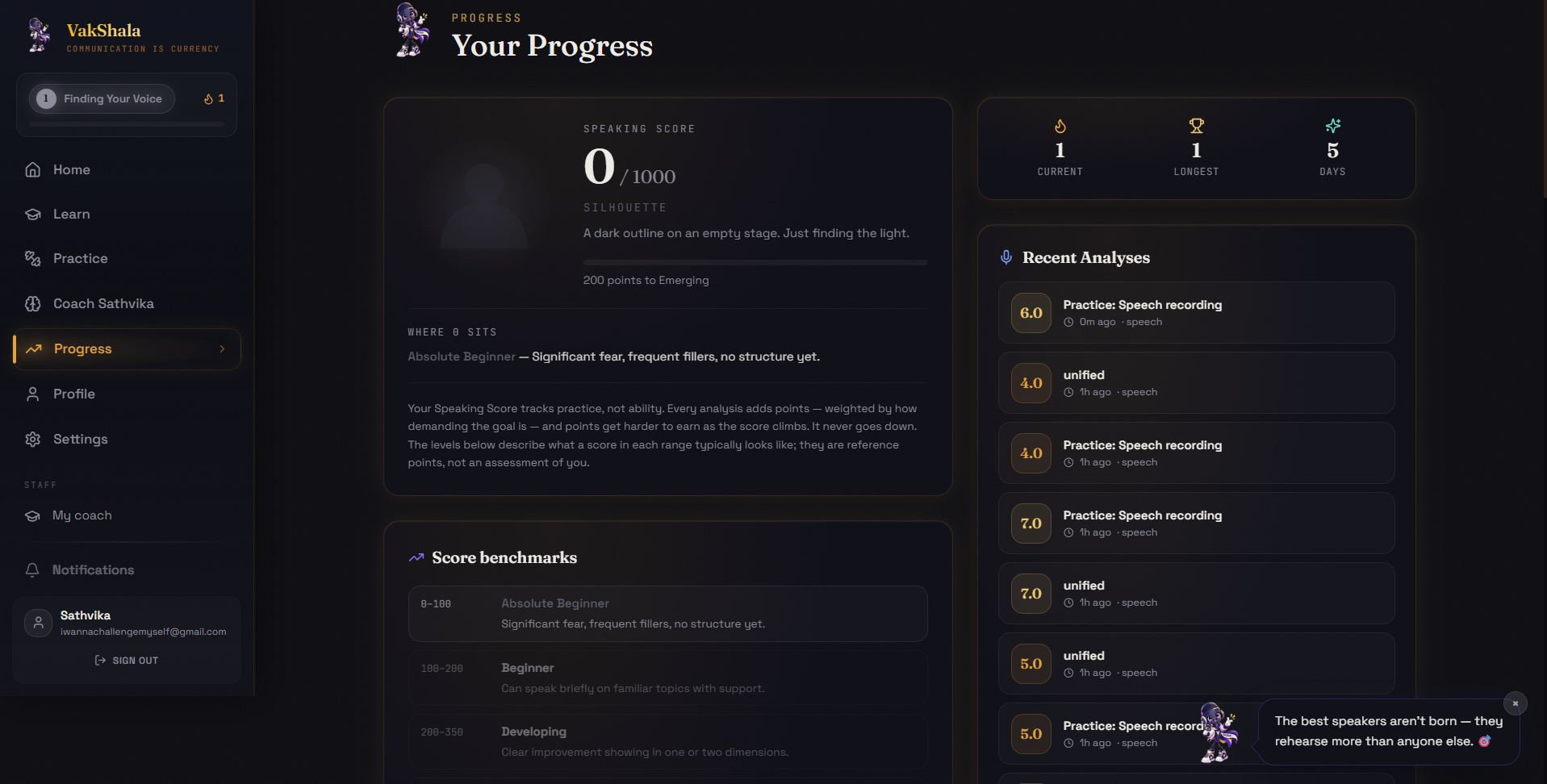
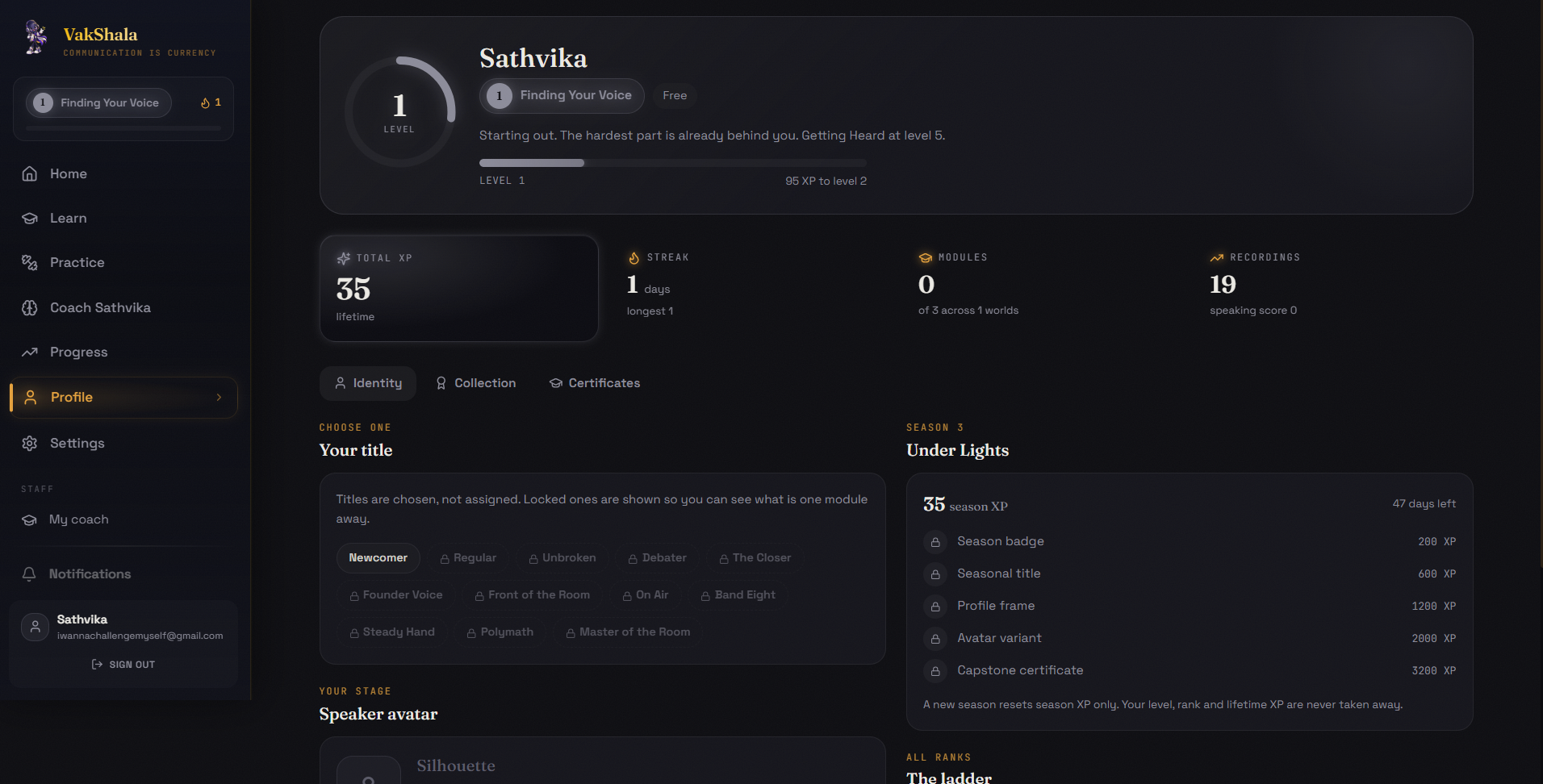
Progress is tracked through a Speaking Score from 0 to 1000, a 5-stage evolving avatar (Silhouette → Emerging → Spotlight → Commanding → Transcendent), XP, streaks, 27 achievements, seasonal titles, and a shareable Speaker Card.
And Vaki -- VakShala's mascot and companion -- guides students through every step, celebrates milestones, encourages them when they struggle, and makes the whole experience feel alive rather than transactional.
How we built it
VakShala began as an earlier communication-learning project, but during the CUTC Transform Hackathon I focused on building and expanding the core product experience showcased in this submission, including its learning ecosystem, goal-aware coaching, simulations, gamification, and Vaki companion experience.
Frontend: React 18 + Vite + Tailwind CSS, deployed on Netlify, 45+ source files.
Backend: Supabase with PostgreSQL -- 18 relational tables with Row Level Security on every table. Tables cover profiles, worlds, journeys, roadmaps, lessons, goals, analyses, practice sessions, AI memory, analytics, gamification, community rooms, coaching sessions, payments, access codes, certifications, and notifications. Automated triggers handle speaking score updates, streak tracking, and daily analytics rollups.
ML Model: A custom Stacking Regressor with a Random Forest ensemble, trained on real student speeches I personally graded plus 10+ public datasets including TED talk transcripts. The model extracts 32+ hand-engineered linguistic features per speech, filler word density, Moving Average Type-Token Ratio for vocabulary richness, sentence length variety, hedging vs assertive language ratios, rhetorical marker density, trigram repetition, engagement density, readability scores, and more. It scores across 7 dimensions: Clarity, Confidence, Concision, Vocabulary, Structure, Pace, and Overall.
Goal-aware lens system: The same ML model produces completely different feedback depending on the user's active goal. IELTS goals map scores to the 4 official IELTS criteria (Fluency/Coherence, Lexical Resource, Grammatical Range, Pronunciation) and predict band scores. Lincoln-Douglas debate goals score framework, contentions, rebuttals, and evidence use. Interview goals score STAR structure, confidence signal, and conciseness. No retraining required, the lens system adapts the output at inference time.
Audio engine: Web Audio API handles real-time pace, pitch, volume, rhythm, and pause analysis from recorded or live audio.
Motion analysis: Frame-by-frame pixel differencing across fixed body regions tracks physical presence and movement through the webcam.
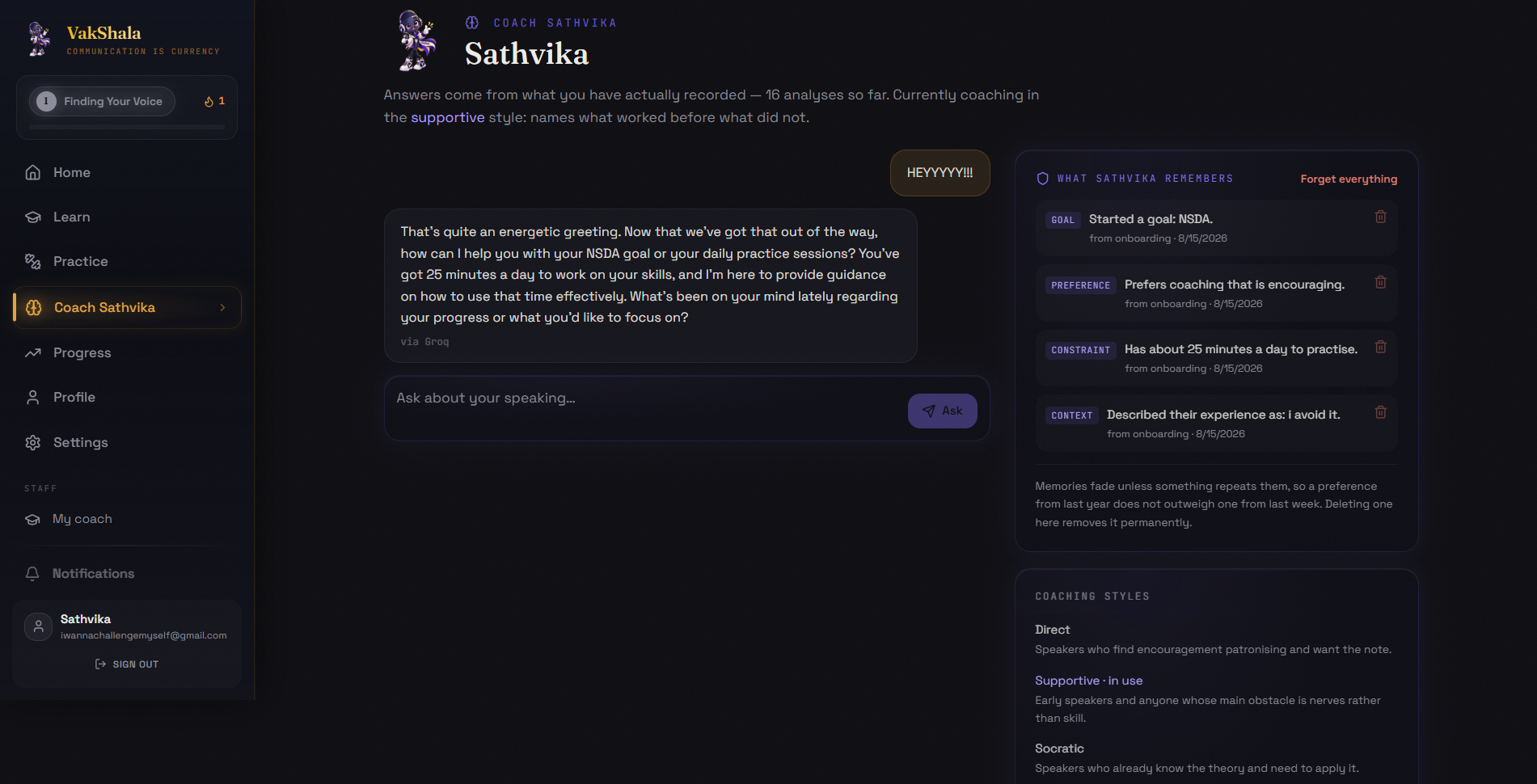
AI coaching system: Persistent per-user memory stores strengths, weaknesses, recurring patterns, upcoming deadlines, practice history, and coaching style preferences. The coach adapts between Direct, Supportive, Socratic, and Examiner modes. The memory panel is visible and editable by the user.
AI tools were used throughout the development of VakShala as development assistants. I used AI to help brainstorm product ideas, structure features, generate and refine code, debug implementation issues, improve UI/UX concepts, and accelerate development. AI was also used as a programming and problem-solving assistant while building parts of the application. everything runs client-side in the browser.
Challenges we ran into
The hardest challenge was turning something as subjective as communication quality into a system that gives feedback specific enough to be useful. A score of 7.2 means nothing if you don't know what to fix. Building the goal-aware lens system, where the same ML output produces completely different, contextually relevant feedback depending on what the student is preparing for, was the most technically complex part of the build.
The second hardest challenge was the ML model itself. Early versions showed very low score spread (a strong speech scored 5.0, a filler-laden speech scored 3.8, only 1.2 points of separation on a 10-point scale) and high inter-dimension correlation (up to 0.97 between some dimensions). Fixing this required rethinking the training data strategy entirely, scoring dimensions independently rather than all at once, and building a more diverse dataset with genuine low-scoring examples.
Accomplishments we're proud of
The goal-aware lens system. The fact that one ML model can serve an IELTS student and a Lincoln-Douglas debater and a job seeker with completely different, contextually appropriate feedback, without retraining, is the technical achievement we're most proud of.
Also: shipping a full SaaS platform with a custom ML model, 18-table relational backend, AI coaching system, 12+ simulation modes, and full gamification layer, as a solo founder.
What we learned
Building an AI product isn't about picking the most powerful model, it's about designing the experience around the model. What information it receives, how feedback is framed, how personalization is layered in, and how users are motivated to keep coming back. The hardest engineering decisions weren't technical, they were product decisions about what feedback actually helps a student improve versus what just tells them how they did.

Log in or sign up for Devpost to join the conversation.