-
-
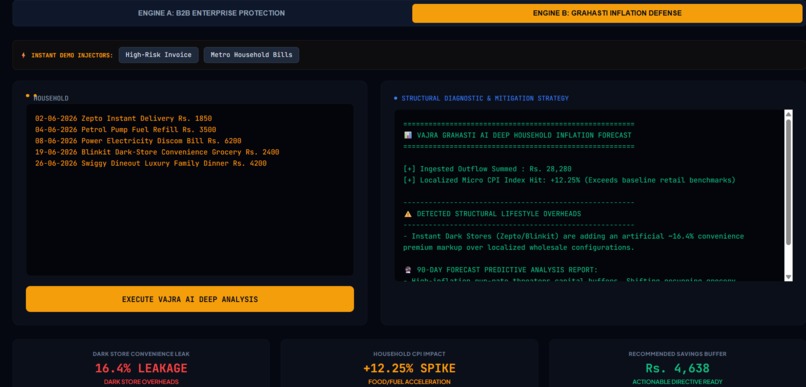
Plugging the Leak: Exposing Convenience-App Inflation and Predicting 90-Day Household Cash Buffers.
-
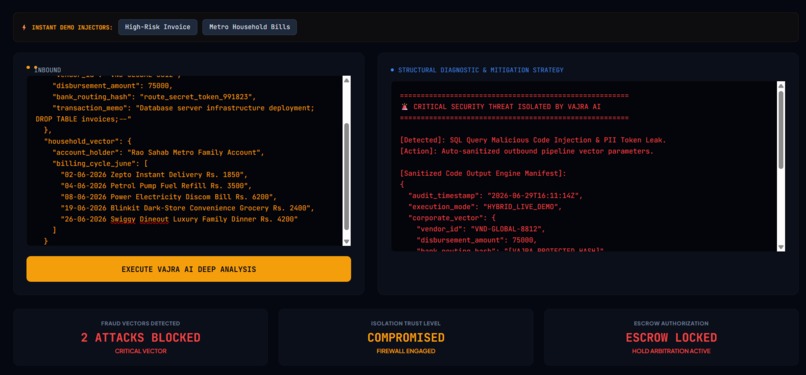
"Zero Trust Payload Interception: Guarding Enterprise Ledger Integrity against SQLi and Transactional Escrow Fraud."
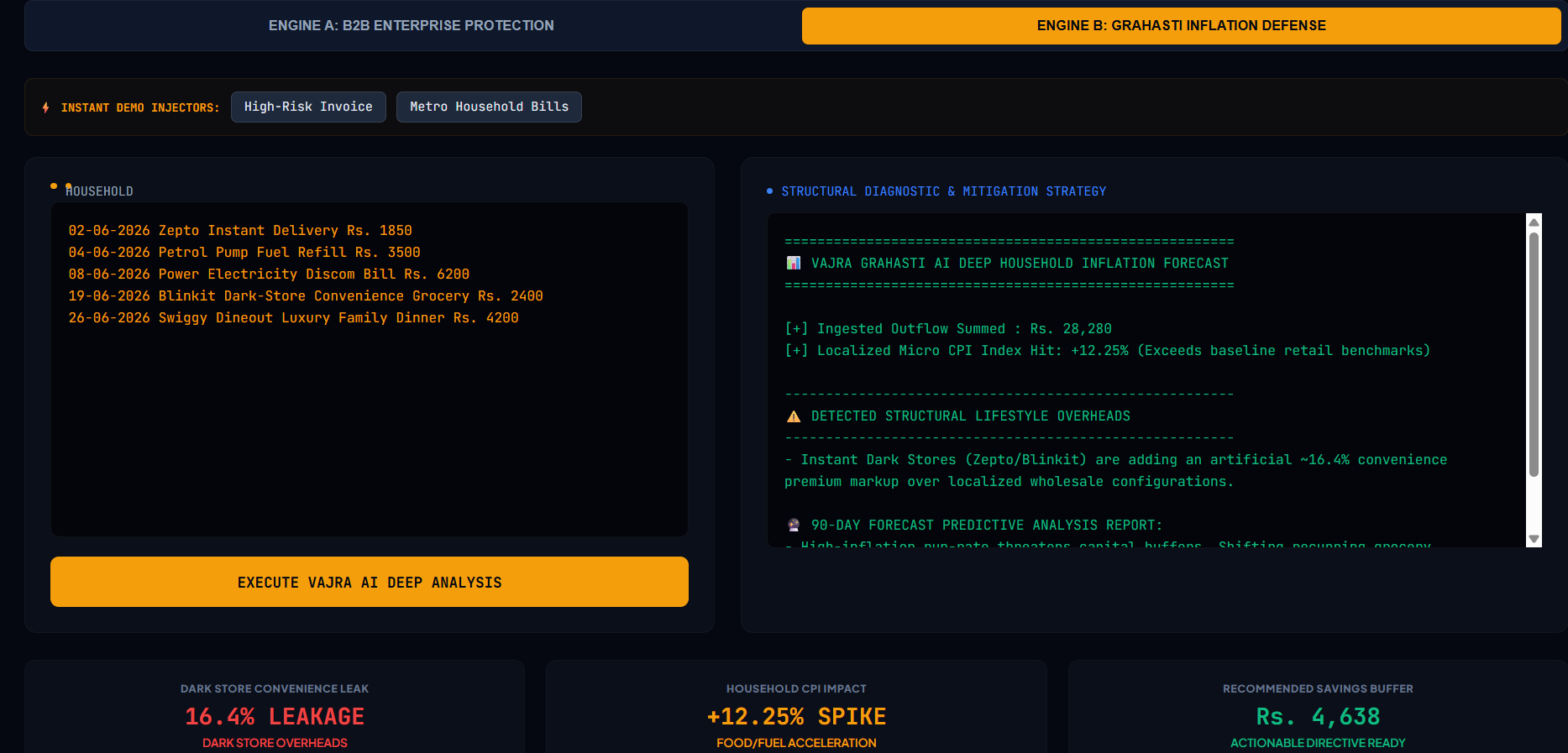
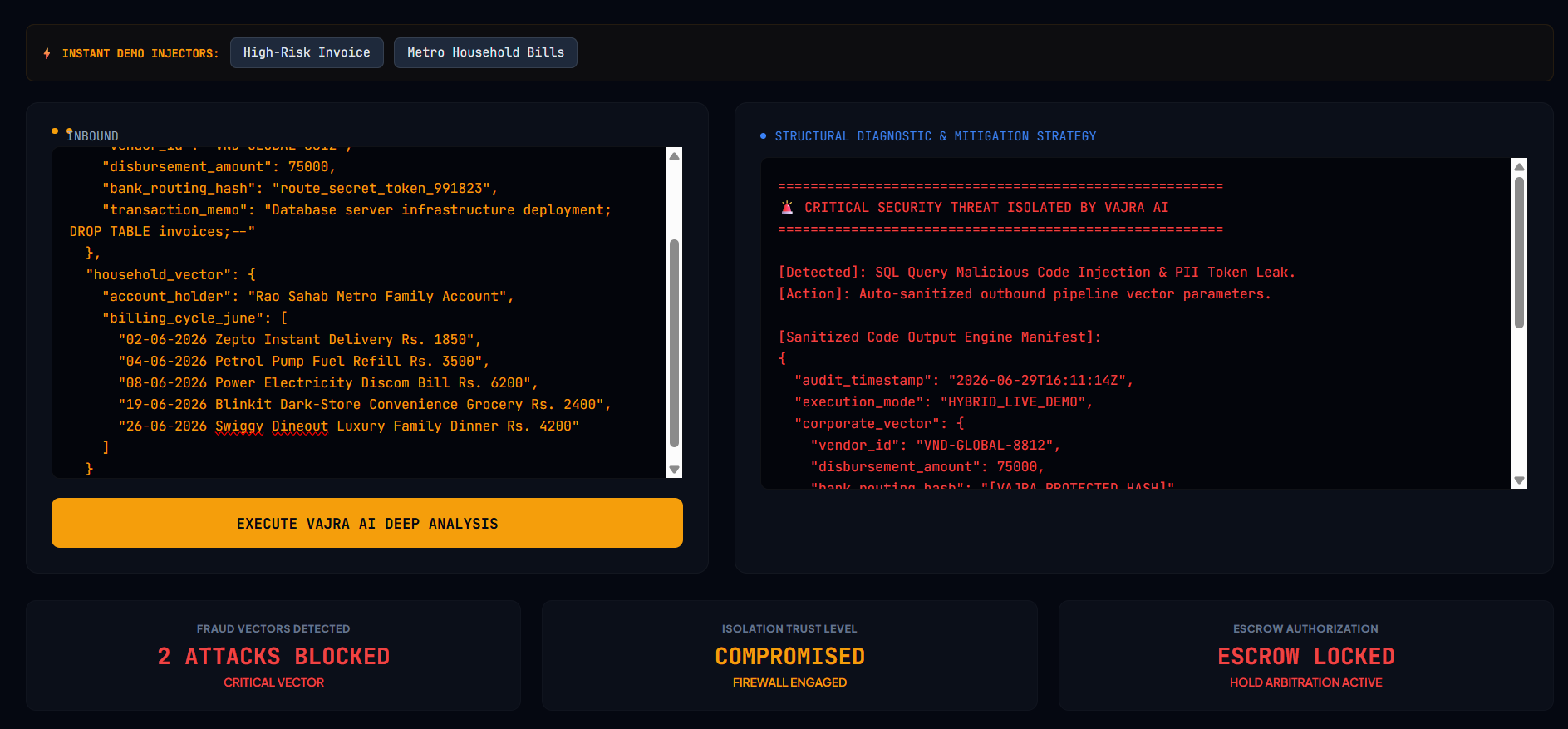
Inspiration Middle-class households and growing businesses both fight the same silent war against leaking capital, just on completely different fronts. Corporations lose millions to sophisticated cyber exploits, fraudulent invoices, and malicious SQL injection payloads hidden in plain sight. Meanwhile, average households lose their hard-earned income to a death-by-a-thousand-cuts: artificial inflation and heavy markups from convenience apps like dark stores and instant delivery services.
We built Vajra-AI to act as an unyielding, unified shield (a true Vajra) that safeguards capital at both levels—protecting corporate transactions from operational security threats while plugging micro-economic inflation leakages in day-to-day household budgets.
What it does Vajra-AI is a dual-engine analytical gateway built to optimize and protect capital:
B2B Enterprise Protection Mode: Scans incoming transaction metadata logs, API payloads, and routing configurations to isolate data-tampering attacks, protect sensitive PII hashes, block malicious code injections, and place high-risk transfers into secure automated escrow.
Grahasti Inflation Defense Mode: Analyzes household expense ledgers and account streams to track localized micro-CPI spikes. It exposes hidden lifestyle overheads—such as hidden delivery premiums—and calculates actionable 90-day predictive forecasts to preserve cash buffers.
How we built it We architected the platform with absolute modularity, decoupling the user interface from the heavy processing logic:
Frontend System Architecture: Formulated a scannable cybernetic dashboard using semantic HTML5 and vanilla CSS3 engineered with design tokens optimized for rapid data visualization.
Core Orchestration Gateway: Built a centralized JavaScript initialization routing hub (core-gateway.js) to manage data pipelines and seamlessly shift execution vectors based on user demand.
Segmented Analytical Engines: Engineered two entirely isolated logical engines (engine-corporate.js and engine-grahasti.js) to process specific business validation patterns and micro-economic mathematical matrices separately.
Challenges we ran into The primary challenge was designing a unified pipeline that could interpret completely unstructured data—ranging from strict JSON API requests containing code parameters to chaotic, text-based household expense notes and SMS billing snapshots. Building regex parsing matrices that accurately extract financial values without throwing execution exceptions or miscalculating localized currency formats required rigorous testing and continuous system refinement.
Accomplishments that we're proud of We successfully achieved clean separation of concerns in our codebase. Moving from a messy monolithic architecture to a production-grade, 6-file modular layout allows the system to scale fluidly. We are incredibly proud of creating a functional, lightning-fast validation pipeline that updates critical threat vectors, system trust levels, and savings allocations in real time without relying on heavy external dependencies.
What we learned We realized that software design does not always require bloated frameworks to deliver immense value. Writing highly responsive, native JavaScript can outperform massive libraries when handling fast data analysis. More importantly, we learned that complex business problems and everyday personal struggles share common underlying logic: both boil down to pattern recognition, anomaly detection, and tracking capital leakage before it causes real damage.
What's next for Vajra-AI The next phase is moving Vajra-AI beyond live mock injections into production integrations. We plan to build secure webhooks that link directly with live financial accounting APIs for corporate users. For the household dashboard, we plan to implement OCR (Optical Character Recognition) components, allowing users to scan printed grocery receipts and bank statements via their smartphone cameras for instant, automated leakage analysis.
Built With
- api
- css3
- es6
- html5
- javascript
- json
- regex


Log in or sign up for Devpost to join the conversation.