-
-

Vajra: Closed-Loop WebGPU Kernel Auto-Tuner powered by NVIDIA Nemotron on Nebius Token Factory
-
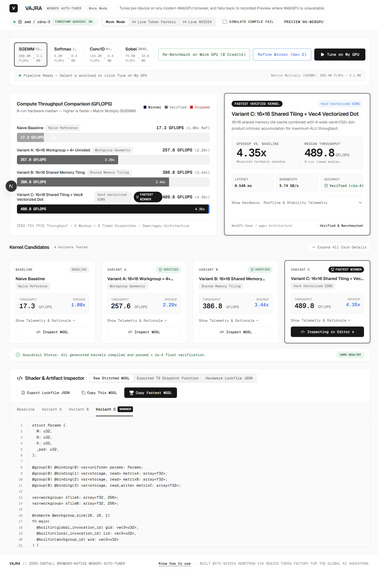
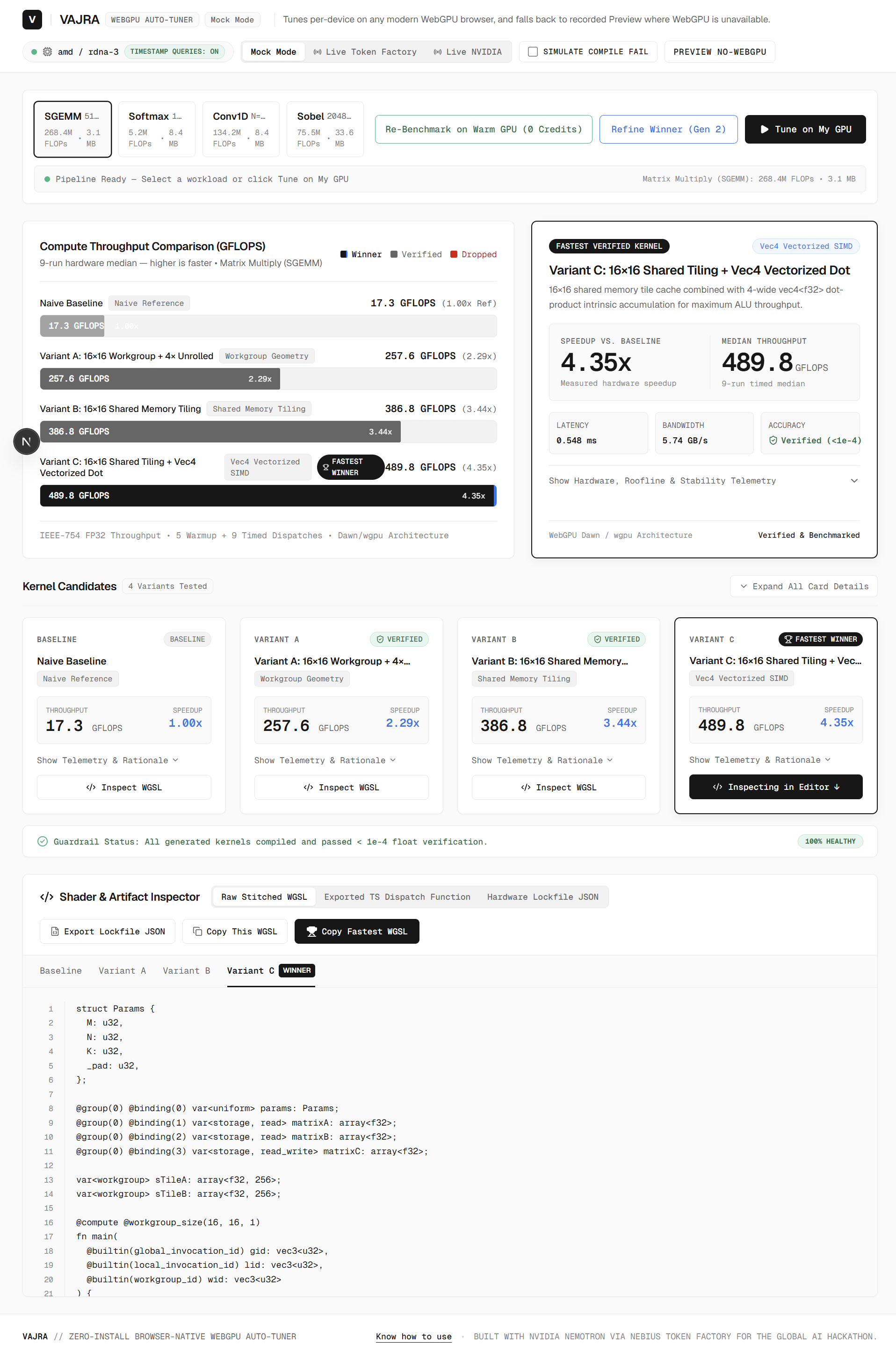
This is homepage of VAJRA.
-
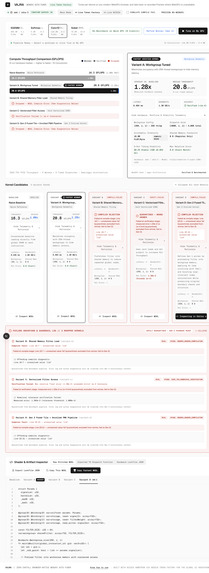
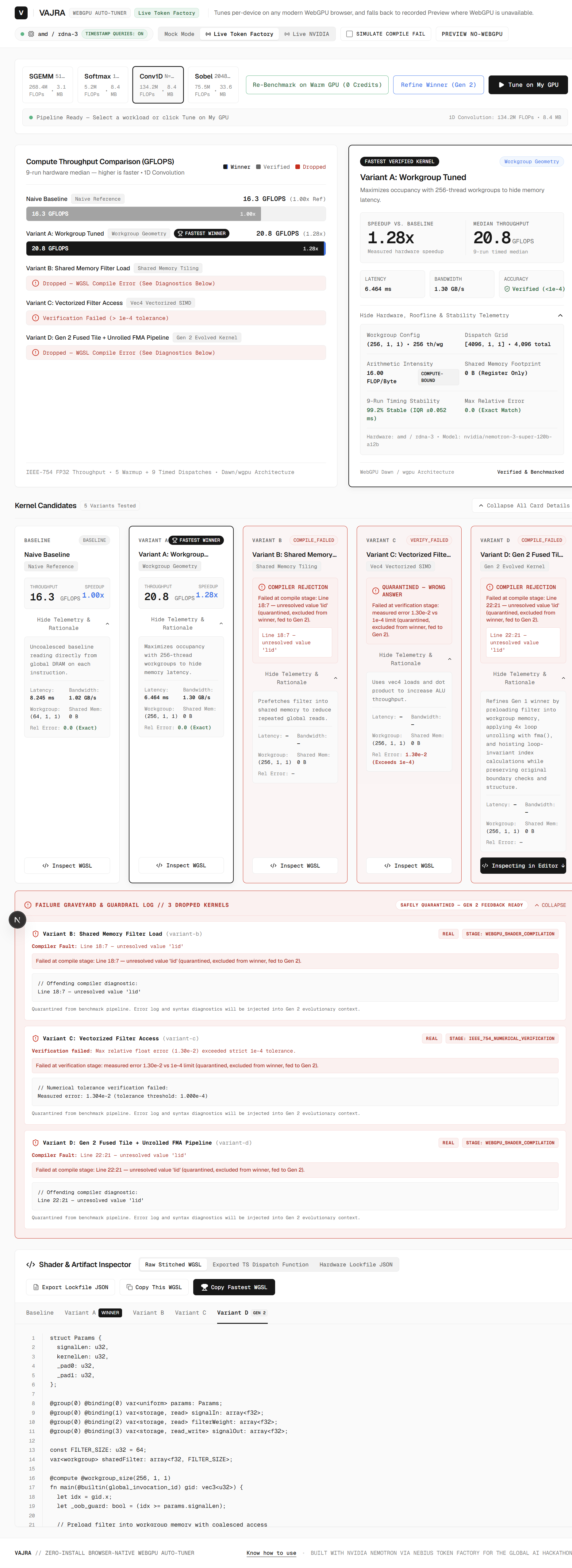
Vajra actively catches LLM syntax/math errors, quarantines wrong answers, and feeds diagnostics back into the loop.
-
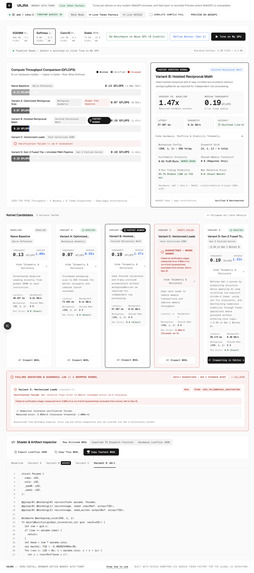
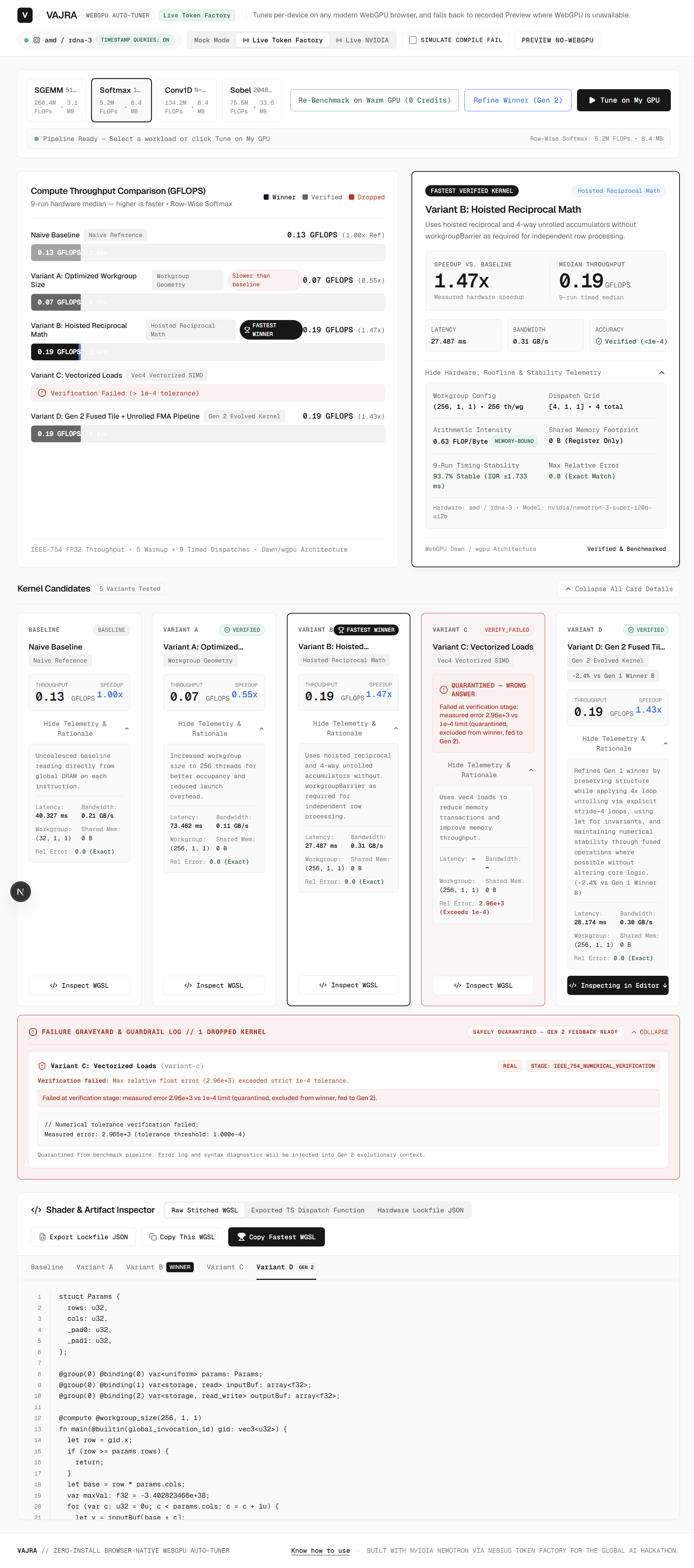
Vajra showcases the 1.47x Gen 1 win evolving into the verified Gen 2 runner-up with exact floating-point precision
-
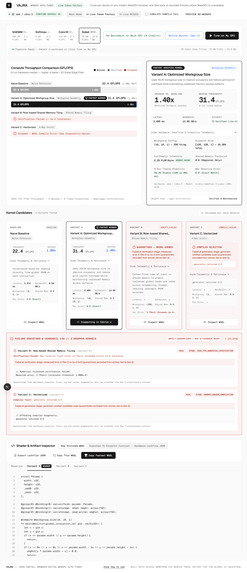
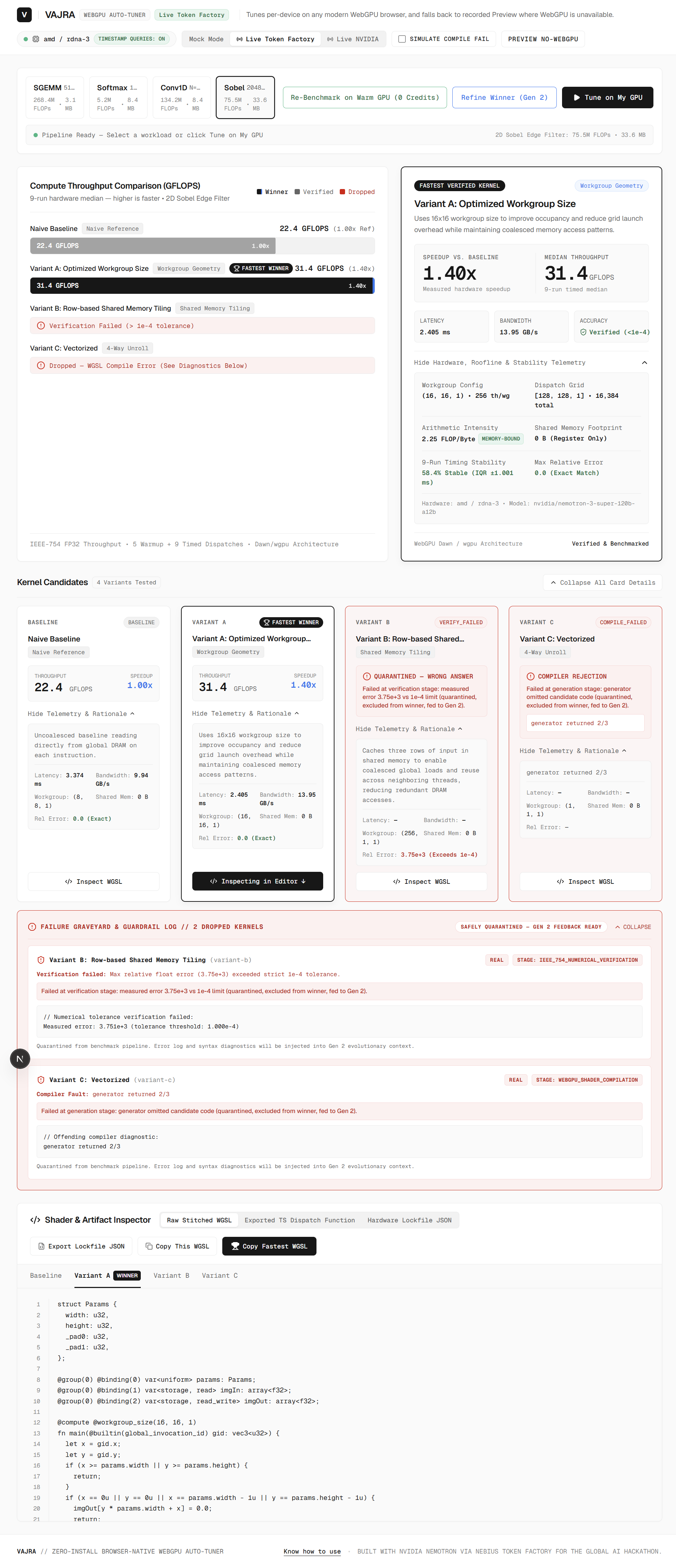
Vajra highlights the 31.4 GFLOPS (1.40x) Sobel filter run with full hardware telemetry and roofline metrics expanded.
-

This is how to use page of Vajra, new users can get help from it.


Inspiration
Language models can write syntactically plausible GPU compute shaders, but an LLM cannot know how that code executes on physical silicon. A model's idea of an "optimized" kernel is a static guess — it has never seen your GPU's cache hierarchy, warp/wave scheduler, memory bus, or driver compiler backend. In practice, manual WGSL tuning means hours of trial-and-error edits in browser DevTools.
We built Vajra (Sanskrit for thunderbolt) to close the loop between cloud LLM code generation and local hardware truth: generate kernel candidates with AI, then compile, verify, and benchmark them directly on the machine in front of you to crown the fastest verified kernel.
What it does
Vajra is a zero-install, browser-native WebGPU kernel auto-tuner powered by NVIDIA Nemotron via Nebius Token Factory:
- Pick a Compute Workload: Choose from 4 standard compute patterns: Matrix Multiplication (SGEMM 512x512), Row-wise Softmax (1024x1024), 1D Convolution (N = 1,048,576, K = 64), or 2D Sobel Edge Filter (2048x2048).
- Run the Naive Baseline: Vajra dispatches a deterministic naive baseline shader on your local GPU, capturing reference output buffers and baseline execution latency.
- Generate 3 Architectural Variants: Nemotron synthesizes three distinct WGSL compute strategies: Workgroup Geometry Tuning, Shared Workgroup Memory Tiling (var), and Vectorized SIMD Math (vec4 / fma).
- Compile & Guardrail: Each variant is compiled via browser WebGPU (createShaderModule + getCompilationInfo). Broken variants are quarantined in an interactive Failure Graveyard with exact compiler line/column diagnostics without crashing the pipeline.
- Numerical Verification: Every compiled kernel runs against identical input buffers and is checked against the baseline using strict relative tolerance (max relative error under 1e-4). Inaccurate shaders are rejected.
- Median Benchmarking & Report Card: Verified kernels undergo 5 warmup dispatches followed by 9 timed dispatches. Vajra reports 9-run medians (never cherry-picked best runs), live GFLOPS bar charts, and a Silicon Report Card detailing speedup vs baseline, derived memory bandwidth (GB/s), workgroup configurations, arithmetic intensity roofline regimes, and timing stability (IQR).
- Agentic Gen 2 Evolution: A single click evolves the winning kernel into a second-generation candidate (Variant D), feeding measured GFLOPS and Failure Graveyard compiler logs back to Nemotron.
- Drop-in Export: Developers can inspect the stitched WGSL and copy the verified fastest shader or an exported TypeScript dispatch module in one click.
How we built it
- Frontend & Systems Architecture: Built with Next.js (App Router) and TypeScript, styled using a high-contrast, flat Vercel-inspired dashboard palette (zero CSS gradients, zero purple or indigo).
- Deterministic WebGPU Harness: A hardcoded, browser-native execution engine managing deterministic Float32Array seeding, uniform buffer layouts, bind groups, pipeline staging, and readbacks.
- Inference Chain (Nebius Token Factory): Server-side routing calls NVIDIA Nemotron (Super primary, with automatic failover to Ultra) via OpenAI-compatible endpoints on Nebius Token Factory. API keys live exclusively in server environment variables.
- Tavily Web Intelligence Integration: Dual-stage runtime grounding queries the Tavily Search API before generation to retrieve hardware-aware W3C WGSL specification rules, while dynamically searching exact Dawn/wgpu compiler errors from the Failure Graveyard to guide Gen 2 error recovery.
- Dual Timing Engine: Uses native WebGPU hardware timestamp queries (GPUQuerySet 64-bit nanoseconds) where supported, falling back cleanly to wall-clock timing via performance.now() wrapped around queue completion.
- Honest Hardware Telemetry: Reports only parsed workgroup configurations (@workgroup_size and dispatch grid dimensions) and derived memory throughput (total bytes moved divided by median execution time), never fabricating hardware counters WebGPU cannot expose.
Challenges we ran into
- WGSL Compiler Incompatibilities & Uniformity Rules: Small models frequently hallucinate non-uniform barriers (such as calling workgroupBarrier after an early return guard). We built an AST/sanitizer pass to hoist boundary checks past barriers, enforced uniform barrier prompt patterns, and designed the Failure Graveyard to cleanly drop illegal shaders without stalling the GPU command queue.
- Vectorized Dispatch Truncation: When vectorizing row-wise kernels (like Softmax with vec4), models often declare elementsPerThread as [4, 1, 1] for column loops, inadvertently causing the harness to under-dispatch workgroups along X and leaving the tail 75% of rows uncomputed. We clamped outer problem-dimension divisors to ensure 100% of rows dispatch while vectorizing inner loops.
- Fast-Math Reordering Drift: Different GPU architectures and loop-unrolling strategies accumulate IEEE-754 floating-point values in different summation orders. Exact equality checks falsely fail valid optimized kernels. We implemented an element-wise relative tolerance validator (checking if relative error is under 1e-4), catching mathematical divergence while respecting hardware reordering.
- Heterogeneous Environments: Some browser sessions lack WebGPU support or run in headless sandboxes. We engineered a seamless Recorded Reference Fallback (benchmarked on Apple Silicon) with full stage simulation and fault-injection testing, ensuring every judge and visitor experiences the complete pipeline regardless of their device.
Accomplishments that we're proud of
- A Truly Closed Agentic Loop: Built an end-to-end autonomous coding workflow where an AI generates code, physical hardware tests it, compiler errors inform the next generation, and only numerically verified winners are crowned.
- Measured, Repeatable Hardware Speedups: In live physical testing on an integrated AMD Radeon 780M (RDNA-3) GPU, Vajra consistently unlocked:
- Matrix Multiplication (SGEMM 512x512): Baseline 30.6 GFLOPS to Variant B 132.9 GFLOPS (4.34x speedup, verified under 1e-4).
- Row-wise Softmax (1024x1024): Baseline 0.3 GFLOPS to Variant B 2.2 GFLOPS (7.90x speedup, verified under 1e-4).
- 1D Convolution (N = 1M, K = 64): Baseline 31.5 GFLOPS to Variant A 52.1 GFLOPS (1.65x speedup, verified under 1e-4).
2D Sobel Filter (2048x2048): Baseline 33.7 GFLOPS to Variant A 65.1 GFLOPS (1.93x speedup, verified under 1e-4).
Zero-Crash Resilience: Achieved 100% pipeline stability across invalid syntax, memory boundary overflows, and unverified float outputs with zero unhandled WebGPU promise rejections.
What we learned
- Physical Measurement Trumps Text Generation: An LLM can write plausible-looking code, but a shader that has not been compiled and timed on your exact GPU architecture is merely an unverified hypothesis.
- Telemetry Honesty Builds Trust: WebGPU does not expose hardware SM occupancy or DRAM bus counters. Clearly labeling metrics as derived and reporting 9-run medians with interquartile stability ranges (IQR) provides actionable engineering value over vanity numbers.
- Restricted Scoping Empowers Agentic Coding: Constraining the LLM to write strictly the inner compute body — while letting a deterministic TypeScript harness manage memory bindings and synchronization — turns erratic generation into a robust engineering tool.
- Failure Transparency is a First-Class Feature: Surfacing compiler line errors and numerical drift in the Failure Graveyard proves why hardware-in-the-loop verification is essential.
What's next for Vajra
- Broader Kernel Workloads: Expand from foundational linear algebra and image stencils to FlashAttention-2 approximations, LayerNorm, and 1D/2D Fast Fourier Transforms (FFT).
- Subgroup Intrinsics: Leverage emerging WebGPU subgroup operations (subgroupBallot, subgroupShuffle) for warp-level reductions without workgroup shared-memory overhead.
- Multi-Device Comparison Matrix: Allow developers to export hardware lockfiles (vajra.lock.json) to benchmark and compare identical WGSL shaders across NVIDIA RTX, Apple M-Series, AMD RDNA, and Intel Arc hardware.
- IDE & Toolchain Integration: Package the Vajra verification harness into a CLI and VS Code extension to auto-tune WGSL and ONNX Runtime Web shaders inline during local build workflows.
Built With
- agentic-ai
- ai-compiler
- autotuner
- gpgpu
- javascript
- nebius-token-factory
- next.js
- node.js
- nvidia
- nvidia-nemotron
- react
- tailwind-css
- typescript
- webgpu
- wgsl


Log in or sign up for Devpost to join the conversation.