-
-
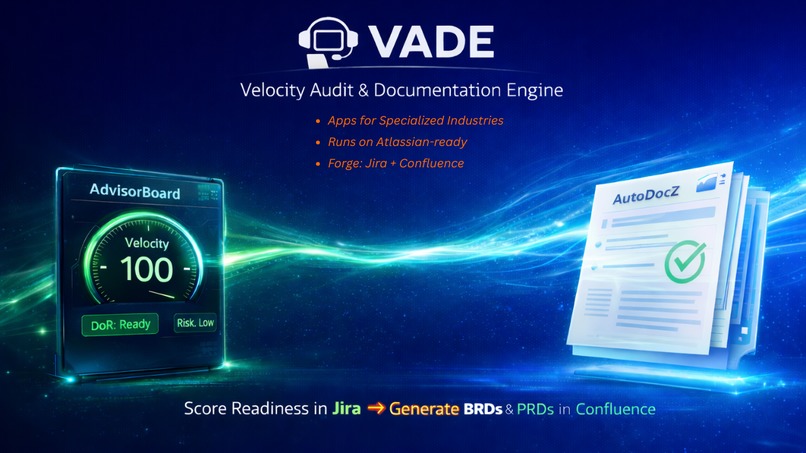
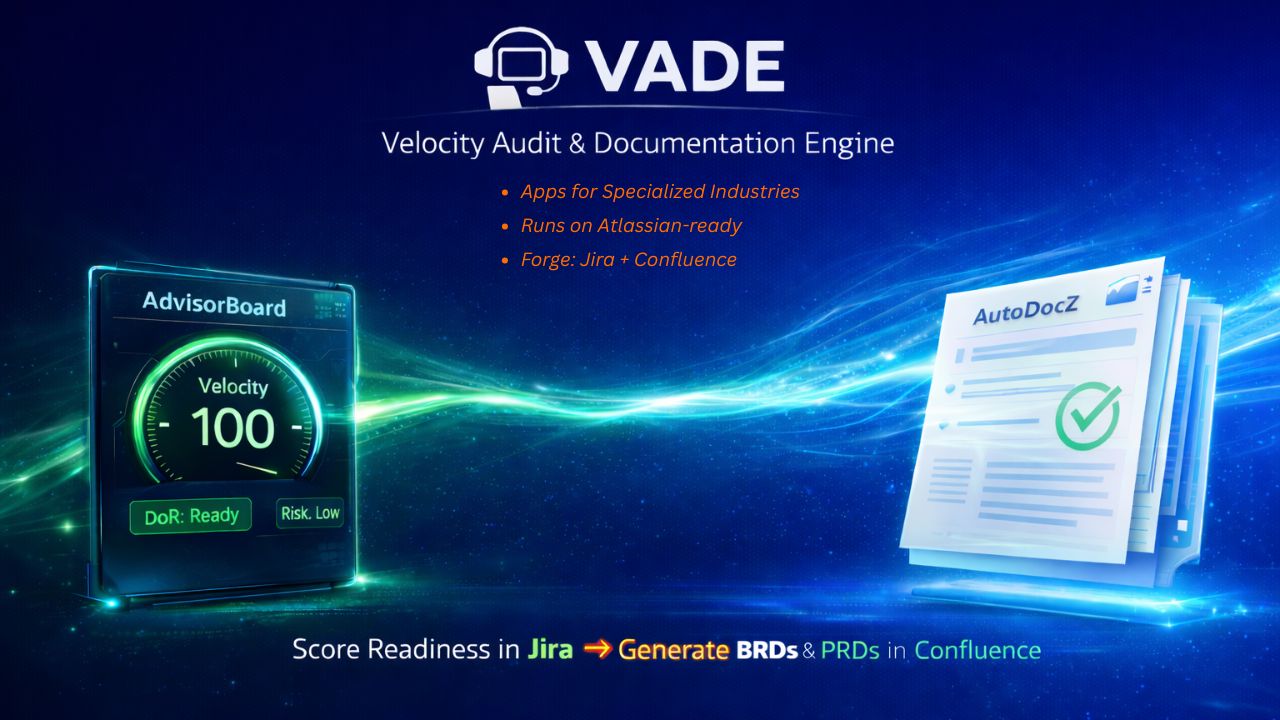
VADE: The Velocity Audit & Documentation Engine for Specialized Industries.
-
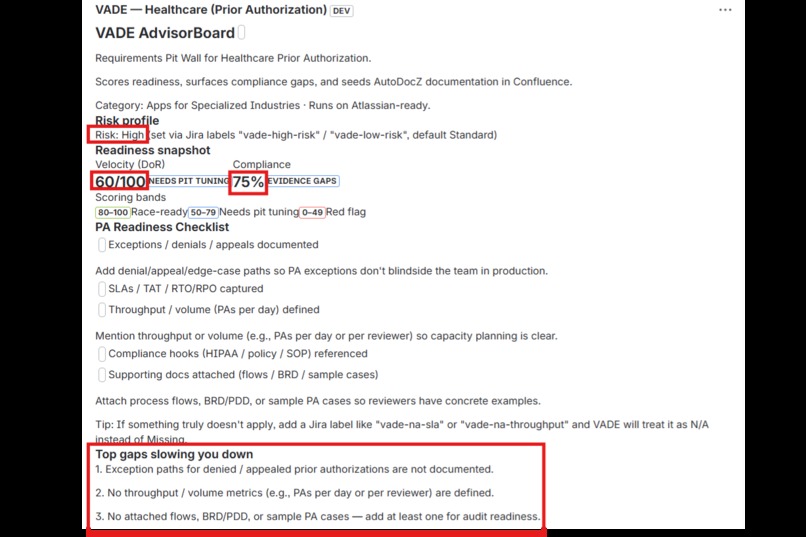
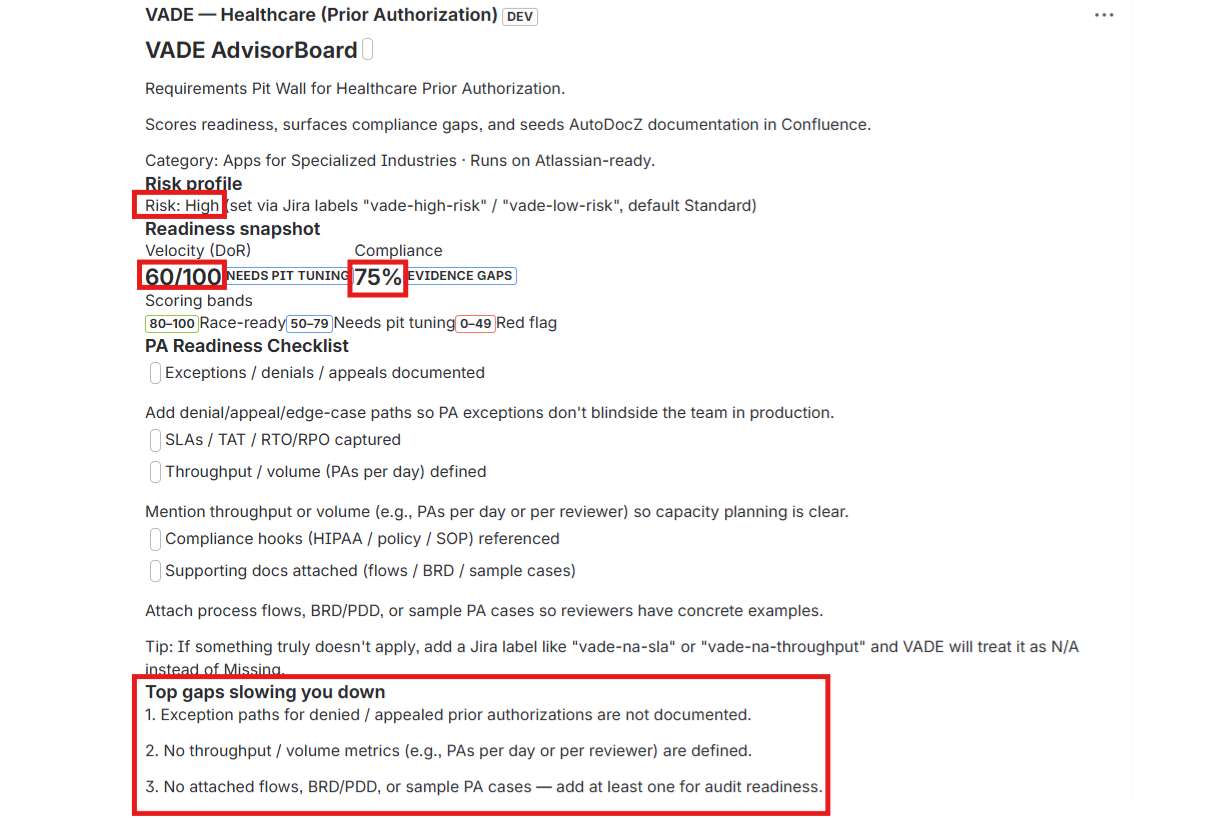
AdvisorBoard detects vague requirements, missing compliance hooks, and high risk (Red Flag) before the sprint starts.
-
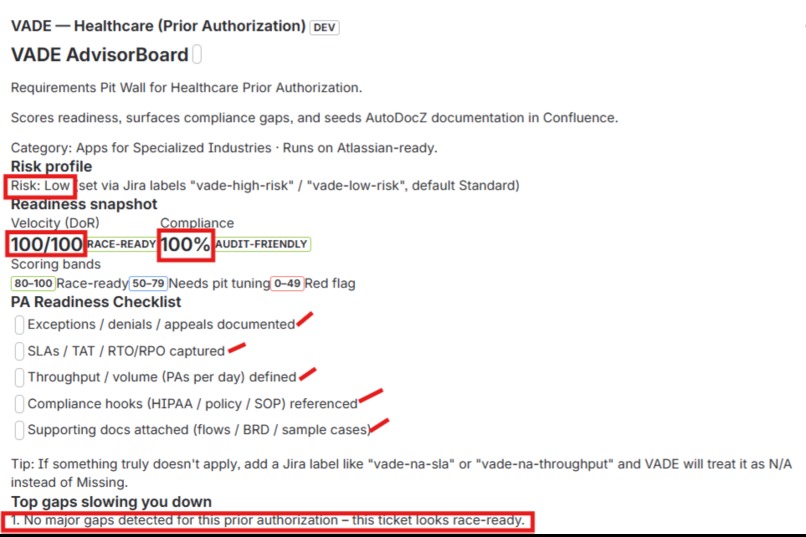
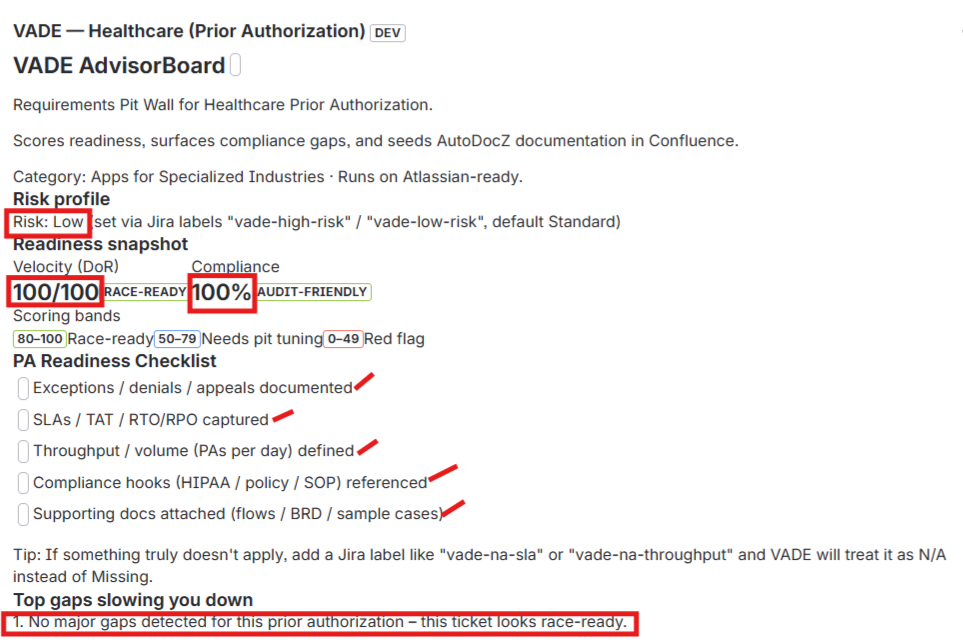
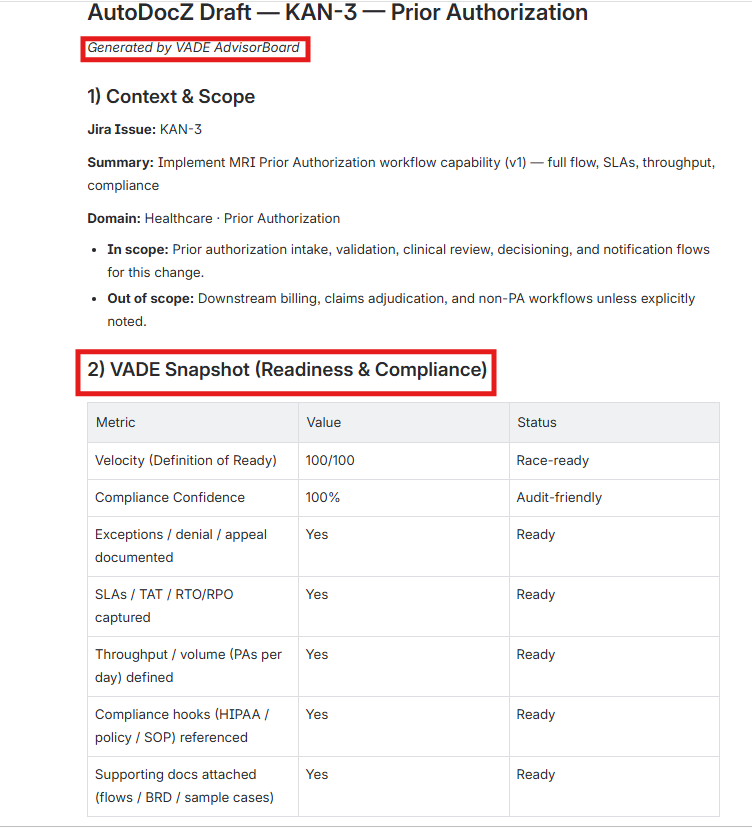
A 'Race Ready' ticket. VADE verifies SLAs, HIPAA keywords, and attachments are present using domain-specific heuristics
-
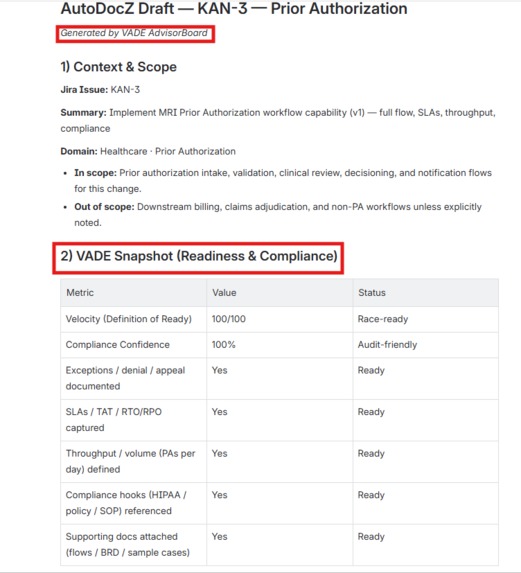
AutoDocZ: One-click generation of a PDD/BRD. It captures the VADE readiness snapshot as permanent audit evidence.
-
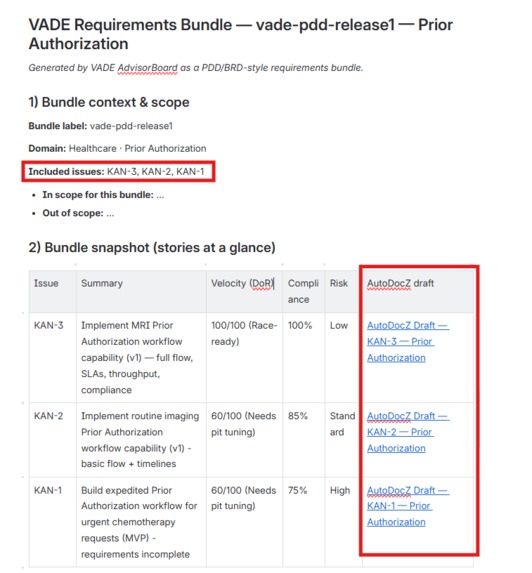
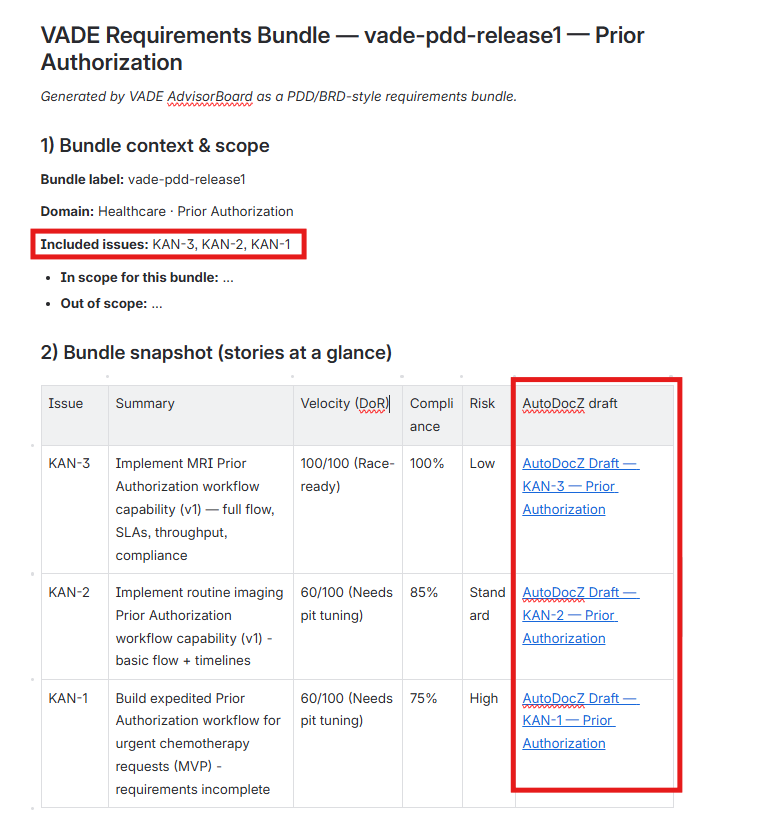
The Requirements Bundle acts as 'Race Control,' aggregating telemetry and documentation links into a single pane of glass.
Inspiration
The Requirements Pit Stop In Formula 1, you never send a car onto the track until the Pit Wall confirms it is race-ready. A loose wheel means a DNF (Did Not Finish).
In high-compliance software, specifically Healthcare Prior Authorization, we do the opposite. We ship vague Jira tickets "because sprint," only to pay for it later with rework, claim denials, and audit failures.
VADE was born from a specific pain: Business Analysts waste 2–4 hours per story rewriting missing requirements (exceptions, SLAs, compliance hooks) and then manually copy-pasting them into Confluence.
I wanted Jira to act like a Requirements Pit Wall—providing an instant telemetry check before the build, and automating the documentation tax instantly.
What it does
VADE is a Forge-native app that acts as a quality gate for your Jira issues. It consists of two powerful engines:
1. The AdvisorBoard (Jira Issue Panel)
Telemetry Scanning: Instantly scores a ticket’s Velocity (Definition of Ready) and Compliance Confidence based on domain-specific heuristics (Healthcare/HIPAA/Payer Policy).
Gap Detection: Flags missing essentials that cause downstream bugs: exception paths, SLAs/TAT, throughput volume, and compliance evidence.
Smart Context: Supports vade-na-* labels so teams aren't punished for irrelevant checks.
2. AutoDocZ (Documentation Automation)
One-Click BRD/PDD: Turns a scored Jira issue into a structured Confluence Product Definition Document instantly. It captures the "Definition of Ready" snapshot as audit evidence.
The Requirements Bundle: Stitches multiple stories (via a release label like vade-pdd-release1) into a single Master Release Document in Confluence. This gives Release Managers a "Single Pane of Glass" to view the readiness of the entire fleet.
While the MVP is tuned for Healthcare Prior Authorization, the engine is designed to scale to any specialized industry (Fintech, Automotive, Clinical Trials).
How we built it
We adhered strictly to the Runs on Atlassian architecture to ensure security for regulated industries:
Platform: Atlassian Forge (UI Kit).
APIs: Native requestJira and requestConfluence bridges.
Security: Zero Egress. No external HTTP calls. No data leaves the customer's instance.
Logic: The "Heuristic Engine" analyzes the ADF (Atlassian Document Format) description against a dictionary of domain-specific risk vectors (e.g., "HIPAA," "SLA," "Denial").
Challenges we ran into
The "Cross-Product" Hurdle: Getting Jira to talk to Confluence seamlessly within a Forge app required careful handling of user permissions and space verification. We had to design a UX that gracefully handles "Missing Spaces" so the user isn't left in the dark.
Heuristics vs. Hallucinations: We consciously chose not to use external Generative AI. In healthcare compliance, "explainability" is king. A rule-based heuristic engine is auditable; a black-box LLM is not. This constraint made our logic harder to write but safer to sell.
Accomplishments that we're proud of
The "Time Collapse": We successfully turned a 4-hour manual documentation task into a 5-second API call.
Visual Impact: The UI communicates complex risk data (Red/Green/High/Low) in a way that is immediately understandable to a non-technical manager.
True "Pit Wall" Feel: The app doesn't just nag you; it coaches you. It highlights exactly what is missing so you can fix it and get back to the race.
What we learned
Trust > Magic: In high-compliance industries like Healthcare, "boring" reliability beats "magic" AI. We learned that users prefer explainable heuristics (rules they can see) over black-box LLM decisions when their audit compliance is on the line.
The "Garbage In, Garbage Out" Reality: Automation cannot fix a fundamentally bad requirement. We learned that the most effective tool isn't one that fixes the code, but one that stops the bad requirement from entering the garage in the first place.
Cross-Product Complexity: Building a bridge between Jira and Confluence within Forge revealed that the biggest challenge isn't the API—it's the User Experience. Handling permissions, space selection, and error states gracefully is what separates a "hackathon script" from a "product."
What's next for VADE: Velocity Audit & Documentation Engine
Industry Profiles: Configurable rule sets for other specialized tracks (e.g., "Banking KYC," "Clinical Trials," "Automotive ISO 26262").
Rovo Integration: (Future) Using Atlassian Rovo to parse meeting transcripts and auto-fill the "Missing Gaps" in the Jira ticket.
Trend Analysis: A project-level dashboard showing "Velocity Quality" over time—are we getting better at writing requirements?
Built With
- atlassian-forge
- confluence-cloud
- forge-ui-kit
- javascript
- jira-cloud
- rest-api
- runs-on-atlassian

Log in or sign up for Devpost to join the conversation.