https://wandb.ai/abhinavpad13-purdue-university/vacation-planner/weave/traces?view=traces_default
Inspiration
Planning group trips is a notoriously frustrating experience. Everyone has different preferences, schedules, and budgets, and coordinating all that through endless messages or polls often leads to confusion, delays, or even canceled plans. I wanted to build a solution that makes group trip planning seamless, fair, and fun — leveraging AI to do the heavy lifting of negotiation and compromise behind the scenes.
What I Learned
Throughout this project, I deepened my understanding of multi-agent coordination and negotiation algorithms, especially how to fairly merge diverse user preferences into a single plan. Implementing the Model Context Protocol (MCP) to power a chatbot assistant helped me explore advanced AI capabilities like context-aware recommendation and dynamic querying. I also improved my skills in full-stack development by integrating AI APIs, real-time chat interfaces, and external travel data sources.
How I Built It
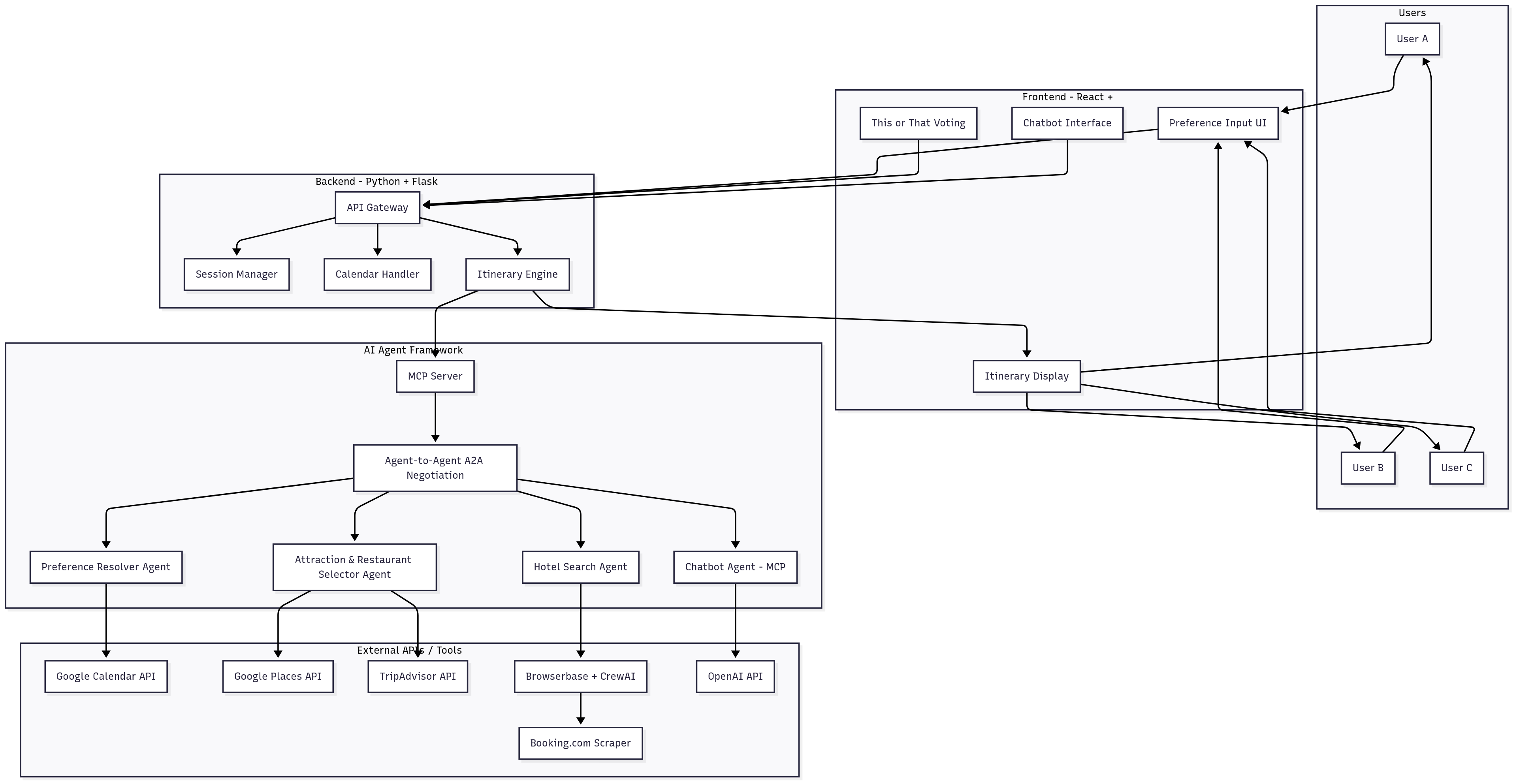
We built a custom MCP (Model Context Protocol) server that allows agents to share context and delegate tasks intelligently. This server acts as the coordination layer for multiple AI agents working together across the trip planning pipeline.
One of the biggest technical hurdles was getting reliable hotel data with booking links, which most public APIs don’t offer. To solve this, we integrated CrewAI with Browserbase, a headless browser platform that let our agent autonomously search Booking.com and extract the top hotels, complete with prices, ratings, images, and booking URLs. Browserbase was essential — without it, real-time hotel bookings would not have been possible.
The platform uses Agent-to-Agent (A2A) communication, allowing different agents to negotiate on behalf of each user. For example, agents compare preferences (like food or activity types), negotiate which restaurants and attractions to visit, and build a balanced itinerary that fits everyone’s tastes and constraints.
Challenges
- Balancing fairness vs. preferences: Designing an algorithm that fairly respects all users without letting any single preference dominate was tricky.
- Integrating MCP for dynamic queries: Ensuring the chatbot understood context and specific requests accurately required careful prompt engineering and error handling.
- Real-time collaboration: Managing simultaneous inputs from multiple users and keeping the itinerary updated live posed synchronization challenges.
Despite these hurdles, the project successfully demonstrates how AI can simplify complex group decisions and deliver personalized, fair trip plans.
Built With
- ai
- browserbase
- crew-ai
- mcp
- python
- react
- typescript

Log in or sign up for Devpost to join the conversation.