-
-
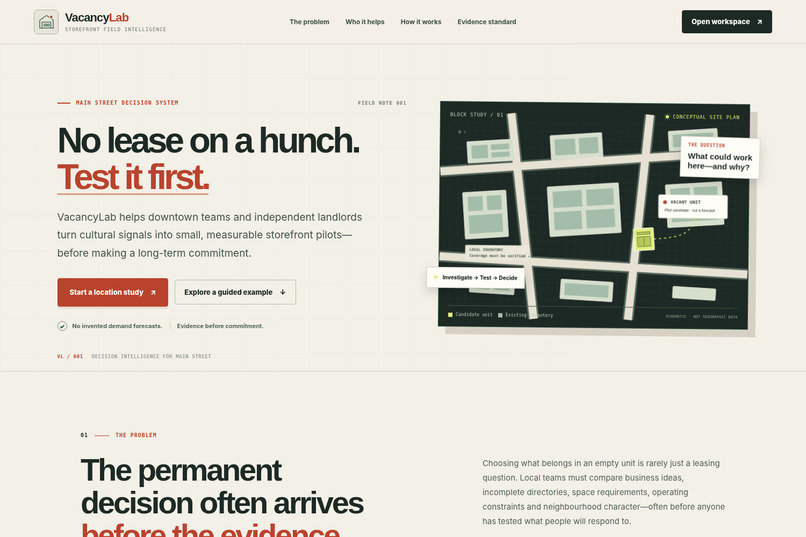
Landing Page: VacancyLab helps landlords investigate vacant storefront opportunities using Qloo cultural intelligence.
-
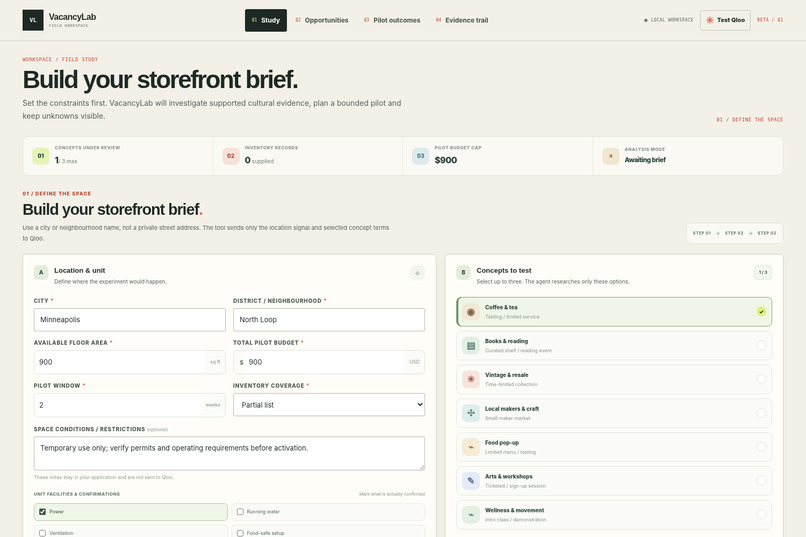
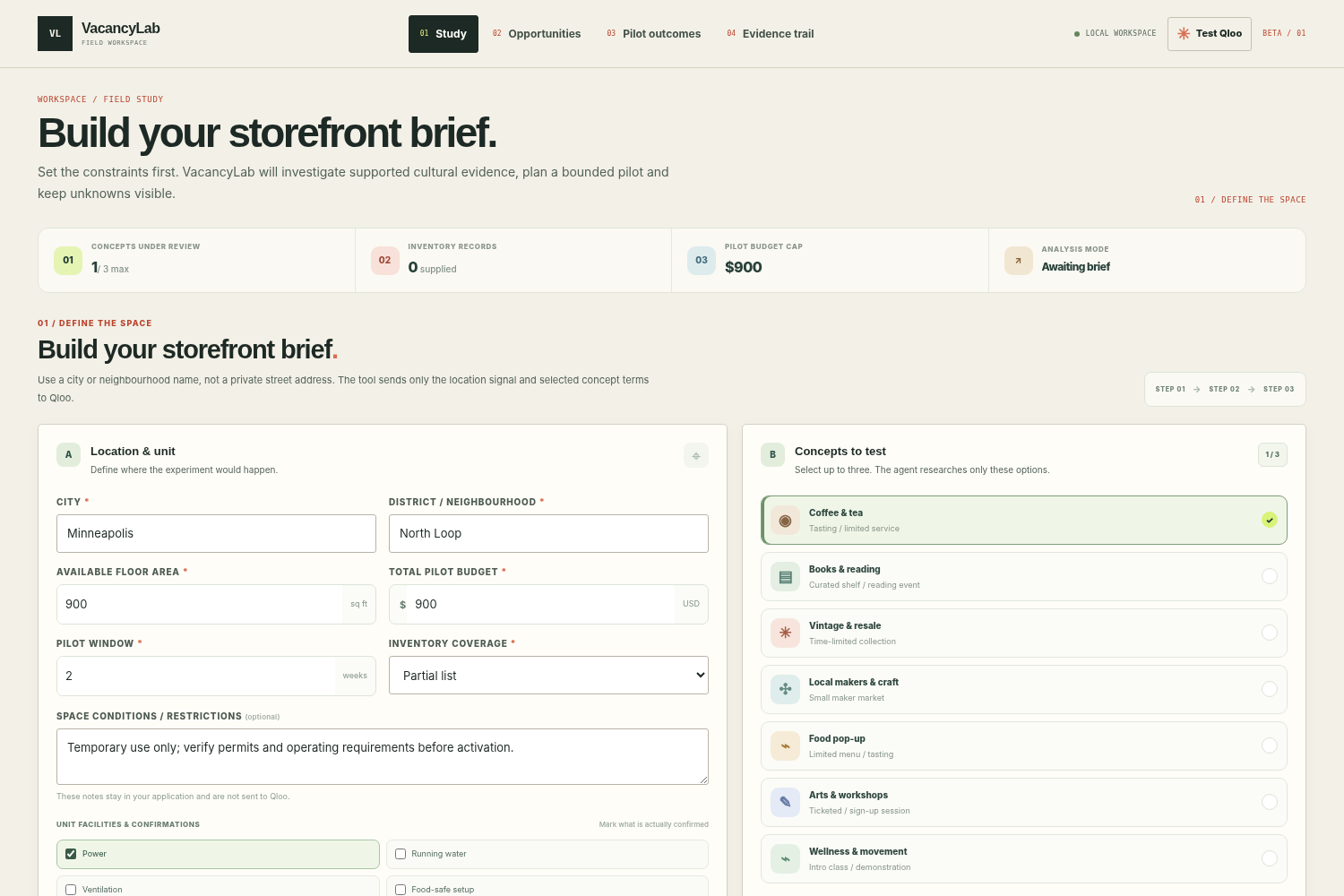
Study Workspace: Define location, budget, floor area, inventory coverage, and concepts to investigate.
-
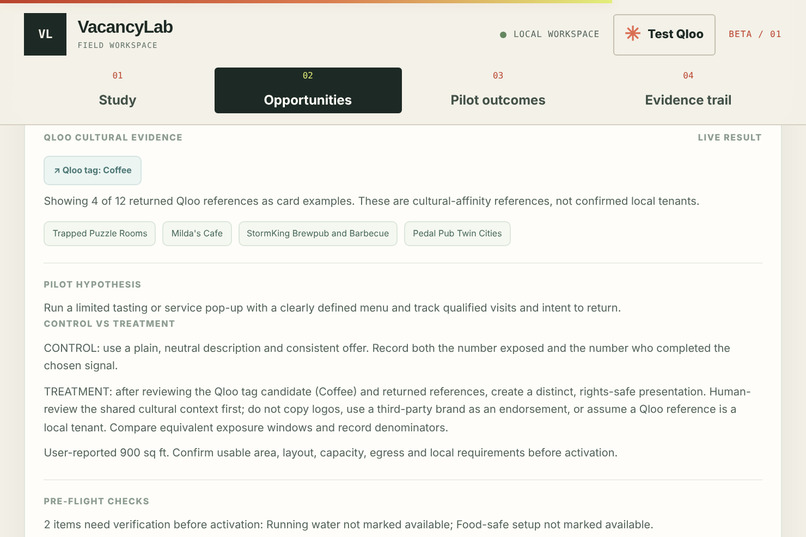
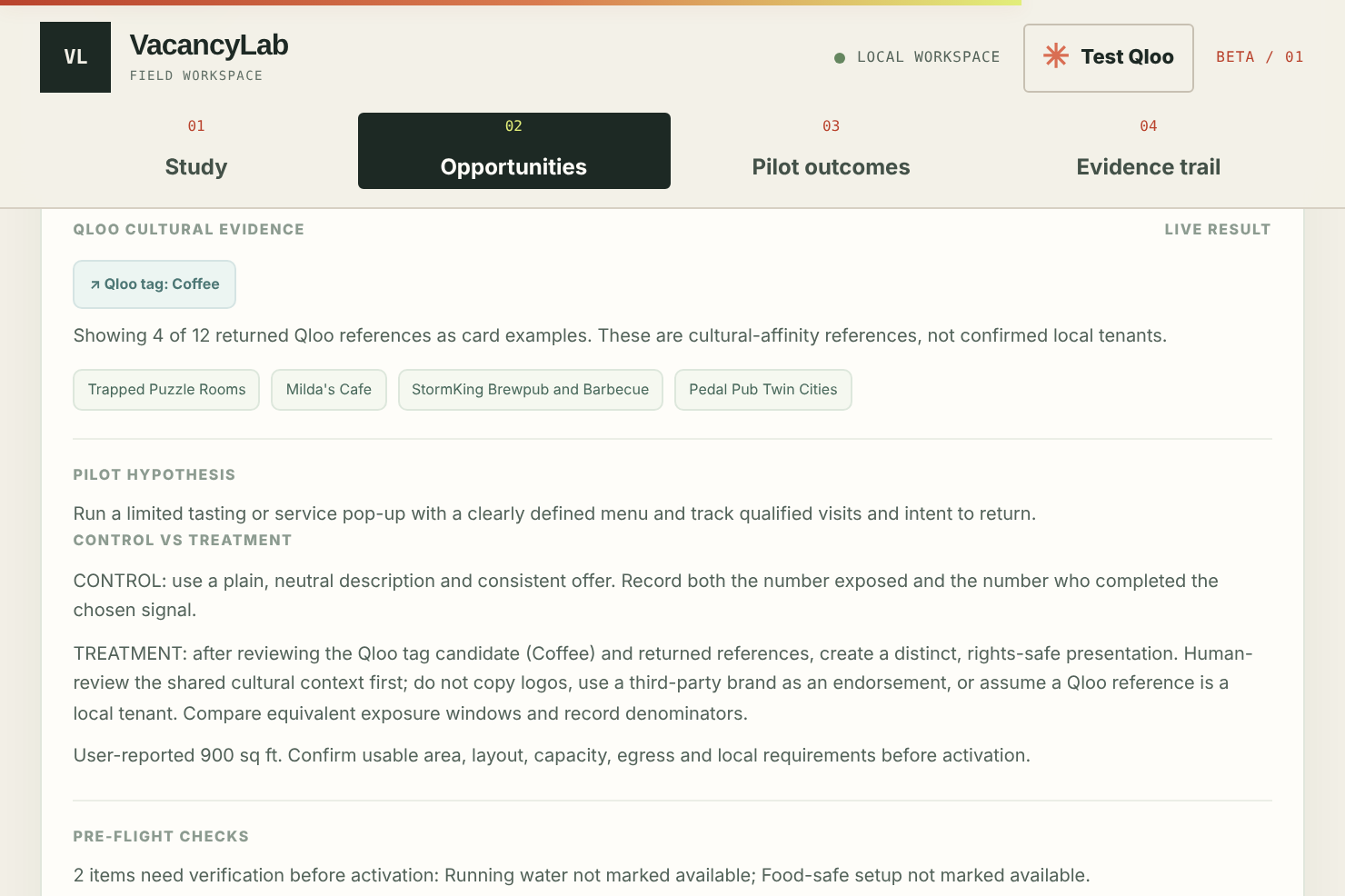
Opportunity Board: Explore Qloo cultural-affinity evidence and identify testable storefront opportunities.
-
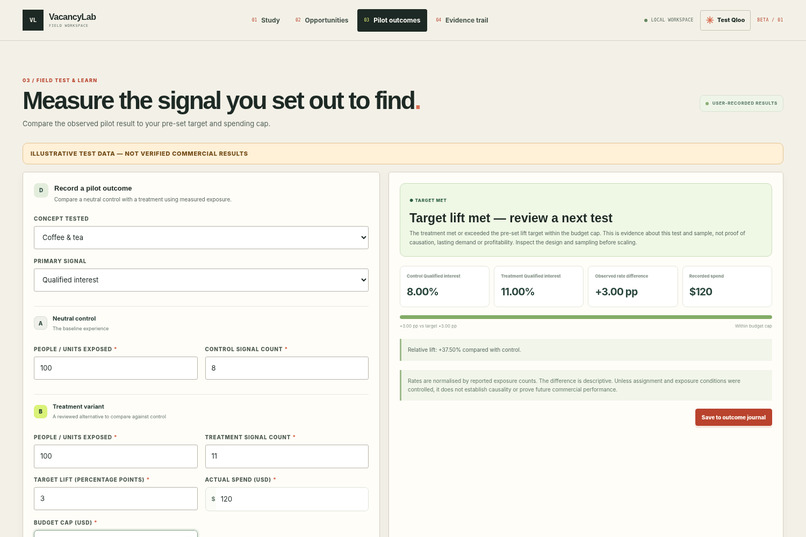
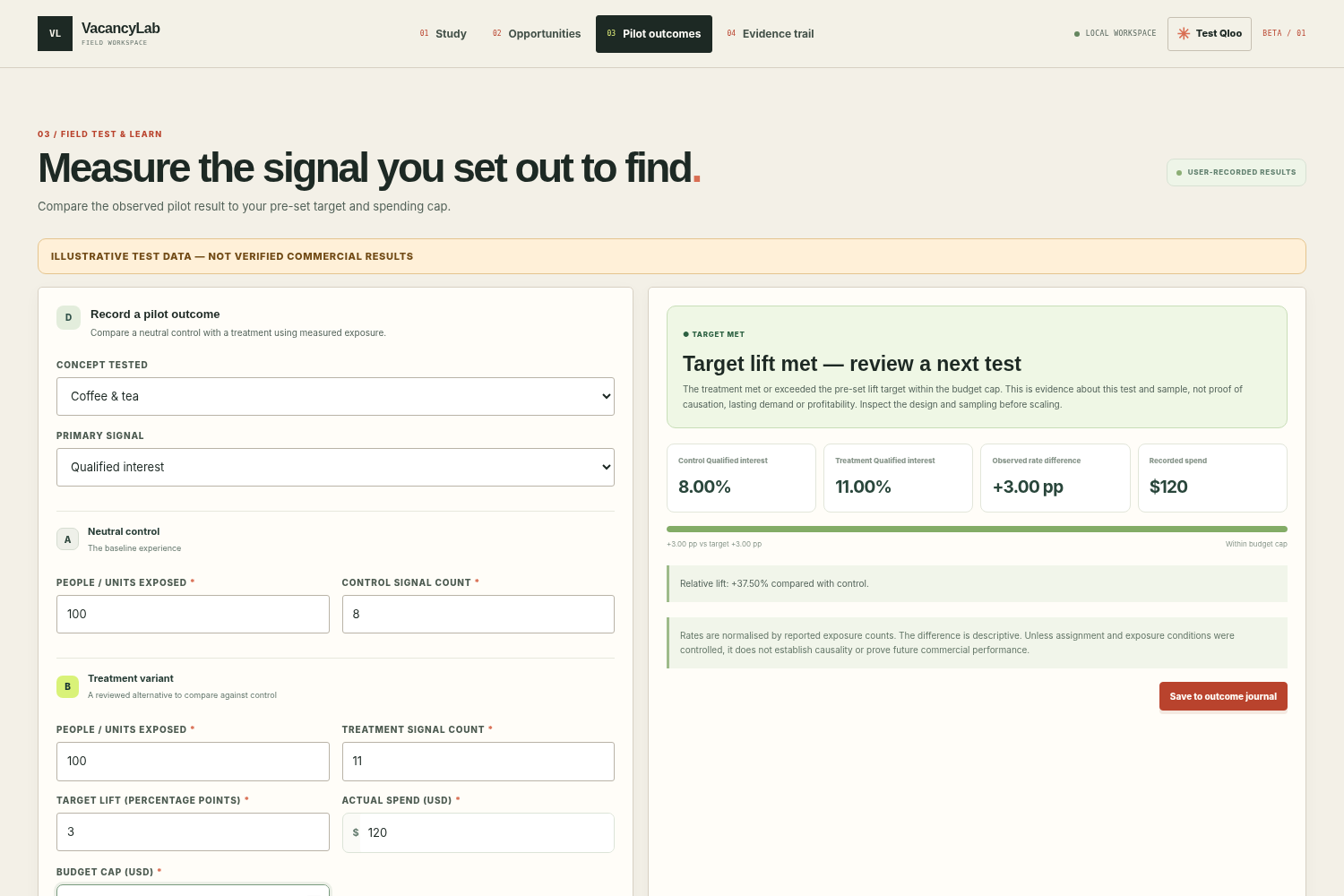
Pilot Outcomes: Compare control and treatment results, track spending, and measure observed outcomes.
-
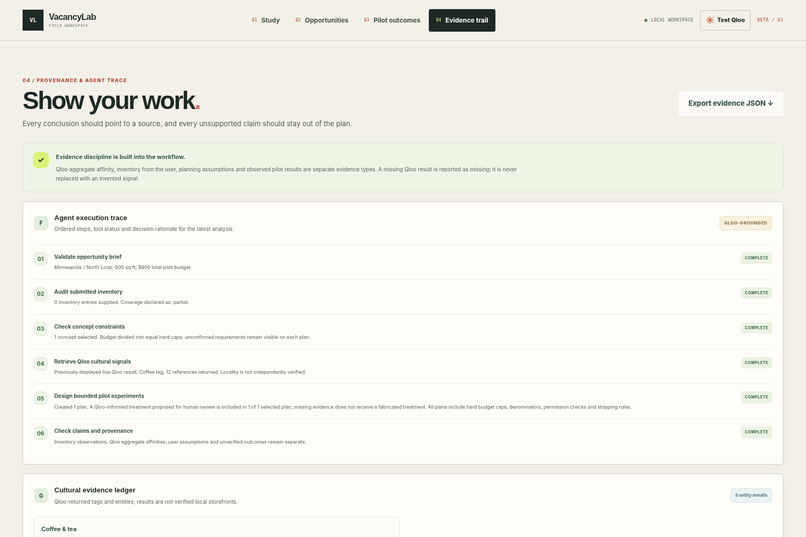
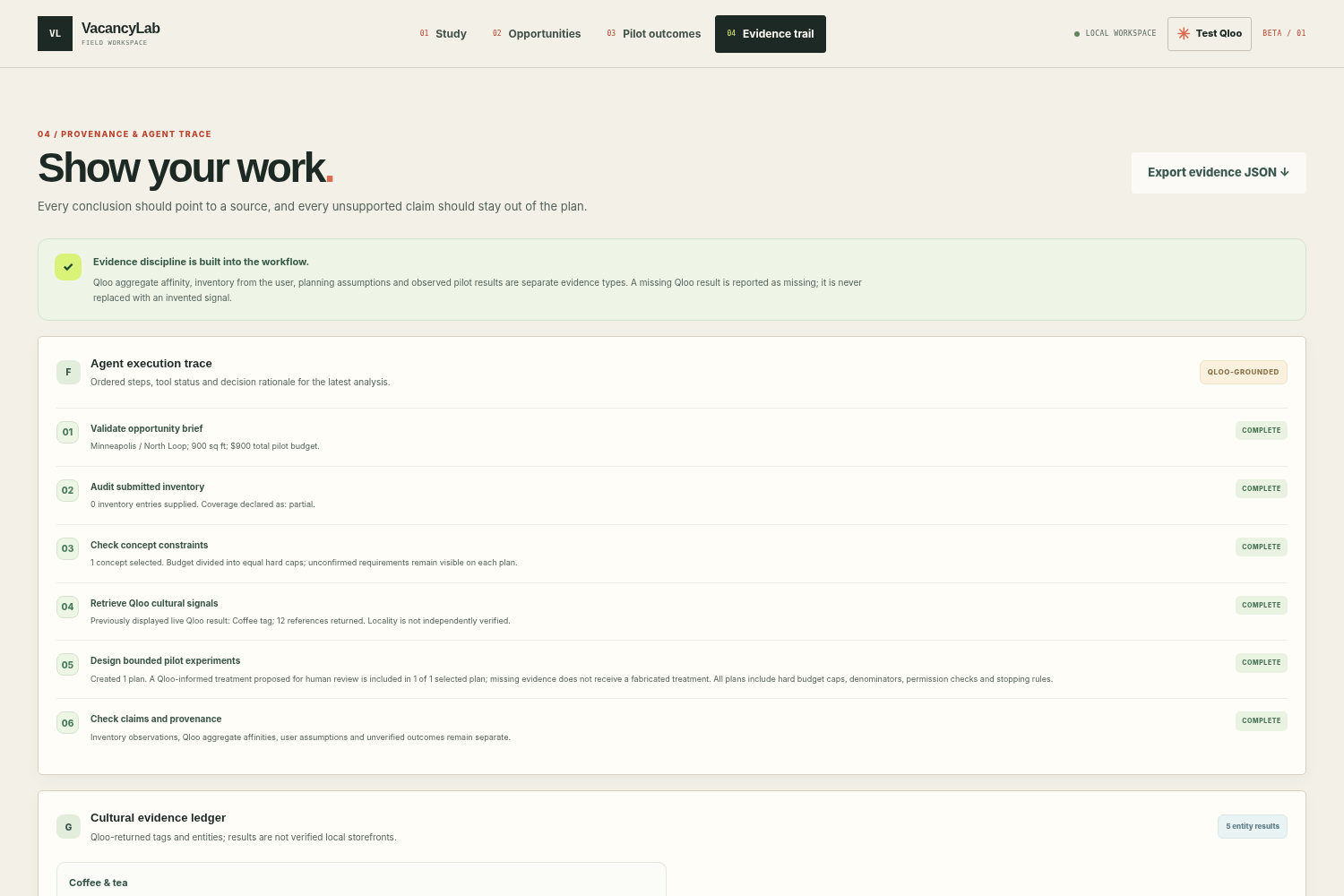
Evidence Trail: Review Qloo evidence, analysis records, limitations, and exportable evidence.
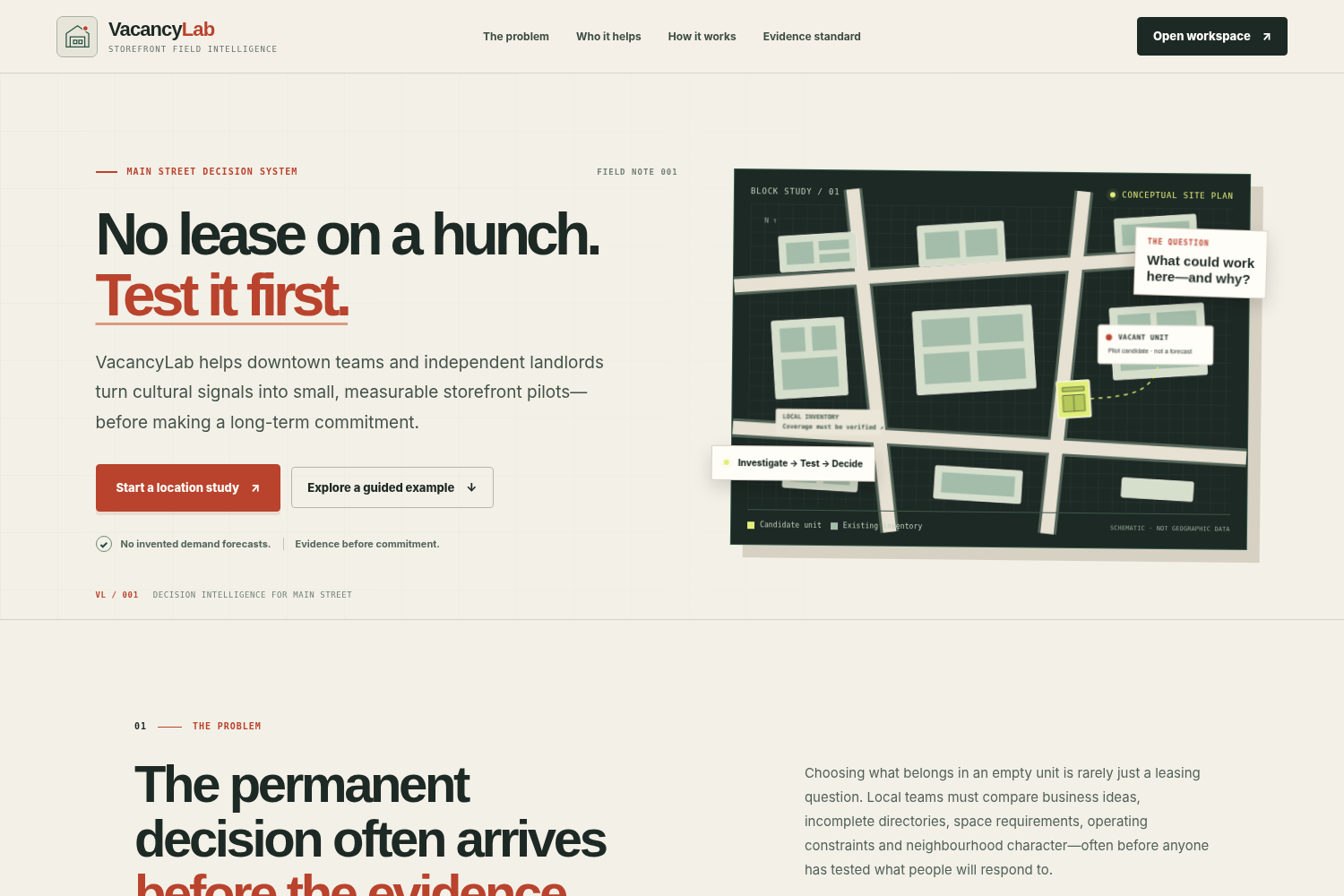
VacancyLab No lease on a hunch. Test the neighbourhood before you sign. The Problem
Choosing what should occupy a vacant storefront is a consequential decision. Independent landlords and downtown development teams must consider local context, available space, budgets, existing businesses, and the concepts that might appeal to a neighbourhood.
Yet cultural interest alone does not prove commercial demand, and an empty inventory spreadsheet does not mean a neighbourhood has a supply gap.
VacancyLab was built to help people investigate these decisions more systematically before committing to a concept.
Our Solution
VacancyLab is a cultural-intelligence-powered storefront decision-support tool that turns an initial location brief into a testable pilot plan.
It combines user-defined storefront constraints with cultural-affinity signals from Qloo, then helps users examine opportunities, identify missing information, plan bounded experiments, and record observed outcomes.
The guiding principle is simple: affinity is a clue; a pilot is evidence.
How It Works
- Define the storefront
Users enter a location, district, floor area, budget, pilot duration, inventory coverage, facilities, and the concepts they want to investigate.
This establishes the constraints for the study instead of treating every storefront as the same opportunity.
- Investigate cultural signals with Qloo
VacancyLab integrates the Qloo API to retrieve cultural-affinity evidence relevant to the selected concept and location.
The resulting references help guide further investigation. The application distinguishes cultural-affinity references from confirmed local tenants and makes relevant geographic limitations visible.
- Turn the evidence into a testable opportunity
The Opportunity Board organizes the findings into opportunity cards, pilot hypotheses, proposed next steps, and outstanding assumptions.
For example, a coffee-and-tea concept might lead to a limited tasting or service pop-up designed to measure qualified interest and intent to return.
This is a proposed experiment, not a guarantee that the concept will succeed.
- Record and compare pilot outcomes
VacancyLab includes a Pilot Outcomes workflow for recording control and treatment exposures, observed signals, spending, and target lift.
It calculates observed rates and differences to help users review what happened during a recorded test. These descriptive comparisons do not automatically prove causation, profitability, or future demand.
- Inspect and export the evidence
The Evidence Trail provides access to the analysis trace, cultural evidence, provenance, and known limitations. Users can export an evidence record for further review.
The goal is to make the basis of a decision more transparent rather than hiding uncertainty behind a recommendation.
What Makes It Qloo-Powered?
Qloo provides the cultural-affinity signals that inform VacancyLab's opportunity investigation.
VacancyLab incorporates the API results into a practical workflow: retrieve cultural evidence, organize references, connect findings to a pilot hypothesis, record outcomes, and preserve the evidence trail.
Qloo does not verify that a referenced business operates in the target district, and cultural affinity does not establish purchasing intent. VacancyLab is designed to keep those distinctions visible.
The Workflow and Technical Approach
VacancyLab is a hosted web application with a JavaScript-based interface and server-side API integration.
Its tool-driven study workflow connects user-defined constraints with Qloo retrieval, evidence normalization, opportunity planning, outcome recording, and exportable records. The Evidence Trail makes the latest analysis and its decision context easier to inspect.
The Qloo credential is handled server-side rather than exposed in the public browser interface.
Challenges and What We Learned
One of the central challenges was turning cultural-affinity data into something useful for a real decision without overstating what the data proves.
A list of cultural references is not a local tenant directory. A missing inventory dataset is not evidence of a supply gap. A higher observed treatment rate does not, by itself, establish causation.
These distinctions shaped the product's evidence labels, geographic-scope explanations, inventory warnings, pre-flight checks, and outcome-measurement workflow.
We learned that a useful decision-support product must communicate not only what its evidence suggests, but also what remains unknown and what users should verify next.
Who Is It For? Independent commercial landlords evaluating concepts for vacant storefronts. Downtown development teams investigating opportunities in their districts. Main Street organizations planning small, measurable local-business experiments. Testing the Live Application
Open the live demo and start a location study. Define the storefront constraints, select a concept, and run the study.
Inspect the Opportunity Board to review the generated opportunity and Qloo evidence. Continue to Pilot Outcomes to examine the measurement workflow, then open the Evidence Trail to review the evidence and test the export.
The application is intended to be explored through its working interface, not just viewed as a static dashboard.
Important Limitations
VacancyLab does not guarantee demand, profitability, successful tenancy, or commercial viability. Cultural-affinity references are not confirmed local tenants. Users must verify actual property conditions, local requirements, inventory information, and operational readiness before launching a pilot.
Recorded outcomes should be interpreted according to their measurement conditions and should not be presented as verified commercial success unless supported by real-world evidence.
Our Vision
VacancyLab aims to make storefront decisions more evidence-led, experiments more measurable, and uncertainty more visible.
No lease on a hunch. Test the neighbourhood before you sign.
Built With
- analysis
- api
- cloudflare
- css
- data
- development
- html
- javascript
- node.js
- qloo
- rest
- web
- workers

Log in or sign up for Devpost to join the conversation.