-
-
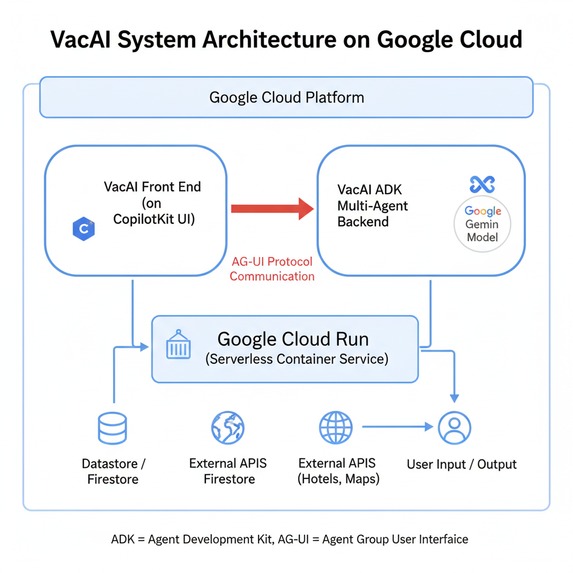
Cloud Run Architecture
-
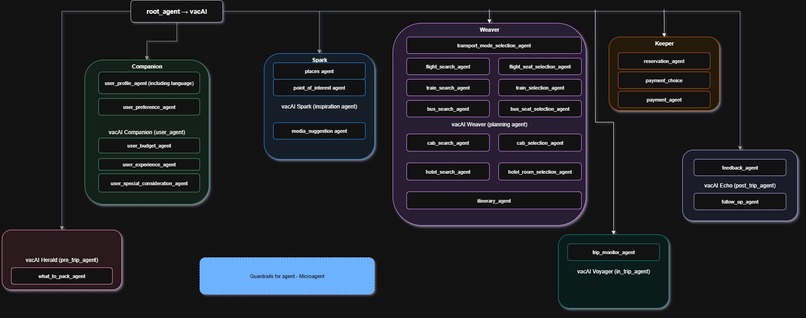
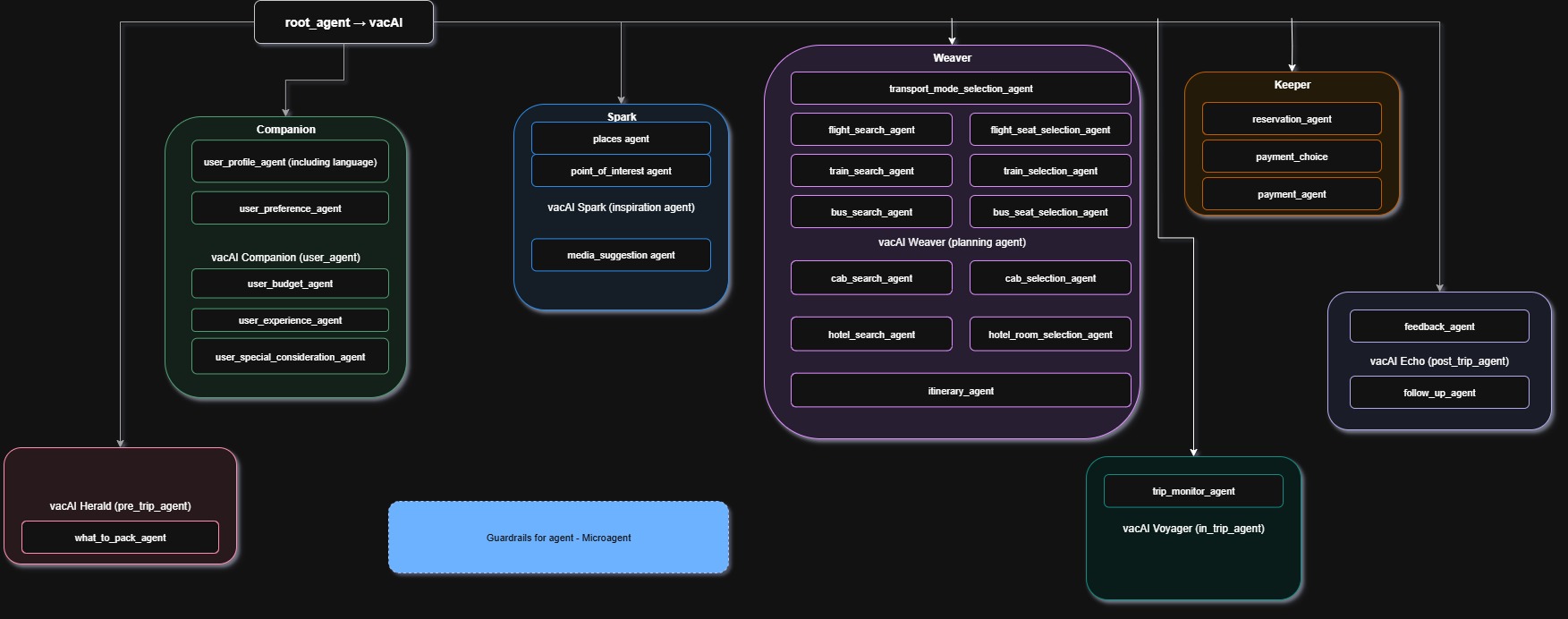
Agents diagram
Inspiration
Travelers face difficulties in planning and managing seamless end-to-end journeys due to fragmented information, hidden costs, lack of personalization, and accessibility challenges. There is no unified platform that integrates transport, accommodation, and activities while providing real-time updates and adaptive recommendations. A comprehensive trip planner is needed to generate personalized, budget-friendly itineraries, offer multilingual support, adjust dynamically to changes, and enable one-click booking and payment, ensuring a smooth and hassle-free travel experience. The AI trend in the travel industry is expected to rise by a CAGR of 28.7% from 2024 to 2030, as per the report Markets and Markets.
What it does
Taking into account of the user's needs and challenges using Design Thinking, VacAI is created. VacAI is an innovative, multilingual, modular multi-agent system designed to streamline and personalize the entire travel lifecycle. It generates dynamic itineraries that adapt to user inputs and preferences on budget, trip duration, themes, hotel preferences, food choices, and medical requirements. It is mobile friendly, ensures safety needs of children , women and older citizens, and also tailors to your conversation style and provides a human like experience, educates about any terminology it may use which user cannot understand. Our logo is built using Google AI Studio.
How we built it
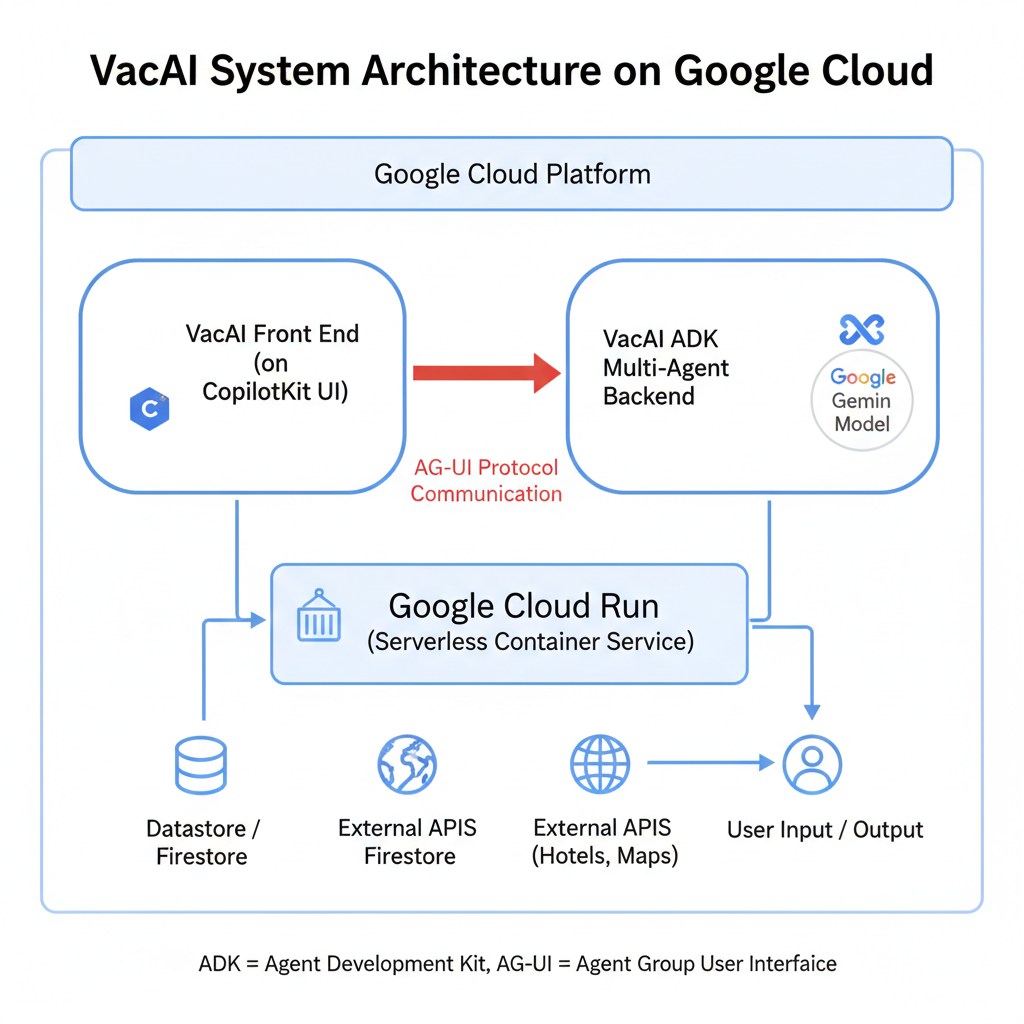
We have conducted interviews and captured users' pain points, and our methodology uses Design thinking. A traveler's experience can be divided into two stages: pre-booking and post-booking stages, and we have implemented in the same manner. VacAI uses ADK-supported tools such as Gemini Flash 2.5, Google Places API, Google Search Grounding, and Firebase for user profiles. We have also implemented a governance layer, a.k.a Guardrails, using ADK Callbacks, to assess and prevent user inputs that pose security risks (like prompt injections) or brand risks (off-brand requests). It often uses a lightweight LLM to evaluate the prompt's compliance with defined policies. To ensure scalability, we have used a containerized platform, GCP Cloud Run and have utilized it to host our backend service as well as our Front-end service. Our front-end UI is powered by Copilotkit. Both front-end and back-end services are hosted on two different Cloud Run services, and they interact with the AG-UI protocol.
Challenges we ran into
While deploying our integrated solution of our agent backend services and the UI from Copilotkit, we discovered that only the UI part was working, and the backend ADK was found to be unresponsive. After a certain iteration of trial and error, we came to the conclusion to have two separate Cloud Run services to host the front end and backend separately, and it worked.
Accomplishments that we're proud of
Implemented security guardrail and successfully validated using Log Explorer, we were able to validate for all use-case scenarios and fallback. successful deployment of both backend and frontend
We are proud of successfully implementing Vertex AI Security Guardrail and validated its effectiveness comprehensively using Log Explorer, which will help us to prevent any misuse of our agents from prompt injection attacks, jailbreaks, and PII or internal data exposure.
Secondly, we tested our agent for all critical use-case scenarios and fallbacks, including:
Vulnerable Populations: Specific requirements for women's safety and senior citizens.
Essential Needs: Personalized handling of food and medical requirements.
Real-Time Adaptability: Validation of responses based on real-time conditions.
Furthermore, we achieved the successful deployment of both the backend and frontend components using the AG UI (Agent Group UI), ensuring a fully operational and secure integrated solution.
What we learned
During this hackathon, our primary focus was mastering Cloud Run Deployment to provide a scalable and managed environment for our solution. We established a streamlined CI/CD pipeline using Cloud Build to connect our repository and automate the deployment of both front-end and back-end services. This foundational knowledge allowed us to successfully implement the Google AI tech stack, specifically by building a multi-AI agent system using the Agent Development Kit (ADK) and leveraging ADK Agent Callbacks to implement security guardrails.
During the hackathon, we sharpened crucial soft skills by embracing a never-give-up attitude and fostering teamwork built on mutual appreciation and empathy. We practiced proactive leadership, navigating complex scenarios with clarity, quick decision-making, and effective time management. As product managers, we learned design thinking to identify our USP, fill feature gaps via user surveys, and motivate the team while working under pressure.
What's next for VacAI-Your travel buddy
-Long-term memory using Vertex AI memory bank service. -MCP toolbox to make our agent more grounded. -Beta testing with users from various age groups, diverse background.
Built With
- adk
- cloudbuild
- cloudrun
- firebase
- gemini-inbuilt-security
- gemini2.5
- google-search-grounding
- places-api


Log in or sign up for Devpost to join the conversation.