-
-
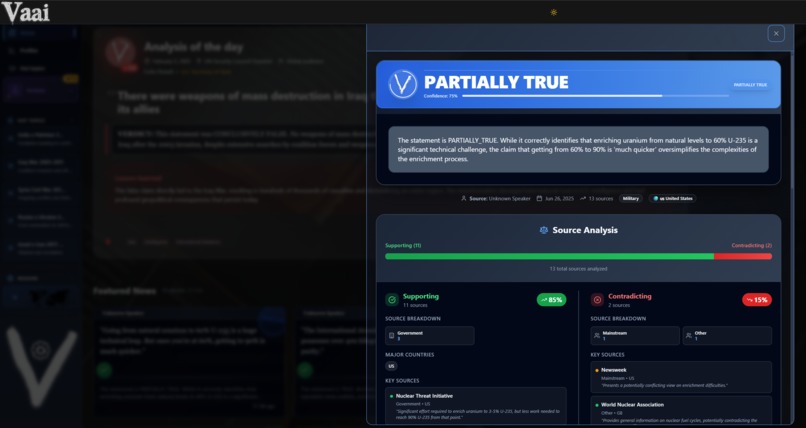
Statement analysis from articles, tweets or videos
-
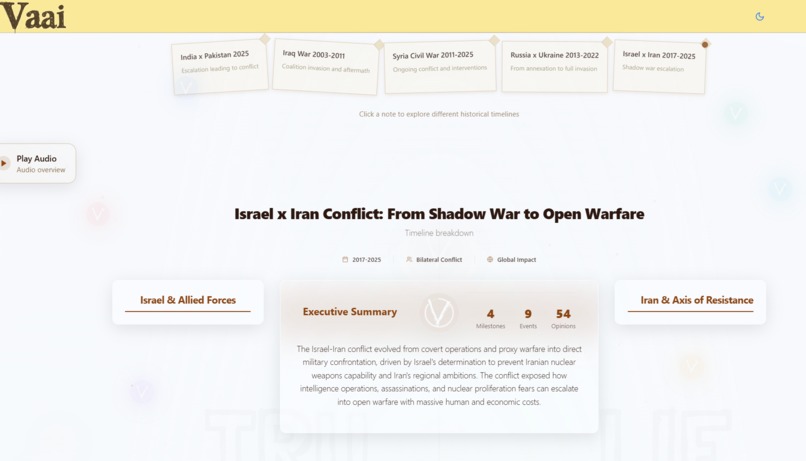
Event breakdown with deep historical analysis
Inspiration
The flood of misinformation and polarized perspectives in today's media landscape inspired us to create a more nuanced approach to news consumption. I wanted to build a platform that doesn't just present facts, but helps users understand the full spectrum of causalities behind decisions with impact damaging humanity in favor of specific groups.
What it does
Vaai is an AI-powered news analysis platform that transforms complex news stories into interactive, multimedia experiences. The platform features:
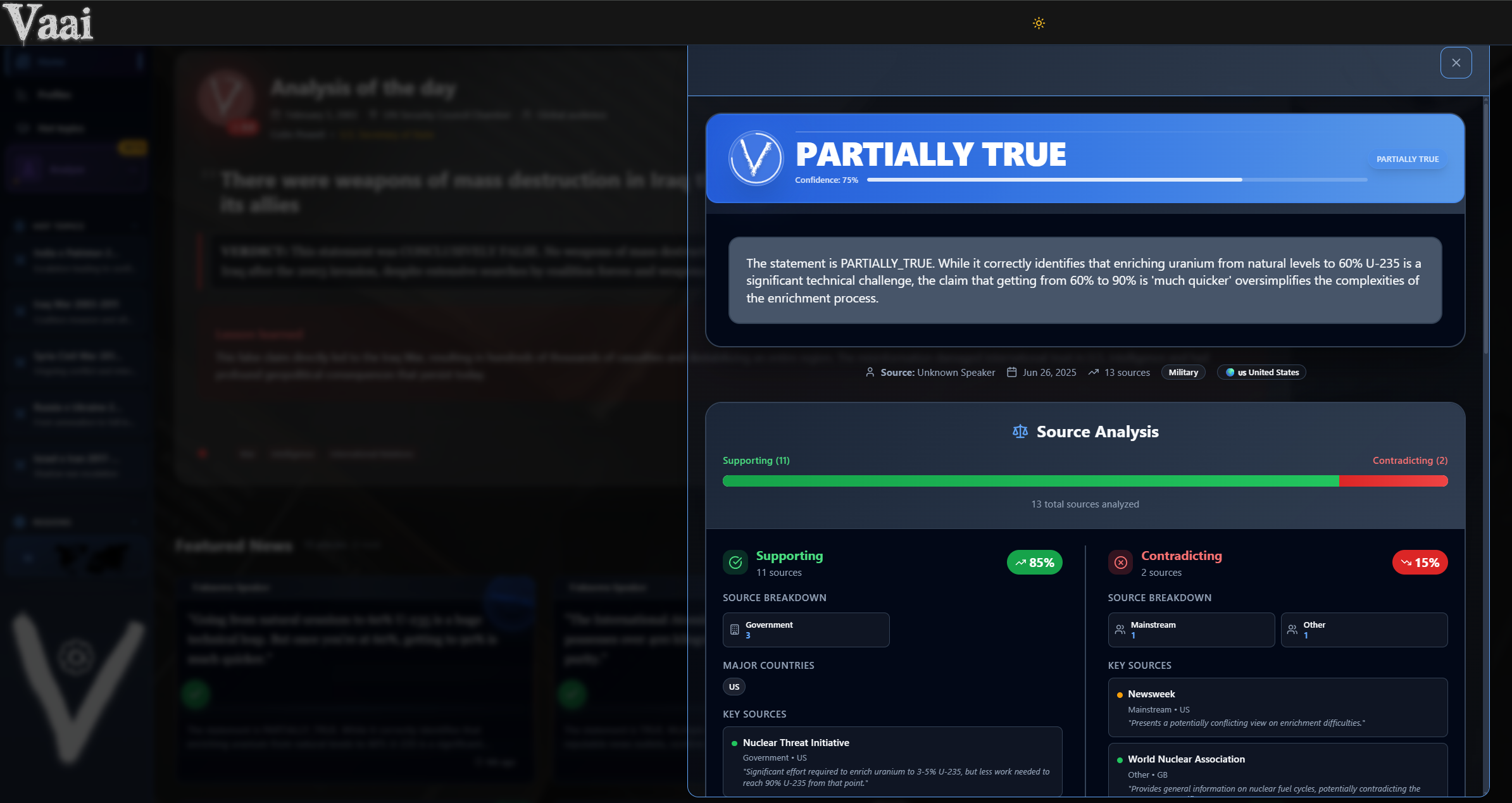
- Fact-checking Analysis: LLM research of statements and videos with multiple point of views in fields of political history, economy, human psychology
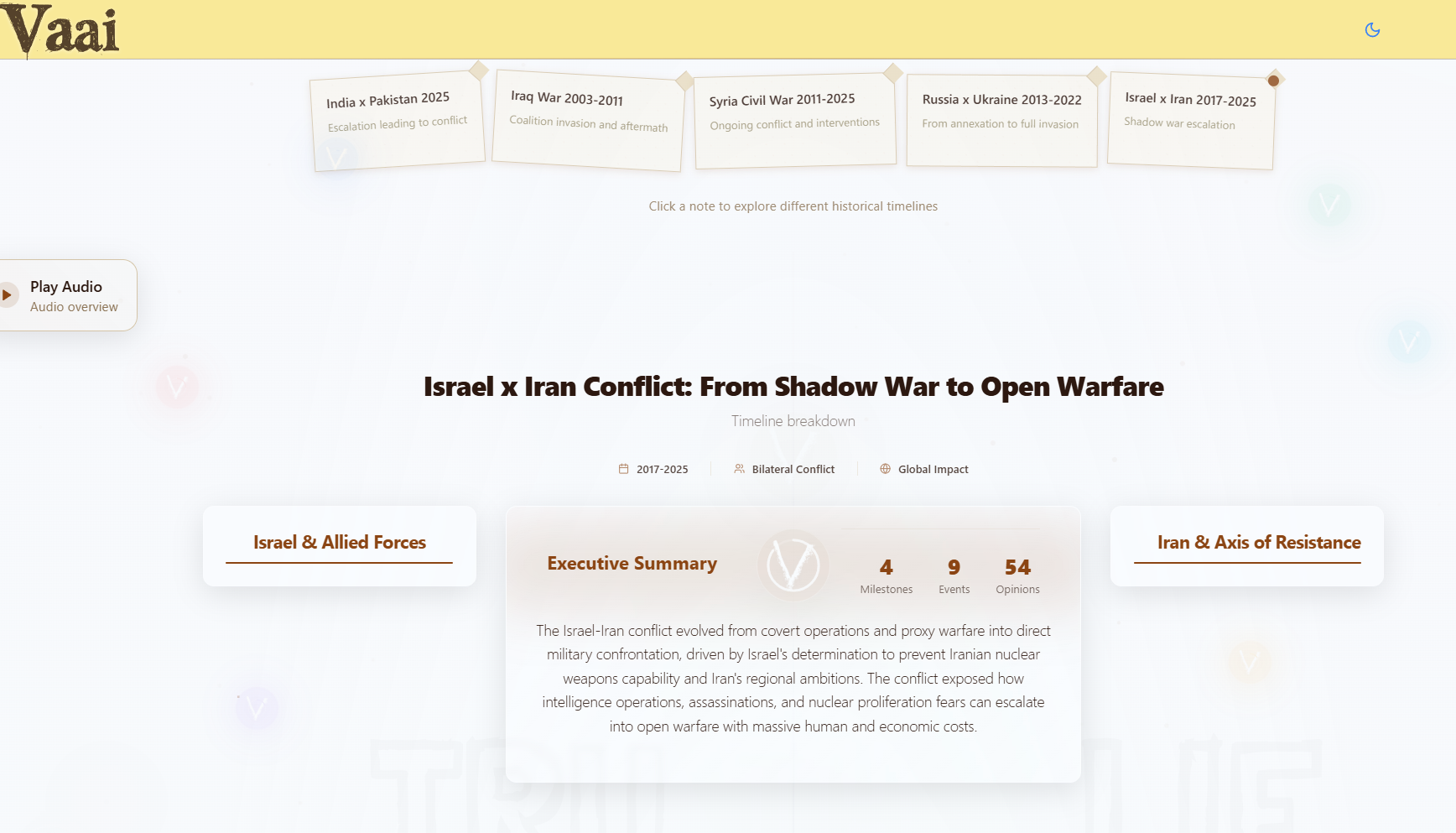
- Interactive Timeline Visualization: Complex news events presented as scrollable timelines with milestone markers and expert perspectives to understand causality of world conflicts.
- Intelligent Audio Narration: AI-generated voice narration with ElevenLabs integration, supporting multiple languages and auto-advancing through timeline events
- User Preference System: Personalized experience with language preferences, theme customization, and content filtering
Tech used
Frontend
- Framework: Next.js 15.3.3 with App Router
- Language: TypeScript for type safety
- Styling: Tailwind CSS
- Animation: Framer Motion for smooth interactions
- State Management: React Query + Zustand stores
Backend Integration
- Database: Supabase (PostgreSQL) for quick caching and data access
- Research API: Custom FastAPI server deployed in Google Cloud Run
- LLM Integration: Multiple AI providers (Groq, Gemini) with fallback
- Audio Processing: ElevenLabs for text-to-speech capabilities
- Translations: Czech, Russian, Spanish - Lingo.dev
Challenges
- Data Normalization: Harmonizing large set of analyzed data in API responses and expert analyses into a unified, type-safe format for consistent UI rendering.
- UI/UX Complexity: Designing interactive, theme-aware components (timelines, expert panels, fact cards) that remain intuitive and visually appealing, and at the same point keeps high educative value.
- Scalability: Building a modular architecture that supports new data sources, languages, and expert types with minimal friction.
- Tooling limitations: Lingo.dev used for translations has limited tier of token using. Supabase caching was in need
Accomplishments
- Developed a robust data mapping and normalization layer, enabling reliable integration of fact-checking APIs and expert verdicts.
- Built a modern, theme-aware React UI with animated expert panels, interactive timelines, and synchronized video markers.
- Integrated AI-powered audio narration and multilingual support for accessible news analysis.
- Implemented a user preference system for language, theme, and content filtering.
- Achieved seamless synchronization between video playback, timeline events, and fact-checking overlays.
What have been learned
- ElevenLabs v3 seems in this moment too unstable for production use of tect-to-speech. Falled back to v2 for more consistent results
- Direct integration between NextJS and database (supabase sdk) seems like an easy and effective approach how to work with data without need of a backend
What's next for the project
- Quality of analysis: Research of recent events us too shallow. Latest tooling around deep research could vastly improve the output quality with costs of tokens and response time.
- Scalability: Real backend or automated workflows are needed to populate database automatically, cover more topics and compose better picture about world events. With the same breath the infrastructure is not built for such scaling and needs to be upgraded
- Optimize performance for mobile and low-bandwidth environments.
Built With
- bolt
- elevenlabs
- lingo
- nextjs
- supabase


Log in or sign up for Devpost to join the conversation.