-
-

Logo & Product name
-
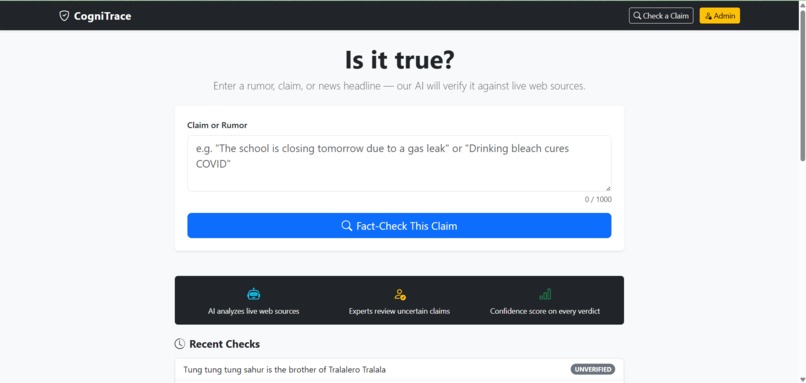
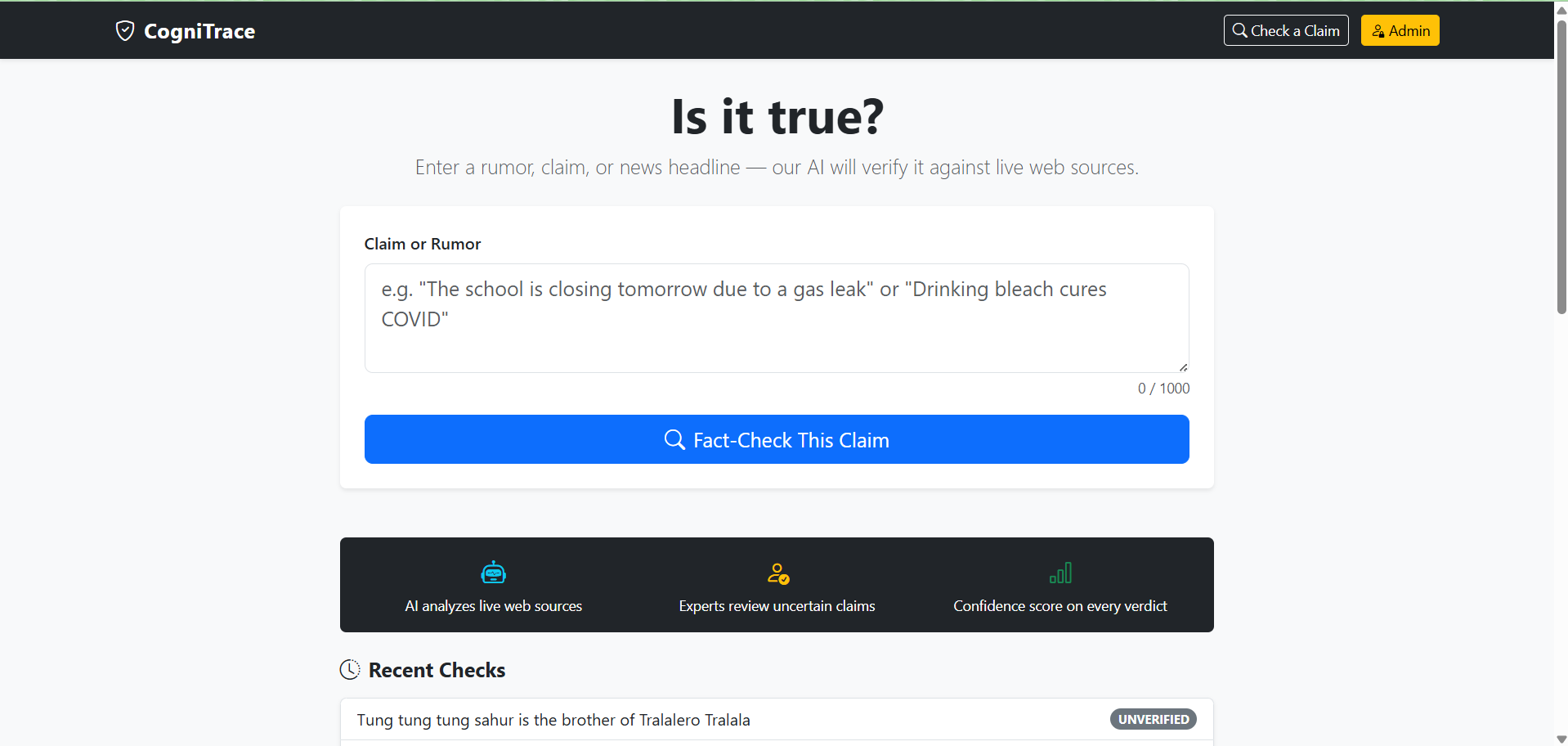
User view
-
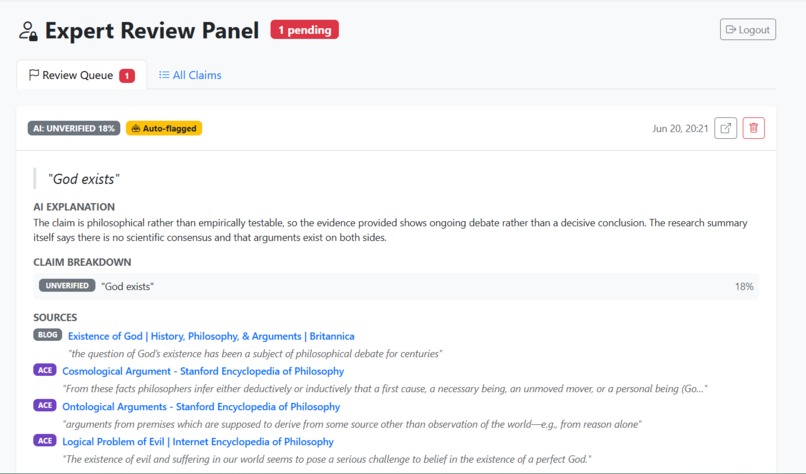
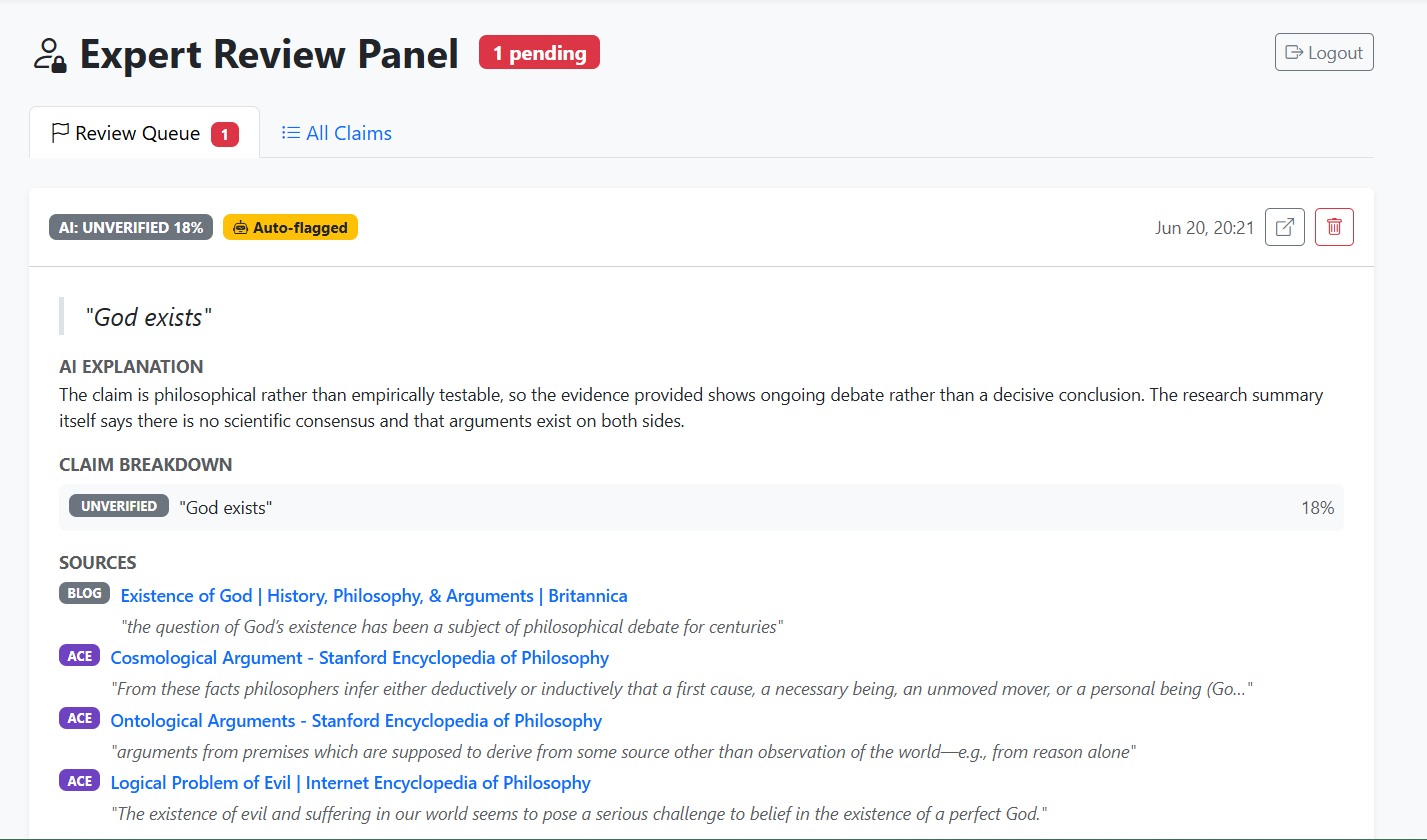
Admin view

Inspiration
Rumors spread faster than help. In schools and local communities, people often hear claims like "school is closing tomorrow," "this cure works," or "this group is dangerous," but they do not always know where to check the truth. Searching manually takes time, sources can be confusing, and misinformation can cause panic, unsafe choices, or social harm.
We built CogniTrace to make support obvious: a simple rumor-vs-reality tracker where anyone can paste a claim and quickly understand whether it is likely true, false, misleading, or unverifiable.
What it does
CogniTrace is an AI-powered fact-checking website. A user enters a rumor, news headline, or claim. The system searches live web sources, breaks the claim into smaller sub-claims, checks source credibility, identifies red flags, and returns:
- a verdict: TRUE, FALSE, MISLEADING, or UNVERIFIED
- a confidence score
- a short explanation
- supporting sources
- claim breakdowns
- flags for claims that need expert review
If confidence is low or a user disagrees with the result, the claim is sent to a human review queue. This keeps AI useful without making it the final authority.
How we built it
We built CogniTrace as a full-stack web app using FastAPI, Jinja2, Bootstrap, SQLite, SQLAlchemy, and OpenAI APIs. The AI workflow has two layers:
- Live research layer - OpenAI Responses API with web search finds current public information related to the claim.
- Structured reasoning layer - OpenAI Chat Completions API analyzes the evidence in JSON format, including verdict, confidence, sub-claims, source credibility, and red flags.
We also built an admin panel where reviewers can inspect uncertain claims, compare the AI explanation with sources, and approve or override the verdict.
Challenges we faced
The hardest challenge was making the AI careful instead of overconfident. Many claims are jokes, memes, vague statements, or partially true. We had to design the system to separate “false” from “unverified,” detect uncertainty, and avoid presenting AI as an expert replacement.
Another challenge was source quality. The web contains official pages, news, blogs, social posts, and low-quality content. Our system does not only search the web - it also evaluates credibility and flags weak evidence.
What we learned
We learned that fact-checking is not just classification. It is a decision-support problem. The most important part is helping people understand why a claim received a verdict and when they should still ask a human.
We also learned how to build responsible AI systems with human oversight, rate limits, transparent outputs, and review workflows.
What’s next
Next, we want to improve source ranking, add community-specific trusted sources, support more languages, and build a public “rumor dashboard” for schools and local communities. Our long-term goal is to make reliable information easier to find than misinformation.
Built With
- fastapi
- jinja
- json-mode
- openai-api
- openai-chat-completions-api
- python
- sqlalchemy
- sqlite
- starlette
- systemd
- uvicorn
- web-search


Log in or sign up for Devpost to join the conversation.