- Prototype link (Please submit a link to a playable prototype, not a link to your design file)
- Describe your project (max 150 words)
“Human connection is so special and you can’t get that from the digital world.” In the digital age that we live in, everything is quick and at the touch of our fingertips, thanks to technology and AI. However, humans has been becoming quite lazy due to the fast-paced nature of our society. Gen Z, in particular, has a hard time establishing deep relationships with the people around them due to laziness and lack of initiative in those connections. Having these deep, emotional connections with others is necessary to live a joyous and meaningful life.
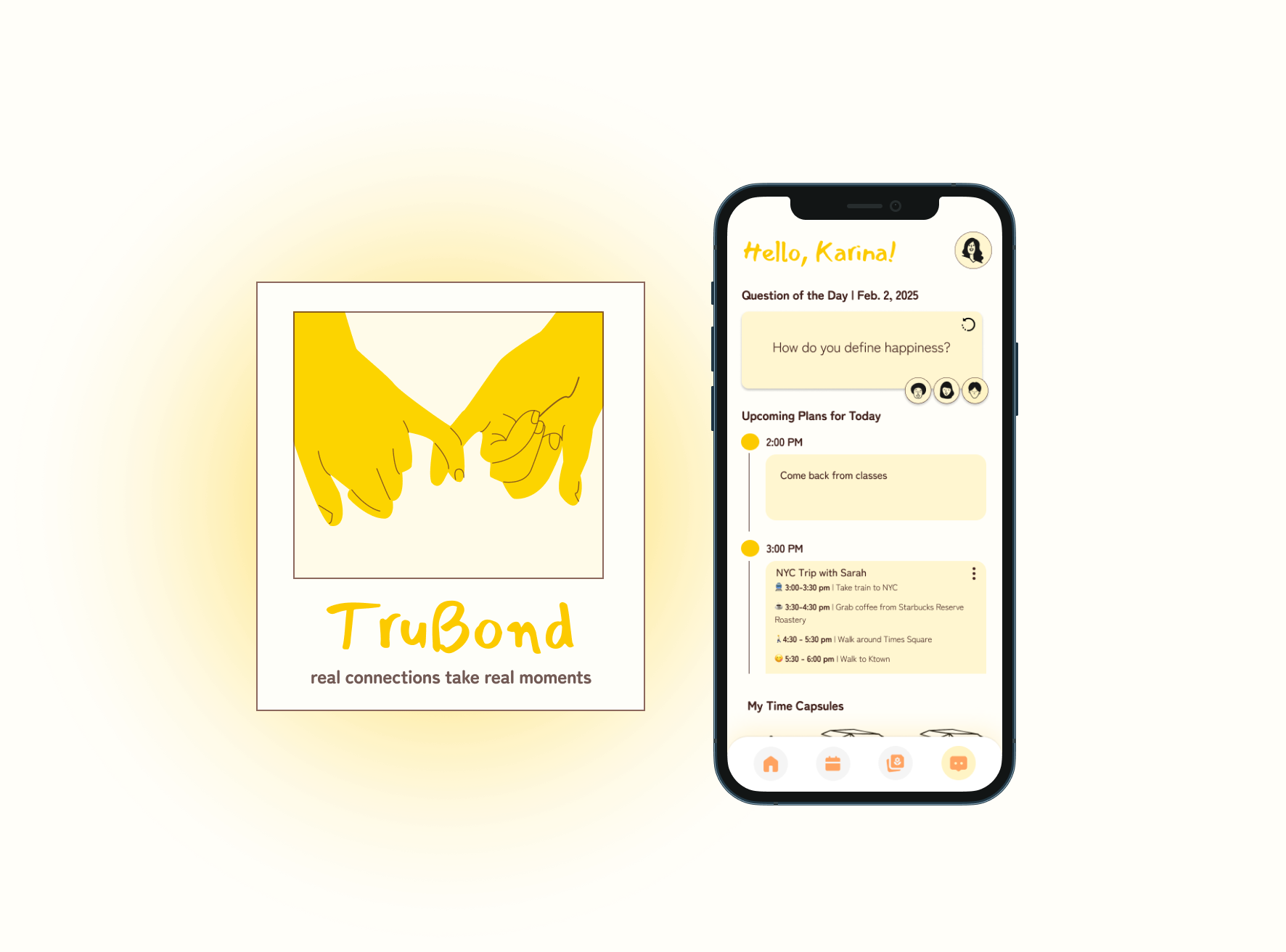
TruBond helps facilitate getting deeper in the relationships that Gen Z have. We provide spaces where friends and others can make memories, experience life together, and cherish those times, strengthening those connections. TruBond encourages people to transition towards a deeper level of connection by engaging in conversations, spending quality time with each other, and sharing memories.
- Describe your research process and findings. If you conducted any surveys or interviews, please include the survey form and/or interview questions here. If you conducted secondary research by pulling from online sources, please include a link to your sources. (Max 500 words)
The prompt “staying human in the age of AI” was quite broad. What does it even mean to be human? Our team brainstormed ideas about “staying human” and came across key ideas such as connection, community, identity, nostalgia, and social interaction. We began conducting desk research using online articles to understand more about AI and its effect on humanity. Brainstorming together and doing this desk research helped us identify areas to explore on a deeper level, and overall served as guidance prior to conducting our primary research.
We used qualitative and quantitative methods for our primary research by conducting 7 interviews and sending out a survey with both multiple choice and open ended questions. The interviews were conducted with 7 Gen Z individuals and helped us gain a deeper understanding of their beliefs around being human, what it means to them, and their experience with AI. We used the following 3 research questions to guide us in this process: (1) What makes people feel human in this day and age? (2) How can AI/technology be used to enhance the human experiences people have? (3) How can AI be used to facilitate the relationships people have with each other? By analyzing these findings we were able to identify patterns in what people feel to be “human”, and what values and other aspects are of importance to them.
Aside from these semi-structured interviews, we also analyzed data from 21 respondents to our survey that provided some quantitative support for some of the findings we had from the interviews. The survey used both multiple choice and open ended, so we can receive both statistical support and also a wider range of deep insights into our users’ thoughts and feelings. From our survey, we uncovered that 85.7% of participants are motivated to reach out to others when they have a shared interest, 66.7% mostly interact with others offline, and 90.5% of participants don’t use AI for relationship advice. Our participants mainly use AI for educational or career purposes, which showcases their understanding of AI’s limitation to have emotional connection.These insights point to the fact that humans desire emotional, real relationships.
After collecting the data from the interviews, our team organized the key findings via an affinity map. The pain points that we defined from this were the following: (1) It’s hard for people to build and manage relationships because of not putting the effort in and having difficulty communicating, (2) People have a hard time transitioning into deeper relationships from just shallow ones, and (3) It is difficult for people to accept AI because of its lack of emotional intelligence (they don’t want a major reliance on it). We also uncovered that people tend to gravitate towards those with similar values and upbringing as them. They would rather deepen current relationships rather than forming new ones, emphasizing the idea of quality over quantity.
all research - survey, interview, articles, etc
- Describe your most important design decisions. What research findings and/or user testing results led you to make these decisions? (Max 500 words)
Our design decisions were guided by “how might we” questions formulated after synthesizing our research and ideating some potential solutions. How might we create a space where GenZ relationships feel comfortable truthfully communicating and expressing themselves openly? How might we find ways to help GenZ establish more real and genuine relationships, on a deeper level? How might we incorporate AI so that we play to its strengths and use its efficiency in building relationships between humans?
In addition, we performed a competitive analysis on friendship building applications such as Wanderlog, Howbout, Yubo, and Bumble For Friends. We discovered their common strengths in real time communication with others, interactive calendar syncing, and allowing users to have control of initiation through mutual interactions. These findings led to our decision to create a collaborative itinerary planner that helps foster deeper communication and relationships.
Based on our research findings that 85.7% of participants are more likely to reach out to others when they share common interests, we designed an onboarding process that allows users to personalize their profiles. This also enables AI to identify similarities, ensuring more compatible recommendations for both users and their close relationships during event planning. Our next design decision is guided by our interview insights showing that people struggle to deepen relationships beyond surface-level interactions. To address this, we designed the Question of the Day (QOTD) feature which helps initiate deeper conversations and provides a way to understand friends’ perspectives on various topics. We discovered that many of our interviewees enjoy nostalgia and sharing memories with friends. Some also mentioned that their approach to resolving relationship challenges involves cherishing meaningful moments spent with loved ones. Based on these insights, we designed a Time Capsule feature that allows users to store and revisit special memories with close friends, as a way to fully experience life together and reflect on these moments. Our Time Capsule supports various additions including photos, music, letters, QOTDs, meals shared, fit checks, and more. These small yet meaningful memories can strengthen bonds and foster deeper connections over time.
Our findings reveal that many people are worried about the over-reliance on AI and distrust its emotional intelligence in human interactions. To address these concerns, we designed our app to give users full autonomy over their AI usage rather than letting AI take over the entire planning process. We want users to fully engage in planning events with friends, which can in fact build more excitement and anticipation along the way. Since AI can make planning easier, we decided to incorporate it into helping users find food spots to eat or activities to do, but it’s not nudging the user to do it. We wanted to play at the strengths of AI, as noted from the interviews, such as increasing efficiency and presenting data, but we don’t want AI to take away valuable human values such as understanding, reliability and love that are important in fostering deeper relationships.
Built With
- figma


Log in or sign up for Devpost to join the conversation.