-
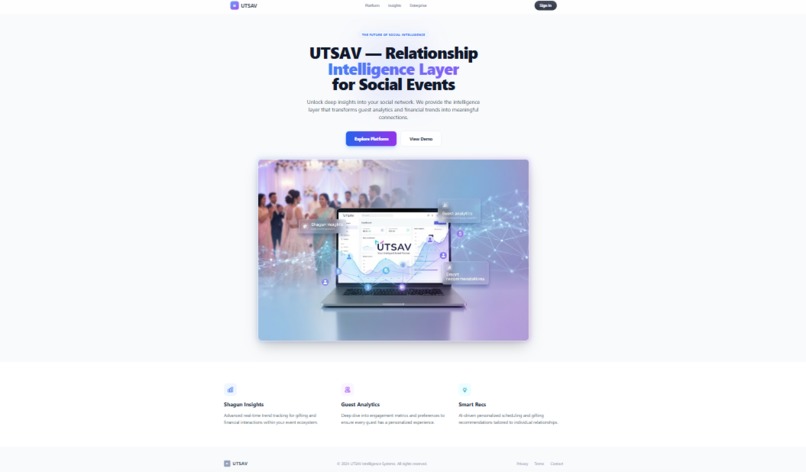
UTSAV — Transforming social interactions into structured, actionable intelligence.
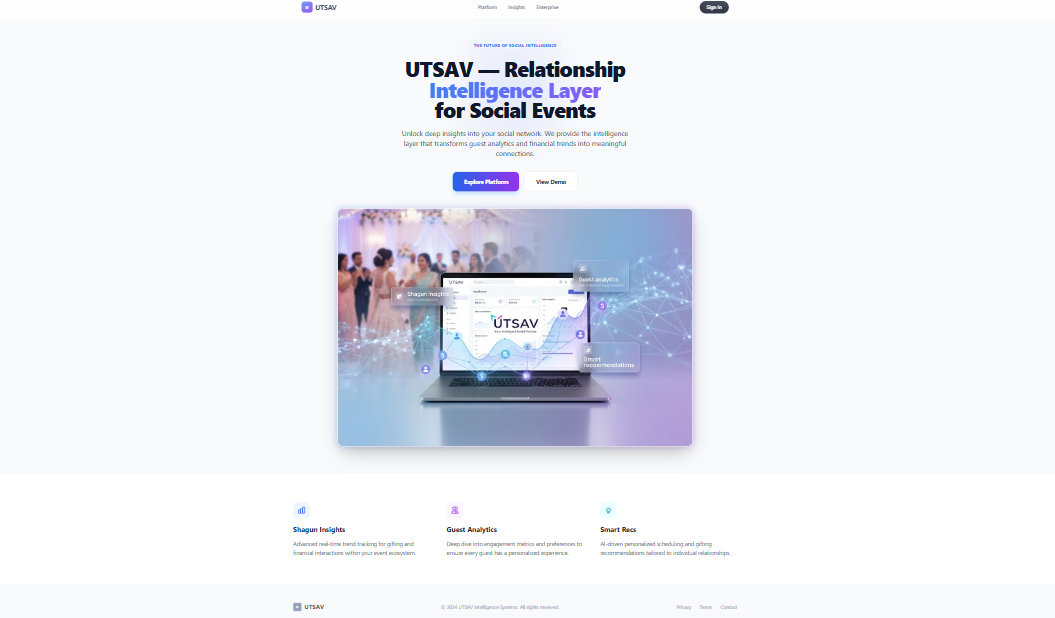
Inspiration
In India, social events like weddings and festivals are more than celebrations — they are systems of relationships, trust, and informal financial exchange. Practices like Shagun represent a deeply embedded cultural mechanism where money flows based on relationships, past interactions, and social expectations. Despite being widely practiced, this system remains unstructured, untracked, and dependent on memory.
This led us to a core question:
Can real-world social interactions be transformed into structured, meaningful intelligence?
What It Does
UTSAV is a relationship intelligence and financial interaction layer built on top of social events. It transforms events into structured systems by capturing:
- relationship networks
- informal financial exchanges (e.g., Shagun)
- event-based interactions over time
This enables users to understand relationships better, track meaningful interactions, and make smarter social and financial decisions.
How We Built It
We designed UTSAV as a scalable full-stack system.
- Frontend: Next.js (mobile-first UX)
- Backend: Go (Gin) with clean layered architecture (Handler → Service → Repository)
- Database: PostgreSQL
Core systems include:
- OTP-based authentication
- Distributed rate limiting
- Structured APIs for events, guests, RSVP flows, and financial interactions
Intelligence Layer
Instead of relying on heavy AI models, we built a structured intelligence layer on top of normalized data. This enables:
- context-aware financial suggestions
- pattern-based insights from past events
- behavioral inference from structured interactions
Key principle:
structure → insight → intelligence
Challenges We Faced
Structuring human behavior was challenging because social interactions are fluid and context-driven. We had to model relationship strength, interaction frequency, financial exchanges, and temporal context without oversimplifying reality.
Modeling Shagun was particularly complex as it depends on cultural norms, relationship hierarchy, and past exchanges, with no fixed rules — requiring a flexible, context-aware system design.
Privacy and trust were critical due to the sensitivity of relationship and financial data, so we focused on minimal data collection and user-controlled participation.
Mapping real-world workflows such as invitations, RSVP updates, and financial exchanges into intuitive digital flows required careful UX and API design. Ensuring scalability required idempotent APIs, rate limiting, and consistency under concurrency.
Throughout, we avoided over-engineering and stayed focused on core system insights.
Accomplishments
- Identified a cultural-financial system hidden in plain sight
- Transformed unstructured interactions into structured, queryable data
- Built a scalable backend architecture with clean separation of concerns
- Designed an intelligence layer without relying on heavy AI models
- Balanced technical depth with real-world usability
- Established a foundation for relationship intelligence systems
What We Learned
We learned that culture is inherently structured, even when it appears informal. Informal financial exchanges carry strong relational signals that can be modeled and analyzed.
We expressed social strength as:
$$ S_{ij} = f(R_{ij}, F_{ij}, T) $$
where S_ij represents social strength, R_ij represents relationship history, F_ij represents financial interactions, and T represents temporal context.
We also learned that structure enables intelligence, simplicity drives adoption, and strong systems emerge from balancing trade-offs such as flexibility vs structure, privacy vs insight, and scalability vs simplicity.
What’s Next for UTSAV
We plan to strengthen the intelligence layer with deeper insights and better recommendations, expand beyond events into continuous relationship tracking, and unlock financial insights from social interactions.
UTSAV will scale across event types and cultural contexts while improving system performance, reliability, and data consistency.
Our long-term vision is to evolve UTSAV into a relationship intelligence system that bridges social interactions, financial behavior, and structured data systems.
Built With
- actions
- api
- apis
- bcrypt
- better
- cloudflare
- css
- datadog
- date-fns
- docker
- eslint
- fly.io
- gin
- github
- go
- golang-migrate
- jose
- jwt
- logtail
- lucide-react
- msg91
- neon
- next.js
- node.js
- openai
- pgvector
- pgx
- postcss
- postgresql
- query
- r2
- radix
- razorpay
- react
- react-day-picker
- react-hook-form
- redis
- render
- rest
- sentry
- shadcn/ui
- stack
- tailwind
- tanstack
- testcontainers-go
- typescript
- ui
- upstash
- uuid
- vercel
- zod
- zustand


Log in or sign up for Devpost to join the conversation.