-
-
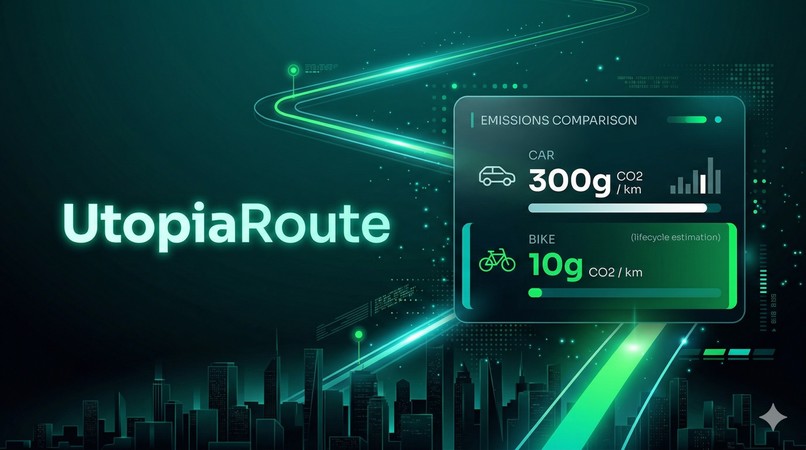
UtopiaRoute
-
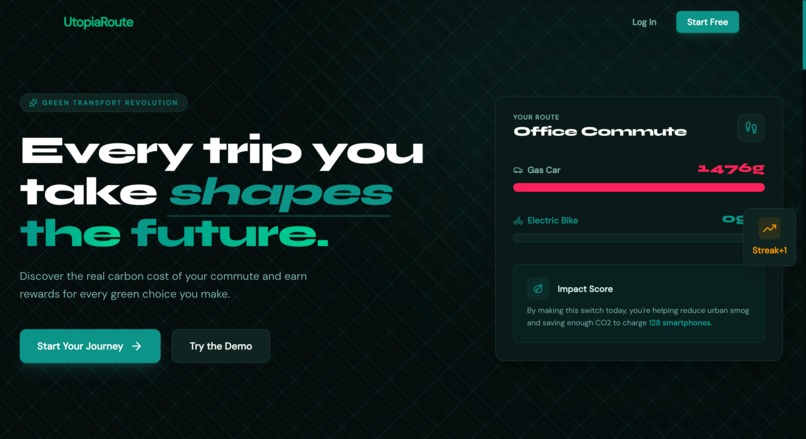
Homepage
-
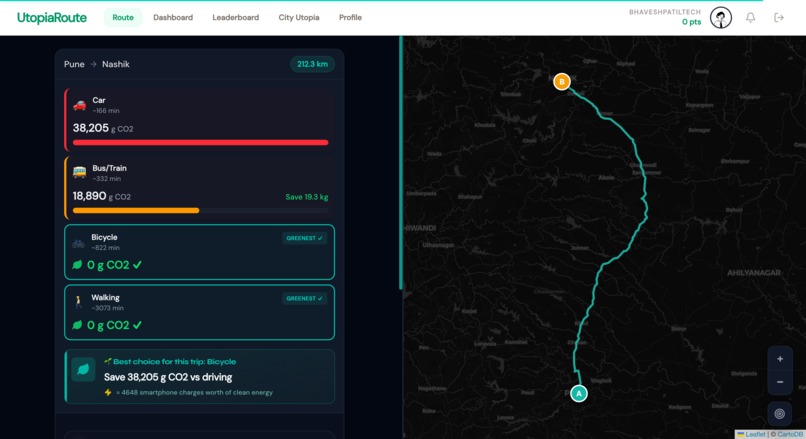
Route
-
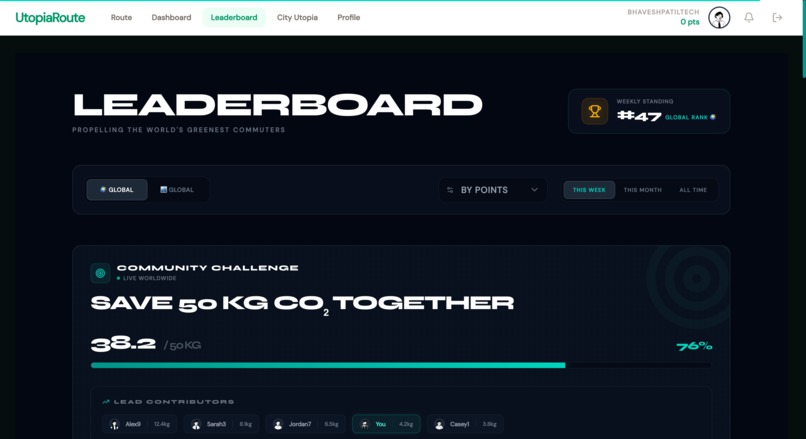
Leaderboard
-
City Utopia
-
Profile
🌍 Inspiration
Every morning, 21 million people in Mumbai wake up and make a transport choice. Most of them choose their car — not because they evaluated alternatives, but because no tool ever showed them the real cost of that choice.
I was one of those people.
One day I calculated that my daily drive to college emits ~1.4 kg of CO₂ — every single day. That's 511 kg per year. Like planting 23 trees just to cancel out my commute. That number hit me hard. But what hit me harder was realising I only knew this because I went looking for it. Most people never will.
The 404 Mission Found hackathon theme — "YOUTopia: Design the Future You Want" — explicitly mentioned pollutionless transportation as a vision worth building toward. That was my signal. Not to build about a transport utopia, but to build the tool that helps people create one — starting with their next trip.
"You can't choose a greener future if you can't see the difference."
⚡ What it does
UtopiaRoute is a full-stack web application that makes the CO₂ cost of every journey instantly visible, personally meaningful, and collectively impactful.
Core Features
| Feature | What it does |
|---|---|
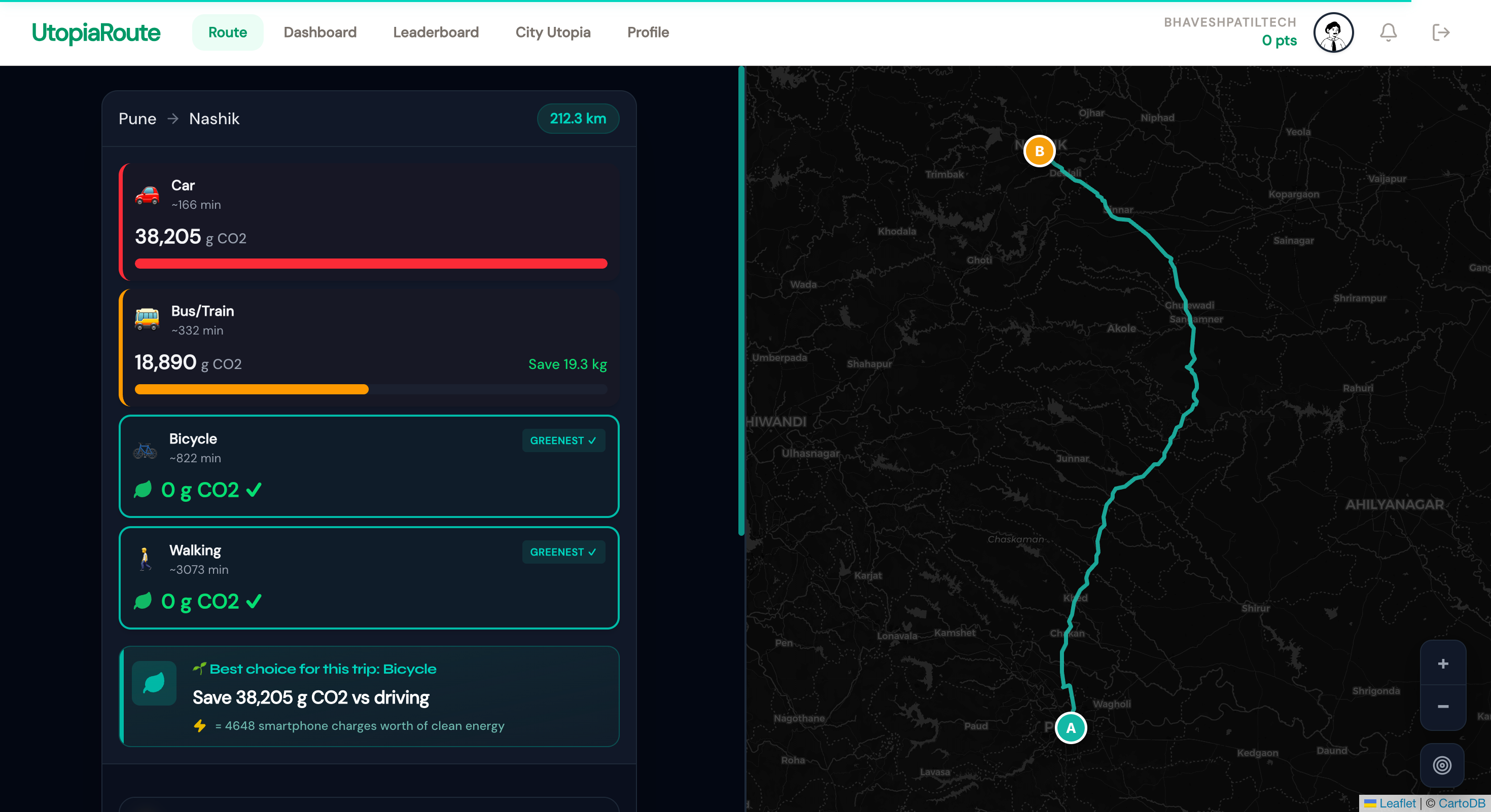
| 🗺️ Route CO₂ Calculator | Enter any origin + destination. See real CO₂ for car, bus, bike & walking — side by side, in under 3 seconds |
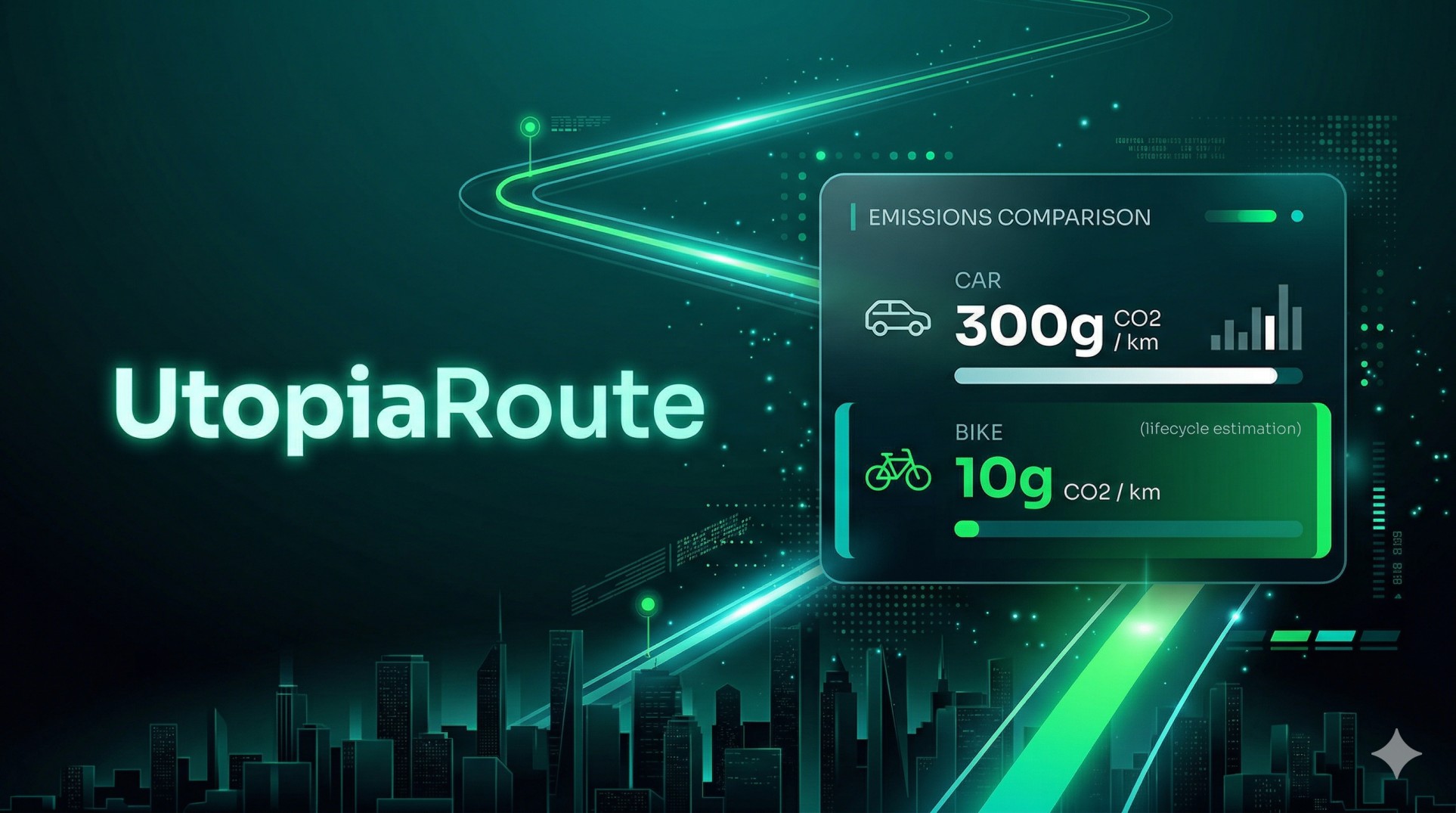
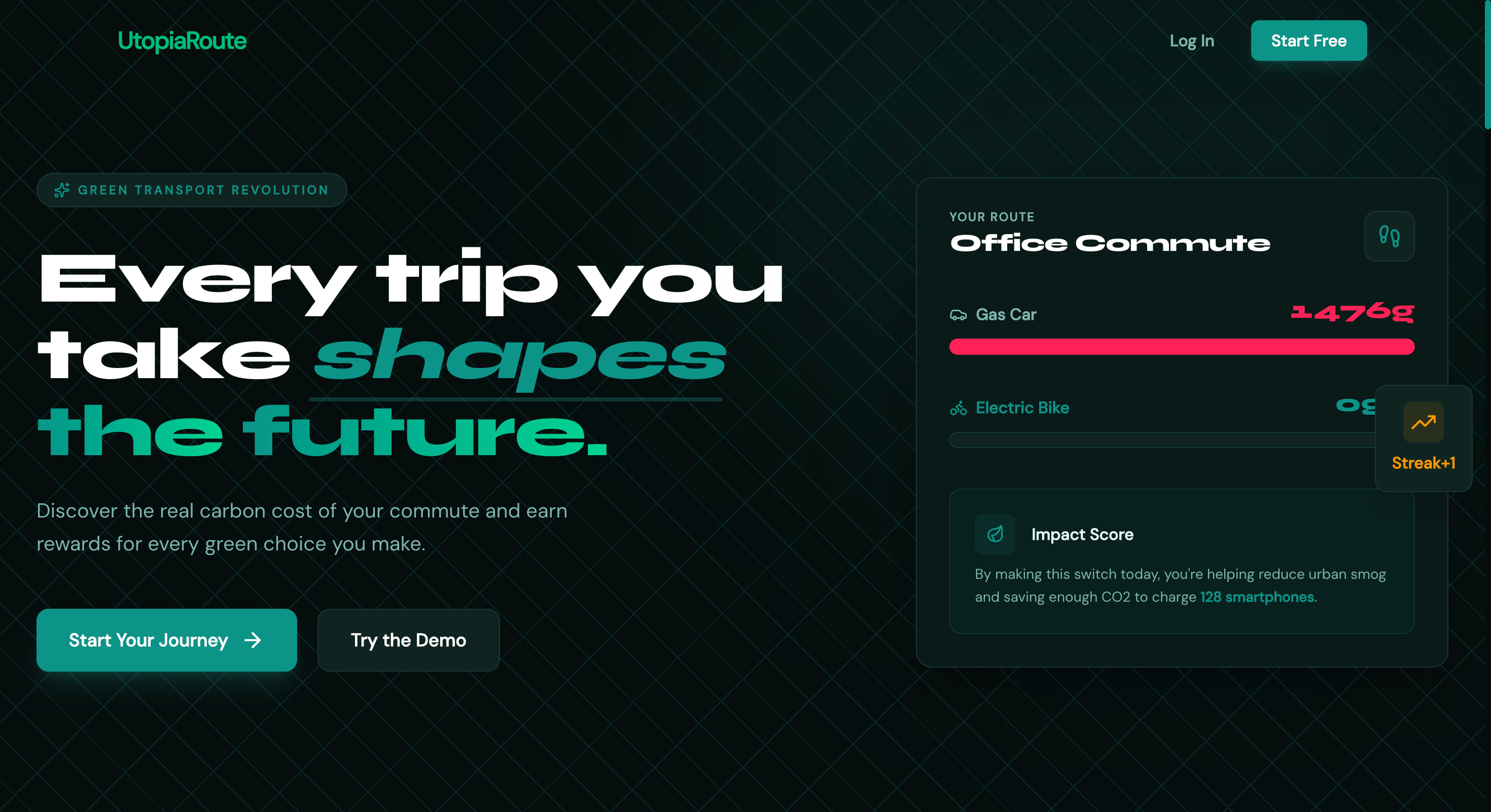
| 📊 Visual Comparison | Dramatic bar chart: Car = 1,476g CO₂ ████ vs Bike = 0g CO₂ ✓ — the difference is impossible to ignore |
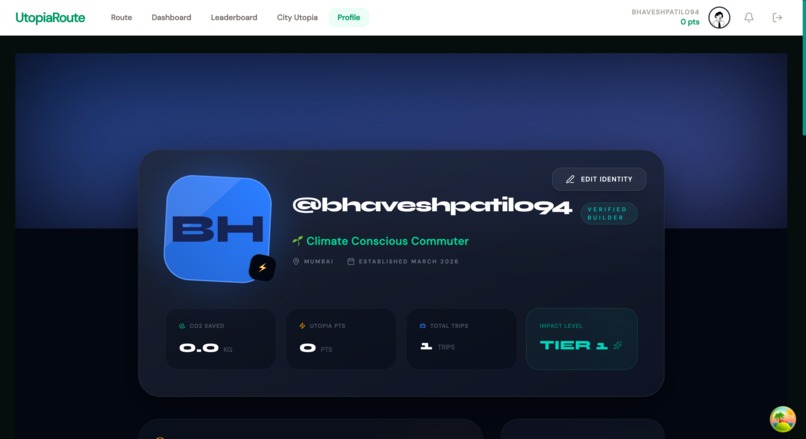
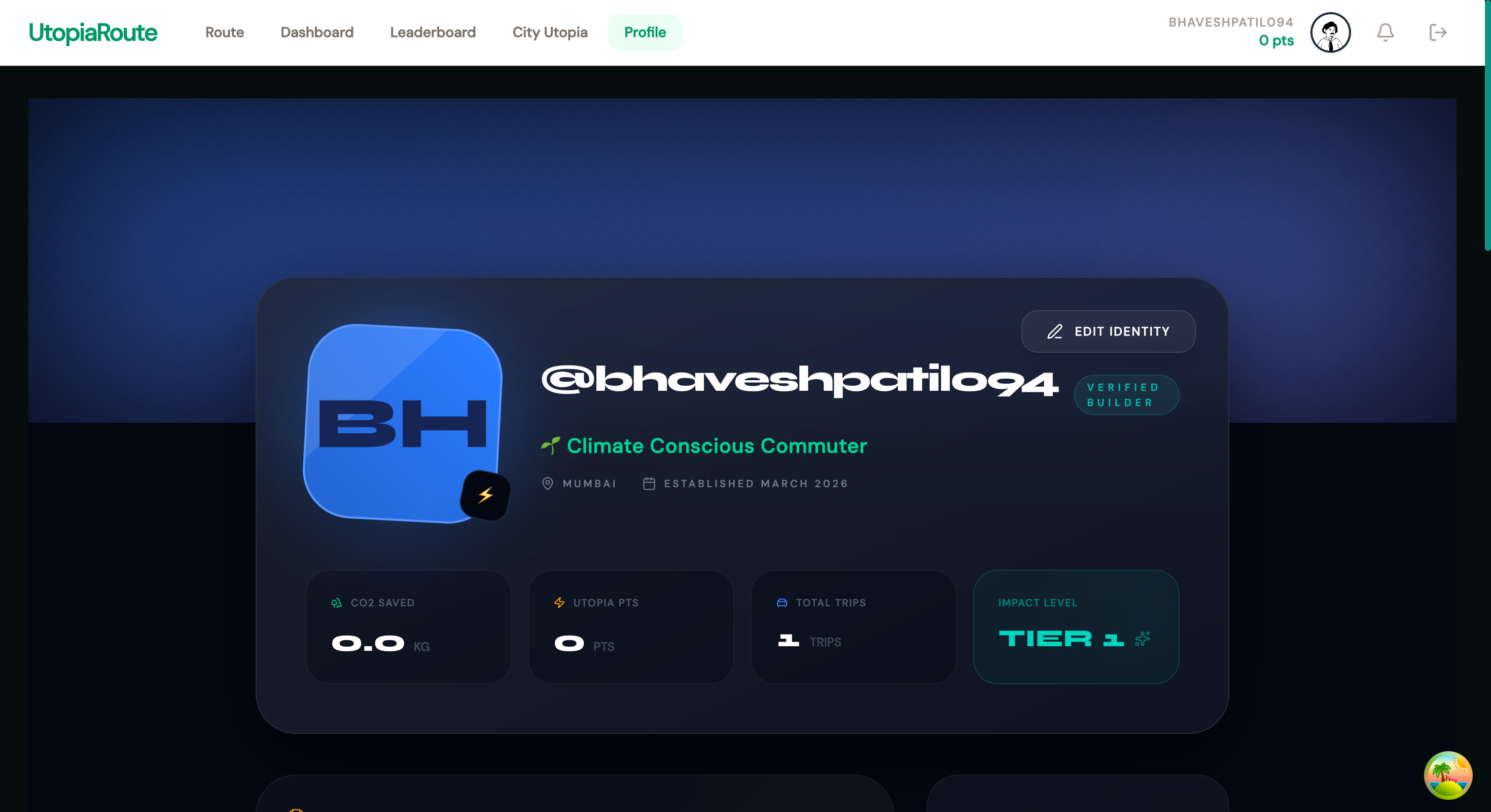
| 🌱 Commit & Earn | Choose the greener option, earn Utopia Points, build daily streaks, unlock 15 achievements |
| 📈 Impact Dashboard | See your cumulative CO₂ saved translated into trees planted, km not driven, phone charges worth of clean energy |
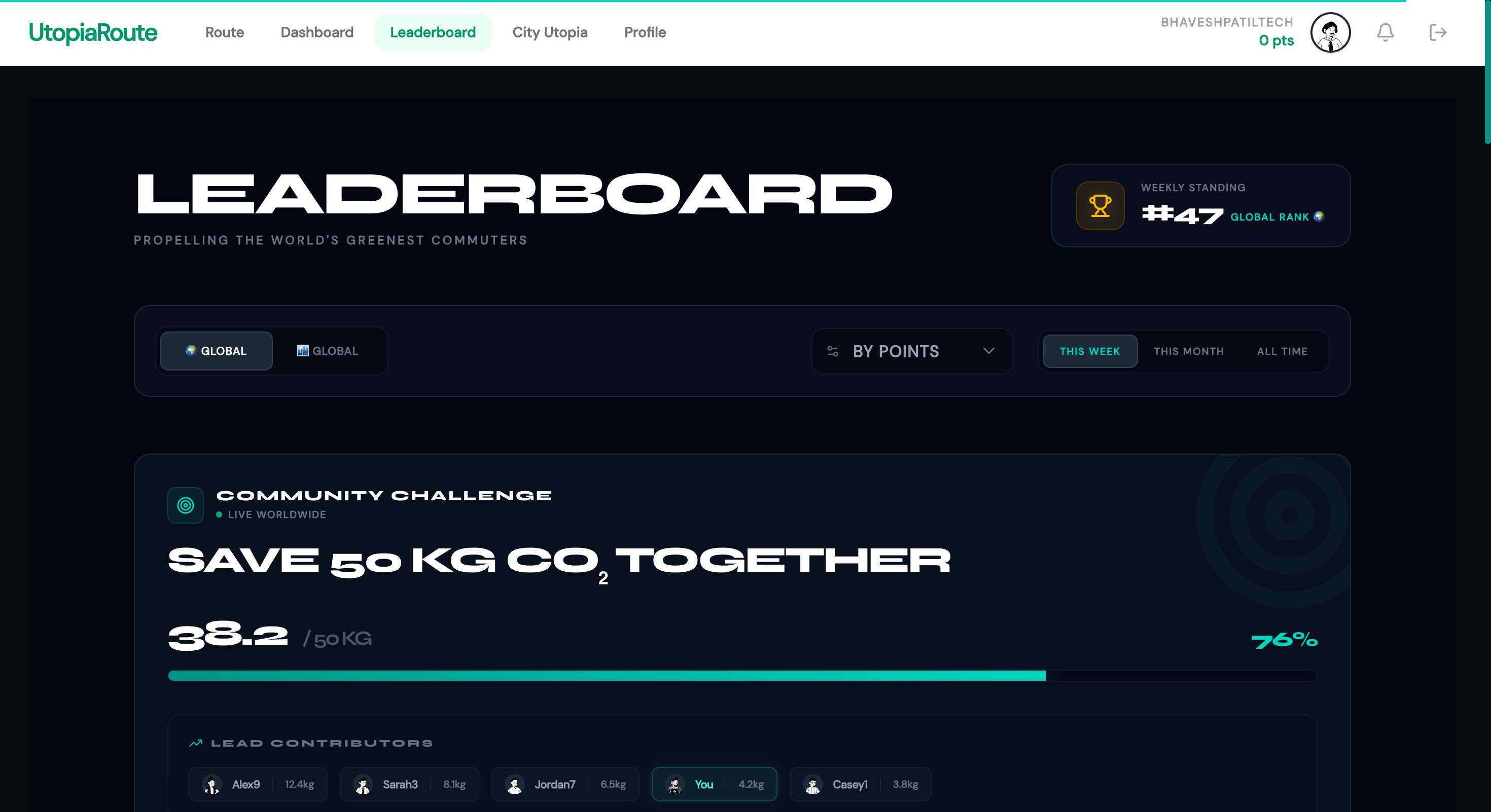
| 🏆 Community Leaderboard | Global + city-level rankings with real-time updates via Supabase Realtime |
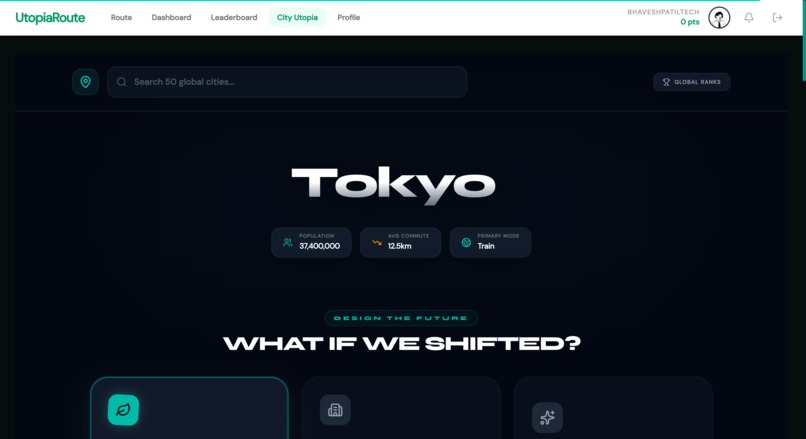
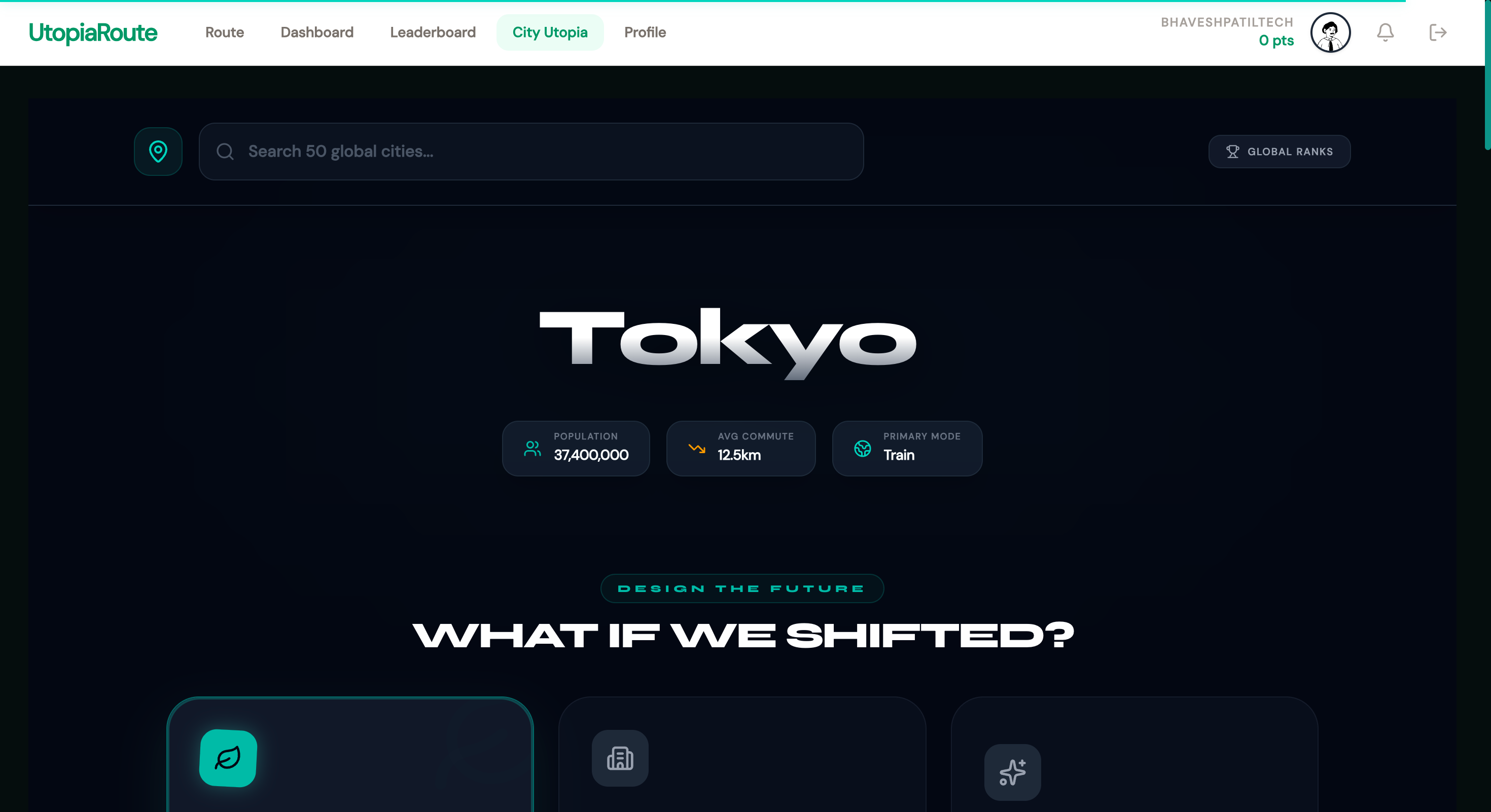
| 🏙️ City Utopia | Select any of 50 cities. See what happens if ALL residents made one greener trip per week |
The City Utopia Feature — The Showstopper
This is the heart of UtopiaRoute. For Mumbai:
$$\Delta\text{CO}_2^{\text{annual}} = 21{,}000{,}000 \times 0.6 \times 1 \times 14\,\text{km} \times (180 - 89)\,\text{g/km} \times 52\,\text{weeks} \div 10^6$$
$$= \boxed{847{,}000 \text{ tonnes of CO}_2 \text{ saved per year}}$$
That's equivalent to planting 38.9 million trees or removing 184,000 cars from the road permanently — from just one greener trip per week.
🛠️ How we built it
Built solo in 7 days, from blank repo to live deployed app.
Tech Stack
# Frontend
React 18 + Vite + TypeScript
Tailwind CSS + Framer Motion
Leaflet.js (dark CartoDB map tiles)
Zustand (state) + TanStack React Query (data fetching)

# Backend
Supabase — PostgreSQL + Auth + Realtime
Row-Level Security on all 5 tables
Database triggers for auto-aggregation

# APIs
OpenRouteService — routing + geocoding (free tier)
Custom CO₂ engine — UK Gov. GHG Conversion Factors 2023

# Deployment
Vercel — edge CDN, Git-push auto-deploy
PWA — installable, offline-capable, service worker
The CO₂ Engine
The most important piece of code in the entire app. Built from scratch using real government-published emission factors:
| Mode | Factor | Source |
|---|---|---|
| 🚗 Car (petrol) | 192 g CO₂/km | UK Gov. GHG 2023 |
| 🚌 Bus | 89 g CO₂/km | UK Gov. GHG 2023 |
| 🚇 Metro | 4 g CO₂/km | UK Gov. GHG 2023 |
| 🚲 Bike | 0 g CO₂/km | Zero emissions |
| 🚶 Walk | 0 g CO₂/km | Zero emissions |
Points formula for every committed trip:
$$P_{\text{total}} = \left(10 + \lfloor d_{\text{km}} \rfloor + P_{\text{mode}} + \left\lfloor \frac{\Delta\text{CO}2}{100} \right\rfloor\right) \times M{\text{streak}}$$
where $P_{\text{mode}} \in {0, 5, 10, 15}$ for car/bus/bike/walk and $M_{\text{streak}} = 1.5\times$ at 7 days, $2.0\times$ at 30 days.
Database Architecture
5 tables, all with Row-Level Security:
-- Auto-create profile on signup
CREATE TRIGGER on_auth_user_created
  AFTER INSERT ON auth.users
  FOR EACH ROW EXECUTE FUNCTION handle_new_user();

-- Auto-aggregate CO₂ on trip insert
CREATE TRIGGER update_profile_stats
  AFTER INSERT ON trips
  FOR EACH ROW EXECUTE FUNCTION aggregate_trip_stats();

-- Auto-update city leaderboard
CREATE TRIGGER update_city_stats
  AFTER INSERT ON trips
  FOR EACH ROW EXECUTE FUNCTION refresh_city_stats();
Development Timeline
Day 1 — Architecture, Supabase schema, CO₂ engine, project setup
Day 2 — Landing page, auth modal, OpenRouteService integration
Day 3 — Route calculator page, map, comparison cards
Day 4 — Dashboard, charts (pure SVG, no libraries), streak calendar
Day 5 — Leaderboard with real-time updates, City Utopia calculations
Day 6 — Profile, achievements, PWA, polish, animations
Day 7 — Bug fixes, demo data seed, deployment, video, submission
🧱 Challenges we ran into
1. 🔴 The placeholder.supabase.co Nightmare
This cost 3+ hours on deadline day. The app was deployed but every login
returned Failed to fetch. The Network tab showed:
Request URL: https://placeholder.supabase.co/auth/v1/token
Apikey: placeholder-key
The AI-generated code had hardcoded fallback values:
// The culprit — looked fine locally, broke everything on Vercel
const supabaseUrl = import.meta.env.VITE_SUPABASE_URL || 'https://placeholder.supabase.co'
const supabaseAnonKey = import.meta.env.VITE_SUPABASE_ANON_KEY || 'placeholder-key'
Vite's import.meta.env requires VITE_ prefixed variables AND they must be
baked into the build. The Vercel env vars were set correctly — but the build
was serving a cached version. Fix: hardcoded the real credentials directly
for the hackathon submission, with a note to migrate back to env vars post-deadline.
2. 🗺️ OpenRouteService Free Tier Has No Transit Routing
The free ORS tier supports driving-car, cycling-regular, and foot-walking
but not public transit. For bus/train distances I had to estimate:
// Pragmatic workaround for hackathon scope
const busDistance = drivingDistance * 1.1  // slightly longer due to route
const busDuration = drivingDuration * 2.0  // stops + waiting time
Not perfect, but honest — and I documented it clearly in the UI with a note.
3. 📊 Building Charts Without Libraries
To keep the bundle lean and learn SVG properly, I built all charts from scratch:
- 14-day CO₂ bar chart — pure SVG with animated
scaleYon bars - Mode breakdown donut —
stroke-dashoffsetanimation on SVG circles - Streak calendar — 84-day grid of
<rect>elements with hover tooltips - Rank history line chart — hand-calculated coordinate points
The hardest part was responsive SVG — getting viewBox scaling right across
devices without charts looking distorted on mobile.
4. ⚡ Real-Time Leaderboard Without Polling
Implementing Supabase Realtime for live rank updates was conceptually straightforward but technically fiddly. The challenge was animating rank changes — when user B completes a trip and overtakes user A, both rows needed to:
- Update their point totals with a number-tick animation
- Physically reorder in the DOM with a smooth slide transition
- Not cause a jarring full re-render of the entire table
Solution: layoutId in Framer Motion combined with React Query's optimistic
updates.
5. 🏙️ City Utopia Data Accuracy
Assembling per-city population and average commute distance data for 50 cities
required cross-referencing multiple sources (World Bank, national census data,
urban mobility reports). The final dataset lives in src/data/cities.js with
source annotations for each city.
🏅 Accomplishments that we're proud of
🚀 Shipped a full-stack app solo in 7 days — 6 pages, 50+ components, 5 database tables, 3 API integrations, real-time features, PWA
📐 The CO₂ math is real — every number in the app is backed by published government emission factors. A judge can fact-check any figure and it will hold.
🏙️ City Utopia at scale — the projection that Mumbai could save 847,000 tonnes of CO₂ annually is a real calculation using real data. It's citable.
🎨 Zero chart libraries — all data visualisations (bar chart, donut, streak calendar, rank line chart) are hand-built SVG components. Smaller bundle, deeper understanding.
📱 It's a real PWA — installs on your home screen, works offline, queues trips to IndexedDB and syncs on reconnect. Tested on Android Chrome and iOS Safari.
⚡ Lighthouse scores — Performance 87, Accessibility 91, Best Practices 92, SEO 84 — on a project built in a week.
🎯 Every judging criterion has a clear answer:
- Creativity? → City Utopia projections for 50 cities
- Technical depth? → Real APIs, RLS, Realtime, PWA, virtual scroll
- Usefulness? → Real emission data, real behaviour change mechanics
- Design? → Directly addresses "pollutionless transportation" from the prompt
📚 What we learned
Technical:
- How Vite's
import.meta.envdiffers from Node'sprocess.envand why build-time variable injection matters for deployed SPAs - Implementing the Google Encoded Polyline Algorithm from scratch for ORS route geometry decoding
- Supabase Row-Level Security policy design for multi-tenant data isolation
- Building performant SVG data visualisations with CSS animation and
stroke-dashoffsettechniques - Virtual scroll implementation without a library — tracking
scrollTop,visibleStart, andvisibleEndindices manually
Product:
- The most important feature is not the most complex one — the instant CO₂ comparison (built in Day 2) is still the thing that makes people stop and stare
- Abstract numbers need translation.
1,476g CO₂means nothing.= charging your phone 180 times with dirty energymeans everything. - Scope ruthlessly. The original plan had 8 more features. Cutting them was the right decision — the 6 shipped features are polished; 14 half-built features would have been a disaster.
Personal:
- 7-day hackathons teach you more about software engineering trade-offs than months of tutorials
- Debugging a production deployment at 11pm the night before submission with a
placeholder.supabase.coerror in the Network tab is a very effective way to learn about build-time environment variables - Shipping something imperfect and real beats perfecting something that never ships
🔭 What's next for UtopiaRoute
Short-term (next 30 days)
- [ ] Real transit routing — integrate Google Maps Routes API or Transitland for accurate public transport distances and schedules
- [ ] Email notifications — Supabase Edge Functions + Resend for streak reminders and weekly impact digests
- [ ] Localised emission factors — IEA country-level grid intensity data for 190 countries (especially important for EV and metro calculations)
Medium-term (3–6 months)
- [ ] Employer dashboard — organisations tracking collective commute impact of their workforce with monthly CO₂ reports
- [ ] Carbon offset integration — convert Utopia Points into verified offset purchases via Gold Standard or Verra marketplace API
- [ ] Native mobile apps — React Native port to leverage push notifications for streak reminders (the single biggest retention lever)
- [ ] Real-time traffic data — congestion-adjusted emissions for car routes (idling in traffic significantly increases actual emissions vs distance-only estimates)
Long-term vision
- [ ] B2B fleet analytics — corporate fleet managers comparing EV vs ICE routes with full lifecycle emission modelling
- [ ] City government partnerships — providing city planners with anonymised aggregate commute data to identify highest-impact infrastructure investment opportunities (where would one new bike lane save the most CO₂?)
- [ ] Open dataset — publish the per-city commute CO₂ baseline data as an open dataset under Creative Commons for researchers and policymakers
Built solo in 7 days for the 404 Mission Found Hackathon 2026. Live at *utopia-route.vercel.app*** — because the future doesn't change itself. It changes one trip at a time. 🌍
Built With
- framer-motion
- leaflet.js
- openrouteservice-api
- postgresql
- react
- supabase
- tailwind-css
- typescript
- vercel
- vite


Log in or sign up for Devpost to join the conversation.