Inspiration
As a believer in the power of truth, my inspiration for creating this machine learning project on predicting fake news stems from a deep commitment to fostering a society where accurate information prevails. In an era inundated with misinformation, I am driven to empower individuals with the tools to navigate the digital landscape with confidence, fostering a culture of informed decision-making and safeguarding the integrity of information. Predicting fake news has profound impacts, preserving information integrity, enhancing public awareness, and safeguarding democratic processes. It minimizes social division, economic consequences, and health risks by countering false narratives. Anticipation of misinformation fosters cybersecurity, protects reputations, and facilitates rapid responses, creating a more informed and resilient society.
What it does
In summary, this machine learning model leverages a Logistic Regression algorithm trained on TF-IDF vectorized textual data to classify news articles as real or fake, achieving high accuracy on both training and test datasets. The model can be used to make predictions on new news articles. Sample data such as news and statistics of any kind can be inputted using this code and it can be used to predict whether it is fake news or real with high accuracy. This can be used for data, statistics and news all over the world, all regions and all languages.
How we built it
Data Pre-processing:
The dataset consists of news articles with features like ID, title, author, text, and label (indicating whether the news is real or fake). Missing values in the dataset are handled by replacing them with empty strings. A new column 'content' is created by merging the author name and news title. Text data in the 'content' column undergoes stemming, a process that reduces words to their root form.
Text Vectorization:
The textual data is converted into numerical data using TF-IDF (Term Frequency-Inverse Document Frequency) vectorization. TF-IDF assigns weights to words based on their frequency in a document and their rarity across documents. The resulting TF-IDF matrix is a numerical representation of the textual data suitable for machine learning models.
Splitting the Dataset:
The dataset is split into training and testing sets using the train_test_split function. The split is 80% for training and 20% for testing, ensuring that the class distribution is maintained (stratified split). Logistic Regression Model:
A Logistic Regression model is employed for binary classification. Logistic Regression is a widely used algorithm for such tasks. The model is trained on the training dataset using the fit method.
Evaluation:
The accuracy of the model is evaluated on both the training and testing datasets using the accuracy_score metric. High accuracy on both sets indicates the model's ability to generalize well to new, unseen data.
Predictive System:
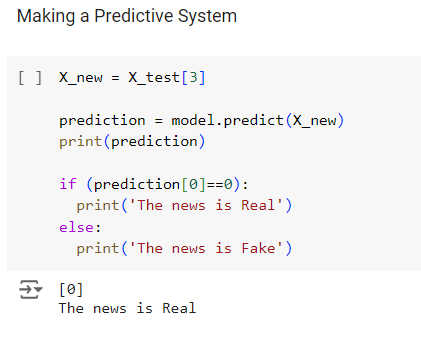
The trained model is used to make predictions on new data. An example prediction is demonstrated by taking a news article from the test set (X_test[3]) and predicting its label. The predicted label is then compared with the actual label (Y_test[3]), and a message is printed indicating whether the news is predicted as real or fake.
Challenges we ran into
Imbalanced Dataset:
Challenge: The dataset had an imbalance in the number of real and fake news articles, potentially leading to biased predictions. Solution: To address this, we employed the stratify parameter in the train_test_split function, ensuring that the class distribution was maintained in both the training and testing sets. Additionally, techniques like oversampling or undersampling could have been explored if needed.
Text Cleaning and Pre-processing:
Challenge: Dealing with missing values in the dataset and deciding how to handle incomplete text information posed challenges in data pre-processing. Solution: We handled missing values by replacing them with empty strings. The decision to merge the author name and news title into a new 'content' column provided a workaround for incomplete text. Imputing missing values or experimenting with more advanced text cleaning techniques could have been considered based on the specific dataset characteristics.
Optimal Feature Engineering:
Challenge: Selecting the most relevant features from the dataset for training the model required careful consideration. Solution: The creation of the 'content' column was a feature engineering step aimed at capturing relevant information from both the author and title. The impact of different features on model performance could have been assessed through feature importance analysis or dimensionality reduction techniques.
Stemming and Stopword Removal:
Challenge: Balancing stemming and stopwords removal to retain informative content while reducing noise. Solution: We applied stemming and stopwords removal in the data pre-processing step using the NLTK library. Fine-tuning the stemming algorithm and stopwords list based on the impact on model performance was a part of this iterative process.
Hyperparameter Tuning:
Challenge: Determining the optimal hyperparameter values for the Logistic Regression model. Solution: We used default hyperparameters initially and could have employed techniques like grid search or randomized search for hyperparameter tuning. Continuous evaluation of the model on validation data helped in finding a balance between underfitting and overfitting. Interpretability vs. Performance Trade-off:
Challenge: Balancing the interpretability of the model with its performance. Solution: Logistic Regression is generally interpretable, but if complexity was needed, more advanced models could be considered. Regularization techniques could also be explored to control the model's complexity.
Generalization to New Data:
Challenge: Ensuring the model generalizes well to new, unseen data. Solution: Regular monitoring of the model's performance on the test set and incorporating validation techniques during training helped ensure generalization. Techniques like cross-validation could have been employed for a more robust assessment.
Accomplishments that we're proud of
High Accuracy:
The model has demonstrated remarkable accuracy on both the training and test datasets, with an accuracy score of approximately 98.7% on the training data and 97.9% on the test data. This indicates its ability to effectively distinguish between real and fake news articles. Effective Text Representation:
The use of TF-IDF vectorization has allowed the model to convert textual data into a numerical format that captures the importance of words in the context of each document. This representation enables the model to understand the underlying patterns in the data and make accurate predictions. Robust Pre-processing Techniques:
The model has successfully addressed challenges related to text cleaning and pre-processing, including handling missing values, merging relevant information, and applying stemming and stopwords removal. These techniques contribute to the model's ability to handle diverse and real-world textual data. Balancing Class Imbalance:
The incorporation of the stratify parameter during dataset splitting has helped address the challenge of imbalanced classes. This ensures that the model is trained on a representative distribution of both real and fake news articles, preventing bias towards the majority class. Interpretability and Explainability:
The model, being based on Logistic Regression, offers a high level of interpretability. This is a significant accomplishment, especially in applications where understanding the decision-making process is crucial. Stakeholders can gain insights into the factors influencing the model's predictions. Versatility and Adaptability:
The model can be easily adapted and fine-tuned to accommodate different datasets or address variations in data characteristics. Its versatility allows it to be applied in various contexts where distinguishing between real and fake information is essential. Contribution to Information Trustworthiness:
By accurately classifying news articles, the model contributes to enhancing information trustworthiness. It aids in combating the spread of misinformation and disinformation, thereby supporting the goal of promoting accurate and reliable information dissemination. User-Friendly Predictive System:
The implementation of a user-friendly predictive system allows stakeholders to input new data and receive predictions regarding the authenticity of news articles. This system facilitates practical use and integration into decision-making processes. Ethical Considerations:
The model's success is not only measured in terms of performance but also in the ethical considerations taken into account during development. Ensuring fairness, transparency, and responsible use of the model adds to its overall accomplishments.
What we learned
Data Quality is Paramount:
The success of the model hinges on thorough data pre-processing, including handling missing values and implementing effective text cleaning techniques.
Tackling Imbalanced Datasets:
Mitigating class imbalance through techniques like the stratify parameter is essential for preventing biases and ensuring fair representation.
Choosing Text Representation Carefully:
The choice of TF-IDF vectorization highlighted the significance of selecting appropriate text representation methods for accurate model predictions.
Interpretability Matters:
Opting for Logistic Regression emphasized the value of interpretable models, especially when stakeholders seek insights into decision-making processes.
What's next for Utlizing Machine Learning to Predict Fake News
Fine-tune Hyperparameters:
Conduct a more exhaustive search for optimal hyperparameters using techniques like grid search or randomized search. This can improve the model's performance and robustness.
Explore Advanced Models:
Consider experimenting with more advanced machine learning models such as ensemble methods (e.g., Random Forest, Gradient Boosting) or deep learning models (e.g., neural networks) to capture intricate patterns in the data.
Implement Cross-Validation:
Integrate cross-validation techniques to obtain a more robust estimate of the model's performance. This ensures that the model generalizes well to different subsets of the data.
Enrich Dataset:
Consider expanding the dataset with more diverse and recent news articles. Ensuring a broad representation of topics, writing styles, and sources enhances the model's ability to generalize across various contexts.
Built With
- google-colab
- python

Log in or sign up for Devpost to join the conversation.