Inspiration
Millions of women worldwide suffer from PCOD, which frequently goes undiagnosed because of a lack of knowledge, delayed medical intervention, and reliance on costly diagnostic techniques. My goal was to create a tool that would enable women to recognize their symptoms early and take appropriate action. The objective was to create a straightforward solution that combines affordability and accessibility.
What it does
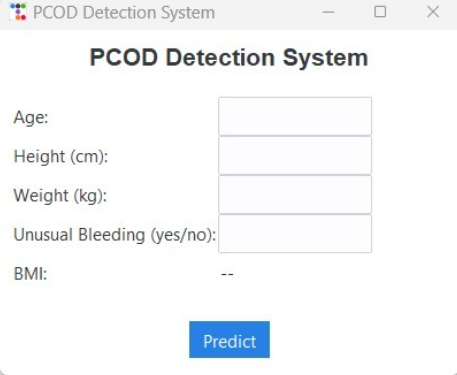
UteraCare is a machine learning based PCOD detection system that analyzes user provided inputs such as age, weight, height and symptoms. Based on these inputs, it automatically calculates BMI and by using all these features it predicts the likelihood of PCOD and provides guidance for next steps.
How it is built
The model is built using Python and its ML libraries. The Tkinter library is used for the user interface. The ML algorithm used in the model is Random Forest Classifier. The dataset for this project is from Kaggle
Challenges
- Finding a reliable and diverse dataset was difficult.
- Cleaning the features in the dataset.
Accomplishments that I am proud of
I'm happy that I successfully trained a machine learning model and served it as a functional prototype that allows real-time predictions from user inputs using GUI.
What I learned
This project helped me to reinforce the concepts I am studying. To be specific I learnt:
- How to work with medical/healthcare datasets and preprocess them effectively.
- How to build, save and connect a model to a GUI.
What's next for UteraCare: ML-based PCOD Detection System
I dream to improve this project in the following ways to make it more stronger and accurate:
- Expanding the dataset with more diverse entries for improved generalization.
- Building a mobile app version for easier access.
- Integrating lifestyle recommendations, health resources, and connections to medical professionals
Built With
- machine-learning
- python
- tkinter


Log in or sign up for Devpost to join the conversation.