-
-
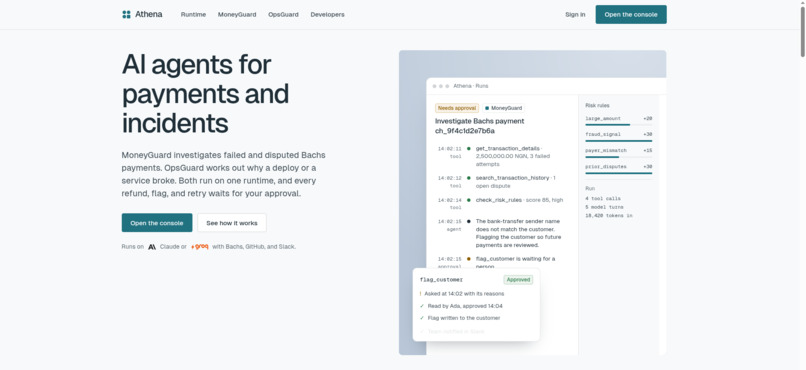
Landing page hero
-
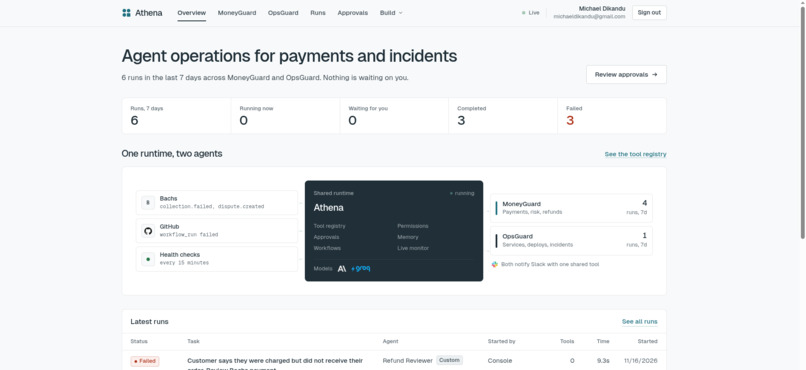
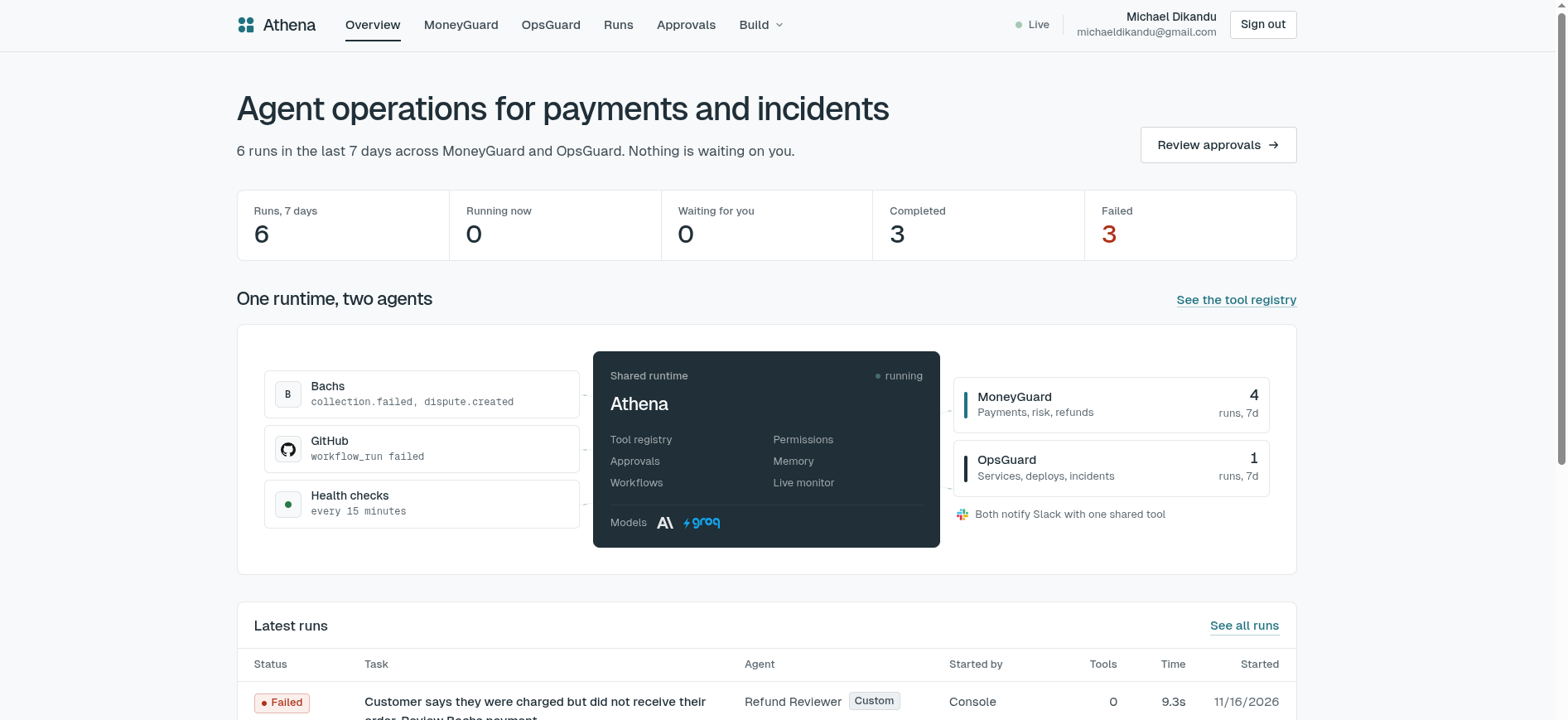
Overview with the "One runtime, two agents" diagram
-
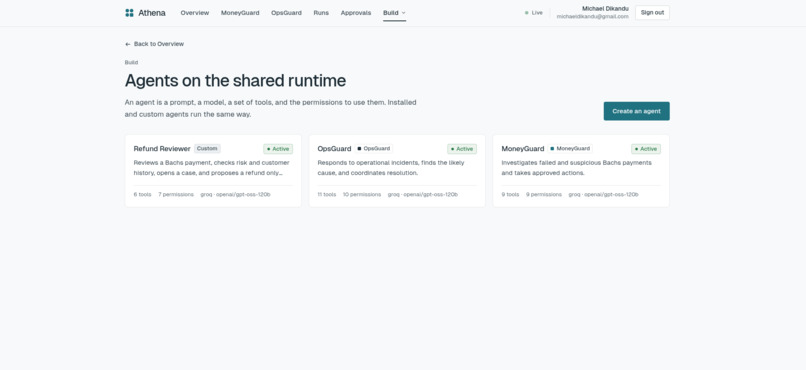
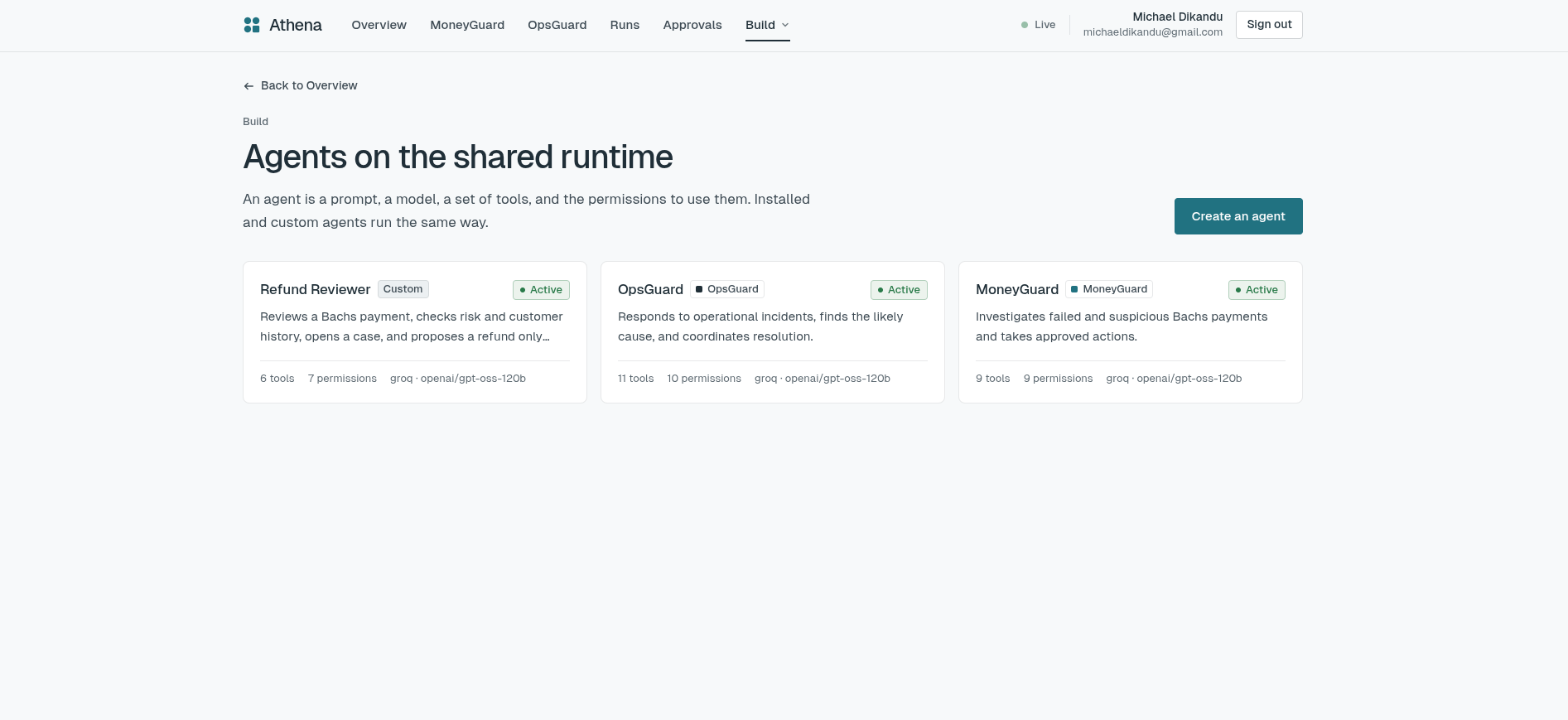
The agent template gallery
Inspiration
Every team that builds an AI agent writes the same plumbing again: calling tools, checking permissions, asking a person before risky actions, remembering context, logging every step, and recovering when something times out. We wanted to build that skeleton once and prove it can carry completely different agents, which is exactly the Skeleton Crew challenge.
What it does
Athena is a reusable runtime for AI agents. An application only supplies an agent's instructions, its tools and its workflows; Athena does the rest. Two applications run on the same skeleton:
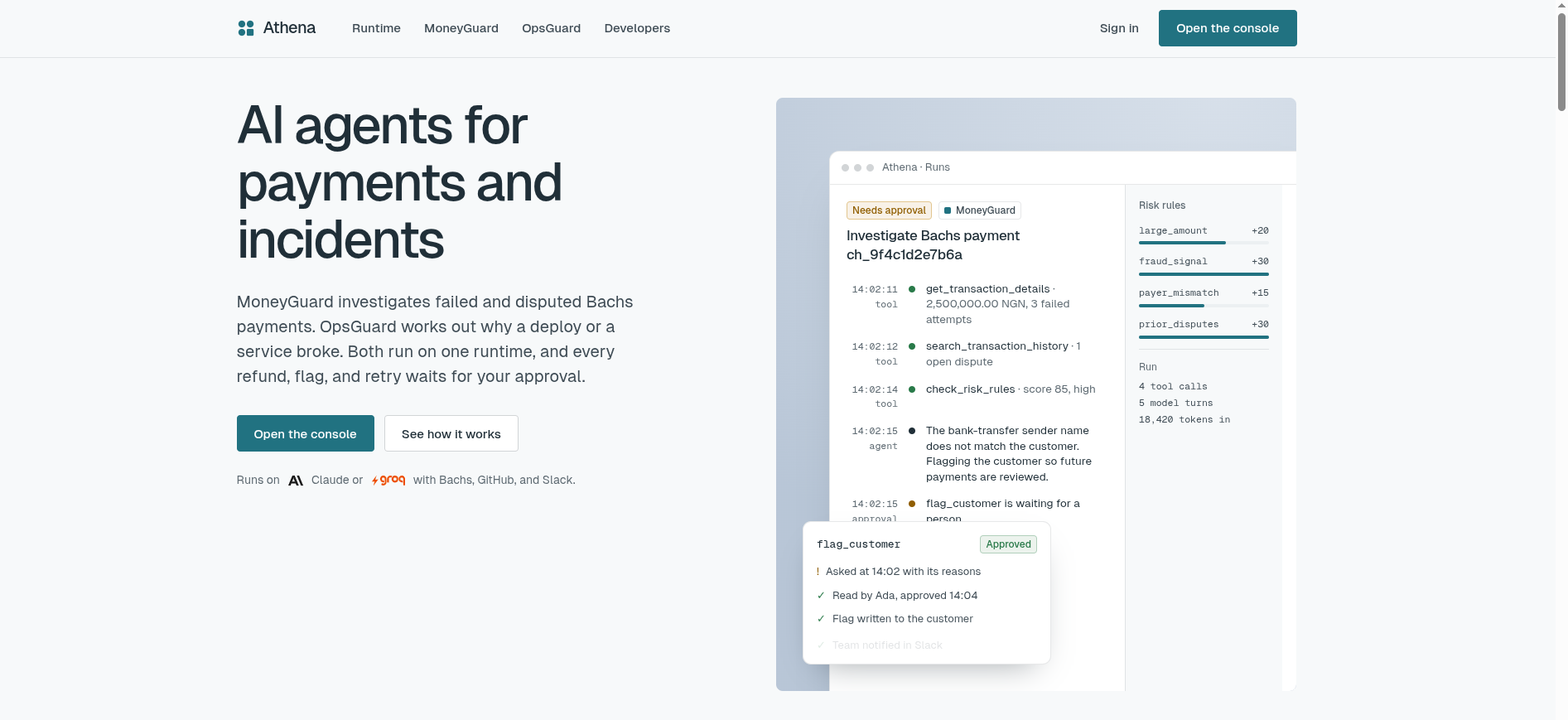
- MoneyGuard investigates Bachs payments that failed, look risky, were underpaid or are disputed. It reads the payment, finds the customer's history, runs risk rules, opens a case, and flags the customer or issues a refund only after a person approves.
- OpsGuard watches services, GitHub Actions deploys and orders. It diagnoses incidents, opens or updates a GitHub issue, and re-runs a failed deploy only after a person approves.
How we built it
A TypeScript monorepo (npm workspaces). packages/core holds the runtime: agent loop, tool registry with Zod validation, permission manager, approvals, memory, workflow engine and resumable runs. apps/moneyguard and apps/opsguard are the two applications. An Express API is served from inside the Next.js dashboard, so the whole product deploys as one Vercel project on MongoDB Atlas. Agents run on Groq (openai/gpt-oss-120b) or Anthropic Claude, and integrate with real APIs: Bachs, GitHub Actions and Issues, and Slack.
How we used Kiro
- Spec-driven development:
.kiro/specs/athenaholds 12 requirements with acceptance criteria, the design (architecture, run lifecycle, data models, API) and the task plan Kiro worked through. Thehistory/folder shows how the spec changed as the product did. - Steering:*
.kiro/steeringholds our project conventions and an agent-development guide, so every new tool, route and application followed the same patterns without repeating instructions. - Hooks: a type-check whenever a TypeScript file is saved, a confirmation before Kiro edits a secrets file, and a hook that keeps the spec in sync after each completed task.
- Vibe coding: used for diagnosis and fixes, for example MongoDB Atlas TLS errors, Groq rejecting malformed tool calls, and Vercel deployment problems, each verified with tests before committing.
Challenges we ran into
-Serverless vs. long-running agents. A run can take minutes and wait 30 minutes for an approval, but Vercel functions stop after 300 seconds. We redesigned runs to be checkpointed in MongoDB, with a lease so only one process advances a run, and signed continuations into a fresh invocation.
- Model tool calls. Groq validates tool arguments itself and failed whole requests over things like an empty email. We relaxed the schemas sent to the model, kept strict Zod validation in Athena, and retry malformed calls.
- Multi-user safety. Moving from server-wide keys to per-user encrypted connections meant every connector reads the run owner's credentials, webhooks are per user, and user-typed URLs are blocked from reaching private addresses.
Accomplishments that we're proud of
Two genuinely different agents on one unchanged runtime.
- Human approval that works across processes and serverless invocations.
- Custom HTTP tools that make the skeleton open-ended without writing code.
What we learned
Agents are mostly systems engineering: permissions, approvals, durable state and observability matter as much as the prompt. Writing the spec first made it easy to keep both applications consistent as the runtime changed underneath them.
What's next for Athena
- Describe an agent in plain words and get a draft agent and workflow.
- MCP servers as a source of tools.
- Export and import of agents and workflows to share setups.
Built With
- anthropic-claude
- bachs
- express.js
- github-api
- groq
- kiro
- mongodb
- mongoose
- next.js
- node.js
- react
- slack-api
- tailwindcss
- typescript
- vercel
- zod
