Main Demo: https://youtu.be/2jd0WFwtG7E
Promo Video: https://youtu.be/H7JfdLpYdKw
Inspiration
We build software for roofing companies. One of our clients is Brava Roof Tile, which makes composite cedar shake, slate and Spanish tile roofs. We had already shipped them a support assistant trained on their calls and a quote tool. What they still needed was a way to train their people: new customer success reps, sales support, and the contractors' salespeople who sell Brava to homeowners.
We kept seeing the same pattern. A new hire asks a senior person the same question three times, and nobody notices which topics they still don't know. The answers are already in the website, the PDFs and the call recordings. Nothing turns them into training. The executives have the opposite problem. They don't need answers to product questions. They need to know what moved in the market overnight and what it means for their product lines.
What it does
usebrain builds a company brain from one input, your website URL.
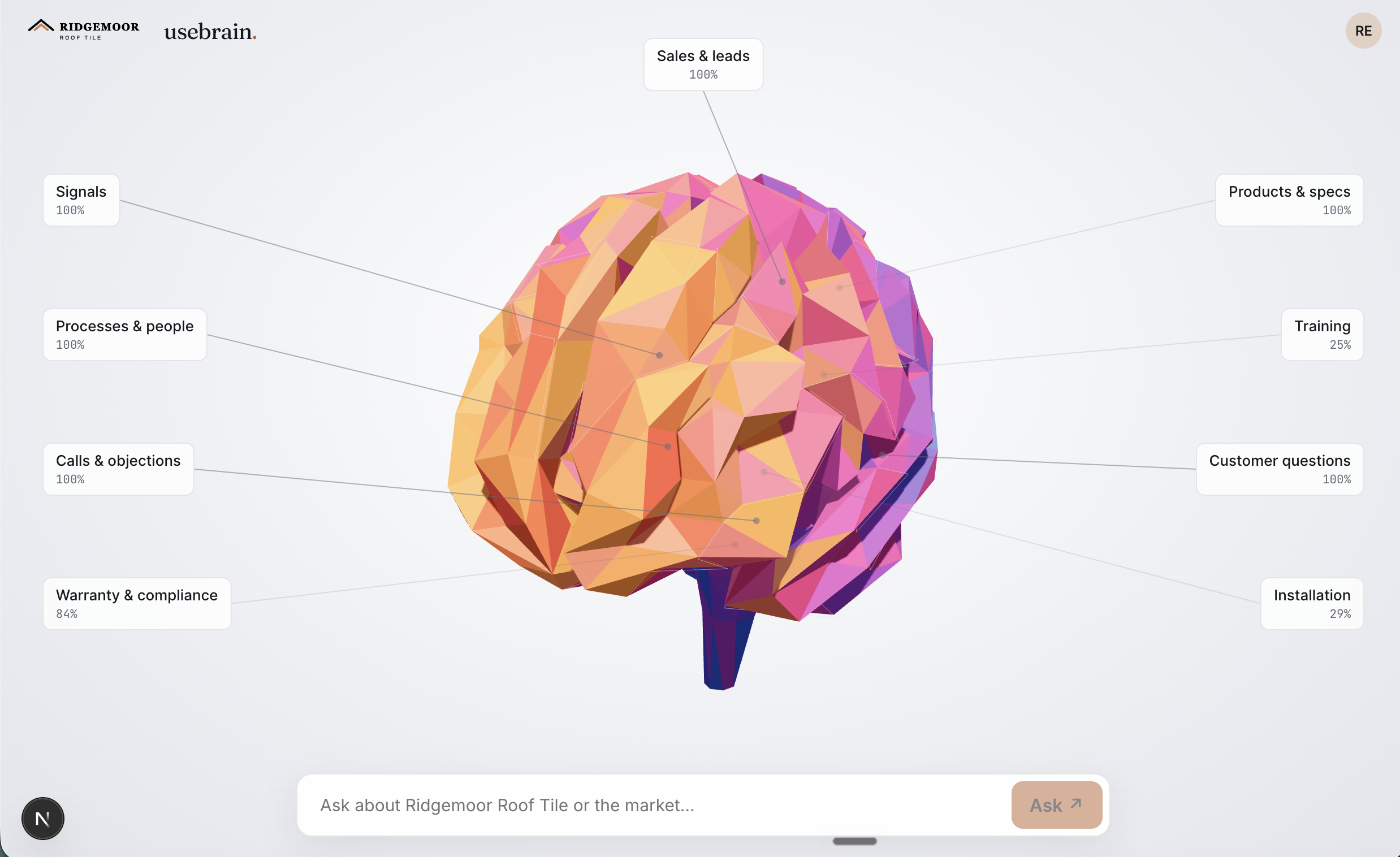
- Ingestion. It crawls the site and its PDFs, tags every page by topic and pulls your logo, colors and fonts. A 3D brain lights up region by region as it learns. Regions the website can't fill stay dark and name the source that would fill them.
- Integrations. Connect calling tools (CallRail, Aircall, Dialpad, RingCentral, Intercom) so the brain learns from real customer calls, and CRMs (Salesforce, HubSpot, Pipedrive, JobNimbus, AccuLynx) so it knows your leads.
- Answers with citations. Anyone on the team can ask a question and get an answer from company knowledge, linked to the page it came from.
- Training that follows your gaps. Every question a trainee asks is a signal about what they don't know. The next morning they get a quiz built from those gaps, written from the company's own docs. Topics they get right fade out and topics they miss come back. Two trainees who ask different things get different quizzes.
- Leads. A rep at a trade show types "talking to Jake Miller, owns Miller Roofing in Austin." The brain logs the lead, enriches it from the web and suggests a pitch based on what it knows about your products. For Jake that means leading with the Class 4 hail rating and the insurance discount.
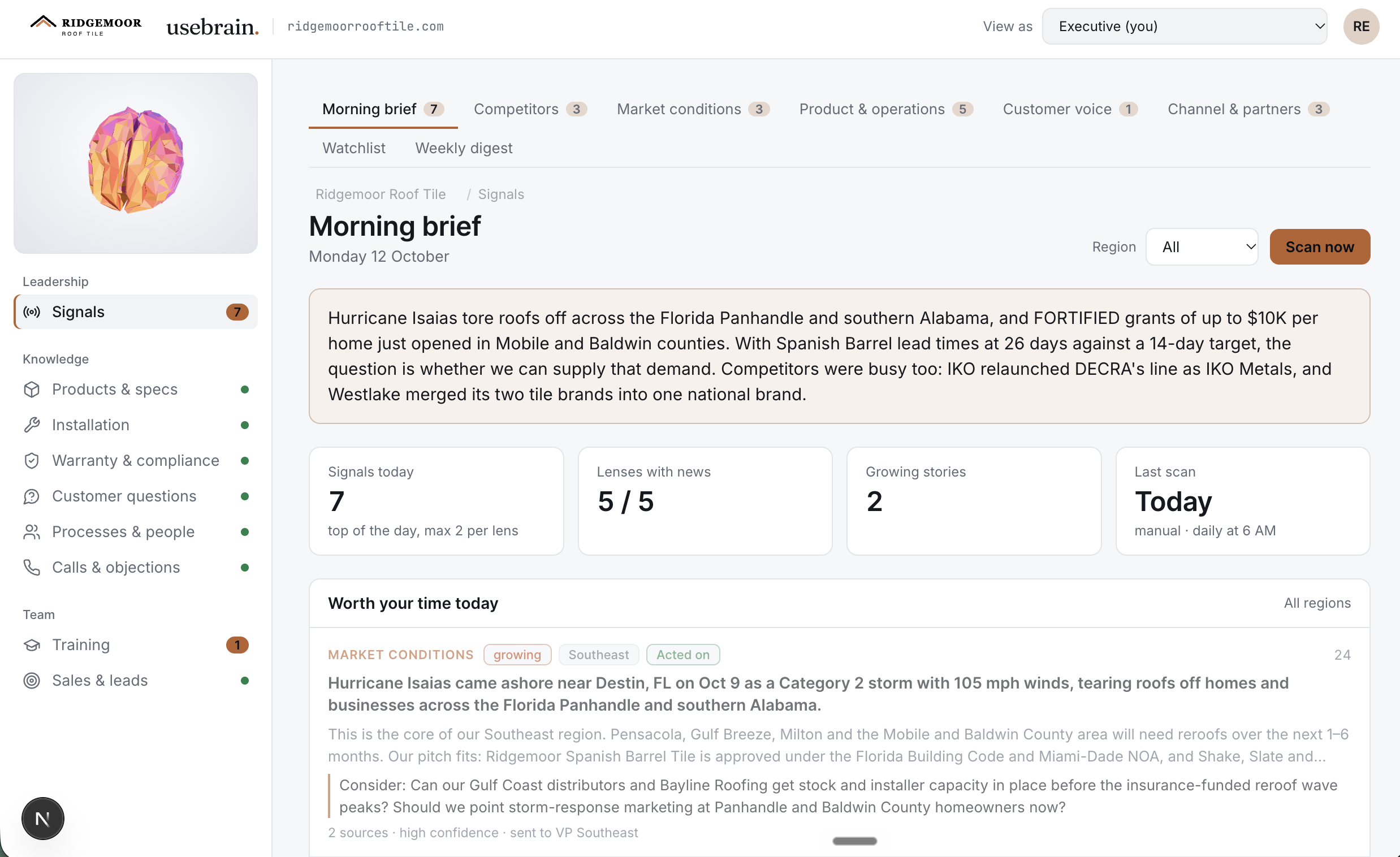
- Executive brief. Each morning, agents scan competitors, market conditions, customer voice and performance against targets. The executive gets the few signals worth acting on, each with sources and a suggested decision. A read-only weekly digest goes to the board.
- MCP server. Other AI agents can ask the brain questions and read the brief over the Model Context Protocol.
How we built it
Next.js 15 and React 19 in TypeScript, with SQLite (better-sqlite3) as the knowledge store. Claude does the reasoning through the Anthropic API and the Claude Agent SDK. That covers cited answers, gap detection, quiz generation and grading, lead angles, and the parallel lens agents behind the executive scan. The 3D brain is Three.js. Ingestion and scans stream progress to the UI over server-sent events. The MCP endpoint uses the official MCP TypeScript SDK, and Zod validates inputs. A scheduler inside the Node server runs the executive scan at 6 AM.
Challenges we ran into
- Cloudflare. Brava's site, like many others, blocks server-side scrapers. We crawled 773 of its 1,093 URLs ahead of time and the demo ingests from that cache. In production, a customer either allowlists our crawler or uploads their files.
- Real call data. Real recordings contain customer names and phone numbers, so the call and CRM connectors run on sample transcripts and records we wrote for each tool.
- One brain, several jobs. A trainee, a sales rep and a CEO want very different things. We kept one brain mesh and one input box, and switched which regions it shows: knowledge sections for the team, signal lenses for the executive.
- Time. About two and a half hours of build time before the in-person demo.
Accomplishments that we're proud of
- The first live executive scan took about two and a half minutes and came back with 10 sourced signals. They included a hurricane in Brava's Southeast territory, a competitor relaunching a rival product line and a tile brand merger.
- Quizzes are specific to one person at one company. They come from that trainee's own questions and that company's own documents, not from a generic question bank.
- The brain shows what it doesn't know. A dark region that says "connect your calling tool to fill this" is more honest than an assistant that guesses.
- The whole app takes on the customer's brand, so Brava's team sees Brava, not us.
What we learned
The questions people ask are the best training data a company has. A question log tells you what each person is missing and, across a whole cohort, which docs are bad. Calls work the same way, because they're where customers say what they actually care about. A website shows how a company describes itself. Calls and questions show where that description falls short.
What's next for usebrain by Hashir
- Ship it to Brava's own team. This is the third system in their roadmap.
- Live calling-tool and CRM connectors in place of the sample data, plus ERP and Snowflake for the performance lens.
- Quizzes delivered where people already work: a Slack DM or text at 9 AM, with spaced repetition at 1, 3 and 7 days.
- Push urgent executive signals as notifications instead of waiting for the morning brief.
- A manager view of each trainee's readiness and the topics the whole team is weak on.
- More roofing and home-service companies. The product only needs a URL to start.
Built With
- anthropic-api
- claude
- claude-agent-sdk
- model-context-protocol-(mcp)
- next.js
- react
- sqlite
- three.js
- typescript
- zod

Log in or sign up for Devpost to join the conversation.