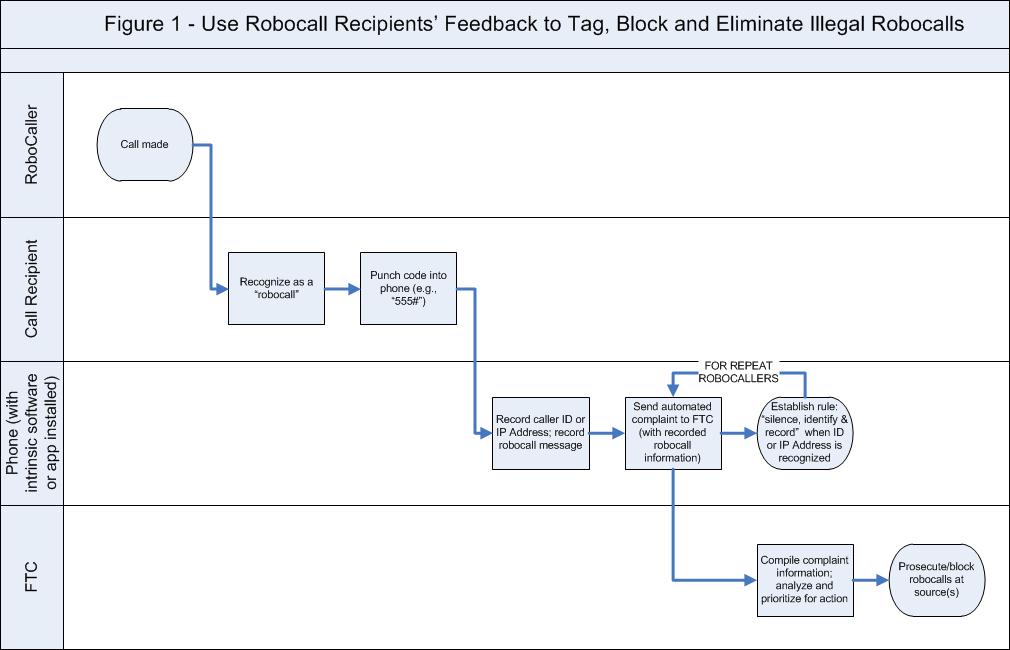
My proposed technical solution envisions land-line and mobile phones being configured (having recording capability) and having intrinsic software or an app installed that allows key information to be recorded (when directed) and later transmitted as discussed below. Figure 1 shows the process that would employ this proposed technical solution.
Once a robocall recipient recognized a call as being a robocall, he/she would be able to easily tag the call. This could be accomplished by establishing a standard code (e.g., “555#”) that the recipient could immediately key (or speak) in (and receive confirmation the robocall is tagged as such). The phone would recognize the code and then act on it as follows.
• Identify and save the caller ID (if originating from a phone) or IP Address (if originating from a computer) • Begin to record the robocall • Establish a rule that if the caller ID or IP Address is seen again to silence the ringer, perform the two steps above and send another automated complaint as discussed below
After the robocall has ended, the phone would then submit an automated complaint (via phone call for land lines, or text for “non-smart” mobile phones, or text/email for “smart” phones) to the Federal Trade Commission (FTC) on the robocall. The automated complaint would contain the:
• Name of person who received the call • Phone number that received the call • Time and date of the call • Caller ID (if originating from a phone) or IP Address (if originating from a computer) • Recording made of the robocall
The FTC could then compile and analyze these complaints. The most active robocall offenders could be prioritized for prosecution and the source(s) of the calls could be blocked or shutdown.

Log in or sign up for Devpost to join the conversation.