Inspiration
As humans, we are bad at long-term decision-making. We underestimate risks, overestimate our future motivation, and often ignore the second-order effects of our choices. Whether it's quitting a job, moving to a new country, or starting a company, we're forced to make life-altering decisions based on gut feelings and limited data.
We realized that while there are tools to track tasks and games to simulate fantasy worlds, there was nothing to simulate your own future. What if decision-making was like a video game? What if you could "save your game," try a risky path, see the consequences, and then rewind if it didn't work out?
This inspired Usaid, a cognitive time simulator that brings the power of "Scenario Planning" (used by military and corporate strategists) to personal life decisions — powered by Aicoo AI with Google Gemini as a reliable fallback.
What it does
Usaid is an AI-powered engine that generates multiple, distinct future timelines based on a single real-world decision.
- You enter a dilemma (e.g., "Should I quit my job to start a startup?").
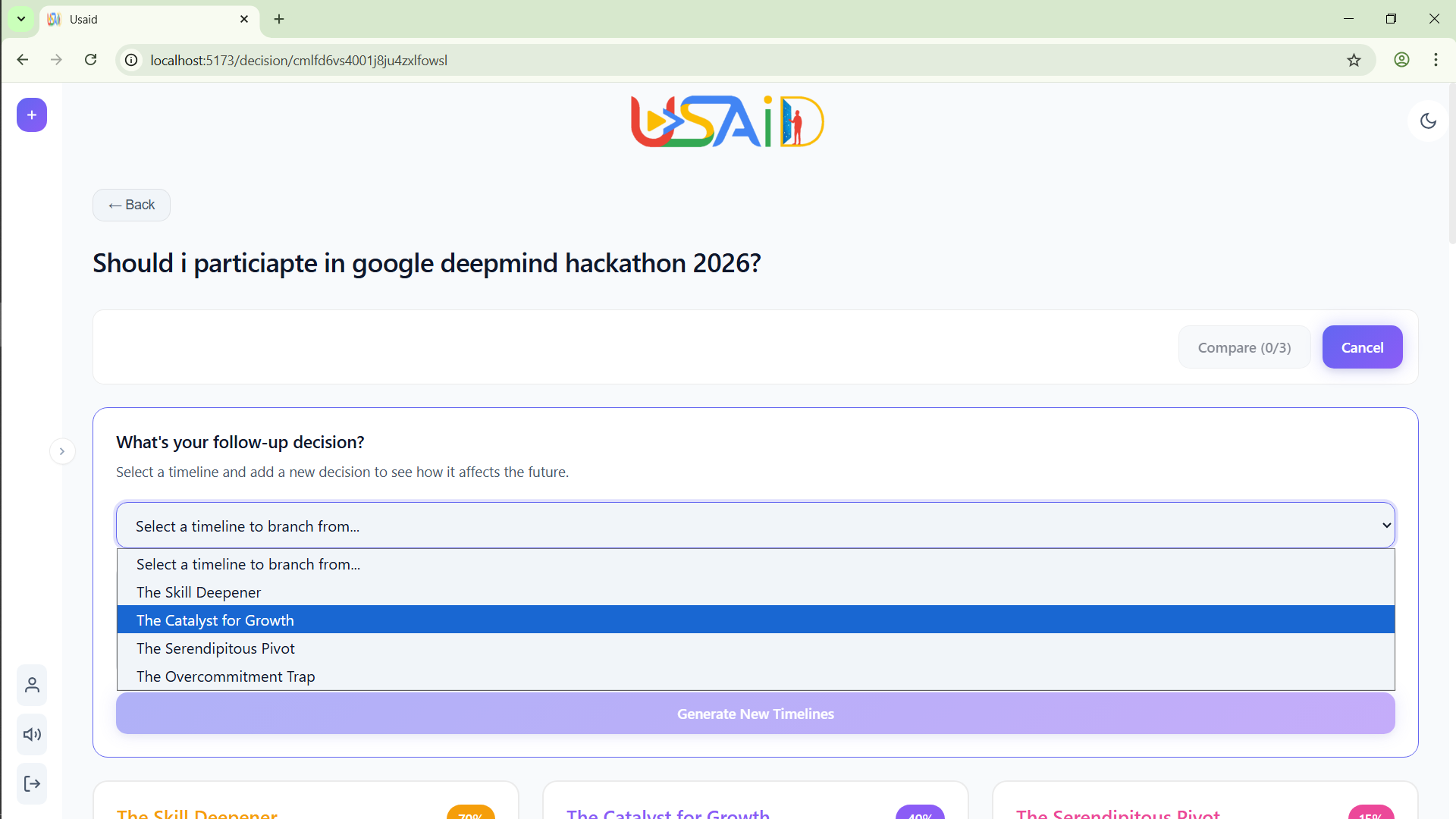
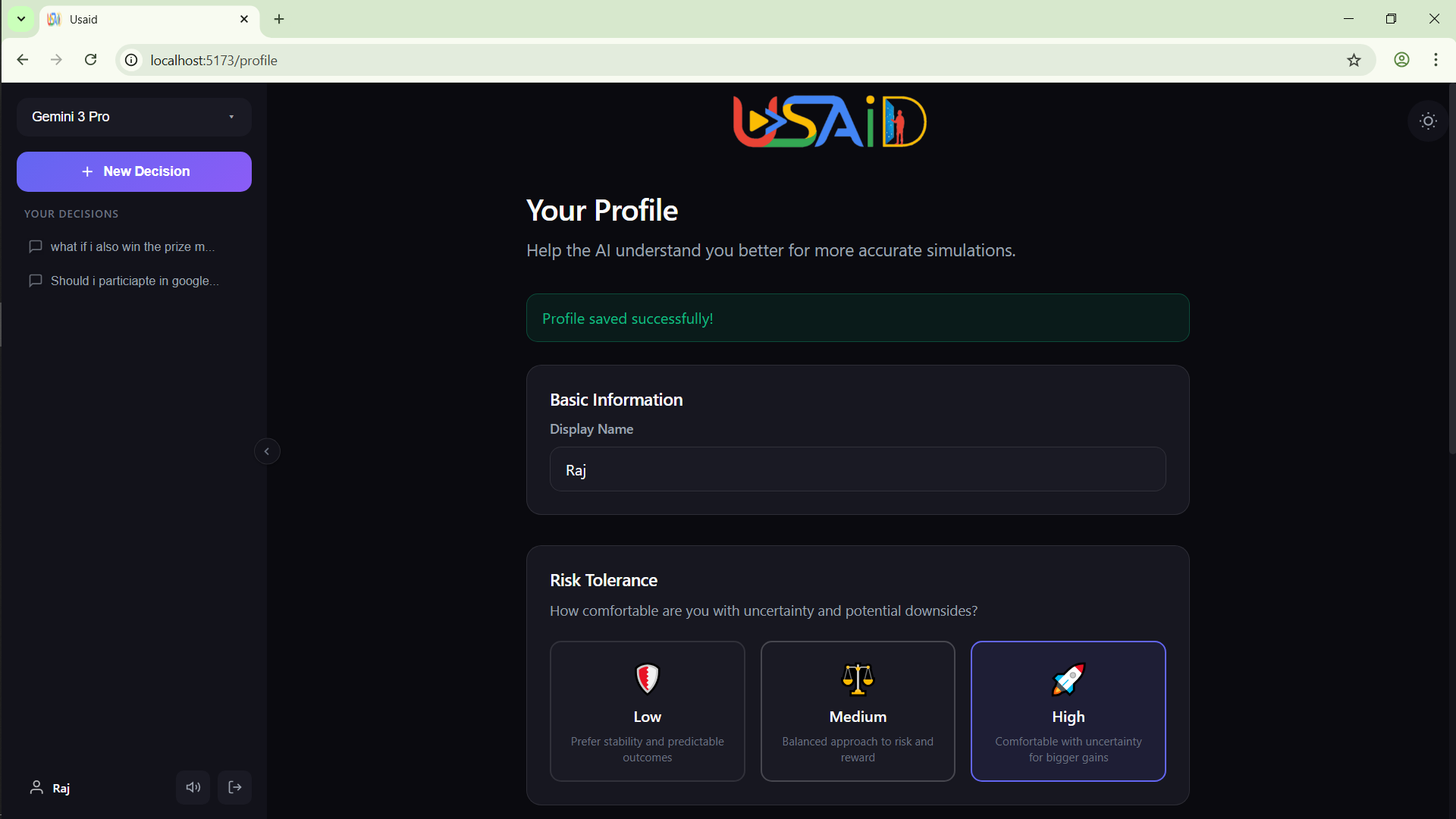
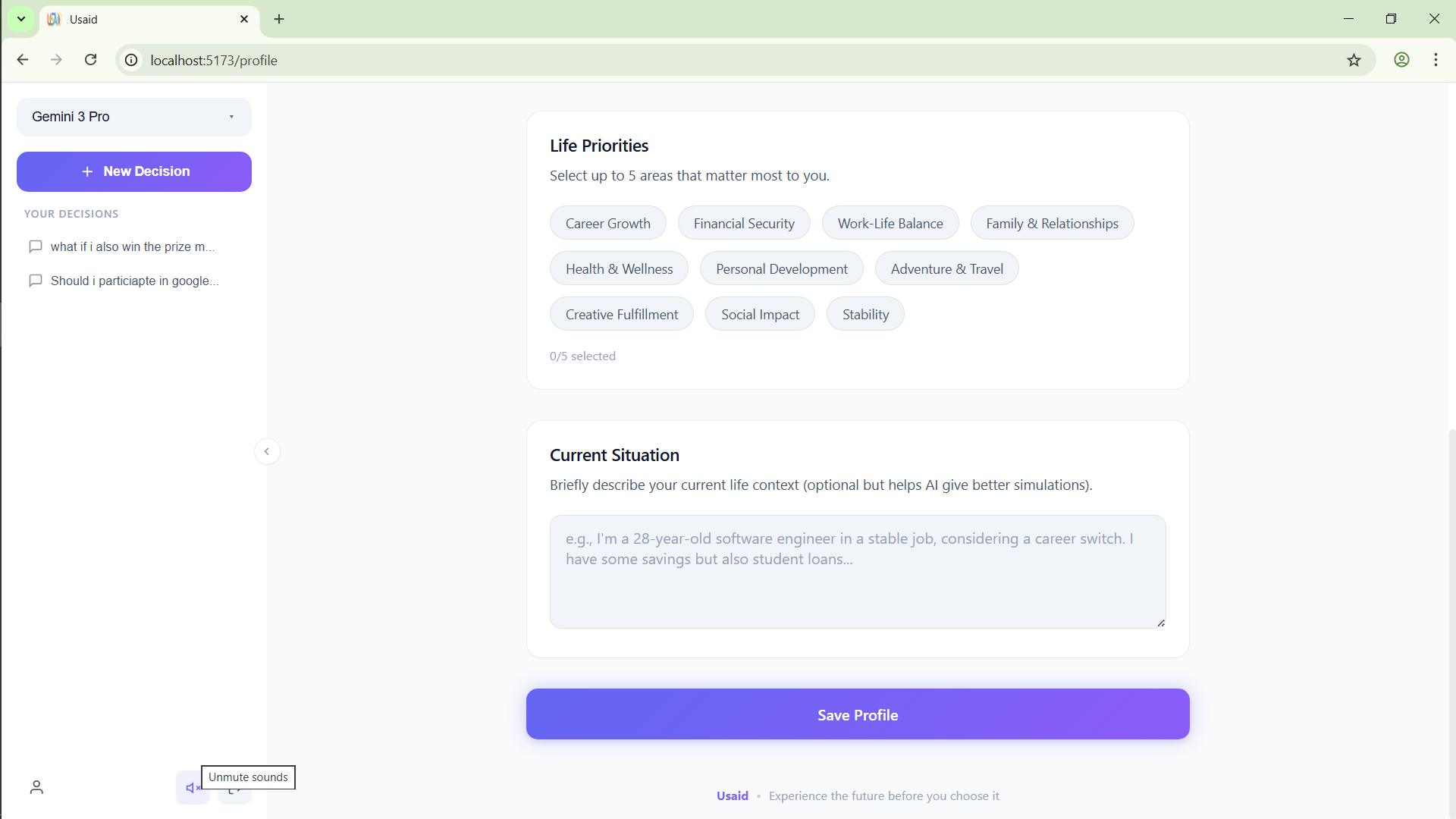
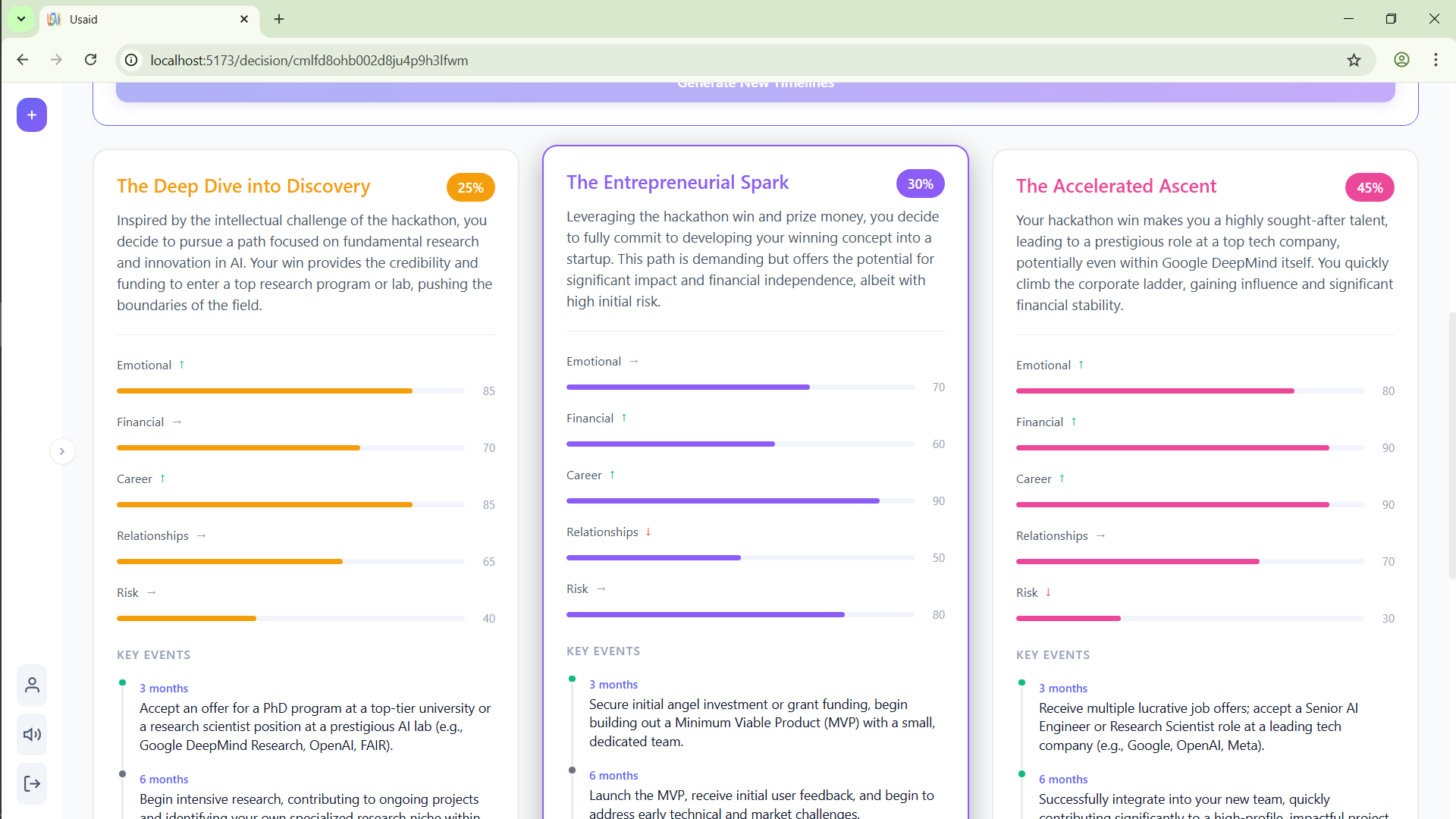
- Usaid analyzes your profile (risk tolerance, values, current state) using Aicoo's Pulse Agent and generates few feasible divergent future paths (Optimistic, Pragmatic, Remote/Risky).
- Each timeline is visualized with year-by-year events and quantifiable metrics for Career, Finance, Relationships, and Mental Wellbeing.
- You can "inject" new decisions into any timeline (e.g., "What if I get funding in Year 2?") and watch the future rewrite itself in real-time.
- Every decision automatically syncs to your Aicoo workspace, and you can share decisions via AI agent links so teammates or mentors can review and discuss your timelines through Aicoo's coordination layer.
It's not just advice — it's experiential foresight of your own life, with built-in collaboration.
How it is built
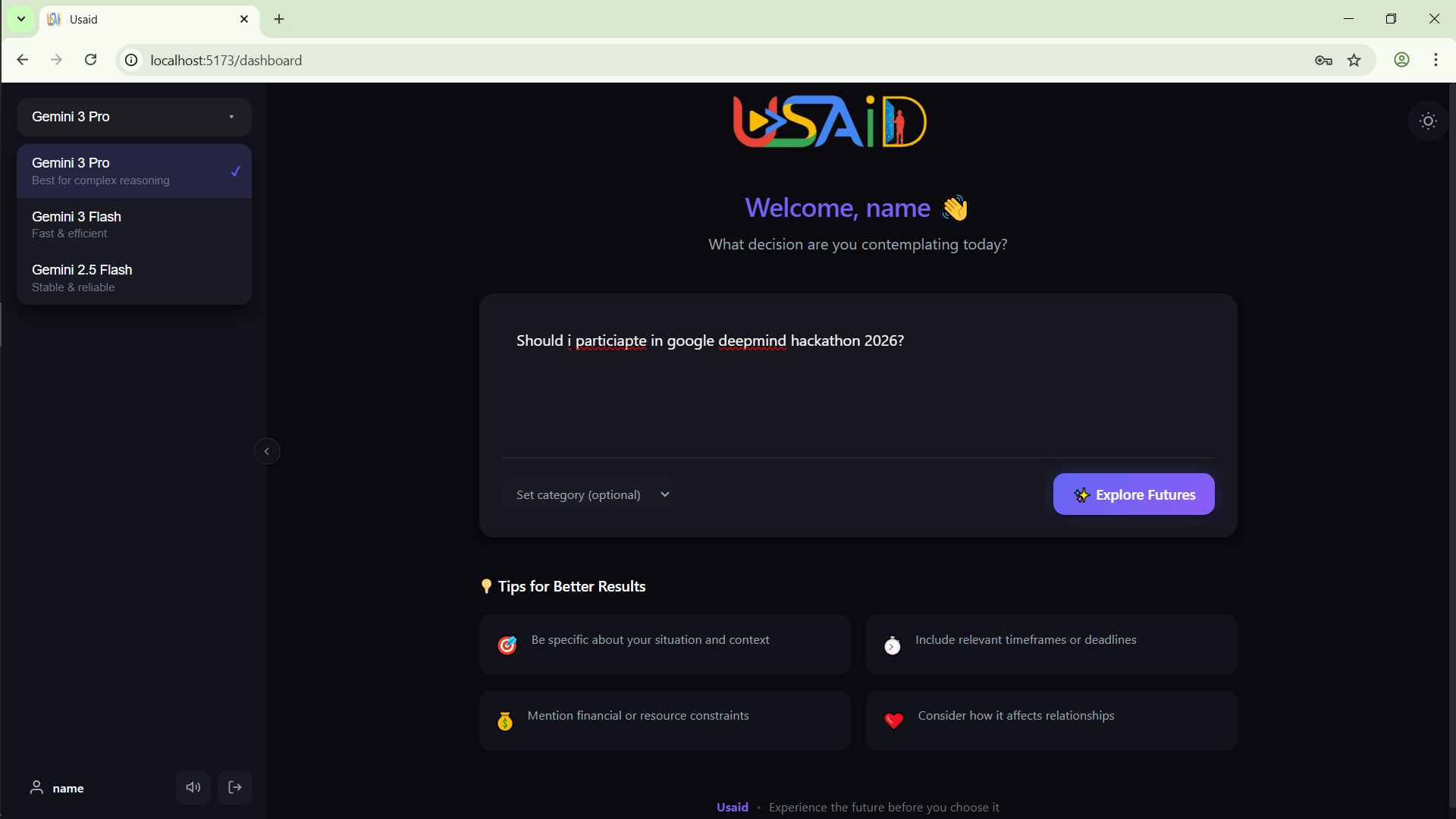
Usaid is a modern full-stack application leveraging a dual AI provider architecture with Aicoo AI as primary and Google Gemini as fallback.
The AI Engine: We use Aicoo's
/api/v1/chatendpoint as the primary AI provider, sending structured prompts through the Pulse Agent runtime. If Aicoo is unavailable, the system automatically falls back to Google Gemini 3's model chain (3-Pro → 3-Flash → 2.5-Flash). All responses go through the same strict Zod schema validation regardless of provider.Aicoo Platform Integration: Beyond AI generation, we deeply integrate with Aicoo's coordination platform — Decision Sync (
/accumulate) auto-saves every decision to Aicoo workspace, Share Links (/share/create) let users generate AI agent links for collaborative review, and COO Strategies (/briefing/strategies) provide Eisenhower-matrix-style strategic analysis.The Frontend: Built with React, TypeScript, and Vite, featuring a premium "Glassmorphism" UI. Framer Motion is used for smooth timeline animations and the model selector shows Aicoo AI as primary with Gemini models as fallback options.
The Backend: A robust Node.js/Express server that acts as the orchestrator. It handles authentication, manages the database (via Prisma), and implements the Aicoo-first → Gemini-fallback AI pipeline with fire-and-forget Aicoo sync for zero latency impact.
The Design: Heavy focus on "Industrial Polish", using a dark, futuristic aesthetic with neon accents to make the user feel like they are stepping into a control room for their life.
Challenges we ran into
Dual Provider Architecture: Building a seamless failover between Aicoo and Gemini required careful abstraction. Both providers return different response formats, but our shared
extractAndValidate()function normalizes everything through one Zod schema pipeline — the frontend never knows which AI answered.Hallucination Control: Getting an LLM to consistently generate plausible 5-year timelines without veering into fantasy was tough. Strict schema validation implementation and "Chain-of-Thought" prompting helps a lot.
Non-blocking Aicoo Sync: Syncing decisions to the Aicoo workspace had to be completely fire-and-forget — a failed sync should never block or slow down the user's timeline generation.
Latency: The dual-provider approach actually helps here — Aicoo's agent runtime can be faster for certain prompts, while Gemini 3 Flash serves as a reliable backup.
Visualizing Abstract Data: How do you visualize "Emotional Wellbeing" over 5 years? The UI has been iterated multiple times to find a graphical representation that was intuitive but not overwhelming.
Accomplishments that make me proud
The "Wow" Factor: The moment you see your life split into three different paths on the screen is genuinely powerful.
True Aicoo Integration: We didn't just slap an API call on top — we integrated Aicoo at three levels: AI generation (primary provider), data coordination (decision sync), and collaboration (share links + strategic analysis).
Zero-Breakage Fallback: The app works identically whether you have Aicoo only, Gemini only, or both configured. No single point of failure.
The UI: The interface feels incredibly premium and responsive. It doesn't feel like a hackathon project, it feels like a SaaS product.
What I learned
Aicoo is a Coordination Layer, Not Just an API: The real power isn't just the chat endpoint — it's the accumulate, share, and briefing primitives that turn a solo app into a collaborative platform.
Gemini 3 is a Reasoner, not just a Writer: If we give Gemini enough context about a user's psychology, it can predict second-order effects (e.g., "High career growth = Risk of burnout/divorce") with scary accuracy.
The Power of Context: The quality of the simulation is directly proportional to how much the AI knows about the user. Personalization is the key.
Dual AI Providers = Resilience: Having two AI providers with automatic failover means the app never goes down because of a single API outage.
What's next for Usaid
Deeper Aicoo Integration: Using Aicoo's Eisenhower Matrix endpoint to automatically classify decision urgency, and leveraging heartbeat tasks for proactive decision check-ins.
Reality Feedback Loop: Allowing users to log what actually happened, so the system learns from reality and improves its future predictions.
Multi-Agent Extensions: Using Aicoo's agent-to-agent coordination to add specific AI advisors (a "Risk Manager," a "Career Coach," a "Therapist") who debate the pros and cons of your timelines through Aicoo's network.
Scientific Extensions: Applying the same engine to simulate research paths or startup pivots for teams, with Aicoo share links enabling team-wide scenario planning.
Built With
- aicoo-api
- express-js
- framer-motion
- mermaid-js
- prisma
- react-query
- reacts
- sq-lite
- type-script
- vite
- zustand

Log in or sign up for Devpost to join the conversation.