
Inspiration
Environmental decisions are hard because their consequences are delayed, interconnected, and difficult to visualize. A student, school, household, or community may want to choose between rooftop solar, composting, rainwater harvesting, public transport, or reducing plastic use, but the long-term impact of each choice is rarely obvious.
We noticed that most existing tools give static numbers, while real environmental choices unfold over time. People need more than a calculator; they need a way to explore how one decision can create different outcomes across cost, emissions, resource use, and quality of life.
This inspired Usaid, a cognitive scenario simulator that brings structured future-planning to environmental problem solving. Instead of guessing what might happen, users can explore multiple possible futures before taking action.
What it does
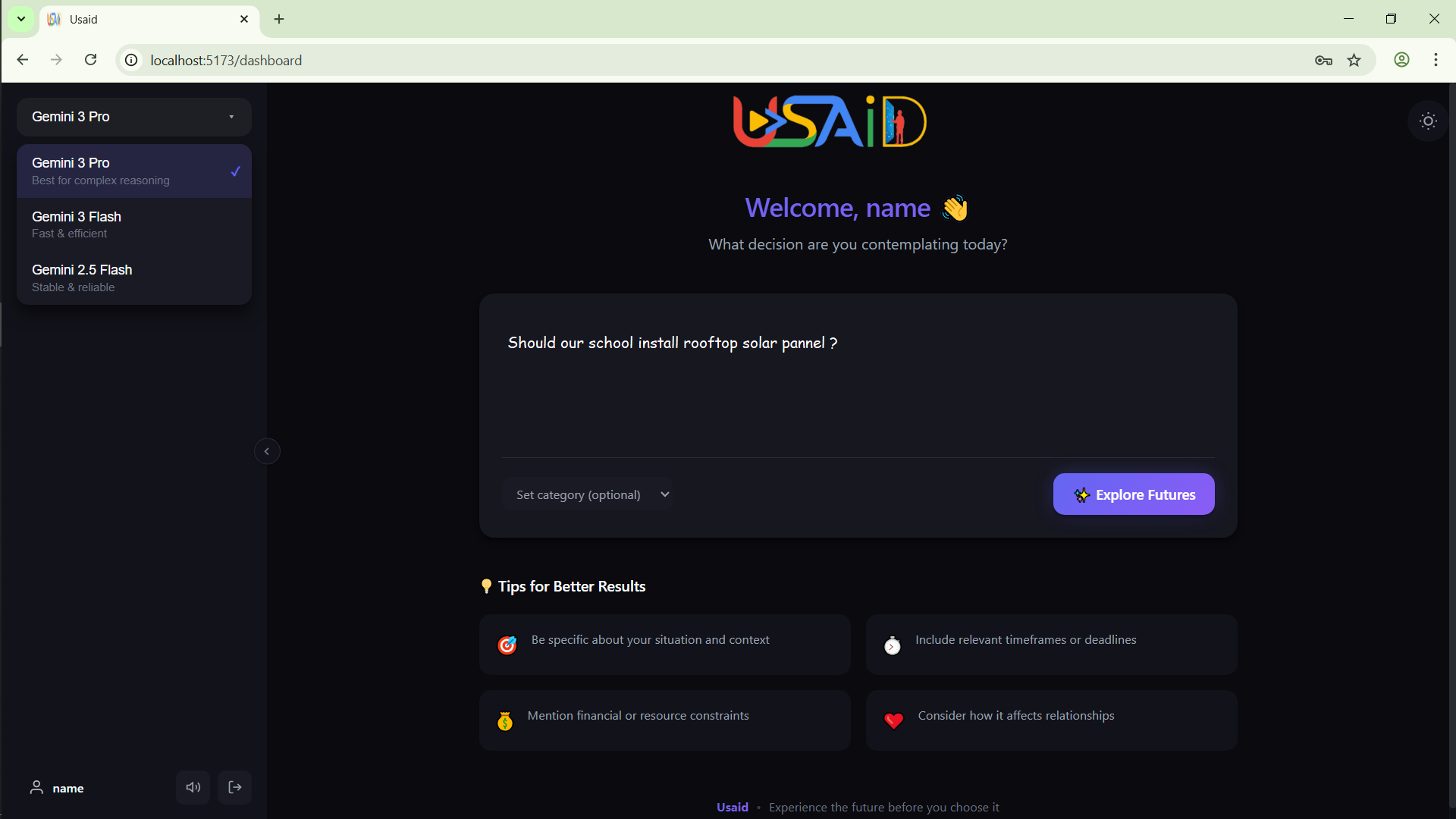
Usaid is an AI-powered engine that generates multiple, distinct future timelines based on a single environmental decision.
- You enter a dilemma such as "Should our school install rooftop solar?" or "What if our neighborhood starts composting and segregating waste?"
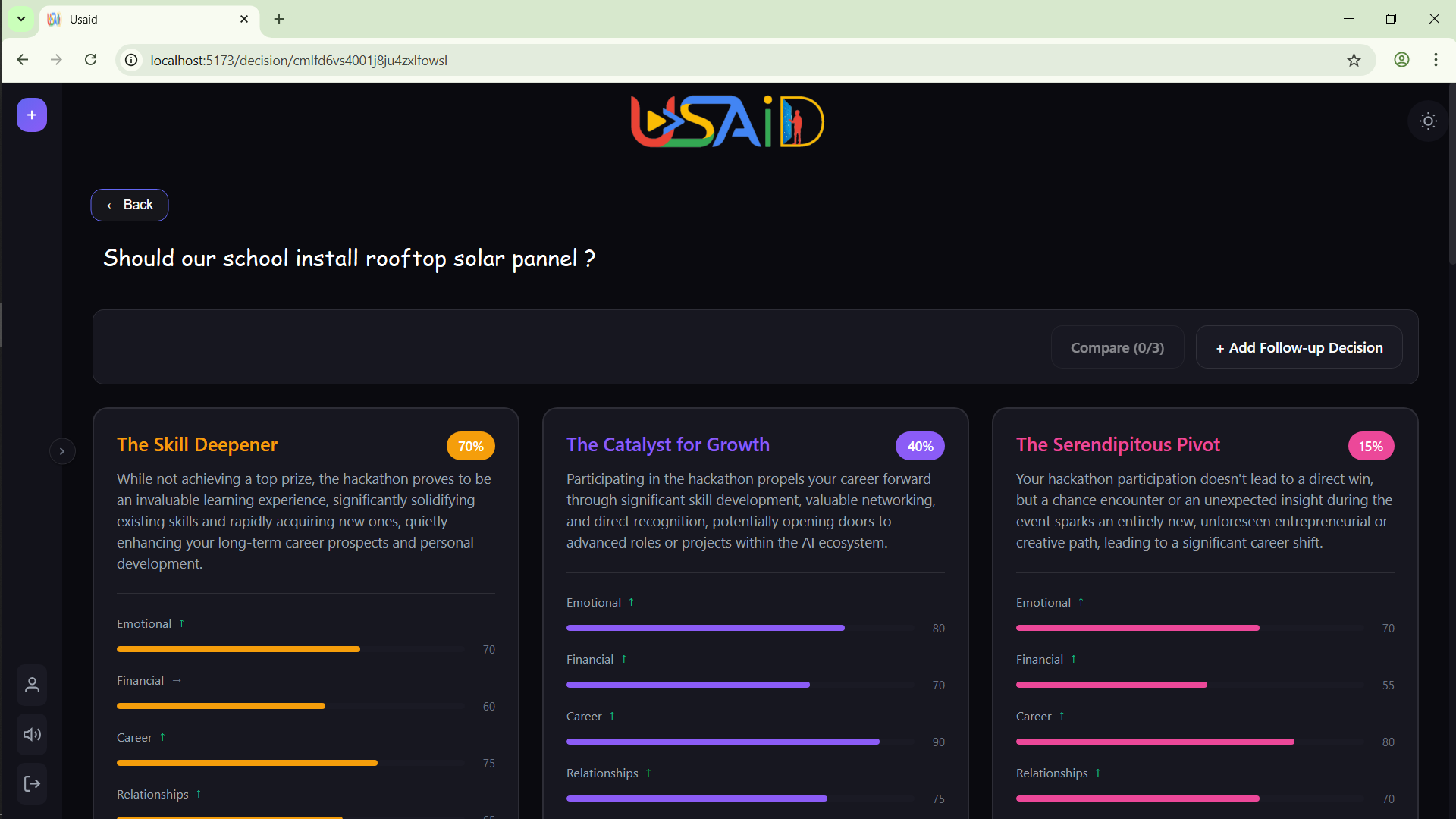
- Usaid analyzes the context, including goals, constraints, scale, budget, and current conditions, then generates a few feasible future paths such as Optimistic, Practical, and Constraint-Heavy.
- Each timeline is visualized with year-by-year events and quantifiable metrics such as carbon reduction, cost savings, resource efficiency, and community impact.
- You can inject new events into any timeline, such as a funding grant, drought year, policy change, or adoption drop, and watch the projected future update in real time.
It is not just advice. It is experiential foresight for environmental action.
How it is built
Usaid is a modern full-stack application leveraging Generative AI for environmental scenario planning.
The AI Engine: Google Gemini 3's reasoning capabilities are used to build the simulation core. Prompt engineering and structured output are used to generate grounded, multi-year environmental scenarios instead of simple text responses.
The Frontend: Built with React, TypeScript, and Vite, featuring an interactive UI for comparing timelines, viewing metrics, and exploring trade-offs between different sustainability choices.
The Backend: A Node.js and Express server acts as the orchestrator. It handles authentication, manages the SQLite database through Prisma, and streams AI-generated scenario data to the client.
The Design: The interface is designed like a decision dashboard, making complex environmental trade-offs feel clear, visual, and actionable rather than abstract.
Challenges we ran into
Keeping scenarios realistic: Environmental forecasting can easily become vague or exaggerated. We had to guide the model toward plausible cause-and-effect relationships and consistent multi-year outputs.
Balancing human and environmental factors: A good environmental decision is not only about emissions. It also depends on cost, adoption, convenience, and local constraints, so the simulator had to reflect both ecological and human realities.
Visualizing impact clearly: Metrics like carbon reduction, water savings, and community benefit are meaningful, but they can be difficult to present in a way that feels intuitive during a fast demo.
Accomplishments that make me proud
Turning one prompt into multiple futures: The app can take a single environmental question and transform it into distinct, understandable scenarios instead of one generic answer.
Structured AI output: We shaped the model into producing timeline-style data that can be visualized and compared, which makes the project feel analytical rather than purely conversational.
Making sustainability interactive: The project makes environmental planning feel engaging, practical, and personal, especially for students and small communities that may not have access to formal planning tools.
What I learned
Scenario planning is powerful for climate and sustainability decisions: People understand trade-offs better when they can see how a decision unfolds over time rather than reading a single recommendation.
Context matters as much as intelligence: The quality of the simulation depends heavily on local details such as scale, budget, existing habits, and adoption barriers. Better context produces more useful environmental foresight.
What's next for Usaid
Add more environmental domains: Expand beyond general sustainability choices into water conservation, waste systems, transport planning, school campuses, and local energy decisions.
Use real datasets: Integrate public climate, weather, pollution, and energy datasets so the simulator can ground its projections in location-specific evidence.
Support collaborative planning: Allow teams, schools, and communities to compare options together and use the tool as a shared decision-making platform for environmental action.
Built With
- google-gemini-3-flash
- node.js
- react
- sqlite
- typescript


Log in or sign up for Devpost to join the conversation.