-
-
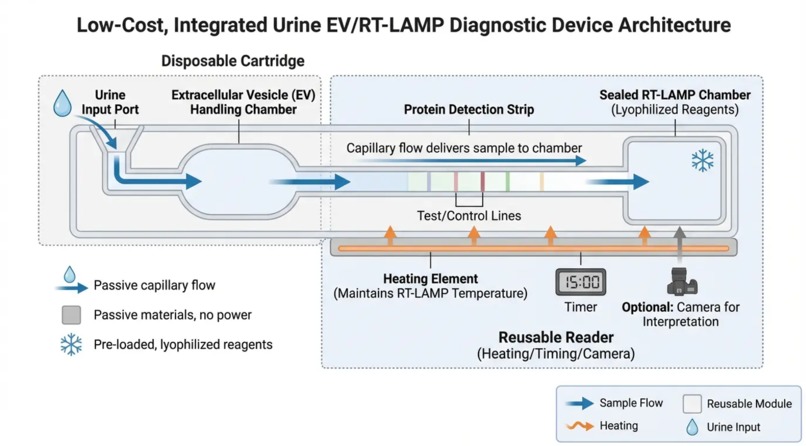
Device Architecture
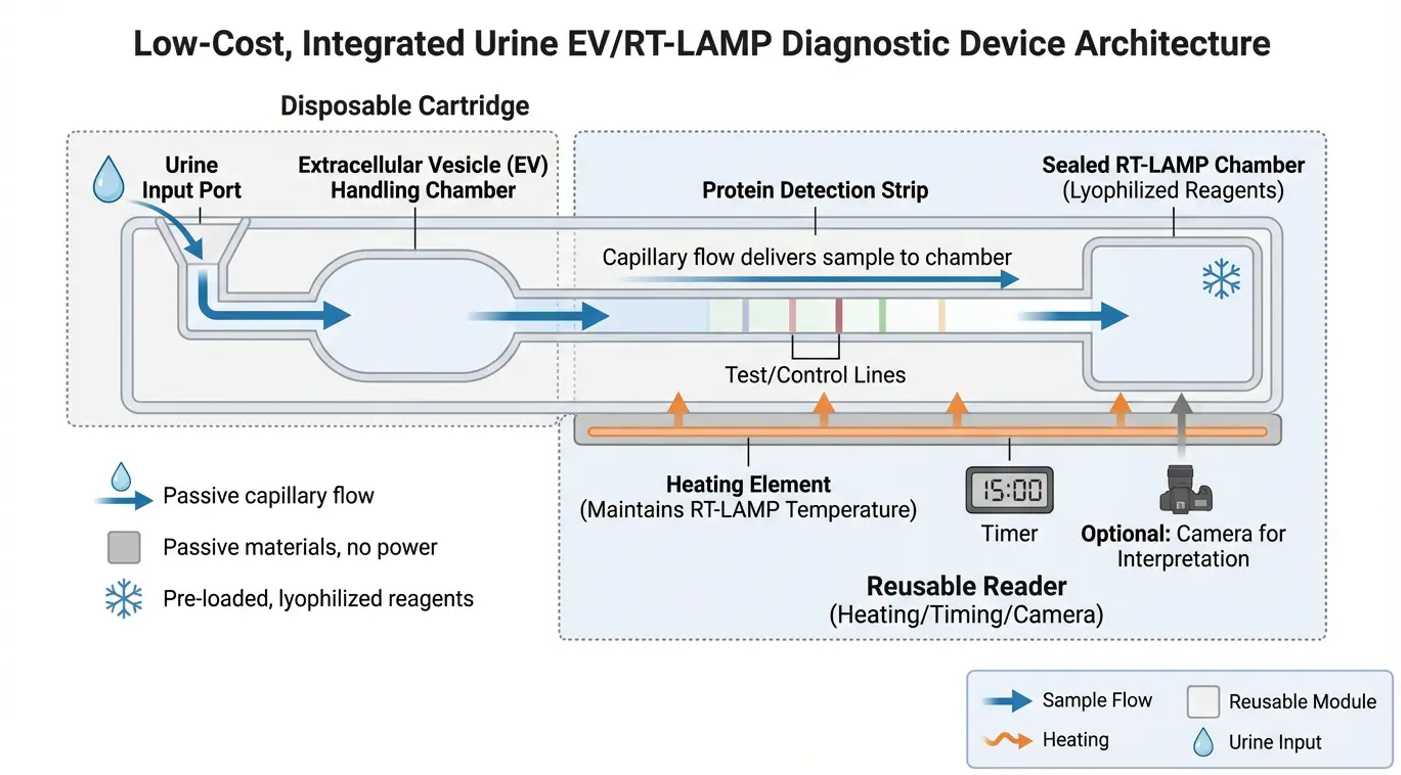
Inspiration
The project is inspired by the challenge: "How to Keep Humans Healthy as they Reach the Sky?". The team identified that rapid, minimally invasive assessment of radiation exposure is critical for space travel and clinical triage. They focused on Urinary Extracellular Vesicles (EVs) because urine is easy to collect, and EVs act as concentrated "messengers" of tissue health that are protected from the "noise" found in whole urine.
What it does
The project proposes a Low-Cost, Integrated Urine EV/RT-LAMP Diagnostic Device. It is designed to: Capture and isolate EVs from small volumes of urine (0.5 mL) using a handling chamber. Detect biomarkers through a dual-track system: a protein detection strip (lateral-flow) and a sealed RT-LAMP chamber for RNA detection. Provide rapid results in space or clinical settings using a reusable reader that manages heating and timing.
How we built it
The team designed a hardware architecture consisting of a disposable cartridge and a reusable reader: Passive Capillary Flow: Moves the urine sample through the device without requiring power. Detection Technologies: Integrated a protein strip with test/control lines and an isothermal RT-LAMP chamber pre-loaded with lyophilized (freeze-dried) reagents. Analytical Validation: Used Monolithic Anion Exchange Chromatography and quasi-Light Scattering (qLS) to prove that EV populations can be sensitively detected and distinguished from contaminants.
Challenges we ran into
The presentation highlights specific hurdles in radiation monitoring: Sensitivity: Whole urine is often too diluted by renal metabolites, making radiation signatures weak. Contamination: Soluble urine components and variable hydration effects can ruin purity and yield. Volume Constraints: Traditional methods require large samples, but the team had to optimize for small-volume (0.5 mL) isolation.
Accomplishments that we're proud of
Small-Volume Efficiency: Successfully proving that SEC (Size-Exclusion Chromatography) spin-columns can yield pure EVs (CD63/CD81+) from only 0.5 mL of urine. Superior Accuracy: Demonstrating that EVs detected 11 significant metabolites post-radiotherapy (RT) compared to the "noisy" and less tissue-specific data from whole urine. Integrated Design: Creating a workflow that moves from "Urine Input" to "Rapid EV Detection" in a single, compact device.
What we learned
The team concluded that EVs are the clear winner for accuracy in radiation detection. They learned that while whole urine is simpler to collect, it provides noisy data; conversely, concentrated EV cargo provides robust metabolome and lipidome changes following irradiation. They also confirmed that specific markers like CD63 and CD81 are reliable handles for validating EV presence.
What's next for Urinary Extracellular Vesicles as Radiation Biomarkers
The next steps involve refining the device architecture for real-world deployment. This includes: Transitioning the concept into a flight-ready integrated diagnostic tool for space missions. Standardizing the lyophilized reagents and heating elements to ensure the RT-LAMP chamber remains stable in various environments. Further developing the reusable reader (possibly with camera interpretation) to make data logging automatic and easy for non-specialists.

Log in or sign up for Devpost to join the conversation.